
Low Water Pressure and Water Hammer: Causes, Diagnosis and Solutions
Low water pressure and loud banging noises in plumbing pipes are two common problems affecting residential and commercial water supply systems.
In some buildings, taps deliver weak water flow or pressure drops significantly when several fixtures operate simultaneously. In others, a loud knocking sound occurs when a tap closes suddenly, a washing machine stops filling or a pump shuts down.
Although these problems can occur in the same plumbing installation, they do not necessarily have the same cause.
Low water pressure is commonly associated with inadequate supply conditions, hydraulic resistance, elevation differences or faulty components. Water hammer, on the other hand, is a transient hydraulic phenomenon caused by rapid changes in water velocity.
In this Thermosphere.gr technical guide, we examine the main causes, diagnostic methods and corrective measures that contribute to safe and reliable water supply operation.
1. What Is the Difference Between Water Pressure and Flow Rate?
Water pressure and flow rate are two different hydraulic quantities.
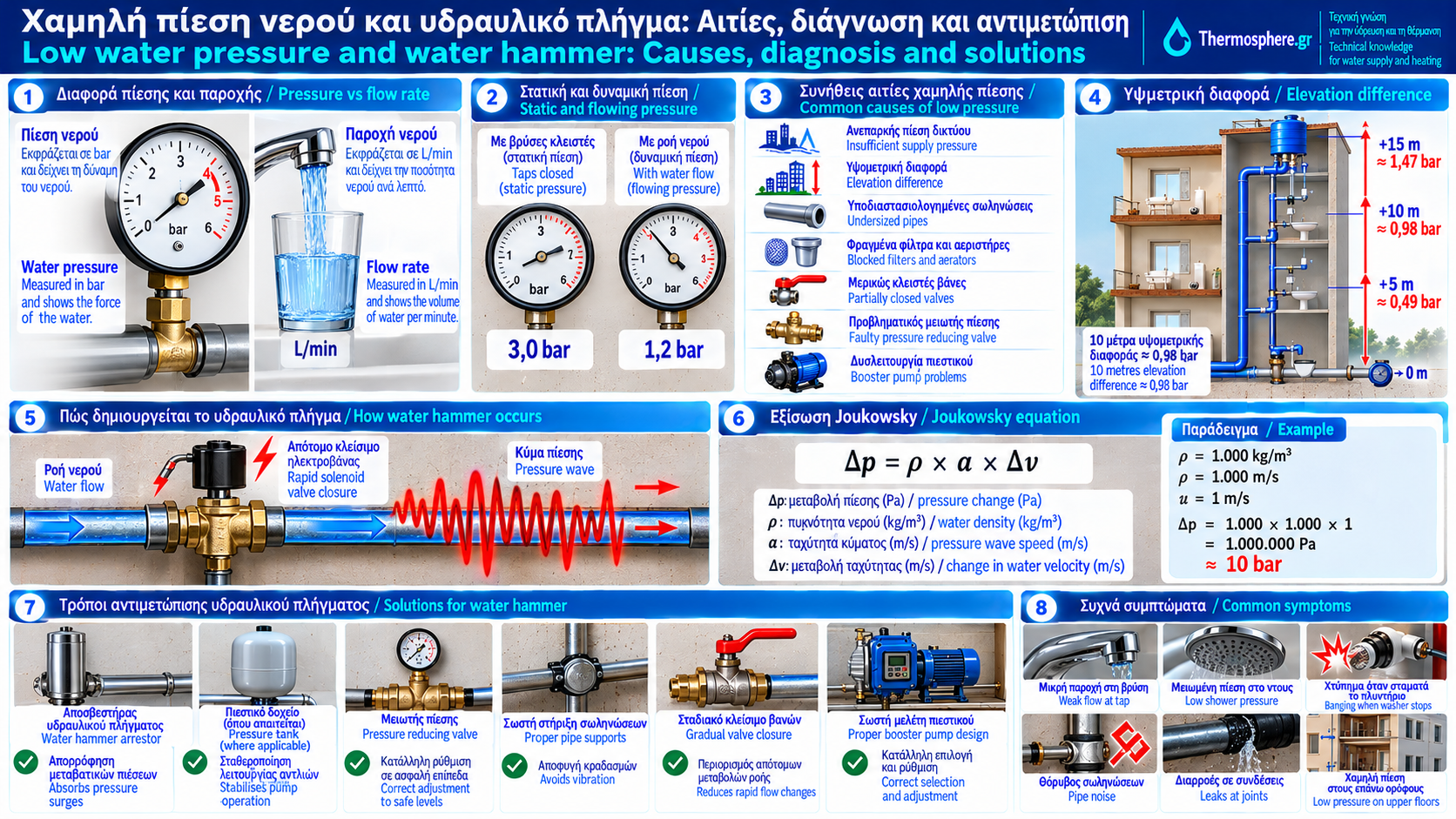
Water pressure describes the pressure at a specific point in the plumbing system and is commonly measured in bar.
Flow rate describes the volume of water passing through a pipe cross-section per unit of time, typically expressed in litres per minute (L/min).
A system may have adequate static pressure when all taps are closed but still fail to deliver sufficient flow when several fixtures are used simultaneously.
This may occur because of undersized pipes, excessive pressure losses or insufficient supply capacity.
Therefore, weak water flow from a tap does not necessarily mean that the network’s static pressure is low.
2. Static Pressure and Pressure Under Flowing Conditions
Static pressure is measured when no water is flowing through the section of the system being examined.
Pressure under flowing conditions, often called dynamic pressure in practical plumbing terminology, is measured while water is being consumed.
For example, a pressure gauge may indicate 3 bar when all taps are closed.
When two or more fixtures operate simultaneously, the pressure reading may decrease significantly.
This reduction may result from friction losses or supply restrictions.
For this reason, proper troubleshooting often requires measurements both with the system at rest and while water is flowing.
3. What Are the Main Causes of Low Water Pressure?
The most common causes include:
Insufficient pressure from the public water supply.
Significant elevation differences between the supply and fixtures.
Undersized water pipes.
Blocked filters or tap aerators.
Partially closed isolation valves.
Faulty or incorrectly adjusted pressure reducing valves.
Booster pump malfunctions.
Excessive pressure losses in pipes and fittings.
Internal deposits or blockages.
Leaks or unrecognised water consumption.
Low water pressure should not automatically be attributed to a single cause.
Older plumbing systems may have several contributing problems.
4. Low Water Pressure at Only One Tap
When weak flow occurs at a single tap, the problem is often located close to that fixture.
Possible causes include:
A blocked aerator.
A partially closed angle valve.
A clogged mixer tap filter.
A restriction in a flexible connector.
A faulty internal tap mechanism.
Comparing water flow with nearby taps can help identify the affected section.
If the problem occurs only with hot or cold water, the corresponding supply route should be investigated.
Before disassembling any component, the water supply must be isolated and pressure safely relieved.
5. Low Water Pressure Throughout the House
When all fixtures have poor performance, troubleshooting should begin at the main water supply.
Important checks include:
Pressure at the building inlet.
Main isolation valve condition.
Possible restrictions around the water meter.
Main water filters.
Pressure reducing valve operation.
Booster pump operation, if installed.
System performance during simultaneous water consumption.
If incoming pressure is already inadequate, replacing internal pipes may not solve the problem.
However, if supply pressure is adequate but falls excessively within the installation, hydraulic restrictions or faulty components should be investigated.
6. Why Is Water Pressure Lower on Upper Floors?
Available water pressure decreases as elevation increases relative to the supply point.
For water under ordinary conditions:
10 metres of elevation difference correspond to approximately 0.98 bar.
If a tap is located 15 metres above the supply reference point, approximately 1.47 bar is required to overcome elevation alone.
Additional pressure is needed to compensate for:
Pipe friction losses.
Fitting and valve losses.
Minimum operating pressure required by the fixture.
This explains why a plumbing network may work satisfactorily on the ground floor but perform poorly on upper floors.
7. How Does Pipe Diameter Affect Water Pressure?
Internal pipe diameter directly affects water velocity.
The fundamental relationship is:
Q = A × v
Where:
Q is flow rate.
A is the internal pipe cross-sectional area.
v is average water velocity.
For a given flow rate, reducing internal pipe diameter increases water velocity.
Higher velocity generally produces greater friction losses.
However, replacing a pipe with a larger diameter does not guarantee better performance if the main restriction is a filter, valve, pressure reducing device or the incoming supply.
Pipe sizing should be based on hydraulic calculations.
8. How Is Low Water Pressure Diagnosed?
A structured diagnostic process involves several stages.
Step 1: Record the symptoms
Determine whether the problem affects cold water, hot water or both.
Step 2: Identify the affected area
Check whether the problem occurs at one tap, in one room, on one floor or throughout the building.
Step 3: Measure static pressure
Use a suitable pressure gauge at an appropriate test point.
Step 4: Measure pressure under flowing conditions
Record pressure while specific fixtures are operating.
Step 5: Inspect system components
Examine filters, isolation valves, pressure reducing valves and other devices that may restrict flow.
Step 6: Evaluate the results
Compare the findings with the system’s operating requirements.
Diagnosis should always precede major modifications.
9. When Is a Booster Pump Necessary?
A booster pump system may be required when the available water pressure is insufficient for the building’s needs.
However, the decision should be based on technical assessment.
Important factors include:
Available incoming water flow.
Required building flow rate.
Desired pressure at fixtures.
Elevation differences.
Hydraulic pressure losses.
Maximum allowable component pressures.
Backflow protection requirements.
Local water utility regulations.
Direct suction from a public water main may be prohibited or permitted only under specific conditions.
A booster pump should not be installed without checking the suitability and regulatory requirements of the supply arrangement.
10. What Is Water Hammer?
Water hammer is a transient hydraulic phenomenon that occurs when water flow velocity changes rapidly.
This sudden change produces pressure waves that propagate through the plumbing network.
Water hammer may occur when:
A solenoid valve closes suddenly.
A pump stops unexpectedly.
A valve closes rapidly.
Water flow changes abruptly within the system.
A typical symptom is a loud knocking or banging noise inside the pipes.
However, not every plumbing noise is caused by water hammer.
11. Why Do Plumbing Pipes Bang?
Water flowing through pipes has mass and velocity.
When the flow is stopped very quickly, the momentum of the moving water changes abruptly.
This produces a pressure wave that travels through the pipe and may reflect at hydraulic boundaries.
The severity of the phenomenon depends on:
Initial water velocity.
Valve closing time.
Pipe length.
Pipe material and elasticity.
Network geometry.
System operating conditions.
Rapid flow changes can produce both positive and negative pressure transients.
12. How High Can Water Hammer Pressure Become?
Under certain idealised rapid-flow-change conditions, the Joukowsky equation can estimate the pressure change:
Δp = ρ × a × Δv
Where:
Δp is pressure change in pascals (Pa).
ρ is water density in kg/m³.
a is pressure wave propagation speed in m/s.
Δv is the change in water velocity in m/s.
Consider a theoretical example:
Water density: 1,000 kg/m³.
Pressure wave speed: 1,000 m/s.
Velocity change: 1 m/s.
Then:
Δp = 1,000 × 1,000 × 1
Δp = 1,000,000 Pa.
Since 1 bar equals 100,000 Pa:
Δp = 10 bar.
This value demonstrates the potential magnitude of hydraulic pressure transients.
It does not mean that every rapidly closing tap produces a 10 bar pressure increase.
Actual pressure changes depend on closure time, pipe characteristics, wave reflections and overall network behaviour.
13. What Are the Symptoms of Water Hammer?
Common symptoms include:
Loud banging when a tap closes.
Knocking when a washing machine stops filling.
Pipe vibration.
Sudden noises near solenoid valves.
Repeated impacts during pump operation.
Stress on joints and pipe supports.
Noise alone does not prove that allowable pressure limits have been exceeded.
Specialised pressure logging equipment may be necessary to confirm significant transient pressure events.
14. Can Water Hammer Cause Leaks?
Yes. Severe or repeated water hammer can create additional mechanical stress.
Possible consequences include:
Loosened pipe supports.
Increased stress on joints.
Valve damage.
Mechanical wear of components.
Leaks at vulnerable connections.
Premature system failures.
The level of risk depends on the actual magnitude and frequency of pressure transients and the strength of the piping system.
Loud impacts accompanied by leaks or visible deformation require prompt professional assessment.
15. How Can Water Hammer Be Prevented or Reduced?
The correct solution depends on the underlying cause.
Check operating pressure
Verify that the system operates within its specified pressure limits.
Review water velocity
Excessive flow velocity may increase the severity of hydraulic transients.
Examine valve operation
Where technically feasible, reducing valve closing speed may limit sudden changes in flow.
Inspect pipe supports
Pipes must be properly supported to prevent unwanted movement.
Install a dedicated water hammer arrestor
An appropriately selected arrestor may be suitable for certain applications.
Evaluate booster pump operation
Systems equipped with pumps may require analysis of startup and shutdown transients.
Installing a device without diagnosing the problem does not guarantee a permanent solution.
16. What Is a Water Hammer Arrestor?
A water hammer arrestor is a device designed to reduce certain sudden pressure changes.
Many designs contain a chamber with compressible gas separated from the water by a suitable mechanism.
When a rapid pressure rise occurs, the device can absorb part of the transient energy.
Its effectiveness depends on:
Arrestor type.
Installation location.
Device sizing.
Water flow velocity.
Operating conditions.
Characteristics of the pressure transient.
Selection should follow manufacturer instructions and the technical requirements of the system.
17. Is a Pressure Tank the Same as a Water Hammer Arrestor?
Not necessarily.
A pressure tank may be used to stabilise pump operation or accommodate pressure and volume variations, depending on the application.
A dedicated water hammer arrestor is designed to address specific rapid pressure changes.
The presence of a pressure tank does not guarantee the elimination of water hammer throughout the network.
These devices should not automatically be treated as interchangeable.
18. Can Low Water Pressure and Water Hammer Occur Together?
Yes.
A plumbing system may experience significant pressure losses during normal consumption while also producing short-duration pressure surges when a solenoid valve closes rapidly.
These are different operating conditions.
Low pressure during steady flow is associated with available hydraulic energy and flow resistance.
Water hammer is a transient phenomenon.
Therefore, low pressure at a tap does not rule out high instantaneous pressures elsewhere in the network.
The two problems require separate evaluation.
19. Practical Troubleshooting Guide
Symptom | Possible cause | Initial check |
Weak flow at one tap | Blocked aerator or local valve | Inspect the affected tap |
Weak flow throughout the house | Supply restriction | Measure inlet pressure |
Low pressure on upper floors | Elevation and friction losses | Hydraulic assessment |
Major pressure drop with multiple taps open | Excessive resistance or inadequate supply | Measure pressure during simultaneous flow |
Banging when washing machine stops | Possible water hammer | Inspect solenoid valve and network |
Noise when pipes heat up | Possible thermal expansion | Inspect supports |
Continuous flow without known consumption | Possible leak or automatic water demand | Check water meter |
This table is intended for preliminary assessment and does not replace professional diagnosis.
20. Common Mistakes When Troubleshooting Water Pressure Problems
Several mistakes frequently occur during plumbing repairs.
Increasing pressure without testing
Arbitrarily increasing water pressure may place additional stress on pipes and fittings.
Replacing pipes without identifying the restriction
Larger pipes may not solve a problem caused by inadequate incoming supply.
Incorrect pressure reducing valve adjustment
Pressure settings must comply with system requirements and manufacturer instructions.
Installing booster pumps without design assessment
Pump selection must reflect actual operating requirements and applicable supply regulations.
Installing a water hammer arrestor without identifying the cause
Not all plumbing noises are caused by water hammer.
Ignoring pipe supports
Loose pipes may generate or amplify unwanted noises.
Effective troubleshooting requires appropriate measurements and technical evaluation.
21. Frequently Asked Questions
Why Is Water Pressure Low Only on the Hot Water Side?
Possible causes include blocked filters, restrictions in hot water pipes, mineral deposits or problems with components of the water heating equipment.
Can a Pressure Reducing Valve Cause Low Flow?
Yes. An incorrectly sized, poorly adjusted or faulty pressure reducing valve may cause excessive pressure loss during flow.
Why Do Pipes Bang When the Washing Machine Stops?
The washing machine solenoid valve may stop water flow rapidly, creating water hammer. Inspection is needed to confirm the cause.
Will Increasing Water Pressure Solve the Problem?
Not necessarily. It may improve performance in some situations but can increase mechanical stress and worsen other problems.
Is Every Knocking Noise Water Hammer?
No. Noise may result from thermal expansion, loose pipe supports, pump vibration or other causes.
Does Every Plumbing System Need a Water Hammer Arrestor?
No. The need for an arrestor depends on operating conditions and technical assessment.
When Should I Call a Plumber?
Professional assistance is recommended for widespread low pressure, repeated loud banging, suspected leaks, booster pump malfunctions or modifications to the water supply network.
Conclusion
Low water pressure and water hammer are two different hydraulic problems requiring accurate identification and technical evaluation.
Low pressure or weak flow may result from supply restrictions, elevation differences, excessive friction losses or faulty components.
Water hammer results from sudden changes in flow velocity and can create significant mechanical stress in plumbing pipes and fittings.
Corrective action should not rely on arbitrary pressure increases or component replacement without investigation.
A reliable water supply system requires correct pipe sizing, appropriate operating pressure, suitable components and timely diagnosis of hydraulic problems.
Technical References and Further Reading
EN 806-2: Specifications for installations inside buildings conveying water for human consumption — Design.
EN 806-3: Pipe sizing — Simplified method.
EN 806-5: Operation and maintenance.
EN 1717: Protection against pollution of potable water installations by backflow.
Joukowsky equation: Fundamental relationship used to estimate transient pressure changes.
Chaudhry, M. H.: Applied Hydraulic Transients, Springer.
CEN-CENELEC: https://www.cencenelec.eu/
Technical solutions must be evaluated according to applicable regulations, manufacturer instructions and actual operating conditions.
Safety note: Water pressure must not be increased arbitrarily, protective devices must not be modified without proper assessment, and pressurised components must not be disassembled. Network modifications should be carried out by appropriately trained personnel.
Thermosphere.gr — Technical knowledge for water supply and heating systems.