
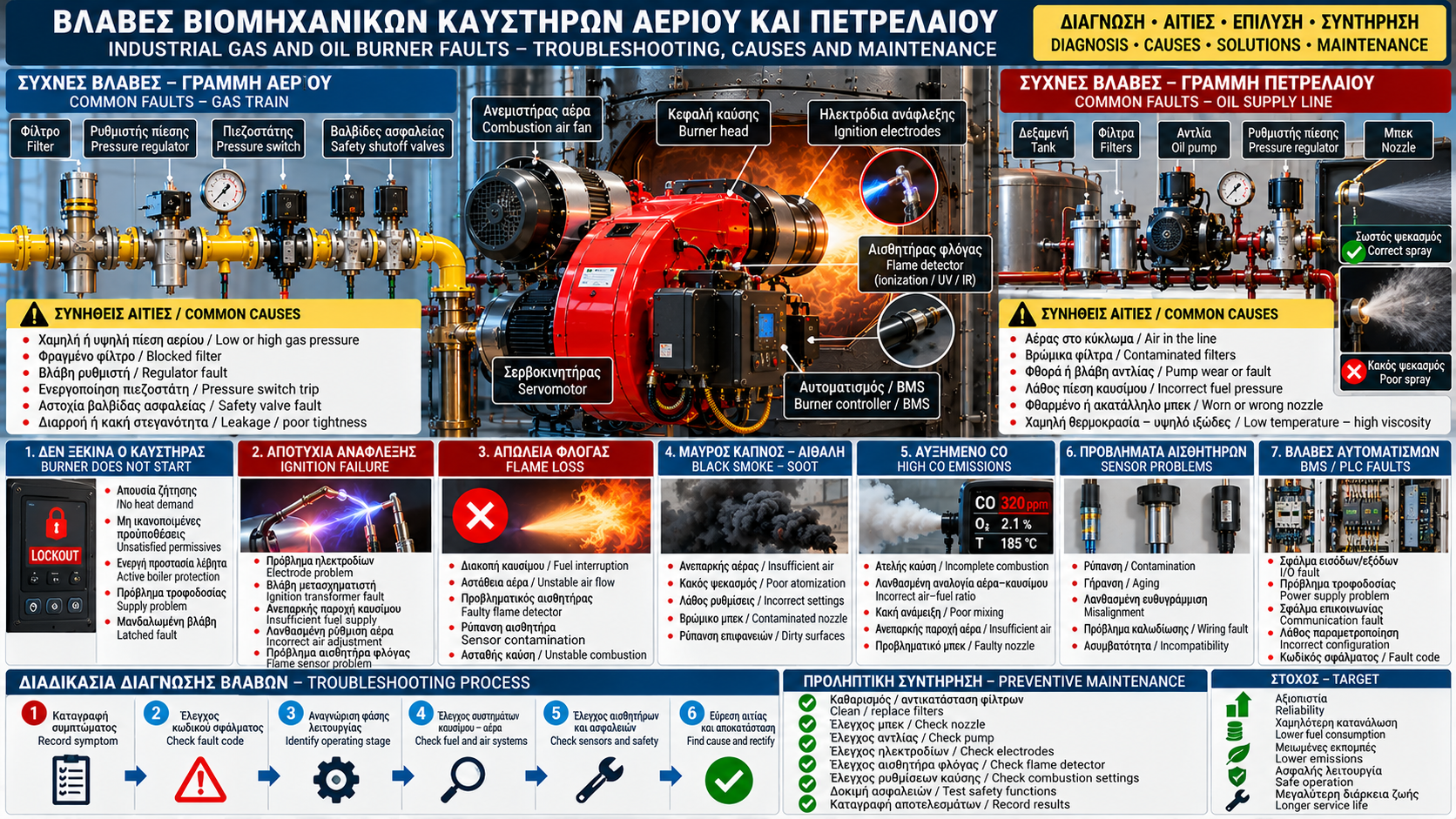
# Industrial Gas and Oil Burner Faults: Troubleshooting, Causes and Maintenance
## Introduction
Industrial gas and oil burners are critical components of steam boilers, hot-water boilers and thermal-energy production facilities.
A burner fault can interrupt production, increase fuel consumption, destabilize combustion or activate safety systems.
Effective troubleshooting requires an understanding of burner operating sequences, fuel-delivery equipment, flame supervision and protective functions.
Intervention on burners and fuel systems must be performed by appropriately authorized personnel. Bypassing protections or repeatedly resetting faults without investigation can create serious hazards.
## 1. Main Categories of Burner Faults
Industrial burner faults can be classified into fuel-supply, combustion-air, ignition, flame-supervision, electrical and automation problems.
A shutdown may also originate from a boiler protection rather than the burner itself.
Correct fault classification reduces unnecessary intervention and helps identify the actual cause.
## 2. Alarm, Fault and Lockout
An alarm indicates a warning or operating deviation.
A fault identifies a detected failure or unacceptable condition.
Lockout is a latched shutdown state that normally requires a defined reset procedure.
Exact terminology depends on the controller manufacturer.
Recording the fault code before intervention is important for accurate diagnosis.
## 3. Burner Fails to Start
When a burner does not respond to a call for heat, the cause is not necessarily mechanical failure.
Potential causes include no heat demand, active boiler protection, an unsatisfied permissive, supply problems or a latched fault.
Troubleshooting begins by identifying the controller's actual state and available indications.
A START command must not be confused with authorization for safe startup.
## 4. Pre-Purge Failure
Pre-purge is a critical stage before fuel admission.
Failure to complete pre-purge may involve the fan, air dampers, airflow-proving devices or associated control signals.
An electrically running fan does not independently prove adequate airflow.
Pre-purge requirements are defined by the approved design and must not be changed arbitrarily.
## 5. Combustion-Air Fan Faults
Possible problems include motor failure, electrical protection trips, mechanical wear, blocked air passages or variable-frequency drive faults.
On burners with variable-speed control, a command to the drive does not guarantee that the required airflow has been achieved.
Diagnosis combines electrical indications, protection status and appropriate measurements by authorized personnel.
## 6. Ignition Failure
Ignition failure occurs when an acceptable flame is not confirmed within the specified time.
Potential causes include problems with ignition equipment, fuel supply, combustion air or flame supervision.
Gas burners may be affected by fuel-pressure conditions or approved valve operation.
Oil burners may experience inadequate atomization or fuel-delivery problems.
Repeated reset attempts without investigating the cause must be avoided.
## 7. Ignition Electrode and Transformer Faults
The ignition system must deliver the required energy at the correct location and time.
Problems can result from electrode wear, damaged insulation, poor connections or high-voltage component failure.
Diagnosis requires special safety precautions due to electric shock hazards.
Electrode positioning and specifications must follow manufacturer instructions.
## 8. Flame Loss During Operation
Flame loss may result from actual combustion interruption or loss of an acceptable flame-supervision signal.
Potential causes include fuel fluctuations, unstable airflow, sensor problems and unfavorable combustion conditions.
The safety system must perform the specified safe shutdown.
Investigation must distinguish genuine flame instability from flame-detection system faults.
## 9. Flame Detectors
Flame detectors may use ionization, ultraviolet or another suitable technology.
Contamination, aging, misalignment or wiring faults can affect supervision.
Sensor-controller compatibility is essential.
Simulating or bypassing a flame signal to keep the burner running is unacceptable.
## 10. Gas Train Faults
A gas train contains fuel-delivery, regulating and safety shutoff components.
Potential problems include unsuitable supply pressure, blocked filters, regulator failure or pressure-switch activation.
Safety shutoff valve problems require particular attention.
Diagnosis and intervention must follow approved procedures for gas installations.
## 11. Gas Pressure Switches
Low- and high-pressure switches supervise specified fuel-pressure limits.
An activation may indicate an actual pressure deviation or a problem with the device or its circuit.
Setpoints must not be changed without engineering justification.
Correct evaluation requires comparison with approved operating requirements.
## 12. Oil Pump Faults
In oil burners, the pump directly affects fuel delivery and atomization quality.
Problems may be associated with wear, inadequate fuel supply, air in the circuit or contaminated filters.
Unusual noise or pressure variations may indicate malfunction.
Checks must follow the specifications of the particular system.
## 13. Nozzles and Atomization Quality
The nozzle determines important characteristics of liquid-fuel distribution.
Wear, deposits or use of an unsuitable nozzle can affect spray pattern and combustion quality.
Potential consequences include increased soot, unstable flames and ignition problems.
Nozzle selection and replacement must follow manufacturer specifications and operating requirements.
## 14. Fuel Temperature and Viscosity
In systems using heavier liquid fuels, temperature and viscosity strongly affect atomization.
Unsuitable conditions may cause difficult ignition and incomplete combustion.
Some installations use fuel preheaters and suitable monitoring devices.
Required values depend on fuel properties and equipment design.
## 15. Black Smoke and Soot
Black smoke or excessive soot deposits indicate problematic combustion, particularly in oil-fired equipment.
Possible causes include inadequate combustion air, poor atomization or insufficient mixing.
Soot on heat-transfer surfaces can reduce boiler efficiency.
Corrective action requires combustion measurements and investigation of underlying causes rather than arbitrary parameter changes.
## 16. Elevated Carbon Monoxide
Increasing CO is an important indication of incomplete combustion.
It may be associated with insufficient air, mixing problems, unstable flames or unsuitable operating conditions.
O₂ should be evaluated alongside CO, but oxygen alone is insufficient for diagnosis.
Assessment must consider manufacturer requirements and applicable emission limits.
## 17. Servomotor and Damper Faults
In modulating burners, servomotors and regulating mechanisms influence fuel and air delivery.
Position errors, linkage wear or control faults can cause deviations from the intended air-fuel relationship.
Problems may occur only at particular firing rates.
Verification must follow approved procedures without arbitrary changes to critical parameters.
## 18. PLC, BMS and Electrical Faults
Power-supply, wiring, input/output or communication failures can affect burner operation.
A fault shown on an HMI does not necessarily mean the HMI itself is defective.
Diagnosis should use the relevant controller's fault code, event history and approved electrical drawings.
The BMS and safety functions must not be treated as ordinary PLC commands.
## 19. Boiler-Originated Shutdowns
A burner may stop correctly because a boiler protection has activated.
Steam-boiler protections may include high-pressure and low-water-level limits.
Hot-water boilers may have temperature limits and other required protective functions.
Before identifying the burner as defective, the actual shutdown cause must be established.
## 20. Systematic Troubleshooting
A sound troubleshooting process begins by recording the symptom, time of occurrence and fault code.
The next step is to identify the operating sequence stage at which the problem occurred and review available indications.
Investigation may include approved checks of supplies, sensors, electrical circuits and operating conditions.
Measurements on energized equipment or fuel systems require suitable procedures and authorized personnel.
## 21. Why Repeated Resetting Is Unsafe
Resetting a latched fault does not necessarily correct its cause.
Repeated startup attempts can worsen hazardous conditions or obscure valuable diagnostic information.
Ignition failures in particular require investigation before another attempt under manufacturer-approved procedures.
Reset is a controlled recovery function, not a repair method.
## 22. Preventive Maintenance
A preventive maintenance program includes inspections of filters, fans, mechanical linkages, ignition equipment and flame-supervision components.
Oil burners also require attention to fuel-delivery and atomization equipment.
Gas burners require the appropriate checks of gas trains and safety shutoff devices.
Safety testing and intervention must follow approved procedures, manufacturer instructions and applicable requirements.
## 23. Fault History and Technical Documentation
Systematic fault records help identify recurring problems.
Useful information includes fault codes, firing rate, fuel conditions, combustion readings and corrective actions.
Comparing incidents can reveal gradual deterioration or faults that occur only under specific operating conditions.
Documentation should be retained alongside approved drawings and equipment manuals.
## 24. Conclusion
Industrial gas and oil burner troubleshooting requires a systematic approach combining combustion knowledge, mechanical equipment, fuel-delivery systems and safety automation.
Identifying the operating stage and actual fault code is an essential starting point.
Safe intervention, suitable maintenance and technical documentation reduce recurring downtime and support installation reliability.