
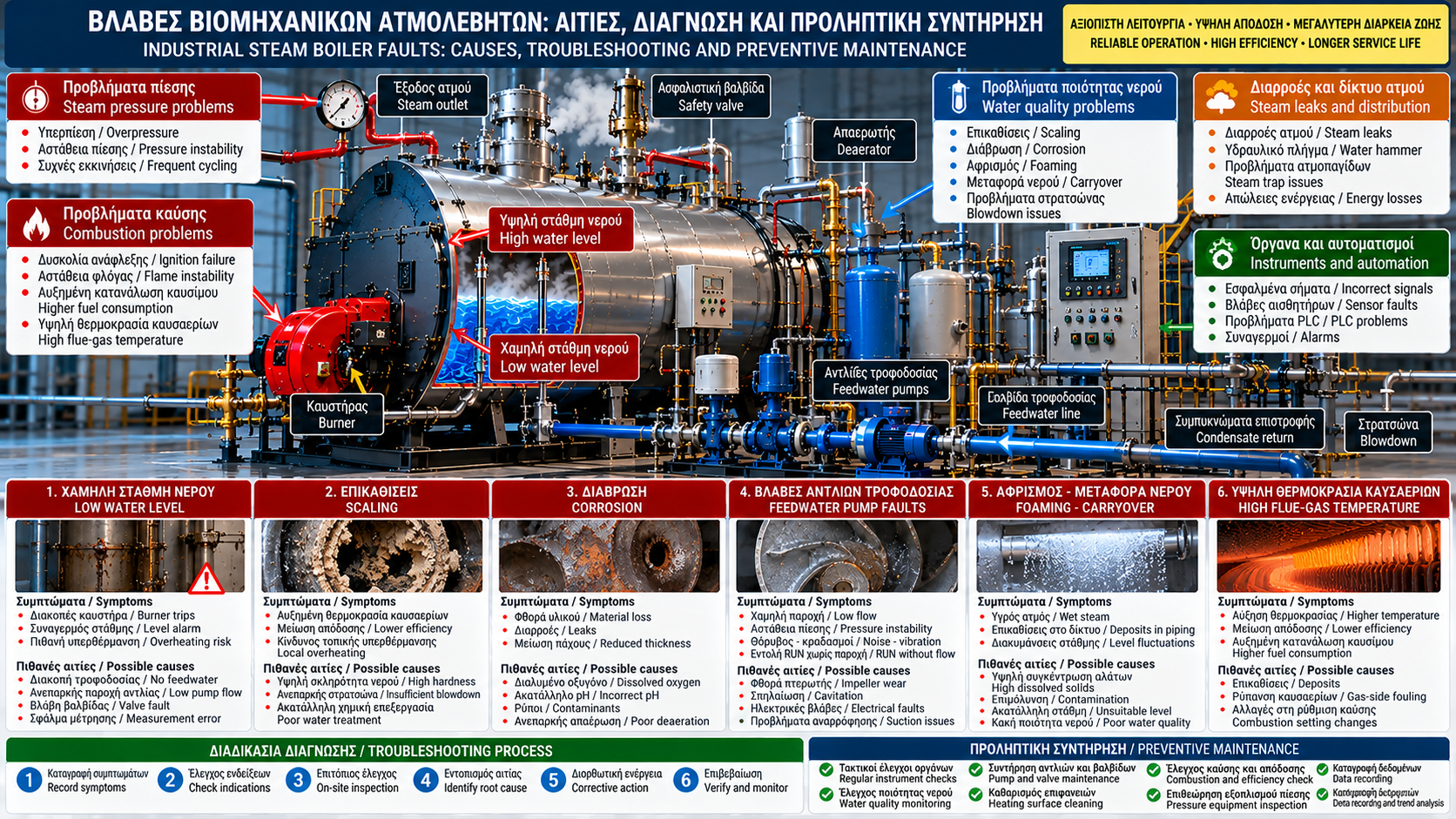
# Industrial Steam Boiler Faults: Causes, Troubleshooting and Preventive Maintenance
## Introduction
Industrial steam boilers are critical thermal-energy equipment. Malfunctions can interrupt production, waste energy, impair steam quality or create serious safety hazards.
Faults are not limited to the boiler pressure vessel. They may originate in feedwater supply, water quality, burner operation, steam distribution, measuring instruments or automation.
Effective troubleshooting requires systematic recording of indications, understanding of operating conditions and investigation of root causes.
Inspection and maintenance must be performed by suitably authorized personnel following manufacturer instructions and applicable requirements.
## 1. Main Fault Categories
Boiler faults can be classified into water-level, steam-pressure, feedwater, combustion, water-quality, thermal-efficiency and electrical problems.
An alarm does not always identify the component that has failed.
For example, low water level may result from insufficient pump flow, a malfunctioning valve or incorrect measurement.
Correct diagnosis distinguishes symptoms from root causes.
## 2. Low Water Level
Low water level is one of the most serious steam-boiler conditions.
Possible causes include interrupted feedwater supply, insufficient pump output, valve failure or level-control malfunction.
Low-water protection must initiate the specified safe shutdown.
If heating surfaces may have overheated due to water loss, water must not be added and restart must not be attempted until suitably qualified personnel have assessed the situation.
## 3. High Water Level
Excessive water level may cause water droplets to be carried with steam.
This impairs steam quality and may create problems in piping and process equipment.
Possible causes include excessive feedwater flow, valve malfunction or an incorrect level signal.
Temporary shrink and swell effects must also be considered.
## 4. Steam-Pressure Instability
Steam pressure may fluctuate when generation and consumption do not remain balanced.
Potential causes include sudden load changes, unsuitable burner-control tuning, flow restrictions or instrument problems.
Diagnosis should consider steam demand, burner firing rate and pressure indications together.
Changing control parameters without engineering assessment may worsen instability.
## 5. High-Pressure Protection Trips
Activation of a high-pressure limiter indicates a detected unacceptable condition or a problem in the associated circuit.
Possible causes include normal-control failure, unsuitable burner response or measurement faults.
Reset must not be attempted until the cause is identified and safe operating conditions are verified.
Protective limits must not be increased arbitrarily.
## 6. Frequent Burner Cycling
Frequent cycling can increase component wear and affect efficiency.
Potential causes include burner oversizing, limited modulation range, unsuitable settings or significant demand fluctuations.
Analysis should include startup history, pressure variation and actual steam demand.
Corrective action may require a review of the control strategy by competent personnel.
## 7. Insufficient Steam Production
When a boiler cannot satisfy demand, this does not necessarily mean its rated capacity has deteriorated.
Actual load, available heat input, heat-transfer surface condition and fuel supply must be assessed.
Steam-distribution restrictions or unsuitable operating conditions may also affect output.
Reliable steam-flow, pressure and fuel-consumption data are required.
## 8. Feedwater Pump Faults
Feedwater pumps must provide adequate flow at a pressure sufficient for system requirements.
Problems may arise from impeller wear, seal failure, electrical faults, cavitation or restricted suction.
A RUN indication does not prove that the pump delivers the required flow.
Diagnosis should combine pressure, flow and motor-condition information.
## 9. Pump Cavitation
Cavitation involves the formation and collapse of vapor bubbles inside a pump.
It can cause noise, vibration, damage and reduced flow.
Suction conditions and available NPSH are especially important in hot-feedwater applications.
Corrective action requires assessment of the hydraulic system and manufacturer requirements.
## 10. Deaerator Problems
A deaerator reduces dissolved gases in feedwater.
Unsuitable temperature, pressure, flow or venting can reduce its effectiveness.
Inadequate deaeration can contribute to corrosion of piping and equipment.
Performance should be evaluated using suitable measurements and plant specifications.
## 11. Scale on Heating Surfaces
Scale forms when substances in boiler water concentrate or precipitate onto surfaces.
Deposits reduce heat transfer and can increase metal temperature.
Severe deposits may create localized overheating hazards.
Prevention relies on suitable water treatment, chemical monitoring and correct blowdown.
## 12. Equipment Corrosion
Corrosion can affect the boiler pressure vessel, piping and feedwater equipment.
Potential contributors include dissolved oxygen, unsuitable chemical conditions and specific contaminants.
The observed corrosion pattern can help identify likely mechanisms.
Equipment integrity requires appropriate inspection and technical assessment.
## 13. Foaming and Steam Carryover
Foaming and carryover can impair generated steam quality.
Contributing factors include excessive dissolved solids, contamination and unsuitable water level.
Water entering the steam distribution system may cause deposits and operational problems.
Investigation should include water quality, load conditions and steam-separation performance.
## 14. Blowdown Problems
Insufficient blowdown can cause excessive concentration of unwanted substances.
Excessive blowdown increases water, chemical and energy consumption.
Problems may also arise from faulty valves, conductivity instruments or automation.
Settings should be based on measurements and water-quality requirements.
## 15. Condensate Contamination
Returned condensate may become contaminated by the industrial process.
Contaminants may include oils, organic compounds or other unwanted substances.
Returning unsuitable condensate can cause foaming, deposits and corrosion.
Plants should have an appropriate monitoring and diversion strategy where required.
## 16. High Flue-Gas Temperature
An increase in flue-gas temperature under comparable operating conditions may indicate reduced heat transfer.
Possible causes include deposits on heating surfaces, fouling on the gas side or combustion-setting changes.
Temperature must be evaluated alongside boiler load and combustion data.
A single reading is insufficient for a reliable conclusion.
## 17. Increased Fuel Consumption
Higher fuel consumption may reflect increased actual demand, lower efficiency or steam-system losses.
Assessment should compare consistent steam-production and fuel-consumption data.
Combustion quality, condensate return, blowdown and insulation condition influence the overall result.
Without an appropriate energy balance, the cause cannot reliably be assigned to one component.
## 18. Steam Leaks
Steam leaks waste energy and may create severe burn hazards.
Possible locations include flanges, valves, joints and piping components.
Visible steam does not always allow a safe assessment of leak severity.
Inspection and repair require suitable isolation, depressurization and verification of safe conditions.
## 19. Water Hammer in Steam Systems
Water hammer can occur when condensate is accelerated by steam flow or through other rapid flow changes.
It may cause loud impacts, vibration and equipment damage.
Contributing factors include inadequate drainage, steam-trap problems and unsuitable startup conditions.
Corrective action requires engineering assessment of the distribution system rather than simply increasing pressure.
## 20. Sensor and Automation Faults
Incorrect pressure, level, temperature or flow signals can cause malfunction.
Causes may include sensor failure, wiring, power supply, calibration or communication problems.
Comparison with independent reliable indications may help diagnosis.
Critical protections must not be bypassed to continue production.
## 21. Example: Repeated Low-Water Trips
A steam boiler experiences repeated low-water shutdowns.
Investigation begins with event history and recorded indications.
Actual water conditions, pump operation, feedwater-flow readings and control behavior are assessed.
Troubleshooting must proceed without bypassing low-water protection.
Restart is permitted only after the cause has been established and approved conditions are satisfied.
## 22. Example: Efficiency Decline at Similar Steam Output
A boiler produces approximately the same amount of steam but consumes more fuel.
Investigation covers combustion quality, flue-gas temperature, heating-surface condition and condensate return.
Blowdown and steam-distribution losses should also be examined.
Comparisons must use consistent system boundaries and equivalent operating conditions.
## 23. Preventive Maintenance Program
A structured maintenance program includes monitoring of pressure, level, temperature, water quality and fuel consumption.
It also covers pumps, valves, burner equipment, instruments and automation.
Protective functions and pressure equipment must be inspected according to plant requirements.
Systematic records help schedule corrective actions before major failures develop.
## 24. Conclusion
Industrial steam boiler faults often result from interactions between water systems, combustion, mechanical equipment and automation.
Effective troubleshooting requires identifying root causes, obtaining reliable measurements and respecting safety protections.
Suitable water quality, correct maintenance and energy-performance monitoring support safe, reliable and efficient steam generation.