
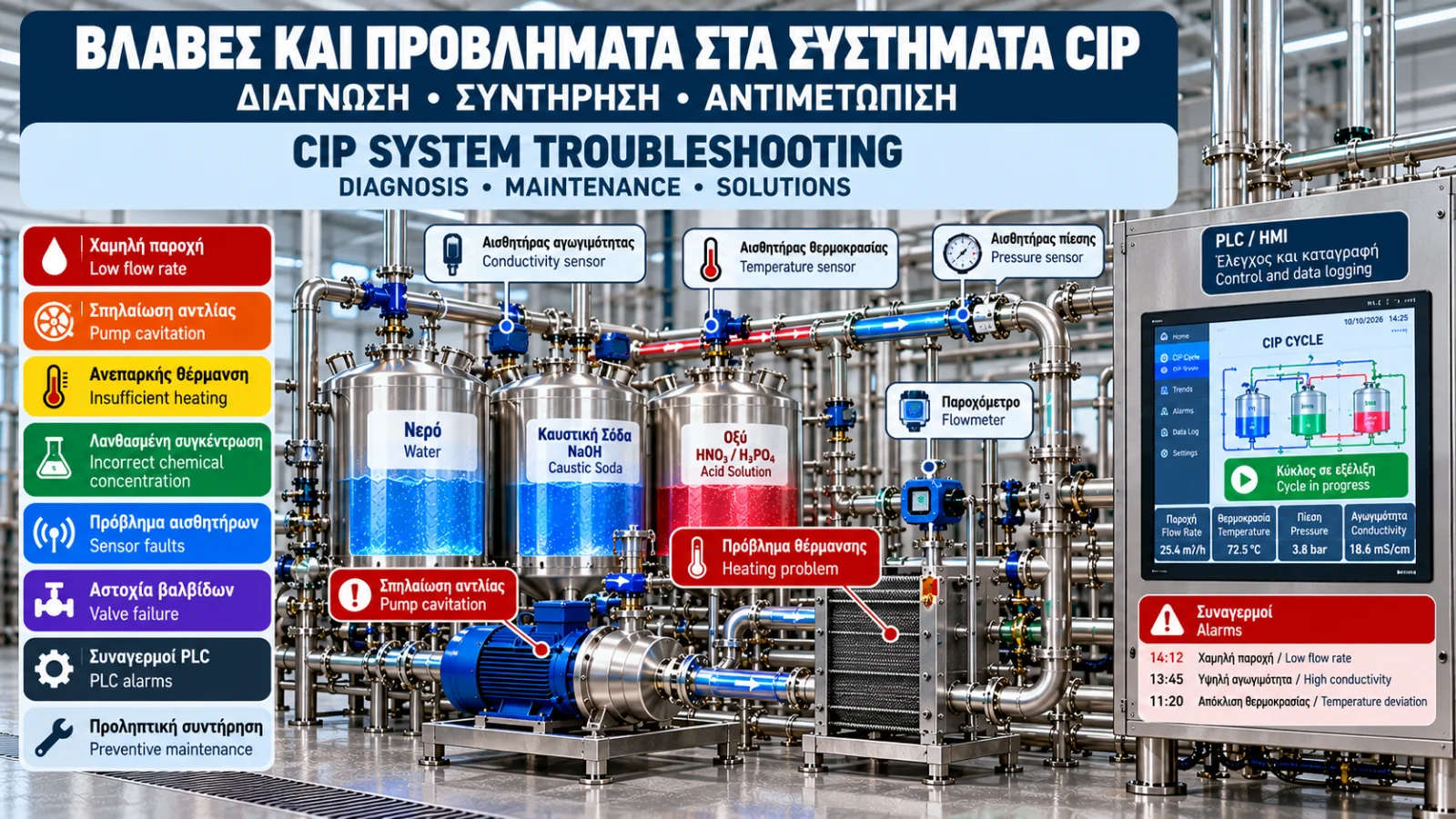
CIP System Troubleshooting: Common Failures, Diagnostics and Maintenance
Introduction
Cleaning in Place (CIP) systems clean appropriately designed industrial equipment without complete disassembly. They are essential in food, beverage, dairy and other hygienic processing facilities.
Effective CIP operation depends on reliable pumps, valves, heating equipment, instrumentation and automation.
A fault does not always cause a complete shutdown. It may gradually reduce cleaning effectiveness, increase water and chemical consumption or cause deviations from required operating conditions.
Reliable troubleshooting therefore requires actual measurements, historical records and systematic investigation.
1. Recognizing CIP Operating Problems
Typical symptoms include:
Inadequate surface cleaning.
Low or unstable flow.
Abnormal pressure.
Insufficient temperature.
Excessive cycle duration.
High chemical consumption.
Incorrect conductivity readings.
Valve failures.
Repeated PLC alarms.
Cleaning-cycle failure.
The first step is to identify the actual deviation and compare it with approved operating limits.
2. Low Cleaning Solution Flow Rate
Insufficient flow may reduce the mechanical cleaning action.
Possible causes include:
Blocked filters or strainers.
Partially closed valves.
Insufficient tank level.
Air entering the pump suction.
Worn pump impeller.
Excessive hydraulic resistance.
Incorrect flowmeter readings.
Diagnostic Approach
Compare current flow readings with historical values for the same circuit and cleaning recipe.
Review pressure measurements, valve positions and available pump operating data.
Physical inspection must only be performed after appropriate isolation, depressurization and safety procedures.
3. CIP Pump Cavitation
Cavitation occurs when local liquid pressure falls sufficiently for vapor bubbles to form and subsequently collapse in higher-pressure regions.
Typical symptoms include:
Unusual noise.
Vibration.
Unstable flow.
Reduced performance.
Impeller damage.
Possible Causes
Low suction tank level.
Restricted suction piping.
High liquid temperature.
Insufficient available NPSH.
Unsuitable pump operating point.
Troubleshooting requires checking suction conditions and comparing available NPSH with manufacturer requirements.
Arbitrarily increasing pump speed may make cavitation worse.
4. Inadequate Cleaning Despite Cycle Completion
A cleaning cycle may be reported as completed even when the required cleanliness has not been achieved.
Possible causes include:
Insufficient contact time.
Low chemical concentration.
Incorrect temperature.
Inadequate flow velocity.
Poor surface wetting.
Dead legs.
Unsuitable cleaning chemicals.
Incorrect completion criteria.
The investigation should include both recorded operating parameters and the required cleanliness verification results.
Timer completion alone does not demonstrate effective cleaning.
5. Chemical Concentration Problems
Cleaning chemical concentration may deviate because of:
Dosing pump failures.
Insufficient chemical inventory.
Unintended dilution.
Incorrect solution recovery.
Instrument problems.
Poor calibration.
Concentration should be verified using a suitable method, such as titration or a calibrated conductivity relationship.
Adding chemicals without identifying the cause may lead to overdosing and safety risks.
6. Incorrect Conductivity Readings
Conductivity is commonly used to monitor cleaning solutions and rinsing.
Potential causes of incorrect measurements include:
Sensor fouling.
Incorrect calibration.
Improper temperature compensation.
Entrained air bubbles.
Electrical problems.
Unsuitable installation.
Changes in solution composition.
Investigation may include comparison with independent measurements and review of historical trends.
The sensor should not be assumed faulty before the actual chemical condition of the liquid has been assessed.
7. Insufficient Heating
If the required temperature cannot be achieved, the cleaning cycle may be extended or fail.
Possible causes include:
Insufficient heating capacity.
Heat exchanger fouling.
Steam or hot-water valve problems.
Low heating-medium flow.
Incorrect temperature measurement.
Excessive thermal losses.
Diagnostics include checking inlet and outlet temperatures, flow conditions and heating system status.
Temperature setpoints should not be increased arbitrarily.
8. CIP Valve Problems
Automated valves control the cleaning solution flow path.
Common problems include:
Failure to open.
Failure to close.
Incorrect position feedback.
Seat leakage.
Pneumatic supply faults.
Seal deterioration.
Valve faults may cause insufficient circulation or unintended connections between circuits.
Critical valves must be inspected according to manufacturer instructions and facility hygiene requirements.
9. PLC Faults and Interlocks
Automation may prevent a cleaning cycle from starting or progressing when required conditions are not met.
Examples include:
Unconfirmed valve position.
Insufficient tank level.
Low flow.
Sensor failure.
Communication errors.
Failure to reach the required temperature.
Stage timeout.
Correct Response
Operators should review the specific alarm and actual equipment condition.
Interlocks and safety functions must not be bypassed to complete a cleaning cycle.
After correcting the fault, the approved reset procedure should be followed and the cleaning cycle status reassessed.
10. Excessive Water Consumption
High water consumption may result from:
Excessively long rinsing.
Incorrect conductivity thresholds.
Leakage.
Valves failing to close properly.
Incorrect cleaning sequences.
Poor separation of rinse water and cleaning solutions.
Optimization should be based on actual water consumption measurements and validated cleaning criteria.
11. Excessive Energy Consumption
Electricity and thermal energy use may increase because of:
Excessive pump operating hours.
Poor motor efficiency.
Unsuitable pump operating conditions.
High thermal losses.
Slow heating.
Repeated failed cleaning cycles.
Energy assessment should compare consumption with cleaning-cycle duration and actual operating conditions.
12. Practical Troubleshooting Table
Symptom | Possible Cause | Initial Check |
|---|---|---|
Low flow | Blocked filter or incorrect valve position | Flow, pressure and valve status |
Pump noise | Cavitation or mechanical fault | Suction conditions and vibration |
Low temperature | Heating problem | Temperatures and heat exchanger operation |
Unstable conductivity | Sensor or solution issue | Independent measurement |
Long rinse duration | Incorrect transition criterion | Conductivity trend and flow |
Stage does not advance | Unsatisfied interlock | Alarms and actual equipment status |
Inadequate cleaning | Chemistry, flow or wetting problem | Cycle records and cleanliness tests |
This table supports initial investigation but does not replace approved maintenance procedures.
13. Preventive Maintenance Program
Inspection frequency should be determined by manufacturer recommendations, equipment criticality and fault history.
Operational Checks
Review active and historical alarms.
Check flow and temperature deviations.
Monitor unusual noise.
Review resource consumption.
Confirm successful cycle completion.
Periodic Technical Checks
Instrument calibration.
Pump and mechanical seal inspection.
Valve actuator checks.
Heat exchanger inspection.
Chemical dosing system maintenance.
Alarm function testing.
PLC backup and documentation review.
Maintenance must be performed by appropriately trained personnel.
14. Safety During Troubleshooting and Maintenance
CIP systems may contain corrosive chemicals at elevated temperatures and pressures.
Before intervention, a risk assessment and appropriate energy isolation, lockout/tagout, depressurization, drainage and chemical residue checks are required.
Special attention must be given to preventing incompatible chemical mixing.
Mixing acids with hypochlorite-based chemicals can release toxic chlorine gas.
Safety systems must not be bypassed, and pressurized components must not be opened.
15. Preventing Recurring Failures
Long-term reliability can be improved through:
Recording faults and deviations.
Root cause analysis.
Planned maintenance.
Operating trend monitoring.
Timely instrument calibration.
Operator training.
Controlled changes to CIP recipes.
Verification following significant repairs.
Resetting an alarm without correcting its underlying cause is not an effective repair.
Conclusion
CIP troubleshooting requires mechanical, hydraulic, chemical and automation expertise.
Low flow, temperature deviations, chemical concentration problems and valve failures can reduce cleaning effectiveness even when the equipment continues to operate.
Systematic monitoring, data analysis and preventive maintenance help reduce faults, resource consumption and unplanned downtime.
Technical References
EHEDG — Hygienic Design Requirements for CIP Installations, Guideline Document 50.
https://www.ehedg.org/3-A Sanitary Standards — Cleanability of Equipment.
https://www.3-a.org/Hydraulic Institute — Pump Fundamentals and Pump System Assessment.
https://www.pumps.org/Alfa Laval — Hygienic Equipment and Service.
https://www.alfalaval.com/IEC 61131-3 — Programmable Controllers: Programming Languages.
IEC 61511 — Functional Safety: Safety Instrumented Systems for the Process Industry Sector.
ISO 14159 — Safety of Machinery: Hygiene Requirements for the Design of Machinery.