
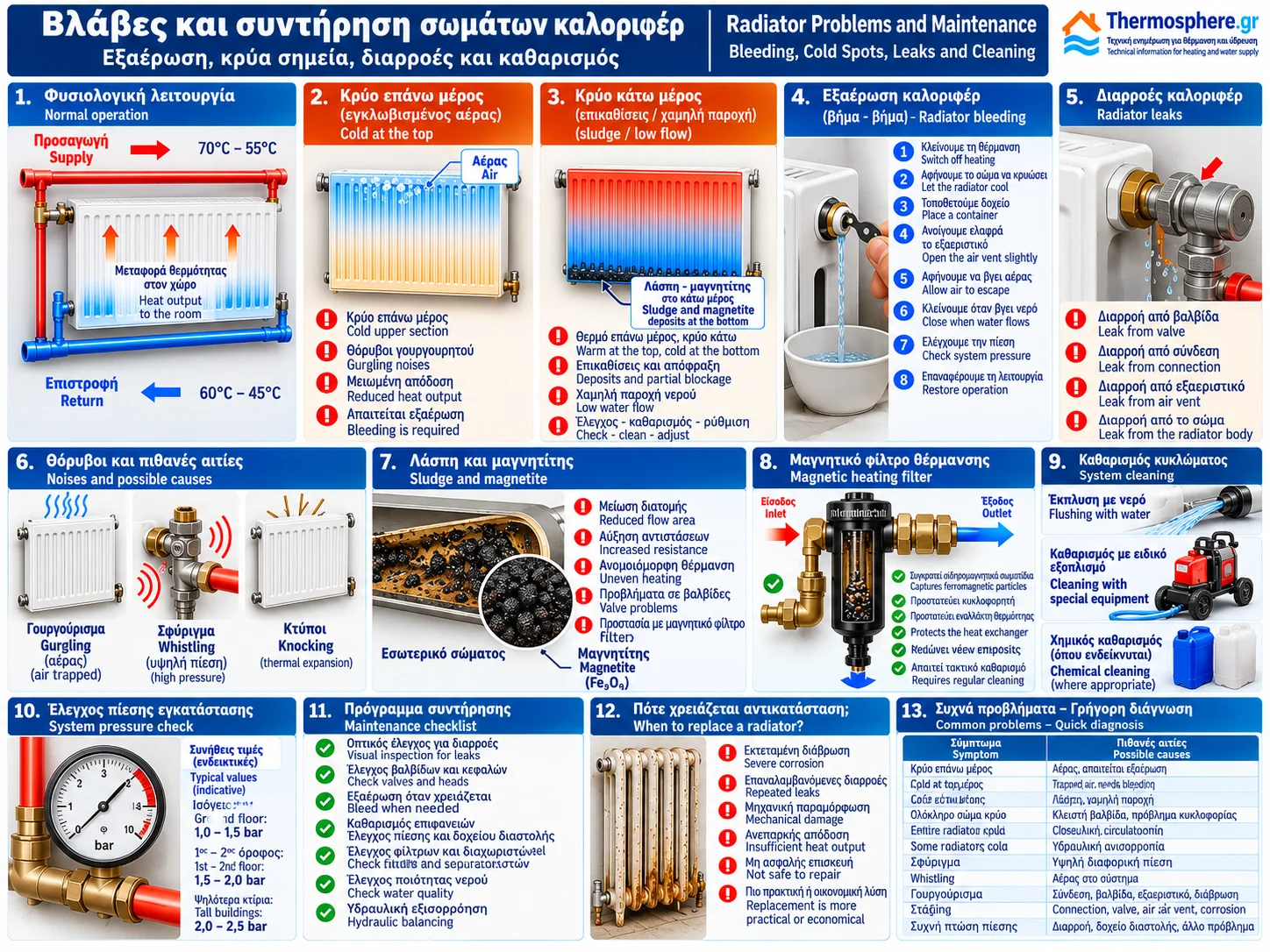
Radiator Problems and Maintenance: Bleeding, Cold Spots, Leaks and Cleaning
Radiators are essential components of hydronic heating systems. They transfer thermal energy from circulating water into indoor spaces through radiation and convection.
Although their construction is relatively simple, radiators can develop problems affecting heat output, water circulation and system reliability.
A radiator may remain cold, heat unevenly, produce noise, leak or show signs of corrosion.
Effective troubleshooting starts by identifying the underlying cause. Bleeding the radiator or increasing pump speed is not the correct solution to every heating problem.
1. How Does a Radiator Work?
Hot water enters through the supply connection, circulates through the radiator and leaves through the return connection.
As water moves through the radiator, it releases heat into the room.
Heat output depends on:
Supply water temperature.
Return water temperature.
Room air temperature.
Water flow rate.
Radiator construction and surface area.
Proper internal water circulation.
A heating problem may therefore originate in the radiator itself or elsewhere in the hydronic system.
2. Why Is a Radiator Not Heating?
Common possible causes include:
Closed or malfunctioning valve.
Thermostatic head already at its temperature setpoint.
Trapped air.
Insufficient water flow.
Hydraulic imbalance.
Sludge accumulation or blockage.
Incorrect piping connections.
Circulation pump problems.
Insufficient supply water temperature.
Heating control or zone problems.
Diagnosis should first establish whether the problem affects one radiator, several radiators or the entire heating installation.
If every radiator is cold, a common system problem is generally more likely than simultaneous failure of all radiators.
3. Radiator Cold at the Top
When the upper section of a radiator remains cold while the lower section is warmer, trapped air is one possible cause.
Air tends to collect at high points.
If it occupies part of the radiator's internal volume, it can prevent hot water from reaching the entire heat transfer surface.
Possible symptoms include:
Cold upper section.
Gurgling sounds.
Reduced heat output.
Uneven heating.
However, the temperature pattern alone is not sufficient for a definitive diagnosis.
4. Radiator Cold at the Bottom
A cooler lower section does not necessarily indicate a fault.
During normal operation, water releases heat as it travels through the radiator.
The return-side region may therefore be noticeably cooler than the supply side.
A problem may exist when an unusually cold area is persistent and accompanied by inadequate room heating.
Possible causes include:
Sludge or corrosion deposits.
Insufficient water flow.
Partial blockage.
Incorrect valve adjustment.
Hydraulic imbalance.
A cold lower section alone does not prove that chemical cleaning is required.
5. What Is Radiator Bleeding?
Radiator bleeding is the process of removing trapped air through an appropriate air vent.
The objective is to restore proper water filling and circulation.
Most conventional radiators include a manual air vent at a high point.
Some installations also feature automatic air vents at suitable locations.
Bleeding addresses trapped air but does not correct sludge accumulation, closed valves or insufficient flow.
6. How to Bleed a Radiator Safely
The exact procedure depends on equipment design and manufacturer instructions.
For a conventional radiator with a manual vent, the general process is:
Stop heating operation according to system instructions.
Allow the radiator to cool to reduce scalding risk.
Place a suitable container or absorbent material beneath the vent.
Open the vent slightly using the correct tool.
If trapped air is present, an escaping-air sound may be heard.
Close the vent when a steady stream of water without air appears.
Check system pressure according to heat source instructions.
Restore operation and assess the result.
Warning: Water may be hot and pressurised. Never remove the vent assembly or other water-retaining components. If the procedure is unfamiliar, consult a qualified technician.
7. Why Does a Radiator Need Frequent Bleeding?
Repeated air accumulation may indicate a system problem.
Possible causes include:
Frequent water top-ups.
Small leaks.
Incorrect operating pressure.
Expansion vessel problems.
Inadequate dissolved-gas management.
Air ingress under unfavourable pressure conditions.
Gas generation through chemical or corrosion processes.
Repeated bleeding without identifying the cause may conceal a more significant fault.
8. What Is Heating System Sludge?
Over time, solid particles and corrosion products may accumulate inside the heating circuit.
In systems containing ferrous components, magnetite (Fe₃O₄) can be an important corrosion product.
Fine dark particles may circulate with the water and collect in areas with low flow velocity.
Deposits can cause:
Reduced flow passages.
Increased hydraulic resistance.
Uneven temperature distribution.
Valve problems.
Additional stress on pumps and heat exchangers.
Deposit composition depends on system materials and water quality.
9. How Do Magnetite and Corrosion Develop?
Corrosion depends on factors including:
Oxygen availability.
Water pH.
Electrical conductivity.
Water chemistry.
Dissimilar metals.
Temperature.
Filling and topping-up practices.
A properly designed, tight closed-loop heating system should minimise continuous oxygen ingress.
Frequent addition of fresh water may introduce dissolved oxygen and worsen corrosion conditions.
Water treatment should follow manufacturer requirements and applicable technical guidance.
10. What Is a Magnetic Heating Filter?
A magnetic filter or magnetic dirt separator captures ferromagnetic particles circulating in the water.
Many devices also incorporate mechanical particle separation.
They can help protect:
Circulation pumps.
Heat exchangers.
Valves.
Other sensitive equipment.
However, they do not necessarily capture every non-magnetic particle and cannot automatically remove deposits already accumulated inside radiators.
Filters must be maintained according to manufacturer instructions.
11. When Is Heating System Cleaning Necessary?
Cleaning may be appropriate when there is evidence of contamination or blockage.
Possible indicators include:
Persistent uneven heating.
Increased hydraulic resistance.
Frequent particle accumulation in filters.
Repeated valve problems.
Findings from inspection or water sampling.
Before deciding on cleaning, check water flow, operating temperatures, hydraulic balancing and valve condition.
12. Radiator and Heating Circuit Cleaning Methods
Depending on the system condition, possible methods include:
Water Flushing
Removal of mobile particles using controlled water flow.
Specialised Mechanical Cleaning
Use of suitable equipment and controlled flow conditions.
Chemical Cleaning
Application of compatible products targeting specific deposits.
Chemical cleaning is not suitable for every installation.
It requires assessment of materials, seals, pipe condition and manufacturer requirements.
Cleaning solutions and wastewater must also be handled appropriately.
13. Why Does a Radiator Leak?
Leaks may develop at:
Supply and return connections.
Radiator valves.
Air vents.
Plugs or threaded joints.
Section connections.
The radiator body due to corrosion or mechanical damage.
Leaks may be obvious or very small.
In closed systems, leaks can contribute to pressure loss, but falling system pressure does not prove that a radiator is the source.
14. What Should You Do When a Radiator Leaks?
If a leak is discovered:
Avoid contact with hot water.
Protect the surrounding area if safe to do so.
Stop heating operation according to equipment instructions.
Do not tighten or dismantle hot, pressurised fittings.
Arrange inspection by a qualified technician.
Significant leaks near electrical equipment require particular attention to electrical safety and safe isolation.
Temporary sealing products are not a substitute for proper diagnosis and permanent repair.
15. Rust on the Radiator Surface
External rust may result from:
Moisture exposure.
Condensation under particular conditions.
Leaks.
Damaged protective coating.
Mechanical surface damage.
Surface oxidation does not always mean the radiator wall has been perforated.
However, severe corrosion, deformation or leakage requires technical assessment.
Painting over rust without investigating its cause may conceal deterioration.
16. Radiator Noises
Different noises can indicate different conditions.
Gurgling
May be associated with trapped air.
Whistling
May result from excessive differential pressure or high flow velocity through a valve.
Knocking or Metallic Sounds
May result from thermal expansion and contraction of pipes or supports.
Continuous Loud Flow Noise
May indicate unsuitable hydraulic settings.
Diagnosis should consider where and when the noise occurs and the associated operating conditions.
17. Thermostatic Radiator Valve Faults
A thermostatic valve may experience:
Sticking valve pin.
Incomplete opening.
Failure to close.
Leakage.
Noise.
Incorrect operation due to reversed flow direction.
Electronic heads may also develop power supply, communication or actuator faults.
Troubleshooting must follow the specific product instructions.
Never dismantle pressurised water-retaining components.
18. Does System Pressure Affect Radiators?
Yes, but two different concepts must be distinguished.
Static System Pressure
Related to system filling and operating conditions.
Circulation Differential Pressure
The pressure difference driving water through pipes, valves and radiators.
A filling pressure gauge does not directly show whether each radiator has sufficient water flow.
Required filling pressure depends on system height, equipment and engineering design.
There is no single correct value for every installation.
19. How Can Expansion Vessel Problems Affect Radiators?
The expansion vessel accommodates changes in water volume as temperature changes.
If it is faulty or incorrectly set, possible symptoms include:
Large pressure fluctuations.
Discharge through the safety valve.
Frequent water top-ups.
Secondary problems associated with fresh water and gas ingress.
These symptoms require assessment of the entire heating installation, not only the radiators.
20. External Radiator Cleaning
Dust and dirt can accumulate on radiator surfaces and within convection channels.
Cleaning can help maintain suitable air circulation.
Recommended general precautions include:
Allow the radiator to cool.
Remove dust using a suitable soft tool.
Clean accessible convection channels carefully.
Use cleaning products compatible with the finish.
Avoid aggressive chemicals and abrasive materials unless approved.
Do not allow water to enter electrical components where fitted.
21. Preventive Radiator Maintenance
A preventive maintenance programme may include:
Visual leak inspection.
External corrosion checks.
Valve operation checks.
Monitoring unusual noises.
Identifying uneven heating.
Bleeding when trapped air is suspected.
Checking system pressure according to instructions.
Water quality checks where required.
Filter and separator maintenance.
Reviewing hydraulic balancing after changes or persistent problems.
Maintenance frequency depends on system conditions and manufacturer requirements.
22. Quick Troubleshooting Table
Symptom | Possible Causes | Recommended Check |
|---|---|---|
Cold at top | Trapped air | Assess need for bleeding |
Unusually cold at bottom | Deposits, low flow | Check flow and contamination |
Entire radiator cold | Valve, heating demand, circulation | Check controls and hydraulic branch |
Some radiators cold | Imbalance, branch problem | Check hydraulic balancing |
Whistling | High differential pressure | Check valves and pump |
Gurgling | Possible trapped air | Check gas accumulation |
Dripping | Connection, valve, corrosion | Locate and repair leak |
Repeated pressure loss | Leak, safety discharge, other fault | Inspect entire installation |
This table supports initial assessment but does not establish a definitive diagnosis.
23. When Should a Radiator Be Replaced?
Replacement may be necessary when:
Corrosion is extensive.
The radiator body develops repeated leaks.
Mechanical deformation is present.
Safe repair is not possible.
Heat output is inadequate for new operating temperatures.
Repair is technically or economically impractical.
Replacement should include investigation of the original failure cause.
Otherwise, the same problem may affect the new radiator.
24. Radiators With Heat Pumps: What Changes?
In low-temperature heating systems, a radiator may feel lukewarm while operating normally.
Surface temperature alone is not a reliable measure of performance.
Assessment should include:
Actual supply and return temperatures.
Room temperature.
Required room heat output.
Radiator output at the relevant conditions.
Water flow rate.
Operating duration and control strategy.
A lukewarm radiator does not automatically indicate a fault.
25. When Should You Call a Technician?
Professional assessment is appropriate when:
A leak is present.
System pressure repeatedly falls.
Severe corrosion is visible.
Bleeding does not resolve the issue.
Unusual noises persist.
A radiator stays cold despite active heating demand.
Blockage is suspected.
Valve replacement or system cleaning is required.
Problems affect multiple circuits.
Work on hot, pressurised hydronic systems requires suitable isolation procedures and technical competence.
Conclusion
Radiator problems do not all have the same cause.
A cold upper section may be associated with trapped air, a persistently cold lower region with inadequate flow or deposits, and noise or uneven heating with hydraulic imbalance.
Proper maintenance includes checking for leaks, valve operation, water quality, air accumulation and flow distribution.
Effective repair does not begin with cleaning or replacing components. It begins with identifying the underlying cause.
This article is intended for technical information. Work involving hot or pressurised circuits and hydraulic component repairs should be carried out by appropriately trained personnel.
Thermosphere.gr — Technical information for heating and water supply.