
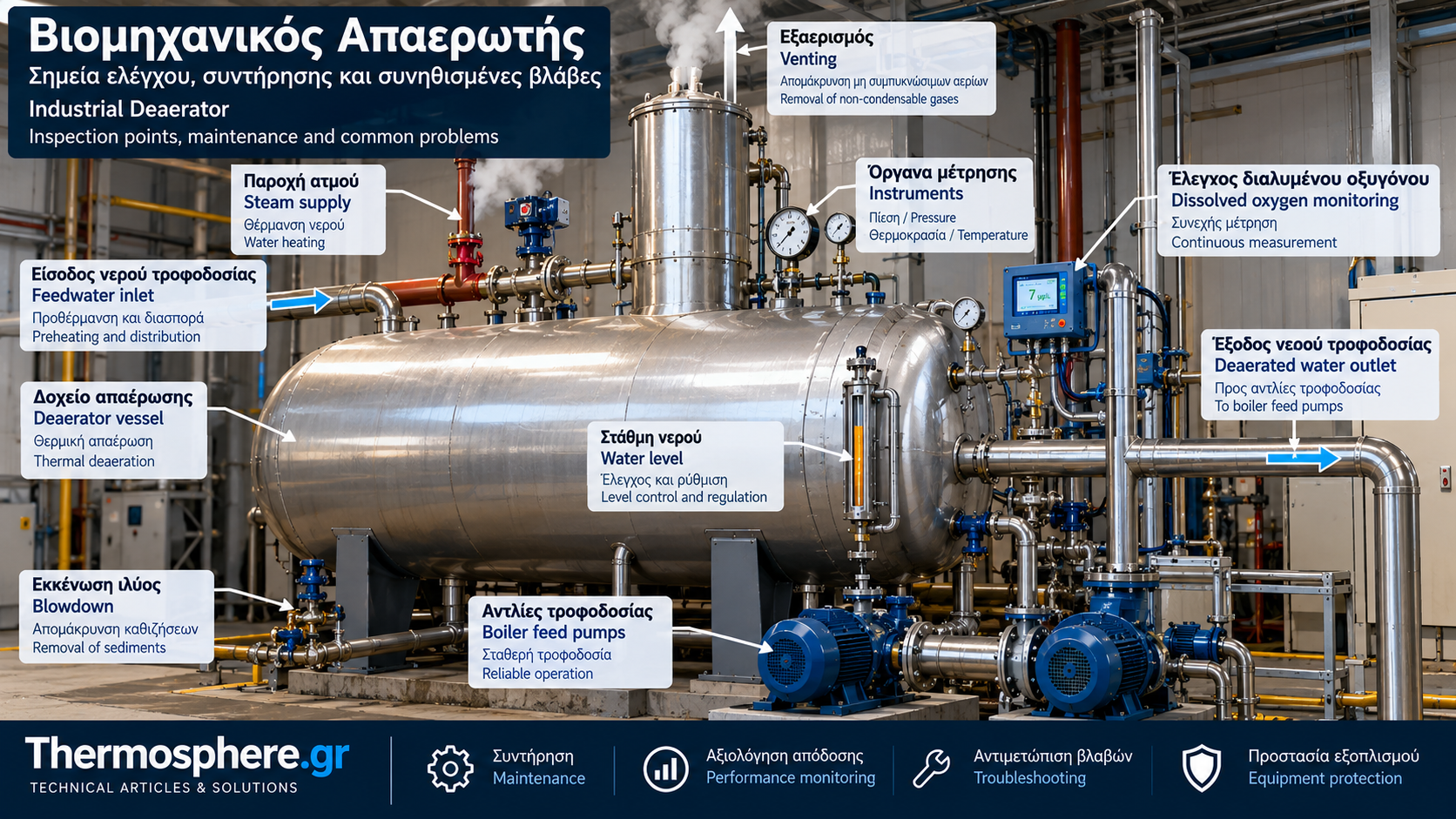
# Industrial Deaerator Troubleshooting, Maintenance and Performance Monitoring
## Introduction
Industrial deaerators are essential components of steam generation systems. Their primary function is to remove dissolved gases, particularly oxygen (O₂) and carbon dioxide (CO₂), from boiler feedwater.
Poor deaerator performance can increase corrosion risk, affect feedwater quality and create operational problems for boiler feed pumps.
Reliable operation requires a combination of process monitoring, mechanical inspection, preventive maintenance and verification of actual dissolved oxygen removal performance.
## 1. How Is Deaerator Performance Evaluated?
The performance of a thermal deaerator is primarily assessed using:
- Dissolved oxygen concentration at the outlet.
- Operating pressure.
- Water temperature relative to saturation temperature.
- Steam supply stability.
- Proper venting.
- Water flow and storage level.
- Condition of internal components.
Water temperature must be assessed against the saturation temperature corresponding to the actual absolute operating pressure.
Under specified operating and test conditions, properly designed deaerators may achieve dissolved oxygen levels of approximately 7 μg/L (7 ppb) or lower.
This value is not a universal performance requirement and should only be used where supported by the manufacturer's guarantee and relevant operating specifications.
## 2. High Dissolved Oxygen at the Outlet
Elevated dissolved oxygen is an important indication of inadequate deaeration.
Possible causes include:
- Insufficient steam supply.
- Low operating temperature.
- Inadequate venting of non-condensable gases.
- Blocked spray nozzles.
- Damaged or worn trays.
- Excessive water flow.
- Sudden load changes.
- Air ingress.
- Incorrect sampling or faulty oxygen measurement.
Troubleshooting should begin by verifying the oxygen measurement and then examining actual process conditions.
## 3. Insufficient Water Temperature
A thermal deaerator heats water close to the saturation temperature corresponding to its operating pressure.
A significantly lower temperature may indicate inadequate heat transfer or poor steam-water contact.
Possible causes include:
- Reduced steam flow.
- Faulty steam control valve.
- Insufficient steam supply pressure.
- Excessive cold makeup water flow.
- Problems with internal water distribution.
- Unstable pressure control.
Diagnosis requires simultaneous monitoring of pressure, temperature, water flow and steam valve operation.
## 4. Pressure Control Problems
Deaerator pressure must remain within the specified design and operating limits.
Low pressure may result from inadequate steam supply, control valve problems or excessive process demand.
High pressure may indicate control failure or incorrect regulation.
Important checks include:
- Steam inlet pressure.
- Vessel operating pressure.
- Control valve operation.
- Instrument accuracy.
- Alarms and protective functions.
- Pressure safety devices.
Safety valves must never be isolated, bypassed or adjusted without appropriate authorization and approved procedures.
## 5. Inadequate or Excessive Venting
Venting removes non-condensable gases from the deaerator.
Insufficient venting can allow gases to accumulate and reduce oxygen removal efficiency.
Excessive venting can increase steam losses and energy consumption.
Correct vent operation depends on deaerator design, venting equipment and manufacturer instructions.
The vent line must not be arbitrarily closed to save steam.
## 6. Spray Nozzle and Tray Problems
Spray-type deaerators use nozzles to distribute water and increase steam-water contact area.
Tray-type deaerators use trays to enhance contact between steam and water.
Potential problems include:
- Mineral deposits.
- Particle accumulation.
- Blocked or worn nozzles.
- Uneven water distribution.
- Deformed or damaged trays.
- Corrosion of internal components.
Internal inspection requires safe isolation, depressurization, cooling and compliance with confined-space entry procedures.
## 7. Unstable Water Level
The deaerator storage tank supplies water to the boiler feed pumps.
Unstable water level can interrupt feedwater supply or affect system hydraulics.
Possible causes include:
- Faulty inlet water control valve.
- Incorrect level transmitter readings.
- Rapid changes in water demand.
- Insufficient storage capacity.
- Control system malfunction.
Diagnosis requires comparison of actual water level with the indicated control system value.
## 8. Boiler Feed Pump Cavitation
Water leaving a thermal deaerator is often close to its saturation temperature.
Adequate pressure at the pump suction is therefore essential to prevent vapor formation and cavitation.
The available net positive suction head can be expressed as:
NPSHa = (Psurface,abs − Pvapor)/(ρg) + Hstatic − Hloss
Where:
Psurface,abs is the absolute pressure above the water surface.
Pvapor is the vapor pressure at the water temperature.
Hstatic is the static elevation difference between the water surface and pump suction.
Hloss represents suction line friction losses.
NPSHa must exceed the pump's required NPSHr with an appropriate design margin.
Possible cavitation symptoms include:
- Unusual noise.
- Excessive vibration.
- Unstable flow.
- Reduced pump performance.
- Impeller damage.
Cavitation should not be addressed by changing deaerator pressure without evaluating the complete hydraulic system.
## 9. Leaks and Corrosion
Deaerators operate under thermal and mechanical stresses.
Important inspection locations include:
- Welded joints.
- Flanges.
- Piping connections.
- Supports.
- Internal surfaces.
- Condensate accumulation areas.
- Locations exposed to thermal cycling.
Inspections must follow manufacturer recommendations and applicable pressure equipment requirements.
## 10. Preventive Maintenance Program
Maintenance intervals depend on manufacturer guidance, operating conditions and plant risk assessment.
Routine operating checks may include:
- Pressure and temperature monitoring.
- Water level verification.
- Dissolved oxygen testing.
- Steam consumption monitoring.
- Alarm checks.
Scheduled maintenance may include:
- Control valve inspection.
- Instrument calibration.
- Vent system inspection.
- Spray nozzle and tray inspection.
- Leak and corrosion checks.
- Vessel examination under applicable safety requirements.
Internal vessel work must only be performed after the required permits and isolation procedures are completed.
## 11. Common Troubleshooting Guide
High dissolved oxygen:
Possible causes: insufficient steam, poor venting, blocked nozzles.
Checks: oxygen measurement, pressure, temperature and vent operation.
Low water temperature:
Possible causes: insufficient steam or excessive cold water flow.
Checks: heat balance and steam control valve.
Unstable pressure:
Possible causes: control malfunction or rapid load changes.
Checks: pressure sensors, steam valve and steam supply.
Unstable water level:
Possible causes: faulty water valve, level sensor or control system.
Checks: actual water level and controller response.
Feed pump noise:
Possible causes: inadequate NPSHa or suction system problems.
Checks: static elevation, temperature, pressure and suction line losses.
## 12. Performance Optimization and Energy Efficiency
Deaerator optimization involves more than achieving low dissolved oxygen.
Important objectives include:
- Stable pressure control.
- Adequate but not excessive venting.
- Uniform water distribution.
- Prevention of air ingress.
- Appropriate condensate recovery.
- Reliable valves and instrumentation.
- Prevention of pump cavitation.
- Monitoring of specific steam consumption.
Energy savings should be verified through reliable before-and-after operating measurements.
## 13. When Is Immediate Technical Intervention Required?
Immediate evaluation under plant safety procedures is required when there is:
- Pressure outside allowable limits.
- Significant steam or hot-water leakage.
- Uncontrolled water level.
- Activation of protective devices.
- Severe vibration.
- Evidence of structural failure.
- Loss of safe boiler feedwater supply.
Safety devices must never be bypassed to maintain operation.
## Conclusion
Reliable industrial deaerator operation depends on correct thermal performance, effective gas removal, stable pressure and water level control, and adequate boiler feed pump protection.
Systematic dissolved oxygen monitoring, preventive maintenance and timely fault diagnosis reduce corrosion risk and unplanned downtime.
Overall deaerator performance should be evaluated using water quality, operating safety and energy efficiency together.
Thermosphere.gr – Technical Knowledge for Professionals.