
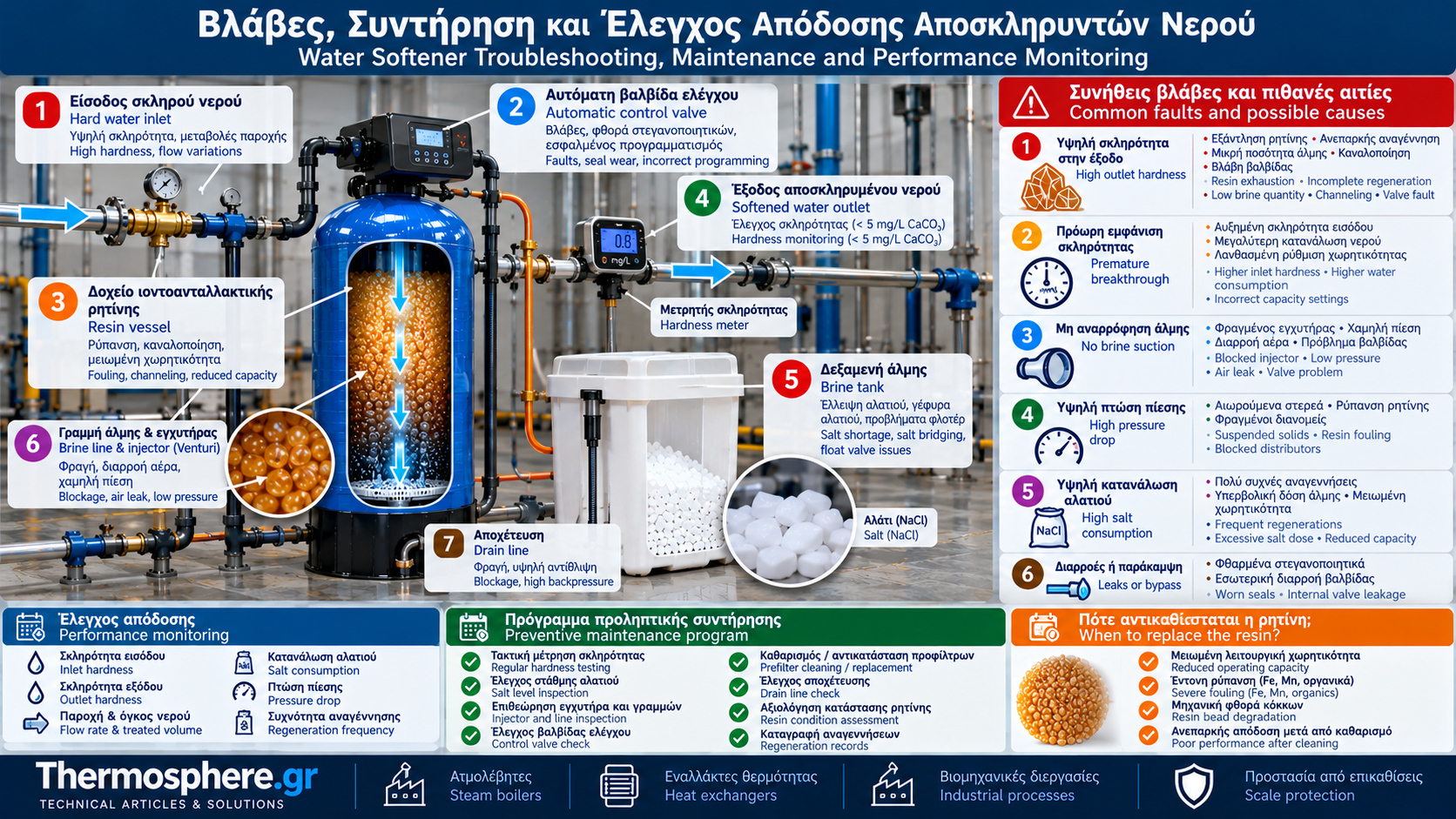
# Water Softener Troubleshooting, Maintenance and Performance Monitoring
## Introduction
Industrial water softeners are essential components of water treatment systems, particularly in steam generation, heating and industrial process installations.
Most conventional softeners use strong acid cation exchange resins that retain calcium (Ca²⁺) and magnesium (Mg²⁺) ions while releasing sodium (Na⁺) ions.
Poor performance can lead to hardness breakthrough, scale formation, increased salt consumption and problems in downstream equipment.
Systematic water quality monitoring and preventive maintenance are essential for reliable operation.
## 1. How Is Water Softener Performance Evaluated?
The primary performance indicator is residual hardness in the treated water.
Other important parameters include:
- Inlet water hardness.
- Outlet water hardness.
- Water flow rate.
- Total treated volume per service cycle.
- Pressure drop across the vessel.
- Regeneration frequency.
- Sodium chloride consumption.
- Regeneration water consumption.
- Control valve and automation performance.
Required outlet hardness depends on the specifications of the installation and downstream equipment.
There is no single universal residual hardness limit applicable to every industrial process.
## 2. Hardness Breakthrough
Elevated outlet hardness is one of the most common signs of poor softener performance.
It may occur gradually near the end of the service cycle or immediately after regeneration.
Possible causes include:
- Exhausted resin operating capacity.
- Incomplete regeneration.
- Insufficient brine quantity.
- Excessive service flow.
- Resin fouling or degradation.
- Resin bed channeling.
- Untreated water bypass.
- Damaged internal distributors.
- Control valve malfunction.
Troubleshooting should begin by verifying the hardness measurement using an appropriate analytical method.
Next, check actual flow, treated volume since the last regeneration and correct regeneration sequence.
## 3. Early Exhaustion Versus Incomplete Regeneration
Distinguishing these two conditions is important for accurate diagnosis.
### Early exhaustion
The softener initially produces water within specification, but outlet hardness rises earlier than expected.
Possible causes include:
- Increased inlet hardness.
- Higher actual water consumption.
- Incorrect capacity programming.
- Reduced resin operating capacity.
### Incomplete regeneration
Outlet hardness remains elevated immediately after regeneration and final rinsing.
Possible causes include:
- Insufficient brine suction.
- Incorrect brine concentration.
- Inadequate contact time.
- Control valve problems.
- Resin fouling or degradation.
Recording outlet hardness immediately after regeneration and throughout the service cycle helps identify the cause.
## 4. Brine Tank Problems
The brine tank supplies sodium chloride solution during regeneration.
Common problems include:
- Insufficient salt.
- Salt bridging.
- Salt accumulation or compaction at the bottom.
- Blocked brine line.
- Faulty float valve.
- Incorrect water level.
- Brine suction line leaks.
Salt bridging forms a hard layer that can prevent salt from contacting the water.
As a result, a tank may appear full while producing insufficient brine.
Inspection must be performed safely without damaging the tank or associated piping.
## 5. Insufficient Brine Suction
Many automatic water softeners use a Venturi injector to draw brine into the resin vessel.
Correct operation requires adequate feedwater pressure and a properly functioning hydraulic path.
Possible causes of poor brine suction include:
- Blocked injector.
- Low water pressure.
- Restricted drain line.
- Air leakage in the brine suction line.
- Worn seals.
- Control valve malfunction.
Verification involves observing actual brine level changes and checking the regeneration sequence according to the equipment manual.
## 6. Ion Exchange Resin Fouling and Degradation
Resin performance can deteriorate due to chemical, mechanical and operational factors.
Important mechanisms include:
### Iron and manganese fouling
Iron and manganese compounds can form deposits and reduce available operating capacity.
### Organic fouling
Certain organic substances can accumulate on or interfere with the resin.
### Oxidative degradation
Exposure to chlorine or other oxidizing agents beyond compatibility limits can damage the resin polymer structure.
### Mechanical degradation
Excessive hydraulic stress, improper backwashing or water distribution problems may cause resin bead breakage.
Corrective action depends on the cause and may include improved pretreatment, suitable cleaning or resin replacement.
Chemical cleaning must follow approved procedures compatible with the selected resin.
## 7. Increased Pressure Drop
An increase in differential pressure between the softener inlet and outlet may indicate:
- Suspended solids accumulation.
- Blocked internal components.
- Resin bed compaction.
- Resin fouling.
- Water distribution problems.
Pressure drop should be compared at approximately the same flow rate and temperature.
Increased pressure drop alone does not prove that resin replacement is necessary.
## 8. Resin Bed Channeling
Channeling occurs when water follows preferential flow paths through the resin bed.
This reduces effective contact with the resin and may increase outlet hardness.
Possible causes include:
- Uneven inlet water distribution.
- Distributor problems.
- Deposits or agglomeration.
- Improper hydraulic conditions.
- Inadequate backwashing where applicable.
Diagnosis requires assessment of hydraulic performance and, when necessary, resin bed inspection.
## 9. Automatic Control Valve Faults
The automatic control valve determines water flow paths during service and regeneration.
Potential faults include:
- Worn pistons or seals.
- Motor failure.
- Position sensor problems.
- Incorrect programming.
- Internal leakage.
- Incomplete switching between cycle stages.
Internal leakage can allow untreated water to mix with softened water.
Troubleshooting must follow the hydraulic diagram and manufacturer documentation for the specific valve.
## 10. Excessive Salt Consumption
High sodium chloride consumption may result from:
- Regeneration occurring too frequently.
- Excessive regeneration dose.
- Incorrect hardness settings.
- Faulty flow measurement.
- Reduced resin capacity.
- Improper reserve capacity programming.
Specific salt consumption can be monitored as:
Specific salt consumption = kg NaCl / m³ of softened water.
This value should be evaluated together with inlet hardness, outlet quality and actual treated water volume.
Reducing salt dose without recalculating resin operating capacity can lead to premature hardness breakthrough.
## 11. Actual Resin Operating Capacity
Operating capacity can be estimated from the treated water volume produced until the specified outlet hardness limit is reached.
For approximately constant inlet hardness:
Cactual = Vtreated × (Hin − Hout,avg) / Vresin
Where:
Cactual = actual operating capacity in g CaCO₃/L resin.
Vtreated = treated water volume in m³.
Hin = inlet hardness in mg/L as CaCO₃.
Hout,avg = average outlet hardness in mg/L as CaCO₃.
Vresin = resin volume in L.
Example:
Resin volume: 500 L.
Treated volume: 70 m³.
Inlet hardness: 300 mg/L as CaCO₃.
Average outlet hardness: 2 mg/L as CaCO₃.
Cactual = 70 × (300 − 2) / 500
Cactual = 41.72 g CaCO₃/L resin.
This result can be compared with manufacturer operating capacity data under equivalent regeneration conditions.
If inlet hardness varies significantly, the calculation must use individual hardness measurements and corresponding treated water volumes.
## 12. Preventive Maintenance Program
Maintenance frequency depends on manufacturer instructions, plant criticality and operating conditions.
### Routine operating checks
- Outlet hardness testing.
- Pressure and flow monitoring.
- Salt level monitoring.
- Regeneration records.
- Alarm checks.
### Scheduled maintenance
- Brine tank inspection.
- Injector and brine line inspection.
- Control valve checks.
- Instrument calibration.
- Internal distributor inspection where required.
- Resin condition assessment.
- Leak inspection.
- Vessel inspection under applicable safety requirements.
Before maintenance, equipment must be isolated and depressurized according to plant procedures.
## 13. Practical Troubleshooting Guide
### High hardness immediately after regeneration
Possible causes: insufficient brine, faulty control valve, resin fouling or bypass.
Initial checks: regeneration sequence, brine suction and outlet water quality.
### Premature hardness breakthrough
Possible causes: increased hardness load, incorrect capacity settings or resin degradation.
Initial checks: inlet hardness, actual treated volume and regeneration history.
### No brine suction
Possible causes: blocked injector, low pressure, air leakage or valve malfunction.
Initial checks: brine level, supply pressure and suction line condition.
### High pressure drop
Possible causes: suspended solids, resin fouling or blocked distributors.
Initial checks: differential pressure at comparable flow and pretreatment performance.
### High salt consumption
Possible causes: excessive salt dose or frequent regeneration.
Initial checks: capacity settings, flowmeter and water consumption.
## 14. When Should Resin Be Replaced?
Resin should not be replaced solely because it has reached a particular age.
Replacement decisions should consider:
- Actual operating capacity.
- Resin bead condition.
- Degree of fouling.
- Mechanical strength.
- History of chemical exposure.
- Regeneration effectiveness.
- Economic comparison between cleaning and replacement.
Premature replacement increases costs, while continued use of degraded resin may compromise treated water quality.
## 15. Protecting Steam Boilers and Critical Installations
In steam generation systems, hardness breakthrough can allow calcium and magnesium to enter downstream treatment equipment or the boiler.
Important protective measures include:
- Reliable hardness testing.
- Correct regeneration settings.
- Appropriate redundancy.
- Water quality alarms.
- Prevention of uncontrolled bypass.
- Compliance with boiler manufacturer feedwater requirements.
Critical installations may include automatic isolation or diversion of off-specification water.
## Conclusion
Reliable industrial water softener operation requires effective regeneration, good ion exchange resin condition, properly functioning valves and continuous treated water quality monitoring.
Early diagnosis of hardness breakthrough, insufficient brine suction and increased pressure drop reduces the risk of scaling and unplanned downtime.
Preventive maintenance and assessment of actual resin operating capacity are essential for maintaining performance and controlling operating costs.
Thermosphere.gr – Technical Knowledge for Professionals.