
# Reverse Osmosis (RO) Troubleshooting and Maintenance: Fault Diagnosis, Solutions and Prevention
## Introduction
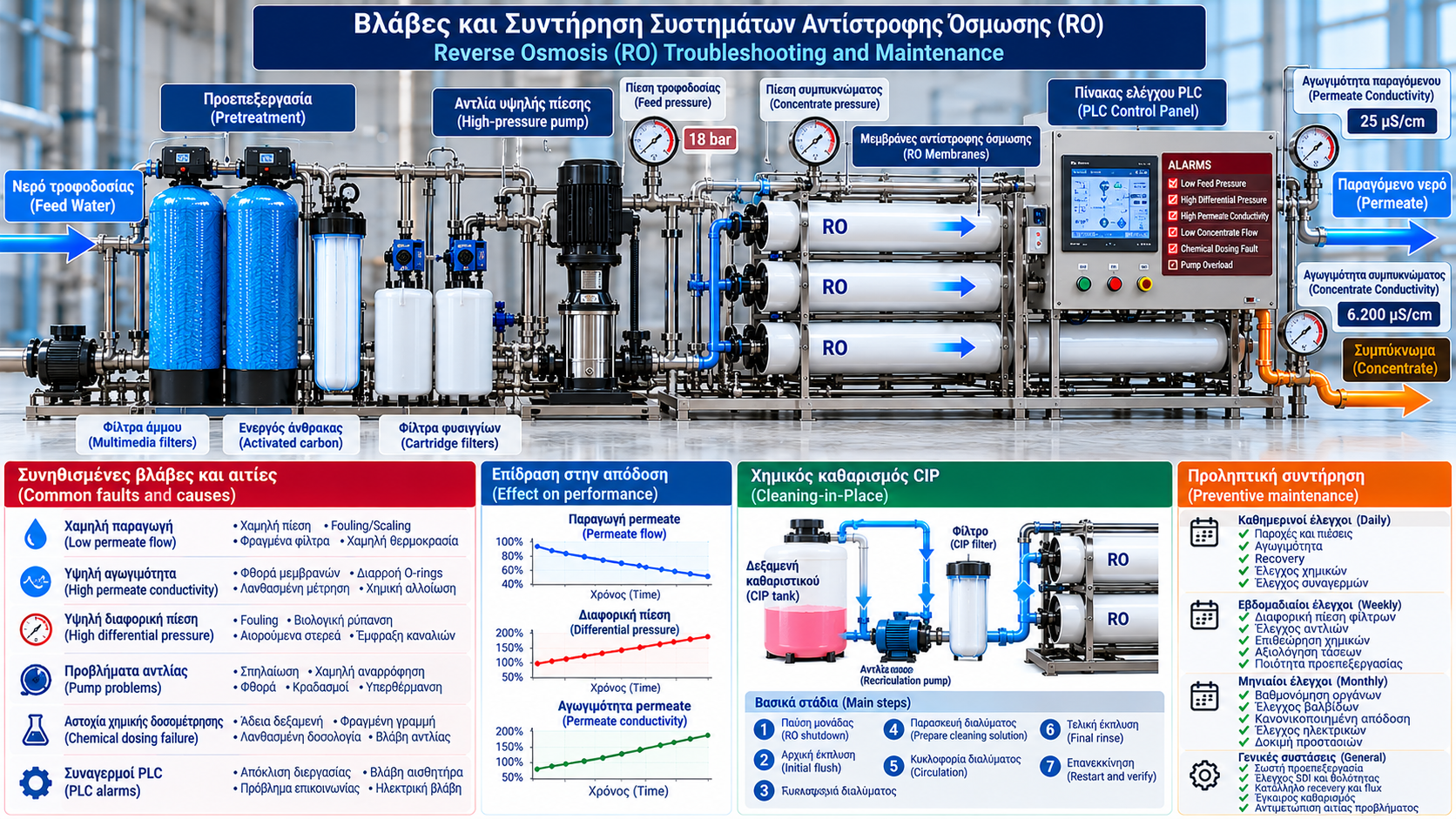
Industrial reverse osmosis (RO) systems operate under controlled hydraulic, chemical and water quality conditions.
Any significant deviation from normal operating parameters can reduce permeate production, increase energy consumption or damage membrane elements and mechanical equipment.
Effective troubleshooting requires a systematic approach based on reliable measurements, operating trends and an understanding of the interactions between pretreatment, high-pressure pumps, membranes and automation systems.
This guide explains common RO faults, their possible causes, practical diagnostic methods and preventive maintenance requirements.
## 1. Essential RO Operating Parameters
The following parameters should be monitored to evaluate system performance:
- Feedwater flow rate.
- Permeate production rate.
- Concentrate flow rate.
- Feed and concentrate pressures.
- Permeate pressure, where relevant.
- Feed-to-concentrate differential pressure.
- Feedwater and permeate conductivity.
- Water temperature.
- pH and system recovery.
- Chemical dosing performance.
- Pump, valve and instrumentation status.
Measurements should be compared with established baseline conditions and membrane manufacturer operating limits.
Where appropriate, performance data should be normalized to account for changes in temperature, pressure, salinity and recovery.
## 2. Low Permeate Production
Reduced permeate flow is one of the most common RO operating problems.
### Possible Causes
- Insufficient feedwater pressure.
- Lower feedwater temperature.
- Increased feedwater salinity.
- Membrane fouling or scaling.
- Blocked pretreatment filters.
- Insufficient high-pressure pump output.
- Incorrect valve settings.
- Increased permeate backpressure.
### Diagnostic Procedure
First, compare feed pressure, permeate flow, feedwater temperature and conductivity with normal operating values.
Check pretreatment filter differential pressure and confirm that the high-pressure pump operates within its expected performance range.
Evaluate normalized permeate flow.
If raw permeate production decreases but normalized production remains stable, the change may result from operating conditions rather than membrane deterioration.
A persistent decline in normalized production may indicate fouling, scaling or other membrane performance problems.
## 3. High Permeate Conductivity
High permeate conductivity indicates increased ionic content in the treated water.
However, it does not automatically mean that the RO membranes must be replaced.
### Possible Causes
- Membrane chemical deterioration.
- Damaged O-rings or interconnectors.
- Membrane element sealing failure.
- Mechanical membrane damage.
- Increased feedwater salinity.
- Reduced net driving pressure.
- Temperature-related changes.
- Conductivity sensor malfunction.
### Diagnostic Procedure
Verify the conductivity instrument calibration and temperature compensation.
Measure feedwater conductivity and compare the permeate results with historical operating data.
Evaluate normalized salt passage.
Where the system configuration allows, individual pressure vessel permeate testing or profiling may help locate the source of abnormal salt passage.
Membrane replacement should only be considered after confirming the underlying cause.
## 4. High Differential Pressure
Differential pressure across the membrane feed channels is an important indicator of hydraulic resistance.
It is calculated from the difference between feed inlet pressure and concentrate outlet pressure across the relevant membrane stage.
### Possible Causes
- Suspended solids accumulation.
- Biological fouling.
- Colloidal deposits.
- Feed spacer blockage.
- Excessive feedwater flow.
- Abnormal hydraulic conditions.
### Diagnostic Procedure
Compare differential pressure under equivalent flow conditions or use an appropriate normalization method.
Inspect pretreatment performance and review changes in feedwater quality.
A progressive increase in normalized differential pressure can indicate increasing resistance within membrane feed channels.
Differential pressure must not be confused with membrane transmembrane pressure or pump discharge pressure.
## 5. High-Pressure Pump Problems
The high-pressure pump is one of the most critical components of an industrial RO system.
Its performance directly affects membrane operating pressure and permeate production.
### Common Pump Faults
- Cavitation.
- Low suction pressure.
- Mechanical seal leakage.
- Bearing deterioration.
- Excessive vibration.
- Motor overheating.
- Variable-frequency drive faults.
- Reduced hydraulic performance.
### Cavitation
Cavitation occurs when local liquid pressure falls sufficiently for vapor bubbles to form and subsequently collapse.
It can cause noise, vibration, material damage and reduced pump performance.
Diagnosis should include suction pressure, available net positive suction head (NPSH), suction line restrictions and the pump operating point.
Pump maintenance must follow manufacturer instructions and appropriate mechanical and electrical isolation procedures.
## 6. Chemical Dosing System Failures
Industrial RO installations may use chemical dosing systems for antiscalants, pH adjustment and dechlorination.
### Common Problems
- Empty chemical storage tanks.
- Blocked injection lines.
- Loss of pump priming.
- Diaphragm failure.
- Incorrect pump calibration.
- Incorrect chemical concentration.
- Instrument or control signal failure.
### Operational Consequences
Insufficient antiscalant dosing can increase scaling risk.
Inadequate dechlorination can expose chlorine-sensitive polyamide membranes to oxidizing agents.
Incorrect pH adjustment can alter scaling potential and membrane operating conditions.
Chemical dosing changes must be based on water analysis, verified dosing calculations and supplier recommendations.
## 7. Instrumentation and Sensor Faults
Incorrect measurements can cause unnecessary shutdowns or allow abnormal operating conditions to remain undetected.
Common instrumentation problems include:
- Conductivity sensor calibration drift.
- Blocked pressure impulse lines.
- Flowmeter malfunction.
- Temperature sensor failure.
- Loss of 4–20 mA signals.
- PLC communication faults.
- Instrument power supply failures.
Critical measurements should be verified using suitable independent instruments where required.
Sensor faults must be distinguished from genuine process abnormalities before corrective action is taken.
## 8. PLC Alarms and Protective Interlocks
Industrial RO systems frequently use programmable logic controllers (PLCs) to manage operation, monitoring and protective shutdowns.
Typical alarms include:
- Low Feed Pressure.
- High Feed Pressure.
- High Differential Pressure.
- High Permeate Conductivity.
- Low Concentrate Flow.
- Chemical Dosing Failure.
- Pump Motor Overload.
- Pretreatment Failure.
- Emergency Stop.
### Alarm Management
A protective shutdown should place the equipment in an appropriate safe condition.
Resetting an alarm must not override an unresolved hazardous or unacceptable process condition.
Before restarting the system, the operator should verify that the original fault has been corrected and all required operating conditions are satisfied.
Interlock logic, alarm limits and restart sequences must be established through equipment specifications and the facility risk assessment.
## 9. Practical RO Troubleshooting Guide
### Symptom: Low Permeate Flow
Possible causes:
- Reduced operating pressure.
- Low water temperature.
- Membrane fouling.
- Increased salinity.
Initial checks:
- Feed pressure.
- Temperature.
- Pretreatment filters.
- Normalized permeate flow.
### Symptom: High Permeate Conductivity
Possible causes:
- Membrane deterioration.
- Damaged seals.
- Increased feedwater salinity.
- Instrument malfunction.
Initial checks:
- Conductivity sensor calibration.
- Feedwater conductivity.
- Normalized salt passage.
- Pressure vessel permeate quality.
### Symptom: High Differential Pressure
Possible causes:
- Particulate fouling.
- Biological fouling.
- Feed channel obstruction.
Initial checks:
- Feed and concentrate flows.
- Pretreatment performance.
- Historical differential pressure trends.
### Symptom: Pump Noise and Vibration
Possible causes:
- Cavitation.
- Bearing damage.
- Mechanical problems.
Initial checks:
- Suction pressure.
- NPSH conditions.
- Pump vibration and mechanical condition.
### Symptom: Frequent PLC Shutdowns
Possible causes:
- Genuine process deviations.
- Faulty instrumentation.
- Electrical or communication problems.
Initial checks:
- Alarm history.
- Independent process measurements.
- Interlock status.
- Instrument signals.
## 10. Preventive Maintenance Program
Preventive maintenance reduces the likelihood of unexpected shutdowns and helps maintain stable system performance.
The maintenance schedule should follow equipment manufacturer recommendations, operating history and actual site conditions.
### Daily Inspections
- Record feed, permeate and concentrate flows.
- Check operating pressures.
- Monitor permeate conductivity.
- Verify recovery.
- Inspect for leaks.
- Check chemical dosing systems.
- Review active and historical alarms.
### Weekly Inspections
- Review operating trends.
- Check filter differential pressure.
- Inspect pumps for abnormal noise or vibration.
- Verify chemical inventory.
- Assess pretreatment performance.
- Review abnormal operating events.
### Monthly or Periodic Inspections
- Verify instrument calibration.
- Inspect valves and actuators.
- Review normalized membrane performance.
- Inspect electrical equipment through authorized personnel.
- Test protective functions under an approved procedure.
- Review maintenance records and corrective actions.
These frequencies are illustrative and do not replace the approved site maintenance plan.
## 11. When Should RO Membranes Be Replaced?
Membrane replacement may become necessary when performance cannot be restored economically or technically.
Possible reasons include:
- Persistent loss of normalized permeate flow after appropriate cleaning.
- Significant deterioration in salt rejection.
- Confirmed irreversible chemical damage.
- Non-repairable mechanical damage.
- Excessive operating costs associated with deteriorated membrane performance.
Membrane age alone is not a sufficient replacement criterion.
The decision should consider water quality, production requirements, cleaning history, operating costs and the condition of the installed membrane elements.
## 12. Safe Troubleshooting and Maintenance
RO maintenance involves electrical, mechanical, hydraulic and chemical hazards.
Appropriate safety procedures are essential before intervention.
Depending on the activity, these may include:
- Electrical isolation.
- Pressure isolation and depressurization.
- Lockout/Tagout procedures.
- Suitable personal protective equipment.
- Chemical safety assessments.
- Verification of stored energy.
- Manufacturer-approved maintenance procedures.
High-pressure components must never be opened while pressurized.
Protective interlocks must not be bypassed to maintain production.
Only appropriately trained and authorized personnel should perform hazardous maintenance activities.
## 13. Improving Reliability and Operating Efficiency
A well-structured maintenance program can reduce:
- Unplanned shutdowns.
- Unnecessary chemical cleaning.
- Excessive electricity consumption.
- Premature membrane replacement.
- Water production losses.
- Equipment repair costs.
Historical operating data can help identify developing problems before they cause significant failures.
Condition-based maintenance uses measured equipment and process performance to determine when intervention is necessary.
For example, a gradual increase in normalized differential pressure may justify investigation of pretreatment performance before severe membrane fouling develops.
Similarly, increasing pump vibration or declining hydraulic efficiency can indicate the need for mechanical inspection.
The objective is to address the underlying cause rather than repeatedly treating the symptoms.
## Conclusion
Troubleshooting industrial reverse osmosis systems requires a combination of hydraulic, chemical, mechanical, electrical and automation expertise.
Reliable diagnosis depends on accurate measurements, normalized performance analysis and a clear understanding of the interaction between pretreatment, pumps, membranes and control systems.
Preventive maintenance, appropriate protective interlocks and timely corrective action help maintain consistent water production and reduce long-term operating costs.
Successful maintenance is not simply about restoring operation after a fault. It is about identifying the root cause, preventing recurrence and preserving the reliability of the entire RO installation.
Thermosphere.gr – Technical Knowledge for Professionals.