
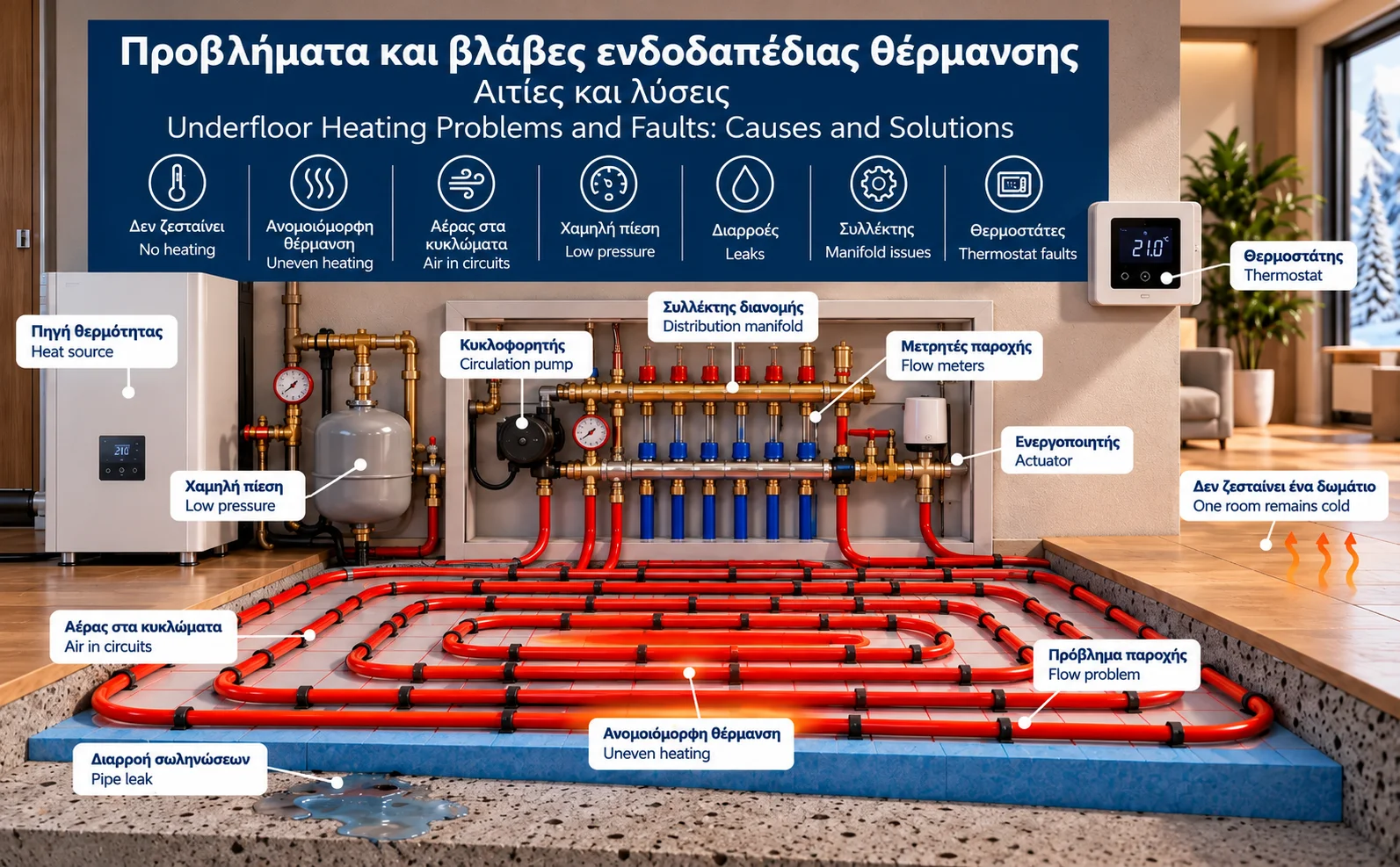
Underfloor Heating Problems and Faults: Causes and Solutions
Hydronic underfloor heating can provide comfortable and efficient space heating for many years. However, like any water-based heating system, it may occasionally develop faults.
A room that remains cold, unusually slow heating, fluctuating system pressure or a malfunctioning manifold are among the problems homeowners may encounter.
Correct diagnosis is essential because similar symptoms can result from very different causes.
This guide explains the most common hydronic underfloor heating problems, their possible causes and the checks needed to identify appropriate solutions.
1. Underfloor Heating Is Not Heating at All
When the entire system fails to provide heat, the problem may involve the heat source, water circulation or heating controls.
Possible causes include:
The heat pump or boiler is not operating.
The thermostat is not requesting heat.
The circulation pump is malfunctioning.
System pressure or water flow is insufficient.
A main isolation valve is closed.
The heating control system has developed a fault.
What Should Be Checked?
First, confirm that the thermostat is set above the current room temperature.
Next, check whether the heat source is operating and displaying any error messages.
A qualified technician can inspect the circulation pump, valves, supply-water temperature and actual water flow.
Safety devices must never be bypassed to force the system to operate.
2. One Room Remains Cold
If most rooms are heating normally but one remains cold, the issue may be associated with its individual heating circuit.
Common causes include:
A closed manifold valve.
A faulty thermal actuator.
Incorrect flow adjustment.
Trapped air in the circuit.
A malfunctioning room thermostat.
Insufficient heating output for the room.
How Is the Problem Diagnosed?
A technician checks whether the thermostat is calling for heat, whether the actuator opens and whether the circuit receives the required water flow.
Supply and return temperatures can also provide useful information.
Low flow does not necessarily indicate a blocked pipe. It may result from a closed valve, trapped air or a control fault.
3. Uneven Floor Heating
Uneven floor temperatures can result from incorrect flow rates, poor hydraulic balancing or design limitations.
Possible causes include:
Incorrect manifold settings.
Insufficient flow through certain circuits.
Trapped air.
Different pipe spacing.
Higher heat losses near external walls or windows.
Different floor covering materials.
Not every temperature difference indicates a malfunction.
Heat distribution is influenced by pipe layout, furniture placement and the thermal characteristics of the room.
Possible Solution
Hydraulic balancing allows circuit flow rates to be adjusted according to the heating design.
Adjustments should follow the calculated requirements rather than arbitrary valve changes.
4. Air Trapped in Underfloor Heating Circuits
Trapped air can restrict or interrupt water circulation.
Typical symptoms include:
A heating circuit remains cold.
Water flow appears reduced.
Unusual noises occur.
Heating performance changes after filling or maintenance.
How Is It Resolved?
Air removal is carried out through the appropriate system connections.
Some installations require individual circuit flushing and venting through the manifold.
This procedure should be performed by a qualified technician because incorrect valve operation or excessive pressure may damage components.
5. Low Heating System Pressure
Pressure loss may result from water leakage, air removal, expansion vessel problems or a faulty valve.
Some pressure variation between cold and warm operating conditions is normal.
However, continuously falling pressure requires investigation.
What Should Be Inspected?
A technician may examine:
Visible pipe connections.
The distribution manifold.
The safety relief valve.
The expansion vessel.
The heat source.
Individual heating circuits for possible leaks.
Repeatedly topping up the system without identifying the cause is not a permanent solution.
6. Leaks in Underfloor Heating Pipes
A leak in a pipe embedded within the floor is one of the more concerning potential faults.
Possible warning signs include:
Persistent pressure loss.
Localized damp patches.
Unexplained floor covering damage.
Frequent need to refill the system.
However, these symptoms do not automatically prove that an underfloor heating pipe is leaking.
Moisture may originate from another plumbing installation or a building defect.
How Are Leaks Located?
Diagnosis may involve pressure testing, isolating individual circuits, thermal imaging and specialist leak-detection techniques.
Thermal imaging can help identify pipe routes and unusual temperature patterns, but it cannot always confirm the exact location of a leak.
Repairs should only be planned after the cause has been verified.
7. Distribution Manifold Problems
The manifold distributes heating water to individual circuits.
Possible faults include:
Sticking valves.
Defective actuators.
Leaking connections.
Blocked or malfunctioning flow meters.
Incorrect circuit settings.
Correct Troubleshooting Approach
Before replacing a component, it is important to confirm the actual cause.
For example, an actuator that remains closed may be functioning correctly but receiving no heating request from the thermostat.
Diagnosis may therefore require both hydraulic and electrical checks by qualified personnel.
8. Underfloor Heating Takes Too Long to Warm Up
Slow response is not always a fault.
Traditional underfloor heating systems embedded in screed have significant thermal mass.
The floor needs time to absorb heat before releasing it into the room.
Warm-up time depends on:
Screed thickness.
Supply-water temperature.
Building insulation.
Initial indoor temperature.
Available heating output.
If the system previously warmed the building effectively but has recently become much slower, water flow, operating temperatures and controls should be investigated.
9. Thermostat and Control Problems
Thermostats and actuators control individual heating zones.
Faults may cause:
No heating in a specific room.
Continuous heating without proper regulation.
Unwanted temperature fluctuations.
Incorrect opening or closing of circuits.
Troubleshooting begins with checking thermostat settings.
Electrical connections and actuator control signals should be inspected by qualified technicians.
Electrical circuits must be safely isolated before any intervention.
10. Quick Troubleshooting Table
Symptom | Possible Cause | Recommended Check |
|---|---|---|
No rooms are heating | Heat source or circulation pump | Check operation and error messages |
One room remains cold | Valve, actuator or trapped air | Inspect the individual circuit |
Uneven heating | Incorrect flow rates | Check hydraulic balancing |
Pressure keeps dropping | Leak or expansion vessel issue | Inspect system tightness and equipment |
Very slow warm-up | Thermal inertia or insufficient output | Check temperatures and water flow |
Heating zone does not respond | Thermostat or actuator fault | Inspect control operation |
This table is intended for initial troubleshooting and does not replace professional diagnosis.
11. When Should You Call a Technician?
Professional assistance is recommended when:
System pressure repeatedly decreases.
Moisture appears on or around the floor.
One or more heating circuits stop working.
Unusual noises develop.
The heat source displays error codes.
Electrical control faults are suspected.
In the event of significant leakage, safely isolating the system and contacting a qualified technician should be the priority.
12. Frequently Asked Questions
Can underfloor heating pipes become blocked?
Yes. Flow may be restricted by deposits or other problems. However, reduced flow can have several causes, so proper diagnosis is necessary before any intervention.
Does underfloor heating need frequent bleeding?
A properly designed, sealed system should not require frequent air removal. Repeated air-related problems should be investigated.
Should the floor feel very warm?
No. Underfloor heating typically operates with moderate surface temperatures. A floor may feel only slightly warm while still providing adequate room heating.
Can a leaking pipe be repaired without removing the entire floor?
In many cases, a localized repair is possible once the leak has been accurately identified. The repair method depends on pipe material, location and system specifications.
Conclusion
Underfloor heating problems are not always caused by the pipes embedded in the floor.
Many faults originate from thermostats, actuators, manifolds, circulation pumps or the heat source.
Correct diagnosis should always come before repairs.
With appropriate maintenance, periodic checks and proper hydraulic balancing, hydronic underfloor heating can provide reliable and efficient operation for many years.
Thermosphere.gr — Technical knowledge for heating and building systems.