
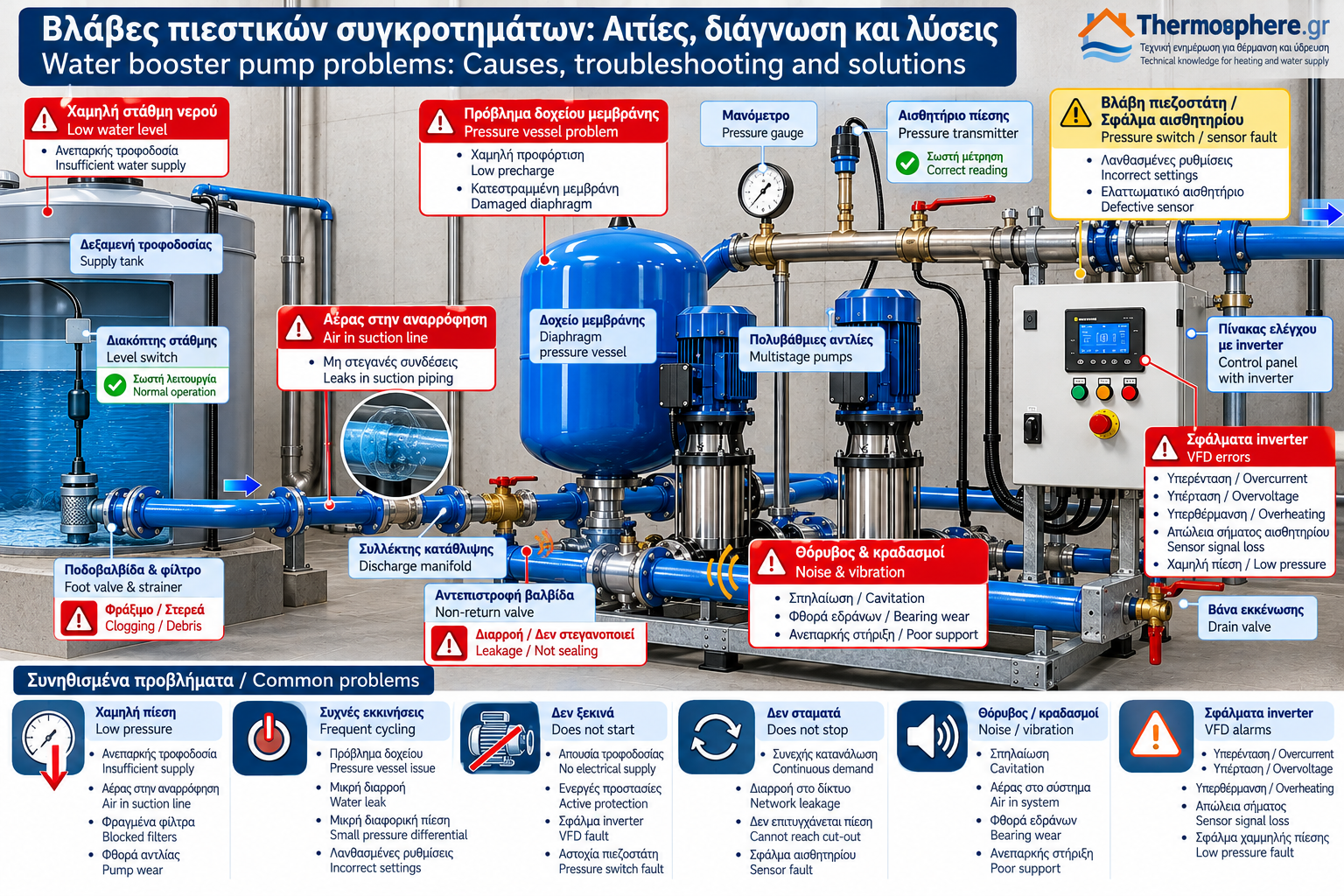
Water Booster Pump Problems: Causes, Troubleshooting and Solutions
Water booster pump systems are essential for maintaining adequate water pressure and flow in residential buildings, apartment complexes, hotels and commercial facilities.
Although modern booster sets incorporate advanced controls and protective devices, they may still develop faults that affect hydraulic performance, energy consumption and equipment service life.
A booster pump that cycles frequently, fails to build pressure or stops with a fault indication does not necessarily have a defective pump.
The underlying cause may involve inadequate water supply, pipework restrictions, a diaphragm pressure vessel, pressure sensors or incorrect control settings.
Effective troubleshooting requires a systematic approach rather than replacing components without identifying the actual problem.
1. Where should booster pump troubleshooting begin?
Before investigating a specific fault, the operating behaviour of the system should be recorded.
Useful information includes:
Whether the problem occurs continuously or only during periods of high demand.
Whether one or several pumps are operating.
Suction and discharge pressure readings.
The condition and water level of the supply tank.
Controller indications and fault codes.
Unusual noise or vibration.
Whether the fault appeared after a power interruption, maintenance activity or parameter change.
Initial observations can often be made without opening electrical panels or dismantling equipment.
Safety warning: Working on electrical equipment and pressurised hydraulic systems presents serious hazards. Before any intervention, qualified personnel must safely isolate electrical power, prevent unexpected restarting and depressurise the relevant hydraulic components. Variable frequency drives may retain hazardous voltage in their capacitors after the power supply has been disconnected.
2. The booster pump runs but does not build pressure
This is one of the most common booster system problems.
The pump appears to operate, but the pressure gauge does not reach the required value or pressure at the outlets remains insufficient.
Possible causes
Insufficient water supply
The storage tank level may be too low, or the available inlet flow may be inadequate.
Air entering the suction line
Leaking suction connections, unsuitable pipe arrangements or inadequate priming may allow air to enter or become trapped.
Blocked strainer or restricted pipework
Excessive hydraulic resistance can limit flow and worsen suction conditions.
Incorrect rotation direction
On applicable three-phase pump motors, incorrect rotation may significantly reduce pump performance.
Worn or damaged impeller
Mechanical wear may reduce the pump’s available head.
Excessive demand
If actual water consumption exceeds the booster system’s capacity, discharge pressure may fall.
Incorrect VFD configuration
An unsuitable maximum frequency limit, faulty pressure feedback or incorrect setpoint may prevent the pump from reaching the required pressure.
Troubleshooting approach
The technician should first verify water availability and measure actual inlet and outlet pressures.
Flow rate and developed head should then be compared with the manufacturer’s pump performance curves.
Increasing the pressure setpoint without checking the hydraulic conditions may make the problem worse.
3. The booster pump starts and stops repeatedly
Frequent starting and stopping, commonly known as short cycling, indicates that the system is not managing pressure fluctuations or low water demand correctly.
Possible causes
Insufficient pressure vessel precharge.
Damaged vessel diaphragm.
Inadequate usable vessel water volume.
Excessively small pressure differential.
Small but continuous water leakage.
Faulty non-return valve.
Unstable pressure measurement.
Incorrect sleep and wake-up parameters in a VFD-controlled system.
Why is short cycling harmful?
Repeated starting increases thermal and mechanical stress on the motor, switching devices and other components.
The maximum permissible starting frequency depends on the motor and pump manufacturer’s specifications.
What should be checked?
In conventional booster systems, the pressure vessel, cut-in and cut-out settings and potential water losses should be examined.
Variable-speed systems also require assessment of pressure sensor stability, controller parameters and standby transition settings.
Simply increasing the cut-out pressure is not a complete troubleshooting solution.
4. Diaphragm pressure vessel problems
The diaphragm pressure vessel plays an important role in conventional booster pump operation.
When it is not functioning correctly, the pump may cycle frequently even under low demand.
Common symptoms
Rapid pressure drop when a tap opens.
Very short intervals between pump starts and stops.
Unstable pressure.
Insufficient usable water storage in the vessel.
Loss of precharge pressure
Gas pressure inside the vessel may gradually decrease over time.
Precharge must only be measured after the vessel has been hydraulically isolated and the water side has been depressurised and drained.
The correct precharge depends on the system configuration and manufacturer instructions.
Diaphragm failure
In certain vessel designs, water emerging from the gas charging valve is a strong indication of diaphragm failure.
However, the absence of water at the valve does not necessarily prove that the diaphragm is intact.
Inspection, repair or replacement must follow the vessel manufacturer’s specifications.
The vessel’s maximum allowable pressure must never be exceeded during testing or recharging.
5. The booster pump does not start
Failure to start may result from an electrical, mechanical or protective control condition.
Possible causes
Loss of electrical supply.
Activated motor protection.
VFD fault.
Active dry-running protection.
Defective pressure switch or sensor.
External shutdown command.
Mechanical seizure of the pump or motor.
Diagnostic approach
Controller indications and fault codes should be recorded first.
Failure to start does not necessarily mean the motor is defective.
If a protective device has operated, the underlying cause must be identified before restarting.
Pressure sensors, safety switches and protective devices must never be bypassed simply to force the pump to run.
6. The booster pump does not stop
A booster system that continues running may have several possible causes, depending on its control arrangement.
Possible causes
Continuous water demand or leakage.
Failure to reach the cut-out pressure.
Incorrect pressure switch settings.
Defective pressure transmitter.
Insufficient pump performance.
Control system malfunction.
Incorrect minimum-flow or sleep settings in a VFD system.
An important distinction
Some variable-speed booster pumps may operate at low speed for a limited period as part of normal control behaviour.
Continuous running should therefore not automatically be classified as a fault.
Diagnosis requires comparing actual pressure, demand and the control logic of the specific system.
7. Pump noise and vibration
Unusual noise may indicate a hydraulic or mechanical problem.
Possible causes
Cavitation
Cavitation may produce pronounced noise and vibration, often associated with inadequate suction conditions.
Air in the hydraulic system
Entrained or trapped air may cause unstable flow and noise.
Bearing wear
Worn bearings may produce mechanical noise that becomes more noticeable during operation.
Inadequate support
Vibration may be transmitted through the pipework and building structure.
Operation outside the recommended range
A centrifugal pump operating far outside its suitable performance range may experience increased hydraulic stress.
Corrective approach
The source of the noise should be identified before corrective measures are selected.
Adding anti-vibration components without addressing the underlying hydraulic or mechanical cause is not a complete solution.
8. Cavitation: A serious hydraulic problem
Cavitation occurs when local water pressure falls sufficiently for vapour bubbles to form.
When these bubbles move into higher-pressure regions, they collapse and may damage pump components.
Common causes
Low supply tank water level.
Excessive suction pipe losses.
Blocked strainers.
Incorrect suction pipe diameter.
High water temperature.
Operation at an unsuitable point on the pump curve.
NPSH verification
The installation’s available Net Positive Suction Head, NPSHa, must exceed the pump’s required NPSH, NPSHr, with an appropriate engineering margin.
This assessment must reflect actual operating conditions.
If cavitation is identified, the suction conditions must be corrected rather than simply increasing pump speed.
9. Pressure switch faults
Pressure switches control starting and stopping in many conventional booster pump systems.
Possible symptoms include:
The pump does not start at the intended pressure.
The pump does not stop at the required upper pressure.
Irregular starting behaviour.
Pressure readings that do not match system operation.
Potential causes include incorrect settings, mechanical wear, blocked pressure sensing connections or electrical failure.
Verification requires appropriate measuring equipment and the instructions for the specific pressure switch.
Work involving electrical contacts must be performed by qualified personnel.
10. VFD and pressure sensor faults
In modern variable-speed booster systems, the VFD is a central control component.
Fault codes vary between manufacturers and models.
Common fault categories
Overcurrent
May be associated with excessive load, mechanical problems or electrical faults.
Overvoltage or undervoltage
May result from supply conditions or electrical system behaviour.
Overtemperature
May be caused by inadequate ventilation, high ambient temperature or overload.
Pressure sensor signal loss
May prevent correct pressure regulation or cause the controller to enter a protective state.
Low-pressure or dry-running alarm
May indicate insufficient water supply, but can also result from sensor or configuration problems.
Why is resetting the alarm not enough?
Repeatedly resetting a fault without identifying its cause may lead to more serious equipment damage.
Fault codes must be interpreted using the manual for the specific VFD model.
Overcurrent, overheating and electrical faults require appropriate investigation before restarting.
11. Pressure drops when the pump stops
If pressure decreases while all outlets are closed, water leakage or reverse flow should be investigated.
Possible causes
Leakage in the distribution network.
Leakage from a hydraulic component.
Non-return valve failing to seal.
Reverse flow towards the supply line.
Incorrect or defective pressure indication.
A diaphragm pressure vessel can affect the rate of pressure change, but incorrect precharge alone does not necessarily explain continuous pressure loss in a properly isolated, leak-free system.
Diagnosis may require suitable isolation and pressure retention tests by qualified personnel.
12. Problems in multi-pump booster systems
Booster sets containing two or more pumps may experience additional faults.
One pump runs continuously
Possible causes include incorrect pump alternation, failure to start another pump or reduced availability of the remaining units.
The second pump does not start
The staging logic, activation thresholds, electrical protections and motor condition should be checked.
Unstable coordination between pumps
Problems may involve controller settings, pressure feedback or load-sharing arrangements.
Reverse flow through an inactive pump
A defective non-return valve may allow unwanted reverse flow.
Troubleshooting must account for the actual control configuration of the booster set.
13. Practical troubleshooting table
Symptom | Possible causes | Recommended checks |
Low pressure | Insufficient supply, hydraulic losses, pump wear | Inlet/outlet pressures, flow rate, pump curve |
Short cycling | Pressure vessel, leakage, control settings | Precharge, cut-in/cut-out, leak inspection |
Pump will not start | Protection, electrical supply, controller | Control panel indications and fault codes |
Pump will not stop | Leakage, inadequate performance, settings | Actual pressure, demand, setpoint |
Excessive noise | Cavitation, air, bearings | Suction conditions, mechanical inspection |
Pressure loss at standby | Leakage, check valve | Isolation and pressure retention tests |
VFD fault | Electrical fault, sensor, protection | Fault code and manufacturer manual |
This table provides an initial troubleshooting framework rather than a definitive diagnosis.
14. When should operation be stopped immediately?
The system should be safely shut down if any of the following occurs:
Severe or unusual mechanical noise.
Significant water leakage.
Burning smell or smoke.
Repeated activation of electrical protection.
Evidence of dry running.
Excessive vibration.
Pressure approaching or exceeding the installation’s allowable limits.
Inspection is required before returning the equipment to service.
15. Preventive maintenance
Preventive maintenance helps reduce unexpected shutdowns and preserve system performance.
A maintenance programme may include:
Recording suction and discharge pressures.
Monitoring unusual noise.
Inspecting for leaks.
Checking strainers and filters.
Inspecting the diaphragm pressure vessel.
Verifying pressure switch or sensor operation.
Testing dry-running protection.
Electrical inspections by qualified personnel.
Reviewing VFD fault history.
Checking pump alternation in multi-pump systems.
Inspection intervals should follow manufacturer recommendations and reflect actual operating conditions and installation criticality.
Conclusion
Water booster pump problems do not always originate from the pump itself.
Many faults are associated with inadequate water supply, incorrect settings, pressure vessel problems, sensor failures or unsuitable installation conditions.
Effective troubleshooting relies on accurate diagnosis, comparison of measured values with equipment specifications and correction of the underlying cause.
Proper maintenance and early fault detection can prevent a minor operating issue from developing into a major booster system failure.
This article provides general technical information and does not replace manufacturer instructions, project-specific engineering or work by qualified professionals.
Thermosphere.gr — Technical knowledge for heating, water supply and modern plumbing systems.