
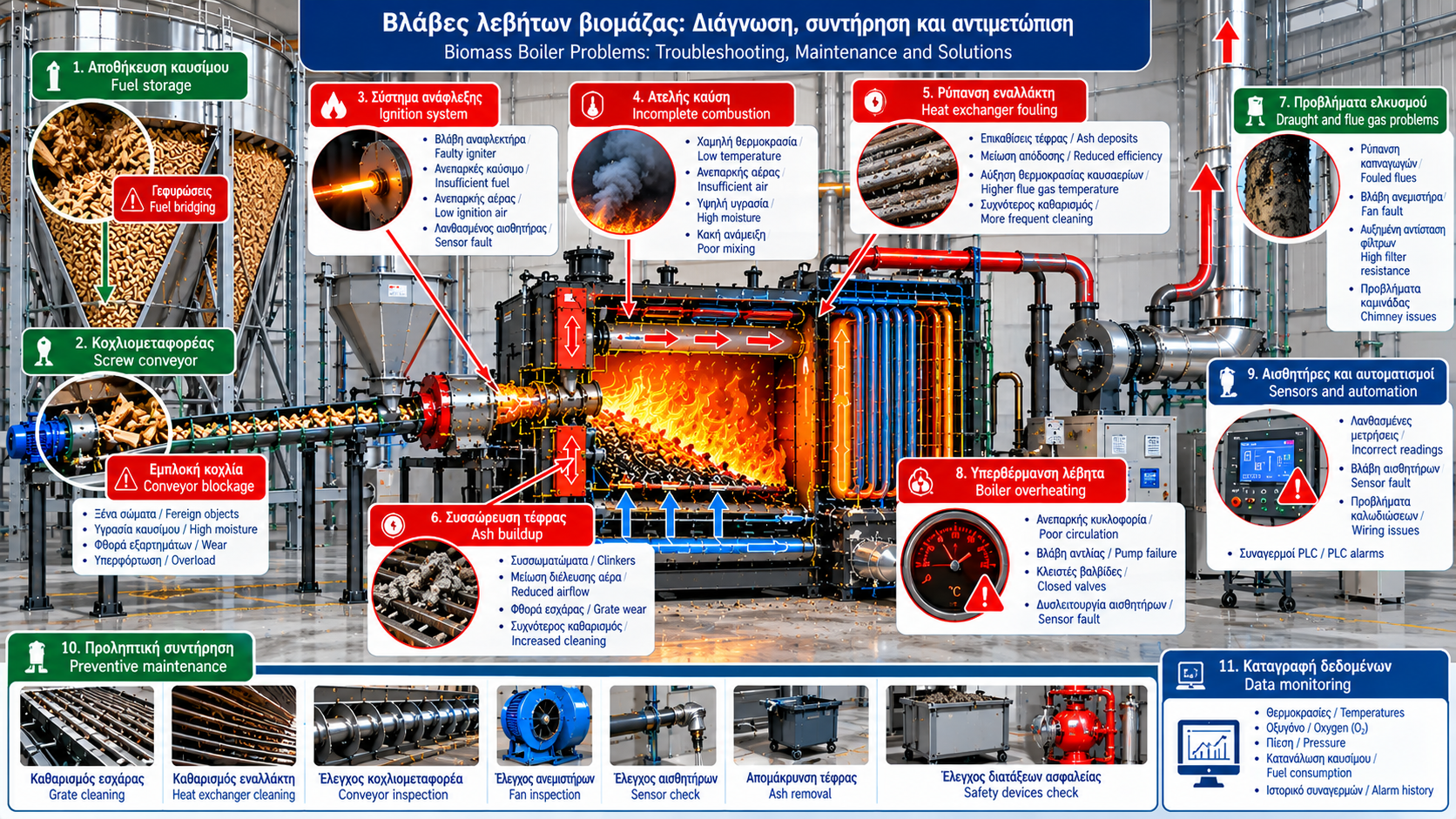
Biomass Boiler Problems: Troubleshooting, Maintenance and Solutions
Industrial biomass boilers combine mechanical fuel feeding, combustion equipment, heat exchangers, fans and automation systems.
Their reliability depends on fuel quality, operating conditions and preventive maintenance. Even relatively small deviations in fuel delivery or combustion air can affect thermal efficiency, emissions and plant availability.
Effective troubleshooting requires identifying symptoms, investigating potential causes and carrying out safe technical inspections without bypassing protective systems.
1. Ignition Problems
Ignition failure is a common problem in automatically started biomass boilers.
Possible causes include insufficient fuel delivery, faulty electrical igniters, excessive fuel moisture, conveyor blockages and inadequate ignition air.
Incorrect flame detection or temperature measurements may also prevent successful startup.
Troubleshooting should begin with the alarm history and verification of the prescribed startup sequence.
Repeated restart attempts without identifying the cause should be avoided.
2. Incomplete Combustion and Excessive Smoke
Incomplete combustion may increase carbon monoxide, organic compounds and particulate emissions.
Typical causes include insufficient combustion air, poor mixing, low combustion temperature and unsuitable fuel moisture.
Diagnosis requires evaluating operating measurements and, where appropriate, using a suitable flue gas analyzer.
Oxygen concentration, carbon monoxide, flue gas temperature and furnace pressure can provide valuable information.
Increasing combustion air without a proper assessment is not always the correct solution.
3. Screw Conveyor Blockages and Feeding Problems
Unstable fuel feeding can cause fluctuations in thermal output and combustion temperature.
Potential causes include oversized fuel particles, foreign objects, moisture-related agglomeration, worn conveyor components and motor or gearbox problems.
Fuel bridging in storage bunkers can also interrupt supply.
Inspection should include actual fuel delivery, motor overload indications and the mechanical condition of the conveying equipment.
Safe energy isolation is required before intervention.
4. Ash Accumulation and Deposits
Ash is a normal by-product of solid biomass combustion.
Its quantity and behavior depend on fuel composition, mineral content and combustion conditions.
Under certain conditions, ash can form hard deposits or agglomerates on grates and hot surfaces.
These deposits may restrict airflow, reduce heat transfer and increase cleaning requirements.
Fuel quality control, suitable combustion conditions and scheduled cleaning help manage these problems.
5. Heat Exchanger Fouling
Ash and particulate deposits on heat transfer surfaces increase thermal resistance.
This can reduce heat transfer from combustion gases to the boiler water or other heat transfer medium.
An increase in flue gas outlet temperature under comparable operating conditions may indicate fouling.
However, flue gas temperature alone is not sufficient for a definitive diagnosis.
Load, excess air, fuel properties and heat exchanger condition must also be considered.
6. Boiler Overheating
Overheating is a serious condition requiring the prescribed protective response.
Possible causes include insufficient water circulation, pump failure, closed valves, sensor malfunction and inadequate removal of residual heat.
Unlike many liquid- or gas-fired systems, heat production in a solid-fuel boiler may continue after fuel feeding stops because burning material remains in the furnace.
Appropriate thermal protection devices and safe shutdown sequences are therefore essential.
Safety devices must never be bypassed to maintain operation.
7. Draught and Flue Gas Problems
Insufficient draught may cause combustion instability, increased emissions or protective shutdowns.
Potential causes include fouled flue gas passages, induced-draught fan faults, increased filter resistance and unsuitable furnace pressure control.
Diagnosis includes pressure measurements, fan inspection and assessment of the exhaust gas system.
All inspections must follow the plant’s safety procedures.
8. Sensor and Automation Faults
Modern biomass boilers use temperature, pressure, oxygen and equipment-status sensors.
Incorrect measurements can lead to poor combustion control or unnecessary shutdowns.
Troubleshooting may involve checking wiring, instrument power supplies, PLC diagnostics and comparison with independent reliable measurements.
Replacing a sensor without confirming the root cause may not resolve the problem.
9. Preventive Maintenance
An effective maintenance program should reflect boiler design, fuel characteristics, operating hours and manufacturer instructions.
Routine checks include alarm monitoring, fuel feeding performance, ash removal and combustion stability.
Scheduled shutdowns allow cleaning, mechanical inspection and instrumentation checks.
Critical safety functions, including overheating and backfire protection, must be tested according to approved procedures.
10. Operational Data and Early Fault Detection
Recording operating data helps identify gradual changes in equipment performance.
Useful parameters include supply and return temperatures, flue gas temperature, oxygen concentration, furnace pressure, fan operating conditions, fuel feeding duration and alarm frequency.
Fuel consumption and useful heat output are also valuable when reliable measurements are available.
Comparing data under similar load and fuel conditions can reveal deterioration before a major failure develops.
Conclusion
Effective biomass boiler troubleshooting requires more than replacing defective components.
It combines combustion engineering, mechanical inspection, operational data analysis and automation diagnostics.
Suitable fuel quality, preventive maintenance and reliable protective systems contribute to thermal efficiency and long-term plant reliability.
Safety note: Inspection, troubleshooting and maintenance must be carried out by appropriately trained personnel in accordance with manufacturer instructions and applicable safety requirements.