
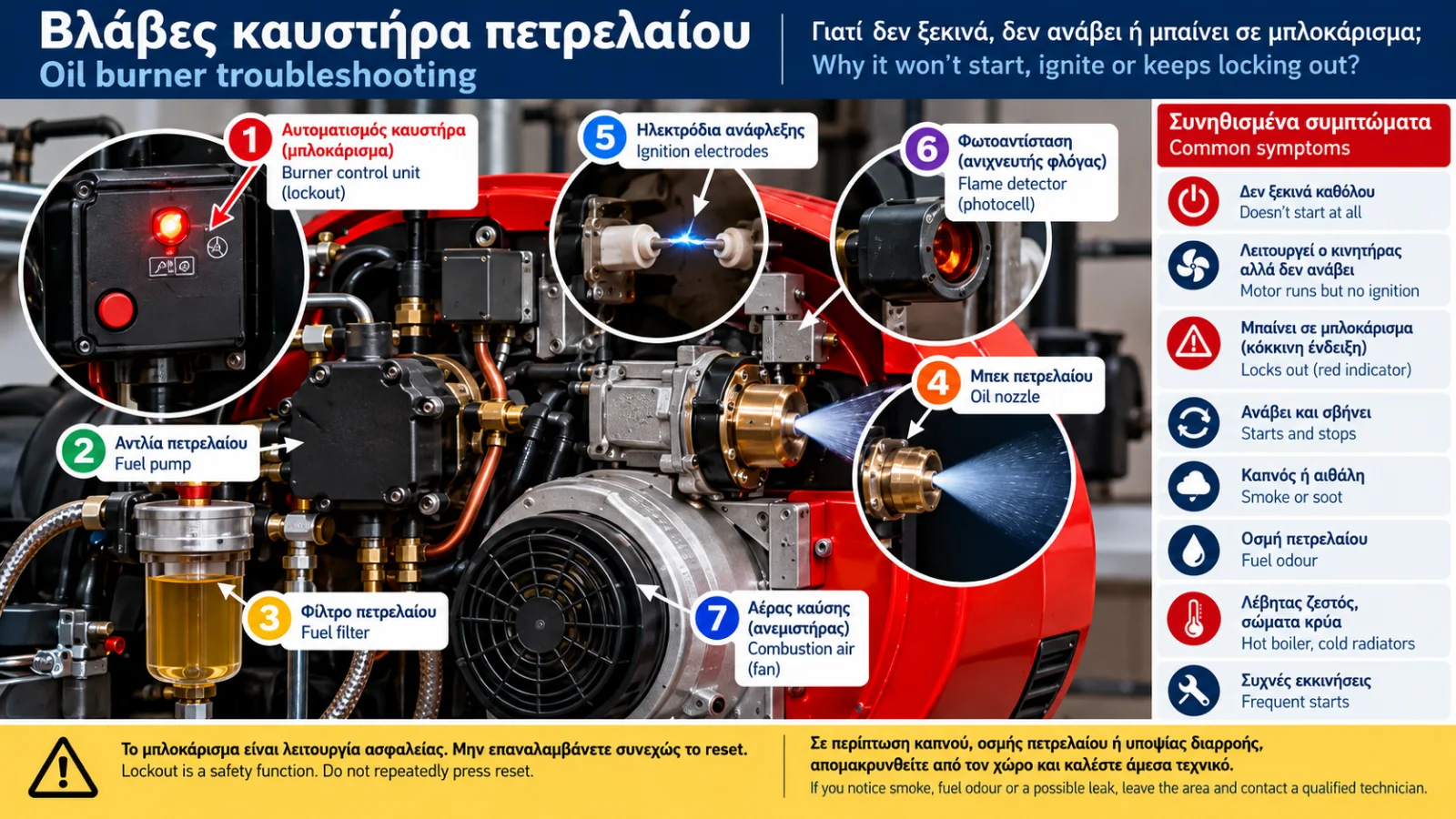
Oil Burner Troubleshooting: Why It Won't Start, Ignite or Keeps Locking Out
An oil burner is one of the most important components of an oil-fired heating installation. When a fault occurs, the boiler may stop producing heat, operate inconsistently or activate its safety shutdown system.
One of the most common symptoms is burner lockout, a safety condition in which the burner controller stops operation because the required safe operating conditions have not been confirmed.
However, a burner that does not start is not necessarily defective. The problem may originate from the thermostat, boiler controller, electrical supply or another heating-system protection device.
This Thermosphere.gr technical guide examines common oil burner faults, their symptoms and the principles of professional diagnosis.
Important: This article is intended for technical understanding. It does not provide instructions for unqualified work on fuel systems, high-voltage circuits or safety devices.
1. Common Signs of an Oil Burner Problem
Oil burner faults can appear in several ways.
Typical symptoms include:
The burner does not start.
The motor runs, but no flame is established.
The burner starts and stops shortly afterwards.
A red indicator or fault code appears.
Repeated startup attempts occur.
The flame is unstable.
Smoke or soot is present.
Unusual noises occur.
Fuel or flue gas odours are noticeable.
Each symptom can have multiple causes.
Diagnosis should therefore be based on the actual operating sequence and measurements relevant to the specific equipment.
2. Why Won't the Oil Burner Start?
When the burner shows no sign of starting, the first question is whether it is receiving a valid request for heat.
Possible causes include:
No heating demand from the thermostat.
The boiler has reached its temperature limit.
A safety thermostat or another protective device has activated.
Electrical power is unavailable.
A fault exists in the heating control panel.
The burner control is already in a fault state.
A motor or electrical component has failed.
It is important to distinguish the absence of heating demand from an actual malfunction.
For example, shutdown after the boiler reaches its target water temperature may be entirely normal.
3. Why Does the Motor Run Without Ignition?
A different symptom occurs when the burner motor or fan operates, but no flame develops.
Possible causes include:
Insufficient fuel supply.
Air entering the fuel circuit.
A blocked fuel filter.
Fuel pump problems.
Solenoid valve malfunction.
An unsuitable or blocked nozzle.
Ignition system failure.
Incorrect fuel-air conditions.
Motor noise alone does not prove that the nozzle is receiving the required fuel flow or that the ignition system is producing a spark.
Distinguishing these possibilities requires professional testing.
4. What Does Burner Lockout Mean?
Lockout is a designed safety function.
The burner control supervises specific stages of startup and normal operation.
If the expected condition is not confirmed, it may stop fuel delivery and enter lockout.
Depending on the controller, possible causes include:
Failure to ignite.
Failure to detect flame within the permitted safety period.
Flame loss during operation.
An unexpected flame signal.
A monitored component or operating-sequence fault.
Safety timing and diagnostic codes vary between manufacturers.
A red indicator does not, by itself, identify the defective component.
5. Understanding the Burner Reset Button
Many burners have a reset button on the safety control.
Resetting allows the controller to leave certain lockout states according to the manufacturer's instructions.
It does not repair the underlying fault.
Repeated startup attempts without diagnosis can be dangerous, particularly when ignition repeatedly fails.
Some manufacturers permit a defined user reset procedure, while others require professional intervention in particular fault conditions.
Only the instructions for the exact model should be followed.
If lockout returns, further attempts should stop and the burner should be professionally inspected.
6. Photocell or Flame Detector Problems
The flame detector provides information about flame presence to the burner controller.
Many oil burners use a photocell or light-dependent resistor, while others use different detection technologies.
Possible problems include:
Contamination of the sensing surface.
Incorrect positioning.
Component deterioration.
Wiring faults.
Poor optical access to the flame.
An unstable or unsuitable flame.
One symptom may be shutdown even though a flame has appeared.
However, the same symptom can also result from genuine combustion instability.
Diagnosis must follow the specifications of the flame detector and burner controller.
Bypassing the flame detector is not an acceptable repair or operating method.
7. Fuel Pump Problems
The fuel pump supplies oil to the nozzle at the required pressure.
Potential problems include:
Insufficient fuel delivery.
Incorrect pressure.
Internal wear.
Suction-side problems.
Air entering the fuel circuit.
Contamination or supply restrictions.
Some symptoms may resemble nozzle or ignition faults.
Diagnosis requires assessment of the fuel supply and appropriate measurements.
Arbitrarily changing pump pressure is not a safe solution.
8. Blocked Oil Filter
The fuel filter helps prevent contaminants from reaching the pump and nozzle.
Over time, it may collect:
Tank sediment.
Dirt and particles.
Other contaminants restricting fuel flow.
A blocked filter may cause fuel starvation and unstable burner operation.
Filter replacement or servicing must use appropriate procedures to prevent leakage and air entry.
9. Air in the Fuel Supply System
Air entering the fuel circuit may affect pump operation and fuel delivery.
Possible causes include:
Leaking suction-side connections.
Low fuel level.
Recent work on fuel lines.
Unsuitable pipework arrangements.
Filter or supply component problems.
Air entering a suction line does not necessarily produce a visible external oil leak.
Restoring system integrity and bleeding the fuel circuit should be performed by a qualified technician.
10. Oil Nozzle Problems
The nozzle determines important characteristics of fuel atomisation.
Possible faults include:
Partial or complete blockage.
Wear.
Incorrect flow rating.
Unsuitable spray angle.
Incompatible spray pattern.
Contamination affecting spray quality.
These conditions may affect ignition, flame stability and combustion quality.
Replacing a nozzle with a merely similar-looking component does not guarantee compatibility.
The correct specifications must be confirmed, and combustion performance verified after servicing.
11. Ignition Electrode and Transformer Faults
The ignition system creates the spark required to ignite the atomised fuel.
Potential faults include:
Worn electrodes.
Incorrect electrode position or spacing.
Insulation damage.
Ignition transformer or electronic igniter failure.
Wiring problems.
Control-command faults.
High-voltage ignition circuits make testing hazardous.
Improvised spark tests and unqualified intervention should be avoided.
12. The Burner Ignites and Stops After a Few Seconds
This symptom requires careful interpretation.
If the burner enters lockout shortly after ignition, possible causes include:
Actual flame loss.
Insufficient flame detector signal.
Unstable fuel delivery.
Atomisation problems.
Abnormal combustion-air conditions.
Burner controller faults.
If the burner stops without a fault indication, heating demand may have ended or a normal operating limit may have been reached.
The fault indication and precise operating sequence help guide professional diagnosis.
13. The Burner Runs but Radiators Stay Cold
A lack of heating is not always caused by the burner.
If the burner operates and the boiler reaches temperature, the problem may involve water circulation.
Possible causes include:
A circulation pump that is not operating.
Closed valves.
Heating zone-control faults.
Zone valves that do not open.
Air in the heating circuit.
Distribution or temperature-control problems.
Distinguishing heat generation from heat distribution is an essential diagnostic principle.
14. Frequent Burner Cycling
Frequent starts are not necessarily evidence of a burner defect.
They may be associated with:
Oversizing.
Low actual heating demand.
Temperature-control settings.
Restricted water circulation.
System thermal behaviour.
Poor matching between burner and boiler.
Normal ON/OFF cycling must be distinguished from ignition failure and lockout.
Assessment should consider the complete heating system.
15. Smoke, Soot and Unusual Odours
Smoke or heavy soot may indicate incomplete combustion.
Possible causes include:
Insufficient combustion air.
Poor fuel atomisation.
Unsuitable firing rate.
Contaminated combustion chamber.
Flue gas evacuation problems.
Fuel odours may indicate leakage or fuel supply issues.
Flue gas odours indoors require particular attention.
If smoke enters the building, fuel leakage is suspected or carbon monoxide exposure may be occurring, leave the hazardous area and seek appropriate emergency assistance. Do not attempt to restart the burner.
16. Symptom and Possible Cause Table
Symptom | Possible causes |
|---|---|
Burner does not start | Thermostat, power supply, boiler limit, controller |
Motor runs without flame | Fuel supply, pump, nozzle, ignition |
Red indicator or lockout | Ignition failure, flame loss or another safety fault |
Ignites then locks out | Flame detection, unstable combustion, fuel delivery |
Frequent normal starts | Temperature control, oversizing, low load |
Smoke or soot | Combustion, atomisation or airflow problems |
Fuel odour | Possible leakage or fuel supply problem |
Hot boiler, cold radiators | Pump, valves, zoning or hydraulic circuit |
This table identifies possible diagnostic directions, not definitive causes.
17. What Can the Property Owner Check Safely?
Without opening the burner or interfering with electrical or mechanical components, an owner may observe:
Whether the thermostat is requesting heat.
Whether a fault indicator is displayed.
Whether the boiler shows a normal or unusual temperature.
Whether fuel appears to be available according to the tank indicator.
Whether unusual noises are present.
Whether there is smoke, odour or visible leakage.
When the fault occurs: before ignition, immediately afterwards or during normal operation.
Recording the exact burner model and fault code can help the service technician.
Electrical covers should not be opened, fuel lines should not be disconnected and safety devices must not be bypassed.
18. How Is Professional Diagnosis Performed?
Diagnosis must follow the specifications and actual operating sequence of the burner.
At a general level, the technician assesses:
Heating demand and operating limits.
Burner controller indicators and diagnostic codes.
Electrical supply and relevant control commands.
Fuel supply system condition.
Ignition and flame detection.
Nozzle condition and compatibility.
Combustion performance using appropriate measurements.
Safe operation following corrective work.
Replacing components without confirming the cause can increase costs without solving the problem.
19. Frequently Asked Questions
Why Is There a Red Light on My Oil Burner?
It often indicates lockout, but its precise meaning depends on the controller and fault indication.
How Many Times Can I Press Reset?
Follow only the manufacturer's instructions. If the fault returns, stop attempting resets and contact a qualified technician.
Could the Photocell Be Faulty?
Yes, although similar symptoms may also result from unstable combustion or other faults.
Could the Oil Filter Be Blocked?
Yes. A blocked filter may restrict fuel delivery.
Why Can I Hear the Burner but It Does Not Ignite?
Possible causes include fuel supply, pump, nozzle and ignition problems.
Why Does the Burner Start and Stop Quickly?
It may be a normal control shutdown or a fault. The presence of lockout and the precise timing are important.
Is It Safe to Keep Using a Burner That Produces Smoke?
No. Smoke or flue gas entering occupied areas requires immediate attention and professional assessment before operation resumes.
Conclusion
Oil burner faults may originate from electrical supply, heating controls, fuel delivery, ignition, flame detection or combustion conditions.
Lockout is a safety function and must not be treated as a minor inconvenience solved by repeated resets.
Correct diagnosis requires understanding the operating sequence, identifying the actual symptom and performing suitable technical tests.
The safest and most effective response to recurring burner faults is professional identification of the underlying cause, not arbitrary component replacement or bypassing safety devices.
Technical References and Further Reading
EN 267: Automatic forced draught burners for liquid fuels.
EN 230: Automatic burner control systems for oil burners.
EN 298: Automatic burner control systems for burners and appliances burning gaseous or liquid fuels.
Riello: Official burner manuals and fault tables — https://www.riello.com/
Baltur: Installation and troubleshooting documentation — https://www.baltur.com/
Danfoss: Oil pump and fuel component documentation — https://www.danfoss.com/
Siemens: Burner control system documentation — https://www.siemens.com/
These references provide general technical background. Diagnosis of a real fault requires the manual for the exact equipment and assessment of the installation.
Safety note: Work on fuel systems, high-voltage ignition circuits and safety controls requires appropriately qualified personnel. If smoke, fuel leakage or suspected CO exposure occurs, prioritise leaving the hazardous area and seeking immediate assistance.
Thermosphere.gr — Technical knowledge for heating and building systems.