
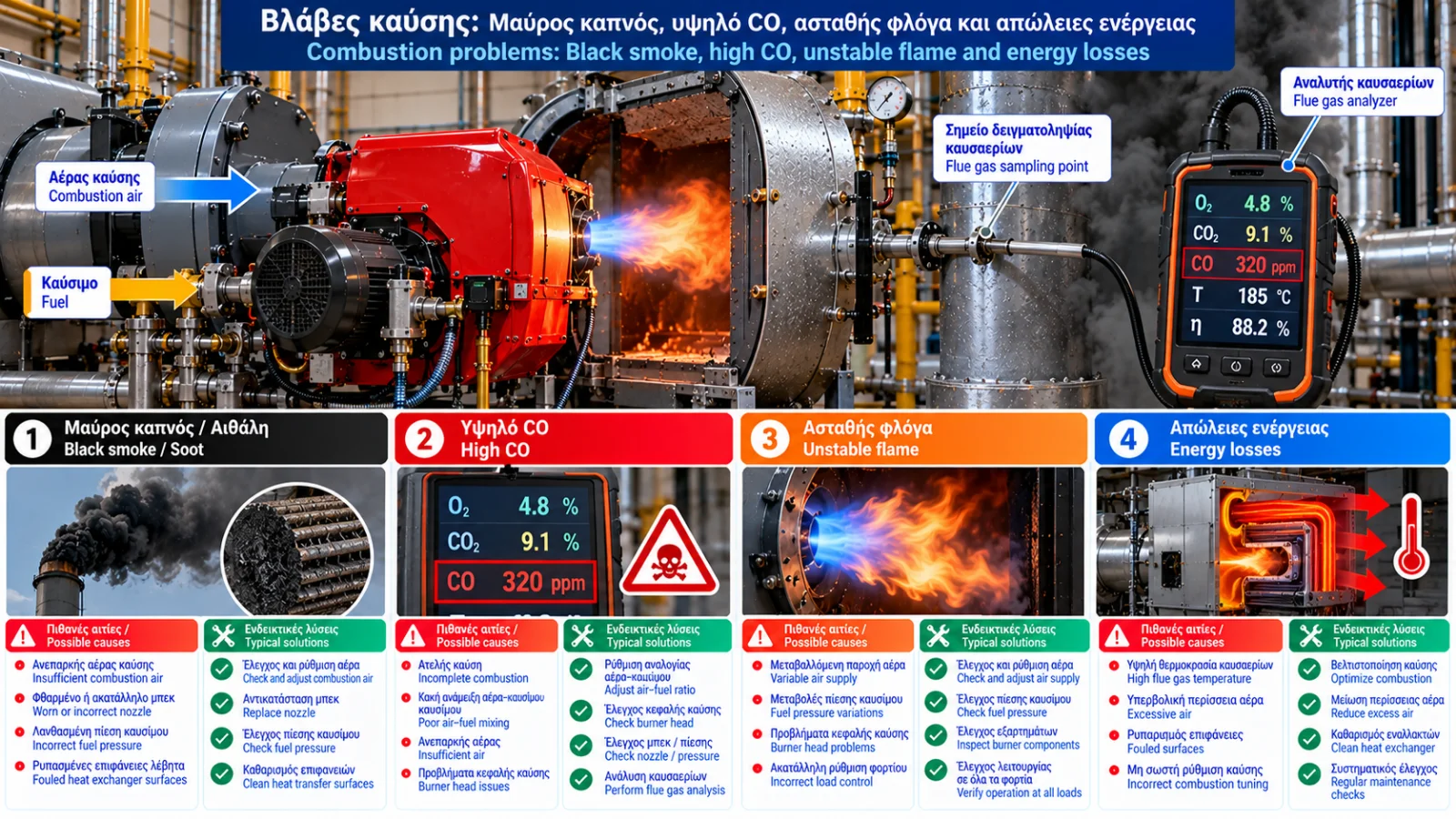
Combustion Problems: Black Smoke, High CO, Unstable Flames and Energy Losses
Combustion faults in oil and natural gas boilers and burners can significantly affect safety, reliability and energy efficiency.
Black smoke, elevated carbon monoxide (CO), unstable flames, ignition failures and high flue gas temperatures are important symptoms that require systematic technical investigation.
Effective troubleshooting is not based on visual observation alone. It combines inspection, reliable measurements and comparison with manufacturer specifications.
1. Common Combustion Problems
Typical combustion problems include:
Black smoke and soot formation.
Elevated CO in flue gases.
Unstable or pulsating flames.
Ignition failure.
Repeated burner lockouts.
Loss of flame supervision signal.
Excessive combustion air.
High flue gas temperature.
Reduced energy efficiency.
Unusual noise or vibration.
Each symptom may have several possible causes. Replacing components without identifying the underlying problem may not resolve the fault.
2. Black Smoke from an Oil Burner
Black smoke is mainly associated with soot particles formed when combustion is incomplete.
Possible causes include:
Insufficient combustion air.
Incorrect or worn oil nozzle.
Poor fuel atomization.
Unsuitable oil pump pressure.
Burner head problems.
Fouled combustion fan or restricted air inlet.
Unfavorable combustion chamber conditions.
Soot is not only an emissions issue. Deposits on heat transfer surfaces can reduce heat transfer and increase flue gas temperature.
Significant black smoke requires prompt safety assessment rather than an unverified increase in combustion air.
3. Why Does Soot Form?
Soot forms when fuel carbon is not fully oxidized during combustion.
In liquid fuel burners, atomization quality influences evaporation, mixing and combustion completion.
Large or uneven droplets can create locally fuel-rich regions.
Similarly, poor air distribution can cause incomplete combustion even when the total supplied air appears adequate.
Diagnosis must therefore consider both fuel and air quantity and distribution.
4. High Carbon Monoxide
Carbon monoxide is a toxic gas and a major indicator of incomplete combustion.
Elevated CO can result from:
Insufficient combustion air.
Poor air–fuel mixing.
Unstable flame.
Burner head problems.
Unfavorable temperature conditions.
Unsuitable low-load operation.
Flue gas discharge problems.
High CO does not always mean that simply increasing airflow will solve the problem.
A burner can produce elevated CO even with relatively high measured O₂ if mixing or flame stability is poor.
If flue gas leakage into an occupied area is suspected or a CO alarm activates, treat the installation as potentially hazardous. Follow safe shutdown procedures and contact qualified personnel or emergency services as appropriate.
5. Interpreting O₂ and CO Together
Combined O₂ and CO measurements provide valuable diagnostic information.
Observation | Possible Interpretation |
|---|---|
Low O₂ and high CO | Insufficient air or poor mixing |
High O₂ and high CO | Poor mixing, flame instability or flue air infiltration |
High O₂ and low CO | Potentially excessive combustion air |
Variable O₂ and CO | Load changes, combustion instability or sampling errors |
These observations support initial investigation but do not prove a specific fault.
6. Unstable Flame: Possible Causes
Flame instability may appear as fluctuations in flame shape, intensity or position.
Possible causes include:
Variable fuel pressure.
Unstable airflow.
Incorrect air–fuel ratio.
Burner head problems.
Combustion chamber pressure fluctuations.
Load control malfunctions.
Fuel supply or atomization problems.
In some cases, instability results from interactions between flame behavior, flow and combustion chamber acoustics.
Assessment requires an understanding of the specific burner and boiler design.
7. Combustion Pulsation and Unusual Noise
Pulsation, humming or severe vibration can indicate combustion stability problems.
Potential causes include:
Unstable air–fuel ratio.
Combustion chamber pressure fluctuations.
Flame–acoustic interactions.
Unsuitable operation at a particular load.
Mechanical component problems.
Not every unusual noise comes from the fan or motor.
Distinguishing mechanical vibration from combustion instability is essential for correct diagnosis.
8. Burner Ignition Failure
Ignition failure may result from problems with the ignition system, fuel supply or required startup safety conditions.
Possible causes include:
Ignition electrode problems.
Ignition transformer or unit failure.
Unsuitable fuel supply.
Solenoid valve problems.
Unmet safety interlock conditions.
Burner control unit faults.
Unsuitable combustion air conditions.
Repeated restart attempts without investigating the cause can be hazardous.
The technician should first assess the fault code and manufacturer-defined operating sequence.
9. Repeated Burner Lockouts
Burner lockout is usually a protective response to an unacceptable operating condition.
Possible causes include:
Ignition failure.
Flame loss.
Unacceptable gas pressure.
Failed airflow proving.
Flame sensor problems.
Valve proving failure.
Other safety device activation.
Repeatedly resetting the control unit without diagnosis is not a maintenance procedure.
Protective devices must never be bypassed or bridged.
10. Flame Detection Problems
Depending on burner design, flame supervision may use a photocell, ionization electrode or another suitable detector.
Potential causes of unreliable supervision include:
Sensor contamination.
Damaged cables.
Incorrect sensor position.
Electrical connection problems.
Actual flame instability.
Control unit failure.
Diagnosis must distinguish real flame loss from loss of the flame detection signal.
11. High Flue Gas Temperature
Elevated flue gas temperature can be associated with increased sensible stack losses.
Possible causes include:
Fouled heat exchanger surfaces.
Soot deposits.
Excess combustion air.
High firing rate.
Reduced heat transfer effectiveness.
Boiler operating characteristics.
Comparisons should be made under similar firing rate, heating medium temperature and combustion air conditions.
One elevated reading does not necessarily prove a fault.
12. How Soot Increases Fuel Consumption
Soot adds thermal resistance to heat transfer surfaces.
This can reduce the amount of heat transferred to water or another heating medium.
As a result, more energy may leave with the flue gases.
When the installation must deliver a particular heat output, deteriorated heat transfer can lead to increased fuel consumption.
The actual impact depends on deposit thickness and boiler design.
No single fuel penalty percentage applies to every installation.
13. Excessive Combustion Air
Excess combustion air may not produce an obvious visual flame defect, but it can increase flue gas losses.
Potential causes include:
Incorrect air damper setting.
Air–fuel ratio control problems.
Servomotor deviations.
Changes in fuel pressure or flow.
False oxygen readings caused by air infiltration.
Excess air should only be reduced while monitoring CO, flame stability and all relevant safety requirements.
14. Oil Fuel Supply Problems
Oil supply problems can affect atomization and flame stability.
Possible causes include:
Blocked fuel filter.
Air in the fuel line.
Suction problems.
Pump wear.
Unsuitable fuel pressure.
Pipe restrictions or leaks.
Incorrect nozzle.
Diagnosis must use the specified pressure measurements and manufacturer procedures.
15. Natural Gas Supply Problems
Gas burner operation depends on the gas supply system and gas train.
Potential problems include:
Insufficient inlet pressure.
Pressure fluctuations during operation.
Blocked gas filter.
Pressure regulator malfunction.
Valve problems.
Pressure switch activation.
Valve proving system failure.
Fuel supply and safety function verification must be performed by appropriately qualified personnel.
16. Combustion Fault Diagnosis Table
Symptom | Possible Causes | Recommended Investigation |
|---|---|---|
Black smoke | Soot, poor atomization, insufficient air | Check combustion, nozzle, airflow and surfaces |
High CO | Incomplete combustion, poor mixing | Verify readings and combustion conditions |
Unstable flame | Variable fuel or air supply | Check supply stability and operating behavior |
Ignition failure | Ignition system or interlock problems | Review startup sequence and fault code |
Frequent lockout | Safety system activation | Diagnose before resetting |
High flue gas temperature | Fouling, load or heat losses | Compare historical data at equivalent load |
High O₂ | Excess air or air infiltration | Check sampling and air control system |
Increased fuel consumption | Tuning, losses or load changes | Compare energy performance under equivalent conditions |
This table supports initial assessment and does not replace equipment-specific technical inspection.
17. A Structured Troubleshooting Process
A reliable troubleshooting procedure includes:
Step 1 — Identify the symptom
Record the fault, frequency and operating conditions.
Step 2 — Assess safety
Determine whether the installation can remain in operation or requires safe shutdown.
Step 3 — Review history
Examine previous faults, maintenance records, measurements and component changes.
Step 4 — Verify measurements
Check analyzer reliability, sensors and sampling locations.
Step 5 — Inspect relevant systems
Assess air supply, fuel supply, ignition, flame supervision and flue gas discharge.
Step 6 — Implement corrective actions
Perform appropriate work according to equipment specifications.
Step 7 — Verify operation
Confirm safe and stable operation using documented measurements.
18. Identifying Energy Losses
Energy performance should be assessed using comparable operating data.
Useful parameters include:
Fuel consumption.
Useful heat output, where measured.
Burner firing rate.
O₂ and CO.
Flue gas temperature.
Combustion air temperature.
Operating hours.
Startup and shutdown frequency.
Fuel bills alone are not sufficient for diagnosis because consumption also depends on heat demand and ambient conditions.
19. Preventive Maintenance and Fault History
Preventive maintenance can reduce the recurrence of combustion faults.
A useful maintenance history includes:
Fault occurrence date.
Error code.
Burner load.
Flue gas readings.
Fuel pressure readings.
Components inspected.
Work performed.
Final verification results.
Systematic records help identify recurring patterns and improve maintenance planning.
20. Relevant Standards
Depending on the equipment, relevant references include:
EN 267: Automatic forced draught burners for liquid fuels.
EN 676: Automatic forced draught burners for gaseous fuels.
EN 298: Automatic burner control systems.
EN 50379: Portable electrical apparatus for measuring combustion flue gas parameters of heating appliances.
EN 161: Automatic shut-off valves for gas burners and appliances.
Applicable editions, standard scope and manufacturer requirements must be verified for each installation.
Conclusion
Black smoke, elevated CO, unstable flames and increased energy losses are important indicators of combustion system problems.
Effective troubleshooting combines visual inspection, measurements, fuel supply assessment, combustion air evaluation and verification of protective systems.
Correct diagnosis must precede adjustments or component replacement.
All interventions must be performed by appropriately qualified personnel according to manufacturer instructions and applicable safety requirements.