
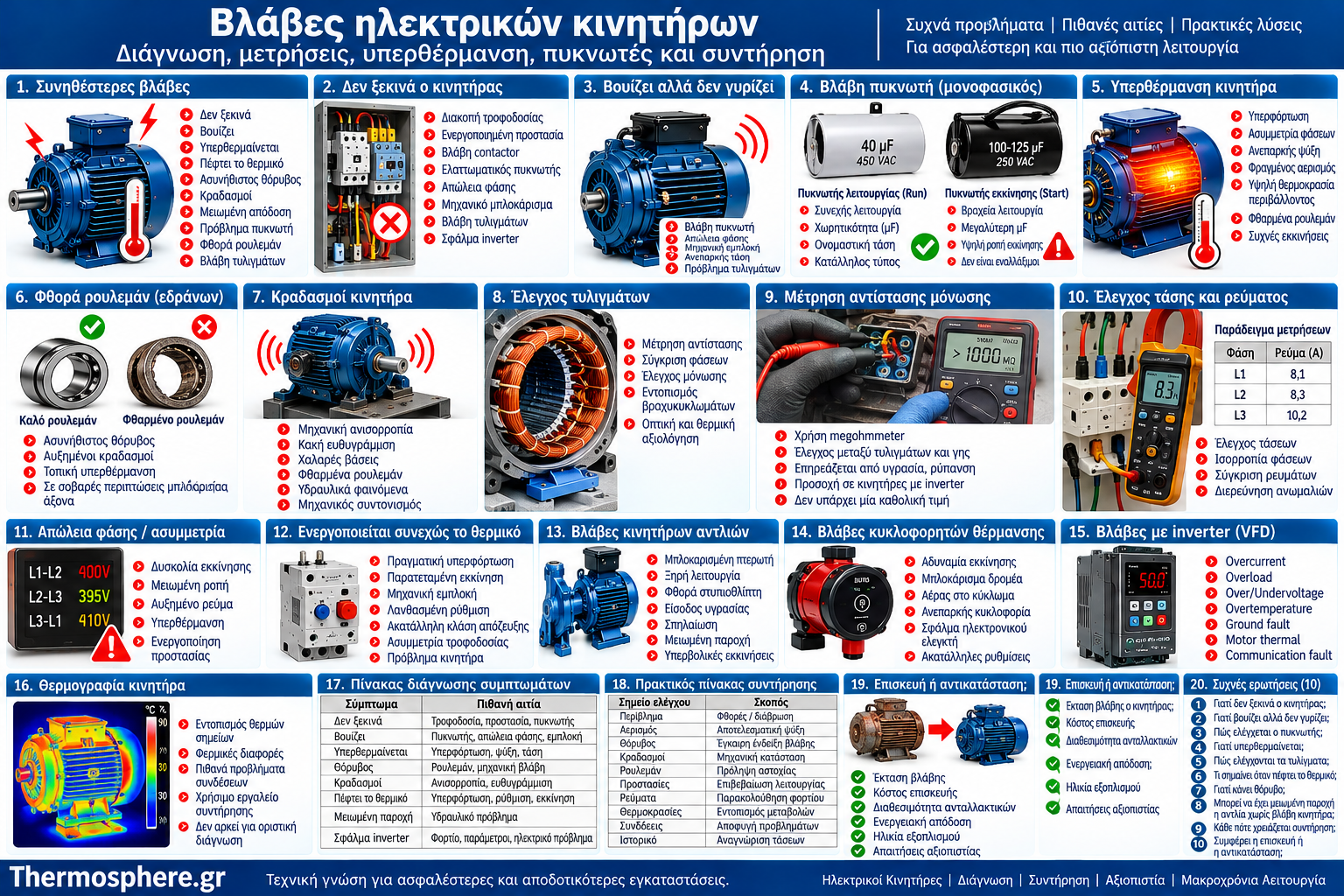
Electric Motor Faults: Complete Guide to Troubleshooting, Testing, Overheating, Capacitors and Maintenance
Electric motors are essential components in water supply systems, heating installations, booster pump sets, circulators and industrial applications. Although designed for reliable, long-term operation, they can develop electrical, mechanical and thermal faults.
A motor that fails to start, produces a humming noise, overheats, vibrates excessively or repeatedly trips its overload protection does not necessarily need replacement. The underlying cause must first be identified.
The problem may originate in the motor itself, the electrical supply, a capacitor, the bearings, the mechanical load or the control equipment.
This guide examines the most common electric motor faults, their characteristic symptoms, professional diagnostic methods and essential preventive maintenance practices.
1. What Are the Most Common Electric Motor Faults?
Motor faults can be divided into three main categories.
Electrical faults
Loss of electrical supply.
Phase failure.
Capacitor failure.
Insulation deterioration.
Winding short circuits.
Poor electrical connections.
Voltage imbalance.
Mechanical faults
Bearing wear.
Shaft blockage.
Misalignment.
Excessive vibration.
Coupling deterioration.
Pump impeller obstruction.
Thermal and operational faults
Prolonged overload.
Insufficient cooling.
High ambient temperature.
Excessively frequent starts.
Operation under unsuitable load conditions.
Correct troubleshooting begins with identifying the symptoms rather than randomly replacing components.
2. The Electric Motor Does Not Start
Failure to start is one of the most common motor problems.
Possible causes
Loss of electrical power.
Activated protective device.
Faulty contactor.
Control circuit malfunction.
Defective capacitor in a single-phase motor.
Phase loss in a three-phase motor.
Mechanical blockage.
Damaged windings.
Inverter or electronic controller fault.
How is the problem diagnosed?
A qualified technician evaluates:
The fault history.
Electrical panel indications.
Protection device status.
Motor supply conditions.
Mechanical load.
The presence of voltage at the electrical panel does not prove that the motor is receiving the correct supply.
Important: Repeatedly attempting to start a mechanically blocked motor may cause severe overheating.
3. The Motor Hums but Does Not Rotate
A humming sound without rotation is a characteristic symptom, but it does not always indicate the same fault.
Single-phase motors
Possible causes include:
Capacitor failure.
Auxiliary winding problems.
Insufficient supply voltage.
Mechanical obstruction.
Three-phase motors
Possible causes include:
Phase loss.
Significant voltage drop.
Locked rotor.
Incorrect electrical connections.
Why is this dangerous?
When a motor is energized but cannot rotate, it may draw very high current.
This can rapidly increase winding temperature.
The shaft must never be turned manually while unintended electrical energization remains possible.
4. Single-Phase Motor Capacitor Failure
Many single-phase induction motors use a capacitor to create an appropriate phase displacement in the auxiliary winding.
Common symptoms
Difficulty starting.
Humming without rotation.
Reduced starting torque.
Overheating.
Protective device tripping.
Starting capacitor
A starting capacitor is used in certain motor circuits for a limited period during startup.
Running capacitor
A running capacitor remains connected during normal operation, according to the motor’s design.
The two types are not automatically interchangeable.
What should be checked?
Capacitance in microfarads (µF).
Rated voltage.
Capacitor type.
Physical condition.
Compatibility with the motor.
Warning: Capacitors can retain dangerous electrical charge after disconnection. Inspection and replacement require appropriate safety procedures.
5. Why Does an Electric Motor Overheat?
Overheating occurs when heat generation exceeds the motor’s ability to dissipate heat safely.
Common causes
Overloading.
Phase imbalance.
Insufficient cooling.
Blocked ventilation passages.
High ambient temperature.
Worn bearings.
Frequent starting.
Unsuitable supply conditions.
Housing temperature vs winding temperature
The external housing temperature is not the same as the winding temperature.
Assessment must consider manufacturer limits, insulation class and actual operating conditions.
A warm motor housing does not automatically indicate a fault, while internal overheating may occur without immediately obvious external signs.
6. How Does Current Affect Motor Temperature?
Copper losses in motor windings can be approximated using:
Pcu = I² × R
Where:
Pcu = copper losses.
I = current.
R = winding resistance.
Example
If current increases from 10 A to 12 A, assuming constant resistance:
P₂ / P₁ = (12 / 10)² = 1.44
Copper losses theoretically increase by 44%.
This does not mean motor temperature rises by the same percentage, because temperature also depends on cooling conditions and thermal inertia.
7. Motor Bearing Failures
Bearings support the motor shaft and allow smooth rotation.
Symptoms of bearing deterioration
Unusual noise.
Increased vibration.
Localized overheating.
Changes in mechanical behavior.
Shaft seizure in severe cases.
Possible causes
Normal wear.
Insufficient or unsuitable lubrication.
Moisture ingress.
Contamination.
Misalignment.
Excessive mechanical loads.
Not all bearings require periodic relubrication. Some are sealed and are not designed for this type of maintenance.
Excessive lubrication can also cause problems.
8. Electric Motor Vibration
Vibration may originate from the motor itself or from connected equipment.
Possible causes
Mechanical imbalance.
Misalignment.
Loose mounting bolts or foundations.
Worn bearings.
Shaft deformation.
Hydraulic phenomena in pumps.
Mechanical resonance.
How is vibration evaluated?
Suitable instruments may be used to measure vibration.
Evaluation can include:
Vibration velocity.
Acceleration.
Displacement.
Frequency analysis.
There is no single vibration limit applicable to every electric motor.
Acceptable values depend on the equipment type, installation and relevant technical standards.
9. Electric Motor Winding Inspection
Motor windings are critical to motor operation.
Possible faults
Open circuits.
Turn-to-turn short circuits.
Earth faults.
Insulation deterioration.
Thermal damage.
Diagnostic methods
Depending on the equipment, testing may include:
Winding resistance measurement.
Comparison of phase resistances.
Insulation resistance testing.
Specialized winding tests.
Visual and thermal assessment.
A normal winding resistance reading does not prove that the insulation is in excellent condition.
Some turn-to-turn faults cannot be detected using an ordinary multimeter.
10. Insulation Resistance Testing
Insulation resistance testing is used to evaluate the condition of electrical insulation.
It is performed using a specialized instrument known as an insulation resistance tester or megohmmeter.
Factors affecting measurements
Moisture.
Contamination.
Temperature.
Insulation aging.
Cable condition.
Connected electronic components.
Important warning
The test applies a higher test voltage than an ordinary multimeter.
It must not be applied indiscriminately to motors with integrated electronics, inverters or sensitive sensors.
The test voltage, required isolation and acceptance criteria must be determined using the applicable instructions and standards.
11. Three-Phase Motor Voltage and Current Testing
Evaluating the electrical supply is an important part of motor troubleshooting.
Main parameters
Line-to-line voltage.
Current in each phase.
Supply frequency.
Voltage balance.
Current balance.
Operating behavior under load.
Example
Phase | Current |
L1 | 8.1 A |
L2 | 8.3 A |
L3 | 10.2 A |
The difference in current readings indicates a condition that requires investigation.
However, these measurements alone are insufficient to determine the cause.
Voltage, load, electrical connections and motor condition must also be assessed.
Measurements on energized circuits must only be performed by authorized professionals using appropriate instruments and safety procedures.
12. Phase Failure and Supply Imbalance
Loss of one phase can prevent startup or create dangerous operating conditions.
Symptoms
Difficulty starting.
Reduced torque.
Increased current in the remaining phases.
Overheating.
Protective device tripping.
Possible causes
Supply problems.
Faulty electrical contacts.
Contactor failure.
Broken conductor.
Protective device malfunction.
Troubleshooting must identify the point where the abnormal condition occurs.
Finding three phases at the panel input does not necessarily mean all three phases reach the motor correctly.
13. Why Does the Thermal Overload Relay Keep Tripping?
Repeated overload protection trips may be caused by:
Actual motor overload.
Prolonged starting.
Mechanical blockage.
Incorrect protection settings.
Unsuitable trip class.
Supply imbalance.
Motor faults.
What should be avoided?
The overload setting must not be increased arbitrarily simply to keep the motor running.
Doing so can conceal an actual fault and may cause severe winding damage.
Proper diagnosis requires comparing actual operating conditions with the motor nameplate and protection manufacturer instructions.
14. Motor Faults in Water Pumps
Pump motors are influenced by the hydraulic system’s operating conditions.
Common problems
Blocked impeller.
Dry running.
Mechanical seal deterioration.
Moisture ingress.
Excessive starting frequency.
Cavitation.
Bearing wear.
Reduced pump performance
Low water flow does not necessarily mean the motor is faulty.
Possible causes include:
Blocked filter.
Air in the hydraulic circuit.
Partially closed valve.
Worn impeller.
Incorrect rotation direction.
Unsuitable operating point.
Correct diagnosis combines electrical and hydraulic measurements.
15. Heating Circulator Faults
Heating circulators have specific operating characteristics.
Possible problems
Failure to start.
Rotor blockage.
Air trapped in the circuit.
Insufficient circulation.
Unusual noise.
Electronic controller faults.
Incorrect operating settings.
Modern electronic circulators
Many modern high-efficiency circulators include electronic controls and diagnostic indicators.
Fault codes must be interpreted according to the specific manufacturer’s manual.
Diagnostic procedures intended for conventional motors should not automatically be applied to electronically controlled circulators.
16. Electric Motor Faults with Variable Frequency Drives
When a motor operates through a variable frequency drive (VFD), troubleshooting must also include the electronic control equipment.
Common fault indications
Overcurrent.
Overload.
Overvoltage.
Undervoltage.
Overtemperature.
Ground fault.
Motor thermal protection.
Communication fault.
Possible causes
Excessive load.
Unsuitable acceleration times.
Incorrect motor parameters.
Wiring problems.
Insufficient cooling.
Mechanical blockage.
The same fault code may have different meanings depending on the VFD manufacturer.
Troubleshooting must therefore refer to the specific drive manual.
Safety warning: VFD capacitors may retain dangerous stored energy after the supply has been disconnected.
17. Common Motor Fault Troubleshooting Table
Symptom | Possible cause | Diagnostic focus |
Motor does not start | Supply, protection, control circuit | Electrical system |
Motor hums | Capacitor, phase loss, blockage | Electrical and mechanical assessment |
Motor overheats | Overload, insufficient cooling | Load and thermal condition |
Unusual noise | Bearings, mechanical faults | Mechanical inspection |
Excessive vibration | Imbalance, misalignment | Vibration assessment |
Overload relay trips | Overload, incorrect settings | Protection and current |
Reduced pump flow | Hydraulic problem | Hydraulic system |
VFD fault indication | Load, parameters, electrical fault | Fault code and drive manual |
This table provides general guidance and does not replace professional diagnosis of the actual installation.
18. Preventive Electric Motor Maintenance
Preventive maintenance helps reduce the risk of unexpected motor failures.
Main maintenance activities
Monitoring cleanliness.
Checking ventilation.
Evaluating unusual noise.
Monitoring vibration.
Inspecting mechanical condition.
Evaluating electrical protection.
Recording operating currents.
Monitoring temperature.
Comparing new measurements with historical records helps identify gradual deterioration.
Why is maintenance history important?
A single measurement may appear acceptable, but a consistent change over time can indicate developing problems.
For example, gradually increasing vibration may suggest bearing wear or deteriorating alignment.
19. Thermography and Condition Monitoring
Thermography can help identify unusual hot spots in electrical and mechanical equipment.
What can thermography reveal?
Temperature differences.
Possible overheating.
Indications of poor electrical connections.
Changes in thermal behavior.
Limitations
Thermal imaging results depend on:
Surface emissivity.
Reflections.
Ambient temperature.
Actual operating load.
Thermography is a diagnostic tool, not definitive proof of a particular fault by itself.
Condition monitoring
In important installations, temperature, vibration, current and operating-hour data can be combined.
Trend analysis supports maintenance planning based on the actual condition of the equipment.
20. Repair or Replace an Electric Motor?
The decision depends on technical and economic factors.
Important considerations
Extent of damage.
Winding condition.
Mechanical condition.
Repair cost.
Spare parts availability.
Energy efficiency.
Equipment age.
Reliability requirements.
Example
For a small motor, specialized repair costs may approach the price of replacement.
For larger or specialized motors, repair may be technically and economically worthwhile.
Before replacing the motor, the original cause of failure should be identified.
Otherwise, the replacement motor may experience the same problem.
21. Practical Electric Motor Maintenance Checklist
Inspection item | Purpose |
Motor housing | Identify physical damage |
Ventilation | Maintain effective cooling |
Noise | Detect mechanical problems |
Vibration | Monitor mechanical condition |
Bearings | Prevent premature failure |
Protective devices | Verify appropriate operation |
Operating current | Monitor load |
Temperature | Identify abnormal changes |
Electrical connections | Prevent connection-related faults |
Fault history | Identify recurring problems |
Maintenance frequency depends on the manufacturer’s recommendations, operating environment and equipment usage.
There is no universal maintenance interval suitable for every electric motor.
22. Frequently Asked Questions (FAQ)
1. Why won’t my electric motor start?
Possible causes include loss of electrical supply, activated protection, capacitor failure, phase loss or mechanical blockage.
2. Why does an electric motor hum but not turn?
This may result from a defective capacitor, insufficient voltage, phase loss or mechanical obstruction.
3. How can you tell if a motor capacitor has failed?
Difficulty starting and humming are possible symptoms. Appropriate professional testing is required to confirm the fault.
4. Why does an electric motor overheat?
Common causes include overload, inadequate cooling, voltage imbalance and mechanical problems.
5. How are motor windings tested?
Qualified technicians use winding resistance measurements, insulation resistance testing and specialized diagnostic procedures.
6. What does it mean when the thermal overload relay keeps tripping?
It may indicate overload, starting problems, incorrect settings or a motor fault.
7. Why does an electric motor make unusual noise?
Possible causes include worn bearings, excessive vibration and mechanical misalignment.
8. Can a water pump have low flow without a motor fault?
Yes. The problem may originate in the hydraulic system, filter, impeller or operating conditions.
9. How often should an electric motor be serviced?
Maintenance frequency depends on manufacturer instructions, operating hours and installation conditions.
10. Is it better to repair or replace an electric motor?
The decision depends on cost, damage severity, energy efficiency and spare parts availability.
Conclusion
Troubleshooting electric motor faults requires a combination of electrical and mechanical assessment.
A motor that fails to start may have a supply problem, defective capacitor or mechanical obstruction. A motor that overheats may be operating under excessive load or with insufficient cooling.
For water pumps and heating circulators, hydraulic operating conditions must also be considered.
Preventive maintenance, measurement records and early identification of unusual symptoms can reduce equipment failures and unplanned downtime.
The most important principle is to identify the actual cause of failure before repairing or replacing the motor.
Thermosphere.gr — Technical knowledge for safer and more efficient installations.
Important Electrical Safety Notice
This article is intended for educational and informational purposes only. It is not an instruction manual for unqualified persons to perform electrical work.
Electrical testing and repair must be carried out by appropriately trained and licensed professionals.
Before any work, suitable isolation, prevention of unintended re-energization and verification of absence of voltage are required.
Capacitors and variable frequency drives may retain dangerous stored electrical energy after disconnection.
Technical References and Standards
IEC 60034-1 — Rotating Electrical Machines: Rating and Performance.
IEC 60034-11 — Thermal Protection of Rotating Electrical Machines.
IEC 60034-14 — Mechanical Vibration of Certain Machines.
IEC 60034-27 Series — Insulation Testing and Partial Discharge Measurements.
IEC 60947-4-1 — Electromechanical Contactors and Motor-Starters.
IEC 60204-1 — Safety of Machinery: Electrical Equipment of Machines.
IEC 60364 Series — Low-Voltage Electrical Installations.
IEC 61800 Series — Adjustable Speed Electrical Power Drive Systems.
ISO 20816 Series — Mechanical Vibration: Measurement and Evaluation.
IEEE 43 — Recommended Practice for Testing Insulation Resistance of Electric Machinery.
International Electrotechnical Commission: https://www.iec.ch/
International Organization for Standardization: https://www.iso.org/
Hellenic Organization for Standardization: https://www.elot.gr/
The applicability of each standard depends on motor type, installation requirements, scope and the relevant edition.