Introduction to Natural Gas Failures
Natural gas installations have become the most popular heating solution in Greece in recent years, offering economy and ease of use. However, like any mechanical system, the wall-mounted boiler and piping may develop malfunctions. Timely identification of symptoms does not only ensure the continuous supply of heating and domestic hot water (DHW), but is also critical for the safety of the occupants. In this article, we will examine the most common failures, how to recognize them, and what is included in a professional inspection by a licensed technician.
The Most Common Symptoms of Failures
Before calling a technician, it is important to observe your unit's behavior. Symptoms are usually divided into operational and safety issues.
- Pressure drop on the manometer: If the needle falls below 1 bar (ideally it should be 1.2 - 1.5 bar), the boiler will stop operating as a protective measure.
- Unusual noises: Sounds resembling whistling, "boiling," or knocking (water hammer) indicate trapped air or scale deposits.
- Gas odor: This is the most serious symptom. Even if the odor is faint, it requires an immediate shutoff of the supply.
- Yellow flame: The flame on the burner should be stable and blue. A yellow flame indicates incomplete combustion and the production of carbon monoxide.
- Error Codes: Modern boilers (e.g., Baxi, Vaillant, Buderus) display codes on the screen that point to a specific component.
What the Technician Checks: The Diagnostic Process
When the licensed technician arrives at your premises, they follow a specific inspection protocol to identify the source of the problem.
Tightness and Leak Inspection
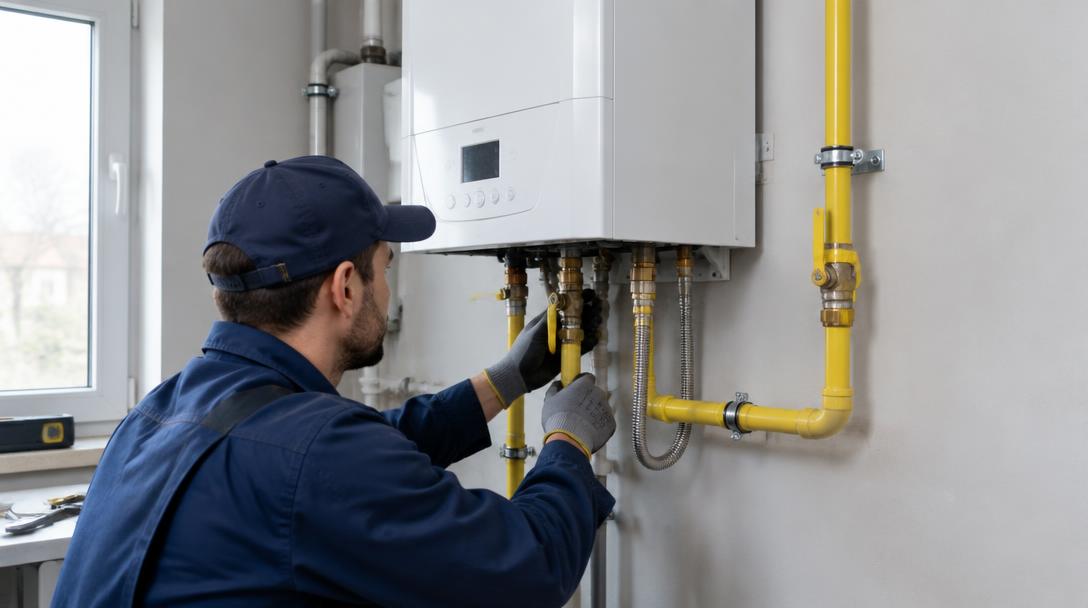
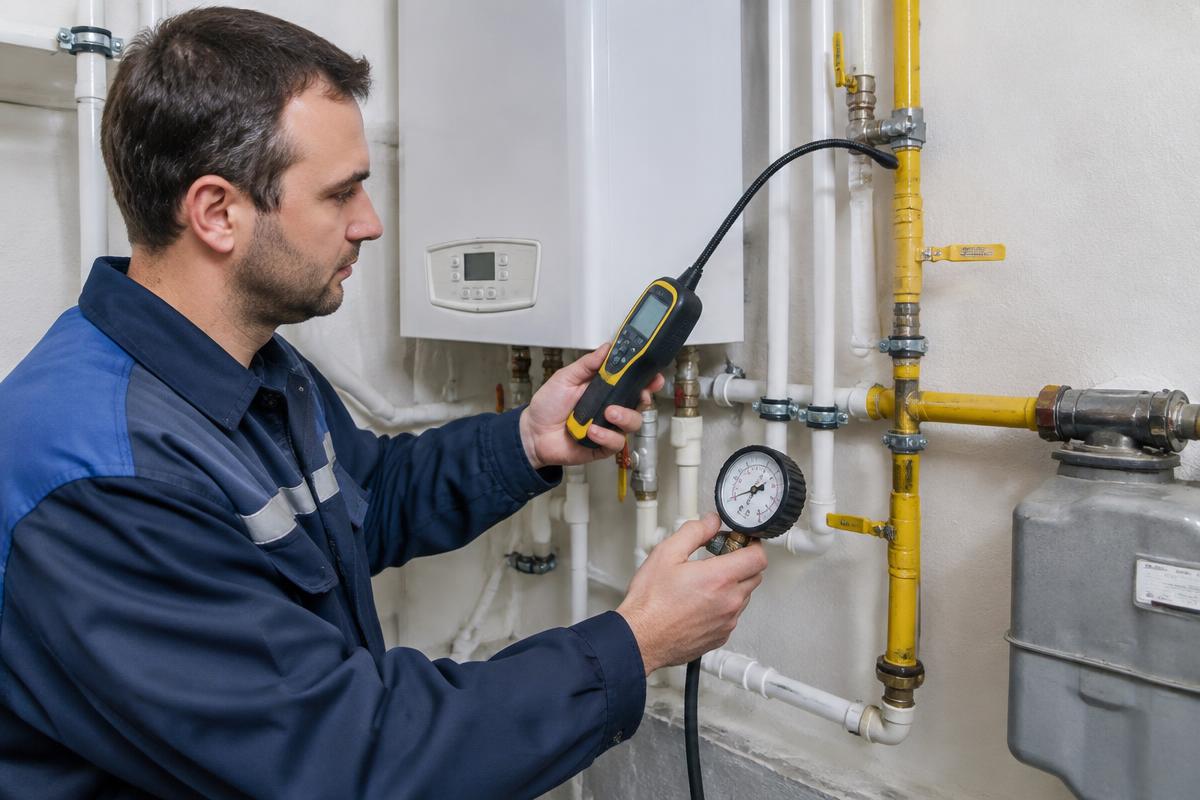
The first check concerns the supply line. Using digital gas detectors, the technician checks the connections (fittings) and the safety valve. If there is a suspected leak inside the boiler, the gas valve is inspected.
Expansion Vessel and Circulator
If the boiler loses pressure or pressure rises sharply when heating up, the technician checks the expansion vessel. Filling with nitrogen or air is often required. Furthermore, the circulator (pump) is checked to determine if it has "stuck" after a long period of inactivity (e.g., in the summer).
Exchanger and Burner Cleaning
The accumulation of scale in the heat exchanger is the main reason a boiler does not perform correctly with domestic hot water. The technician performs a chemical cleaning if necessary or cleans the burner with a special brush to ensure proper air-fuel mixture.
The Importance of Flue Gas Analysis
One of the most critical steps often skipped in superficial maintenance is the flue gas analysis using an electronic analyzer. The technician measures:
- The percentage of carbon dioxide (CO2).
- The concentration of carbon monoxide (CO) in parts per million (ppm).
- The combustion efficiency.
These measurements certify that the boiler is operating economically and is not emitting dangerous gases into the environment or, in the case of poor exhaust, back into the home.
Electronic Failures and Circuit Board
In regions of Greece with frequent voltage fluctuations, the boiler's electronic control board is vulnerable. The technician checks the ignition and ionization electrodes. If the ionization electrode does not "read" the flame, the boiler will shut off immediately after startup. In many cases, installing a voltage stabilizer is considered necessary for protecting the machine.
Frequently Asked Questions (FAQ)
Why does the boiler make a noise like boiling water?
This is called "kettling" and is usually due to scale deposits in the exchanger or low water flow. The heat is not transferred quickly to the water, causing localized boiling.
How often should inspection be done?
Based on Greek legislation and manufacturer instructions, inspection and maintenance must be performed annually. After the inspection, the technician is required to fill out the Inspection Sheet.
Can I add water myself if the pressure drops?
Yes, most boilers have a small valve (usually black or blue) at the bottom. Open it slowly until the pressure reaches 1.5 bar and then close it tightly. If the pressure drops frequently, there is a leak and you must call a technician.
What should I do if I smell gas?
Immediately close the main gas valve, open windows, do not turn on lights or electrical appliances, and call the emergency response service of the gas distribution company (EDA) and your technician.
Conclusion
The proper operation of a natural gas installation is based on prevention. Do not ignore small symptoms like an unusual noise or a slight pressure drop. Collaborating with a licensed and experienced technician ensures that your boiler will operate at maximum possible efficiency, saving money on bills and offering safety to your family.