
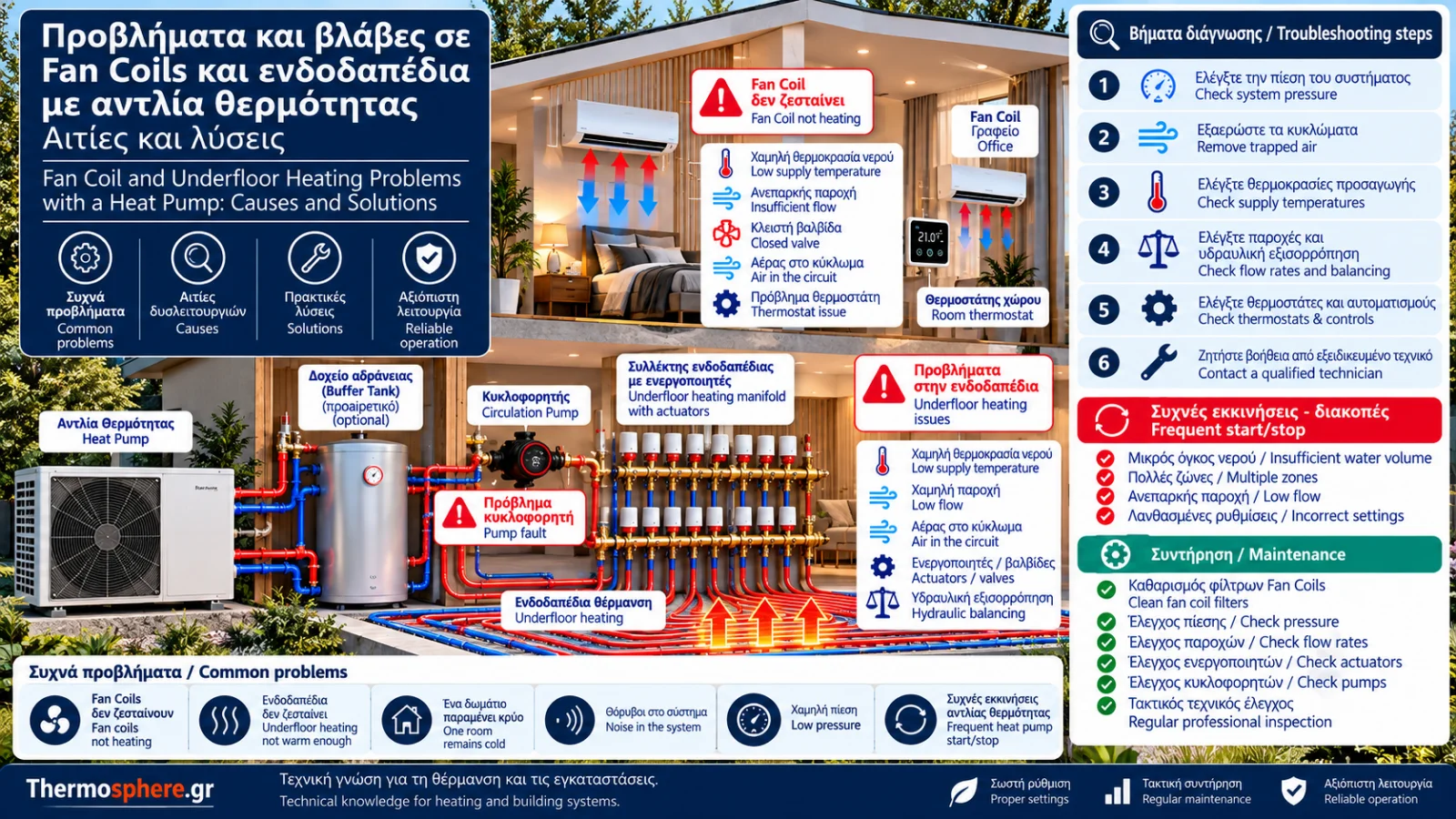
Fan Coil and Underfloor Heating Problems with a Heat Pump: Causes and Solutions
Combining fan coil units and hydronic underfloor heating with a heat pump can provide comfortable and efficient heating. However, like any water-based heating installation, the system may develop operating problems.
A room may remain cold, a circulation pump may run without transferring enough heat, or the heat pump may stop and restart frequently.
Accurate troubleshooting requires examining the heat source, water circulation, controls and heating terminals together.
1. Fan Coil Units Are Not Heating
If a fan coil runs but delivers insufficient heat, possible causes include:
Low supply-water temperature.
Insufficient water flow.
Closed or faulty control valve.
Air trapped in the hydraulic circuit.
Dirty air filter or heat exchanger.
Incorrect thermostat settings.
What Should Be Checked?
First, confirm that the thermostat is requesting heating and that the unit is in the correct operating mode.
Check whether the fan operates and whether any fault indication is displayed.
Water temperature and flow measurements should be carried out by a qualified technician.
2. Underfloor Heating Is Not Warm Enough
Underfloor heating has significant thermal inertia and responds more slowly than fan coil units.
If heating remains insufficient after adequate operating time, possible causes include:
Incorrect supply-water temperature.
Insufficient manifold flow.
Faulty thermal actuators.
Trapped air.
Circulation pump problems.
Higher-than-expected room heat losses.
Increasing the supply temperature without technical assessment is not always the correct solution.
3. One Room Remains Cold
When other rooms heat normally, the problem may be associated with the affected zone.
Possible causes include:
Closed circuit valve.
Faulty actuator.
Incorrect thermostat reading.
Poor hydraulic balancing.
Air or blockage in the circuit.
Troubleshooting should begin by confirming heating demand and then verifying water circulation.
4. Air Trapped in Heating Circuits
Trapped air can restrict water flow and cause unwanted noise.
Common symptoms include:
Gurgling or flow noises.
Uneven heating.
Reduced heating output.
Unstable circulation.
Air removal must follow the manufacturer's recommended procedure.
Complex underfloor heating systems may require individual circuit filling and purging procedures.
5. Low System Pressure
Pressure in a closed heating circuit must remain within the limits specified by the manufacturer and system design.
Low pressure may be caused by:
Water loss.
Inadequate filling.
Expansion vessel problems.
Leaking components.
Repeated pressure loss requires investigation rather than continuous water topping-up.
6. Circulation Pump Problems
The circulation pump moves water through the heating circuits.
Possible warning signs include:
Poor heating across multiple rooms.
Low-flow fault messages.
Unusual noises.
Heat pump shutdowns.
However, similar symptoms may result from closed valves, blocked strainers or unsuitable settings.
A circulation pump should not be replaced without proper diagnosis.
7. Heat Pump Starts and Stops Frequently
Frequent cycling may be associated with:
Insufficient system water volume.
Multiple zones closing simultaneously.
Inadequate minimum water flow.
Incorrect control settings.
Excess heating capacity relative to the current load.
The correct solution depends on heat pump specifications and hydraulic design.
A buffer tank is not automatically required in every case.
8. Different Water Temperatures for Fan Coils and Underfloor Heating
Mixed systems may require different supply-water temperatures.
If underfloor heating performs correctly but fan coils do not, verify whether the fan coils can meet their heating loads at the available water temperature.
Conversely, excessively high supply temperatures may be unsuitable for underfloor heating.
Solutions may involve control adjustments, mixing circuit inspection or equipment sizing review.
9. Thermostat and Control Problems
A faulty thermostat can prevent a heating zone from operating.
Possible causes include:
Incorrect temperature setpoint.
Wrong operating mode.
Power supply problems.
Thermostat and actuator incompatibility.
Communication faults with the main controller.
Before investigating the hydraulic network, confirm that the system is actually receiving a heating demand signal.
10. Symptoms and Possible Causes
Symptom | Possible Cause |
|---|---|
Fan coil not heating | Valve, thermostat or insufficient flow |
Cold underfloor heating zone | Actuator, trapped air or low flow |
Noisy heating circuit | Air or flow problems |
Frequent heat pump shutdowns | Zoning, flow or water volume |
Falling system pressure | Leak or expansion vessel problem |
Uneven heating | Poor balancing or incorrect settings |
This table supports preliminary assessment and does not provide a definitive diagnosis.
11. Preventive Maintenance
Regular maintenance can reduce the likelihood of operating problems.
Depending on the installation, maintenance may include:
Cleaning fan coil filters.
Checking system pressure.
Inspecting for visible leaks.
Checking manifolds and actuators.
Confirming thermostat operation.
Professional inspection of pumps and hydraulic flow.
Reviewing heat pump fault history.
Maintenance intervals and procedures must follow manufacturer documentation.
12. When Is a Qualified Technician Required?
Professional inspection is needed when:
Water leaks are present.
System pressure repeatedly drops.
Flow or circulation faults appear.
The heat pump shuts down frequently.
Electrical problems occur.
Pumps, valves or control components require repair.
Electrical work and interventions on pressurized equipment must be performed by appropriately qualified personnel.
13. Frequently Asked Questions
Why does my fan coil blow air without heating?
Possible causes include insufficient water temperature or flow, a control valve problem or incorrect settings.
Why does underfloor heating take so long to warm up?
The floor's thermal mass causes a slow response. If the delay is excessive, water flow, supply temperature and heat demand should be checked.
Can trapped air stop a heating circuit from working?
Yes. Trapped air can restrict circulation and reduce heating output.
Why does system pressure keep falling?
Possible causes include leaks or expansion vessel problems. Professional inspection is recommended.
Conclusion
Problems in combined fan coil and underfloor heating systems are not always caused by the heat pump itself.
They often involve water circulation, supply temperatures, thermostats, actuators or hydraulic balancing.
Systematic troubleshooting, suitable maintenance and professional technical support are essential for reliable and efficient operation.
Thermosphere.gr — Technical knowledge for heating and building systems.