
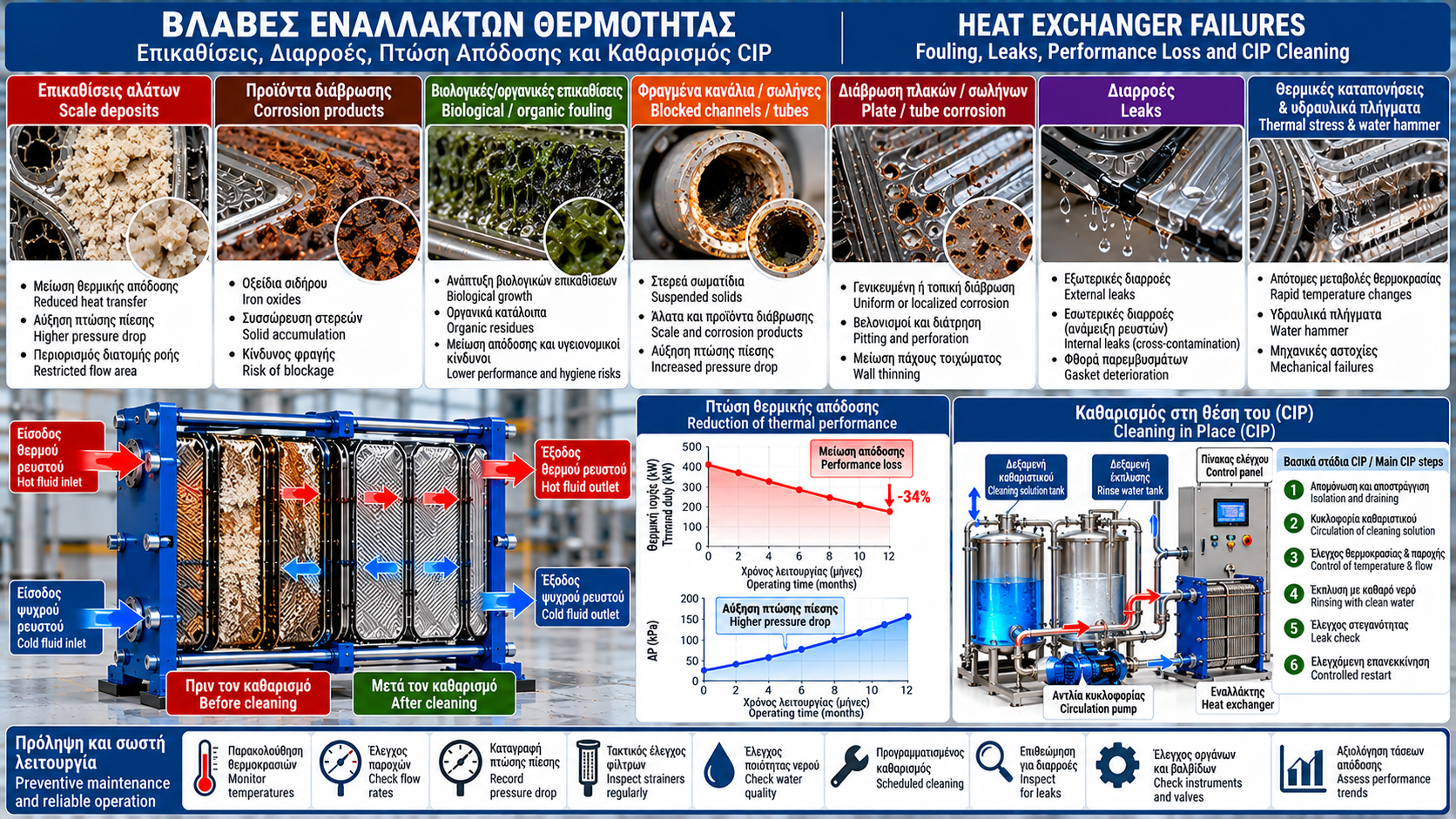
# Heat Exchanger Failures: Fouling, Leaks, Performance Loss and CIP Cleaning
## Introduction
Heat exchangers are critical components of industrial systems. Gradual deterioration in thermal performance can increase energy consumption, reduce production capacity and cause unplanned downtime.
Common problems include fouling, blocked channels, corrosion, leakage, incorrect flow rates and faults involving instrumentation or control valves.
Effective troubleshooting requires reliable measurements, comparison with reference conditions and appropriate inspection and maintenance procedures.
## 1. Recognizing Heat Exchanger Problems
A heat exchanger may be underperforming when:
• The required outlet temperature cannot be achieved.
• Heat transfer duty is lower than expected.
• Pressure drop is abnormally high.
• External leakage is present.
• There is evidence of cross-contamination between fluid circuits.
• Pressure or temperature fluctuates unexpectedly.
No single symptom is sufficient to confirm a specific failure mechanism.
## 2. Reduced Thermal Performance
Reduced heat transfer is one of the most common operating problems.
Possible causes include fouling, low flow, inadequate inlet temperature, condensate accumulation or control-system problems.
For a single-phase fluid:
Q̇ = ṁ × cp × ΔT
Actual thermal duty should be compared with expected performance under equivalent operating conditions.
## 3. Scale Formation
Mineral scale, including calcium carbonate deposits, commonly develops in water circuits with unsuitable water quality or elevated operating temperatures.
Scale adds thermal resistance and may restrict flow.
Possible indicators include reduced heat duty and increased pressure drop.
Prevention involves appropriate water treatment and routine water chemistry monitoring.
## 4. Corrosion Products
Iron oxides and other corrosion products may enter an exchanger from piping, tanks and upstream equipment.
These solids can accumulate on heat transfer surfaces or block narrow plate channels.
Cleaning without addressing the source of corrosion may result in rapid recurrence.
Water quality, piping condition and filtration should therefore be investigated.
## 5. Biological and Organic Fouling
Biological deposits may develop under favorable conditions.
Food-processing and other industrial applications may also generate organic residues.
Such deposits reduce heat transfer and may create hygiene or process-quality risks depending on the application.
Cleaning methods should be selected according to deposit composition and process requirements.
## 6. Blocked Channels and Tubes
Blockage may result from suspended solids, scale, corrosion products or process residues.
Narrow channels in plate exchangers can be particularly sensitive to larger particles.
In shell-and-tube exchangers, blockage may affect individual tubes or specific shell-side regions.
Suitable filtration and pressure-drop monitoring help reduce this risk.
## 7. Excessive Pressure Drop
High differential pressure may result from:
• Fouling.
• Blocked passages.
• Excessive flow.
• Incorrect valve position.
• Changes in viscosity.
• Unsuitable flow configuration.
Before concluding that the exchanger is blocked, verify the instruments and measurement conditions.
Pressure drop must be assessed separately on each side.
## 8. Low Flow Rate
Insufficient flow may be caused by:
• Pump malfunction.
• Blocked strainers.
• Partially closed valves.
• Air accumulation.
• Incorrect control settings.
• Increased hydraulic resistance.
Low flow can reduce total heat duty even when the temperature difference remains substantial.
## 9. External Leakage
External leakage often occurs at gaskets, flanges, connections or mechanically damaged components.
In gasketed plate exchangers, causes may include elastomer aging, incorrect tightening and thermal stress.
In shell-and-tube exchangers, leaks may occur at flanges, welds or other joints.
Corrective work requires safe isolation and identification of the underlying cause.
## 10. Internal Leakage and Cross-Contamination
A perforated plate or tube may allow the two circuits to communicate.
Leakage direction depends on the pressure difference and may change during operation.
Internal leakage is particularly serious when potable water, production fluids or sensitive processes may be contaminated.
Prompt risk assessment, suitable isolation and approved leak testing are required.
## 11. Plate and Tube Corrosion
Corrosion may be general or localized.
Possible mechanisms include:
• Uniform corrosion.
• Pitting.
• Crevice corrosion.
• Galvanic corrosion.
• Stress corrosion cracking under susceptible conditions.
Material selection must consider fluid chemistry, temperature and actual operating conditions.
## 12. Thermal Stress
Rapid temperature changes may produce differential thermal expansion.
This can stress plates, tubes, tube sheets, gaskets and connections.
Some installations require controlled heating during startup.
Startup and shutdown procedures must follow manufacturer instructions.
## 13. Water Hammer
Water hammer creates sudden pressure transients and mechanical loading.
It may result from rapid valve closure, condensate accumulation in steam systems or unsuitable transient operating conditions.
Consequences include damage to joints, seals and internal components.
The underlying cause must be corrected rather than merely replacing the failed part.
## 14. Steam-to-Water Exchanger Problems
In steam-heated exchangers, poor performance may result from:
• Insufficient steam pressure or flow.
• Condensate accumulation.
• Steam-trap malfunction.
• Non-condensable gases.
• Control-valve problems.
Troubleshooting should cover the steam side, condensate return and heated-fluid circuit.
## 15. Instrumentation and Control Faults
Incorrect measurements can create the appearance of poor thermal performance.
Possible causes include:
• Faulty temperature sensors.
• Out-of-calibration pressure gauges.
• Incorrect flow indication.
• Control-valve actuator faults.
• Incorrect controller settings.
Measurement reliability should be verified before intrusive maintenance.
## 16. Systematic Troubleshooting
A structured process includes:
1. Recording symptoms and operating conditions.
2. Checking inlet and outlet temperatures.
3. Measuring flow rates.
4. Measuring pressure drop on each side.
5. Calculating actual heat transfer duty.
6. Comparing results with clean-condition reference data.
7. Checking valves, filters and instruments.
8. Performing an inspection when justified by the evidence.
This approach reduces unnecessary disassembly and cleaning.
## 17. Practical Performance-Loss Example
Consider an exchanger heating water at 10 m³/h.
Under reference conditions, water temperature increases from 30 °C to 60 °C.
Using simplified water properties:
Q̇ ≈ 2.78 × 4.18 × 30 = 349 kW.
Later, at approximately the same flow and 30 °C inlet temperature, the outlet reaches only 50 °C.
Q̇ ≈ 2.78 × 4.18 × 20 = 232 kW.
Heat transfer duty is approximately 34% lower.
This does not prove fouling by itself. Hot-side supply conditions and control operation must also be comparable.
## 18. What Is CIP Cleaning?
Cleaning in Place (CIP) circulates an appropriate cleaning solution through the exchanger without complete disassembly.
It is used when the equipment design, construction materials and deposit type allow it.
CIP cannot repair cracks, corrosion perforation or mechanical deformation.
## 19. Main CIP Cleaning Stages
An approved procedure may include:
1. Safe shutdown, isolation and depressurization.
2. Cooling and draining.
3. Identification of deposits.
4. Selection of a compatible cleaning agent.
5. Controlled circulation at suitable flow and temperature.
6. Monitoring the cleaning process.
7. Rinsing and proper waste handling.
8. Leak checks and controlled restart.
The procedure must be performed by trained personnel following manufacturer instructions and site safety requirements.
## 20. Selecting Cleaning Chemicals
Chemical selection depends on deposit type and exchanger materials.
Some mineral deposits require different chemistry from organic or oily residues.
Acidic or alkaline cleaners must never be selected arbitrarily.
Check:
• Plate and tube compatibility.
• Gasket compatibility.
• Temperature and concentration limits.
• Potential reactions with residual chemicals.
• Rinsing and waste disposal requirements.
Mixing incompatible chemicals can cause hazardous reactions.
## 21. When Mechanical Cleaning Is Required
Mechanical cleaning may be necessary when:
• Approved CIP does not remove deposits effectively.
• Solid debris blocks flow passages.
• Direct visual inspection is needed.
• Mechanical damage is suspected.
Cleaning access depends on exchanger design.
Gasketed plate exchangers and certain shell-and-tube models can be opened, while brazed plate exchangers cannot be dismantled.
## 22. Preventive Maintenance Program
An effective program includes:
• Regular temperature and flow recording.
• Pressure-drop monitoring.
• Strainer inspection.
• Water quality testing.
• Leak inspection.
• Valve and instrument checks.
• Thermal performance trending.
• Condition-based cleaning schedules.
Inspection frequency depends on equipment criticality, fluid quality, manufacturer recommendations and operating history.
## 23. Conclusion
Heat exchanger problems can often be managed more effectively when detected early.
Fouling, leakage, corrosion and flow disturbances do not always produce identical symptoms.
Combining temperature, flow, pressure and thermal duty measurements provides a more reliable diagnosis.
Properly selected CIP cleaning, mechanical inspection where necessary and preventive maintenance help reduce energy losses and extend equipment service life.
Thermosphere.gr — Technical knowledge for industry, heating and energy efficiency.