
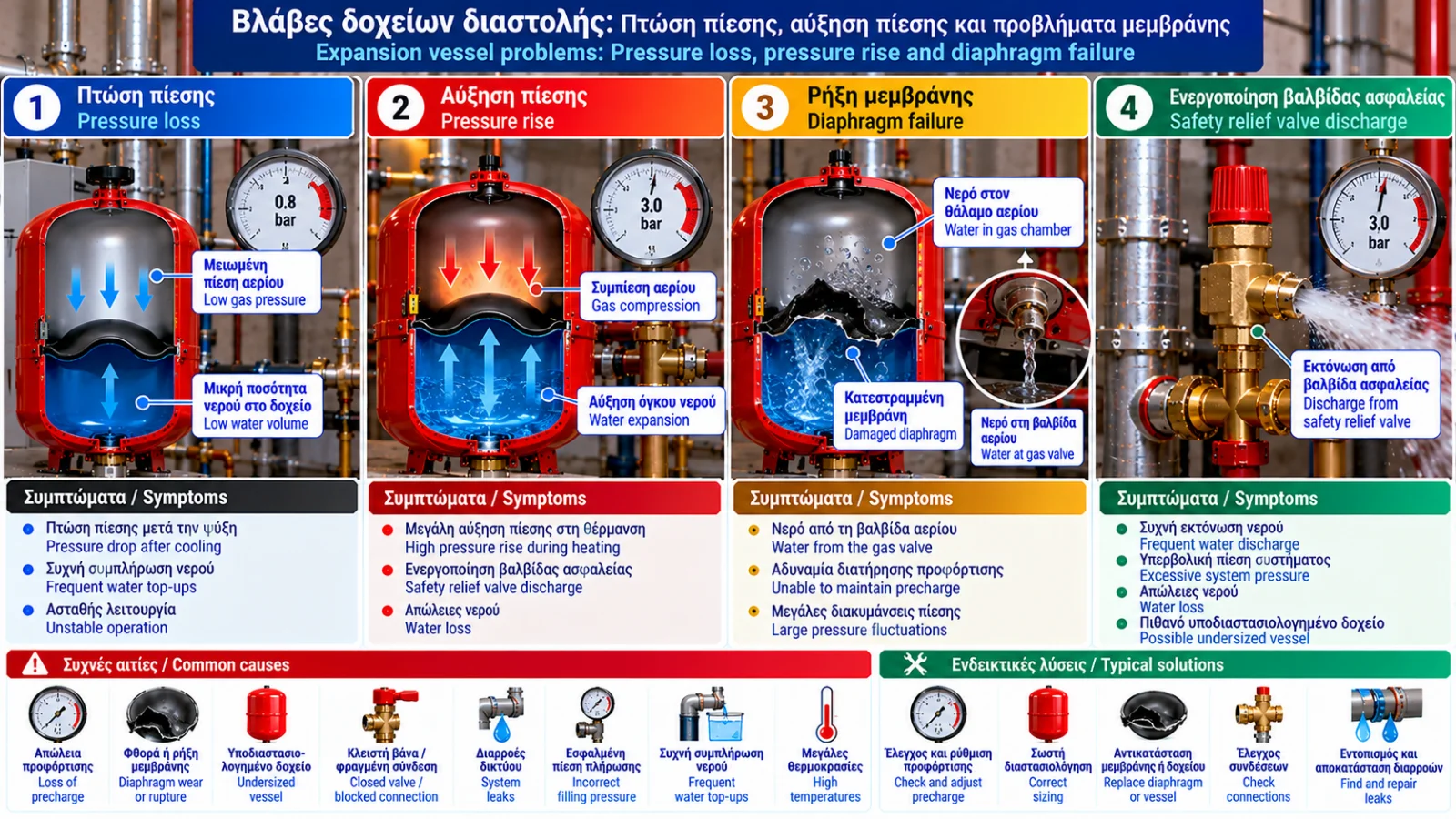
Expansion Vessel Problems: Pressure Loss, Pressure Rise and Diaphragm Failure
An expansion vessel is an essential component of a closed heating or cooling system. It accommodates changes in water volume as temperature varies, helping limit the corresponding pressure fluctuations.
When the vessel fails, loses precharge or lacks sufficient capacity, the installation may develop significant problems: excessive pressure rise during heating, pressure loss after cooling, repeated safety relief valve discharge and frequent water top-ups.
However, these symptoms are not always caused by the expansion vessel. Accurate diagnosis requires inspection of the complete hydraulic system.
1. What Does an Expansion Vessel Do?
In a closed heating system, water volume increases as temperature rises.
An expansion vessel contains a compressible gas chamber separated from system water by a diaphragm or bladder.
As water enters the vessel, the gas compresses and accommodates the additional volume.
During cooling, the gas expands and pushes water back into the system.
If this process is disrupted, pressure fluctuations may exceed the intended operating range.
2. Common Signs of Expansion Vessel Problems
Typical indicators include:
Excessive pressure rise during boiler operation.
Significant pressure drop after cooling.
Frequent safety relief valve discharge.
Repeated need for water top-ups.
Inability to maintain gas precharge.
Water appearing at the vessel's gas valve.
Unusual pressure fluctuations during operation.
Visible leakage or corrosion on the vessel body.
A single symptom is not always sufficient for a definitive diagnosis.
3. Why Does Pressure Rise Excessively During Heating?
Increasing water temperature causes thermal expansion.
In a correctly designed system, the expansion vessel accommodates the additional volume.
If available acceptance capacity is insufficient, pressure can rise significantly.
Possible causes include:
Loss of precharge.
Diaphragm rupture.
Undersized vessel.
Excessive filling pressure.
Closed vessel isolation valve.
Blocked hydraulic connection.
Additional system water volume not included in the original design.
Pressure rise must be evaluated relative to temperature and expected operating conditions.
4. Why Does Pressure Drop After Cooling?
As water cools, its volume decreases.
The expansion vessel should return some water to the circuit, helping maintain pressure within the intended range.
If water was discharged through the safety relief valve during heating, pressure may fall significantly after cooling.
Pressure loss may also result from:
Pipework or component leaks.
Automatic air vent problems.
Leakage through the safety relief valve.
Incorrect filling pressure.
Expansion vessel malfunction.
Not every pressure drop should therefore be attributed to diaphragm failure.
5. Loss of Precharge Pressure
Precharge is the gas pressure in the vessel when the water side is at zero gauge pressure.
Over time, precharge may decrease because of:
Small gas valve leaks.
Gas permeation through the diaphragm.
Seal deterioration.
Internal failure.
When precharge falls significantly, excessive water may enter the vessel even in the cold condition.
This reduces the space available for subsequent thermal expansion.
Simply adding gas is not always the correct solution. The vessel must first be assessed for mechanical integrity and its ability to retain pressure.
6. Diaphragm Rupture or Deterioration
The diaphragm separates water from the gas chamber.
If it ruptures, this separation is lost and the vessel may no longer operate correctly.
Possible signs include:
Water emerging from the precharge valve.
Inability to retain gas pressure.
Large pressure fluctuations.
Frequent relief valve discharge.
Water at the gas valve is a strong indication of diaphragm failure.
Confirmation and decisions regarding repair or replacement must follow the manufacturer's instructions for the specific vessel type.
7. What Is a Waterlogged Expansion Vessel?
The term "waterlogged vessel" is often used to describe a condition in which the available compressible gas volume has been substantially reduced.
This may result from precharge loss or diaphragm failure.
Such a vessel may no longer provide adequate expansion acceptance.
However, tapping the vessel shell and listening to the sound is not a reliable standalone diagnostic method.
Appropriate pressure and condition checks are required.
8. Why Does the Safety Relief Valve Open?
The safety relief valve operates when pressure reaches its specified activation conditions.
If it opens repeatedly during heating, investigate:
Vessel capacity.
Precharge pressure.
Filling pressure.
Vessel connection to the circuit.
Condition of the relief valve itself.
Unwanted water supply from the filling system.
Where relevant, pressure transfer through a defective heat exchanger connected to a higher-pressure circuit.
Repeated discharge is not normal system operation.
The relief valve setting must never be increased arbitrarily.
9. Why Frequent Water Top-Ups Are a Problem
Repeatedly adding water does not correct the underlying cause of pressure loss.
It can also introduce additional oxygen and dissolved minerals into the circuit.
This may accelerate:
Corrosion.
Scale formation.
Gas accumulation.
Component deterioration.
Before topping up, investigate possible leakage, relief valve discharge or expansion system problems.
10. Distinguishing Vessel Failure from System Leakage
Pressure behavior provides useful diagnostic information.
Observation | Possible Cause |
|---|---|
Pressure rises sharply during heating and falls after cooling | Insufficient expansion acceptance, possible water loss |
Pressure decreases gradually even without heating | Possible leakage or another source of water loss |
Pressure rises without a corresponding temperature increase | Unwanted filling or pressure transfer from another circuit |
Water appears at the gas valve | Strong indication of internal diaphragm failure |
Precharge repeatedly decreases | Possible gas leakage or vessel defect |
This table supports preliminary investigation but is not a definitive diagnostic tool.
11. Incorrect Filling Pressure
Filling pressure must be sufficient for the system's static height and operating requirements.
Insufficient pressure may create problems at high points in the circuit.
Excessive filling pressure reduces the margin before maximum permitted pressure is reached.
The following should be evaluated together:
Static height.
Precharge pressure.
Filling pressure.
Maximum temperature.
Safety relief valve setting.
12. Undersized Expansion Vessel
A vessel may be mechanically sound but too small for the installation.
This often occurs after system modifications, such as:
Adding a buffer tank.
Extending pipework.
Adding radiators.
Installing underfloor heating.
Changing operating temperatures.
Converting to a water–glycol mixture.
Corrective action requires recalculating vessel capacity rather than merely adjusting precharge.
13. Isolated or Blocked Vessel
Even a correctly selected vessel cannot function if it is hydraulically disconnected from the circuit.
Possible causes include:
Closed isolation valve.
Blocked connection.
Incorrect installation.
Unsuitable component arrangement.
A maintenance isolation valve must not allow the installation to operate unintentionally without the required expansion protection.
Checking hydraulic communication is an essential part of troubleshooting.
14. Technical Inspection Procedure
Inspection should be performed by appropriately trained personnel.
Step 1 — Record symptoms
Document cold and hot pressures, temperatures and any water losses.
Step 2 — Assess safety
Determine whether safe shutdown is required.
Step 3 — Visual inspection
Check the vessel, connections, gas valve and possible leakage points.
Step 4 — Safe isolation and depressurization
Isolate the vessel and depressurize the water side according to manufacturer instructions.
Step 5 — Measure precharge
Measure gas pressure using a suitable gauge.
Step 6 — Assess vessel condition
Determine whether the vessel retains pressure, whether diaphragm failure is indicated and whether capacity is adequate.
Step 7 — Corrective action
Perform the appropriate permitted maintenance or replacement.
Step 8 — Reconnection and verification
Reconnect the vessel and verify system operation.
15. When Is Replacement Necessary?
Replacement may be required when:
A non-replaceable diaphragm has failed.
The vessel body has significant corrosion or damage.
The vessel cannot retain precharge because of a non-repairable defect.
Vessel capacity is insufficient for the modified system.
The vessel is unsuitable for required pressures or temperatures.
A replacement must be selected using actual design data, not solely the dimensions of the old vessel.
16. Can the Diaphragm Be Replaced?
Some vessels have replaceable bladders or diaphragms.
In other designs, the diaphragm is permanently installed.
Repair feasibility depends on:
Manufacturer and model.
Vessel design.
Availability of approved spare parts.
Shell condition.
Specified maintenance procedures.
Improvised modifications to pressure-containing vessel bodies are unacceptable.
17. Expansion Vessel Problems in Heat Pump Systems
In heat pump installations, symptoms may be associated with:
Insufficient integrated vessel capacity.
Addition of a large buffer tank.
Incorrect precharge.
Temperature changes between heating and cooling.
Different expansion characteristics of glycol mixtures.
Leaks or filling system problems.
Troubleshooting must include the complete hydraulic circuit.
18. Problems in Domestic Hot Water Systems
Domestic hot water expansion vessels operate under different conditions from closed heating circuits.
They must be suitable for their intended service and, where required, potable water contact.
Pressure rise during heating may result from thermal expansion in a system that prevents water from flowing back toward the supply.
Selection and diagnosis must consider the actual hydraulic arrangement and applicable safety requirements.
19. Troubleshooting Table
Problem | Possible Cause | Technical Check |
|---|---|---|
Rapid pressure rise | Precharge loss, undersized vessel | Check precharge and capacity |
Pressure drop after cooling | Water loss, vessel malfunction | Inspect leaks and discharge history |
Water at gas valve | Possible diaphragm rupture | Inspect vessel condition |
Frequent relief valve discharge | Overpressure, expansion or filling problem | Check pressure, vessel and filling system |
Loss of precharge | Gas leakage, diaphragm deterioration | Measure and check pressure retention |
No vessel response | Isolation or blocked connection | Verify hydraulic communication |
Pressure rise without heating | Unwanted filling or pressure transfer | Inspect filling arrangement and heat exchangers |
20. Preventive Maintenance and Technical References
Periodic maintenance helps identify faults before they cause repeated shutdowns or water losses.
Useful activities include:
Recording cold and hot pressures.
Checking precharge with the water side depressurized.
Inspecting for leaks and corrosion.
Verifying vessel connection to the system.
Reassessing capacity after modifications.
Maintaining inspection records.
Relevant references include:
EN 12828: Design of water-based heating systems.
EN 13831: Closed expansion vessels with built-in diaphragm.
Directive 2014/68/EU (PED): Pressure equipment requirements, where applicable.
Manufacturer technical manuals: Pressure limits, precharge, inspection and replacement procedures.
Applicable editions and requirements must be confirmed for each installation.
Conclusion
Expansion vessel faults commonly appear as excessive pressure rise during heating, pressure loss after cooling, repeated safety relief valve discharge and loss of precharge.
However, similar symptoms can result from leaks, filling system problems or incorrect sizing.
Effective troubleshooting requires systematic inspection of both the vessel and the complete hydraulic circuit.
Diagnosis must precede adjustment or replacement, and all work must follow appropriate safety procedures.