
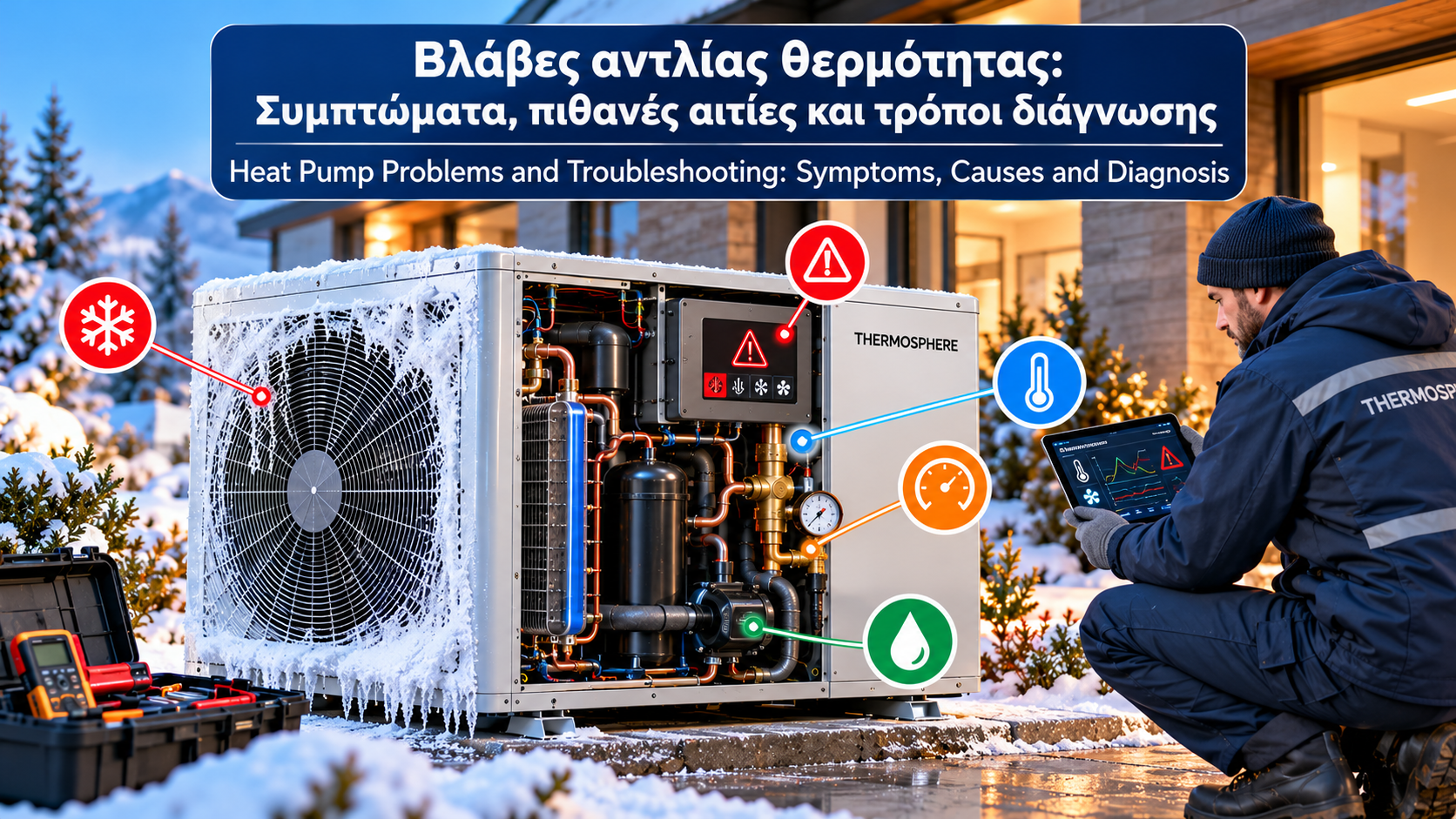
Heat Pump Problems and Troubleshooting: Symptoms, Causes and Diagnosis
Heat pumps are efficient heating systems, but like any electromechanical installation, they can experience operational problems.
A heat pump that fails to start, delivers insufficient heating or displays an error code does not necessarily have a major component failure.
Some issues are related to settings, water circulation or operating conditions, while others require professional diagnosis.
This guide explains common symptoms, possible causes and safe initial troubleshooting steps.
1. Heat Pump Does Not Start
When a heat pump fails to start, the first step is to determine whether it is in normal standby or experiencing a fault.
Possible Causes
No heating demand from the thermostat.
An active schedule or standby setting.
Electrical supply problems.
An activated safety protection.
Sensor or communication faults.
A normal compressor restart delay.
Initial Checks
Check whether the display is operating and whether an error code is shown.
Confirm that the correct operating mode is selected and that heating is being requested.
Do not bypass electrical protection devices or repeatedly restart the unit without identifying the problem.
2. Heat Pump Runs but Does Not Heat Properly
A common complaint is that the heat pump operates continuously without achieving the desired indoor temperature.
Possible Causes
Low supply water temperature.
Incorrect weather compensation settings.
High building heat losses.
Restricted water circulation.
Incorrect thermostat or zone control operation.
Insufficient available heating capacity under current outdoor conditions.
Sensor or component malfunction.
Diagnostic Approach
A technician may evaluate supply and return water temperatures, outdoor temperature and target supply temperature.
A large supply-return temperature difference can sometimes indicate reduced water flow, but it does not independently confirm a fault.
Proper assessment requires consideration of water flow rate, heating output and manufacturer specifications.
3. High-Pressure and Low-Pressure Errors
Two different systems must be distinguished.
Hydronic Water Pressure
Low water pressure may be associated with:
Water loss.
Insufficient filling.
Expansion vessel problems.
Other hydronic system issues.
High water pressure may be caused by overfilling, expansion vessel malfunction or other hydraulic problems.
Acceptable pressure ranges depend on the installation and manufacturer requirements.
Refrigerant Pressure
Refrigerant pressure errors may be associated with:
Poor heat transfer.
Restricted airflow or water flow.
Fan malfunction.
Faulty pressure sensors or switches.
Refrigerant circuit problems.
Important: Refrigerant circuit inspection requires appropriate professional competence and certification where applicable. Homeowners should not attempt this work.
4. Water Flow Errors
Adequate water circulation is essential for reliable heat transfer.
If flow drops below the required level, the controller may display a fault and stop operation.
Possible Causes
Blocked water filter.
Air trapped in the hydronic circuit.
Closed valve.
Circulation pump malfunction.
Incorrect hydraulic balancing.
Faulty flow sensor or flow switch.
Recommended Approach
Review the unit’s displayed information and visually check whether any normally open valves appear closed.
Filter cleaning, air removal and pump inspection should follow manufacturer procedures and be performed by an appropriately qualified person when necessary.
5. Frequent Compressor Starts and Stops
Frequent compressor cycling is often called short cycling.
Possible Causes
Heat pump capacity that is too high for the current heating demand.
Insufficient active system water volume.
Frequent closure of heating zones.
Incorrect control settings.
Poor thermostat placement or configuration.
Limited compressor turndown capability.
Why It Matters
Excessive cycling may reduce efficiency and place additional stress on components.
However, not every compressor shutdown indicates a problem.
Diagnosis requires evaluation of start frequency, run time and actual heating demand.
6. Ice on the Outdoor Unit
During winter heating operation, frost formation on the outdoor heat exchanger of an air-source heat pump can be normal.
When the heat exchanger surface is sufficiently cold and moisture is present, frost or ice may develop.
The controller initiates defrost when required by its operating logic.
When Is Inspection Needed?
Ice remains for unusually long periods without effective defrost.
Repeated error codes occur.
Airflow becomes restricted.
Heating performance deteriorates significantly.
Ice accumulates around the base and blocks drainage.
Do not remove ice with sharp tools or apply uncontrolled heat to the coil.
7. Heat Pump Error Codes
Modern heat pumps include electronic fault detection systems.
When a problem occurs, an error code may appear on the controller or monitoring application.
Error codes are not universal.
The same code may mean different things on different brands or models.
Correct Procedure
Record the exact error code.
Identify the heat pump model.
Consult the official manufacturer documentation.
Note when the fault occurs.
Contact a qualified technician when required.
Repeatedly clearing faults without diagnosis can conceal an ongoing problem.
8. High Electricity Consumption
High electricity consumption does not automatically indicate a defective heat pump.
Possible contributing factors include:
Low outdoor temperatures.
Excessively high target water temperatures.
Frequent auxiliary electric heater operation.
High building heat losses.
Poor weather compensation settings.
Increased domestic hot water demand.
Malfunctions that reduce system efficiency.
How Should Consumption Be Evaluated?
Energy use should be assessed alongside weather conditions, operating hours, water temperatures and building demand.
Where reliable measurements are available, actual heat pump efficiency can also be evaluated.
Comparing two electricity bills alone is not enough for a reliable diagnosis.
9. Unusual Noise and Vibration
Some operating sounds are normal, including:
Fan noise.
Compressor operation.
Changes in sound during defrost.
Water circulation.
Persistent metallic noises, excessive vibration or sudden changes in operating sound may require inspection.
Possible causes include loose mounting components, fan problems, pipe vibration or mechanical faults.
Do not remove protective panels to locate the noise.
10. Troubleshooting Reference Table
Symptom | Possible Causes | Safe Initial Check |
Does not start | Settings, power, protection | Display, schedule, error code |
Poor heating | Heating curve, flow, demand | Temperature readings |
Low water pressure | Water loss, filling, expansion vessel | Pressure gauge |
Water flow error | Filter, pump, valves | Display and visible valve positions |
Frequent cycling | Settings, zones, low water volume | Record cycle frequency |
Persistent icing | Defrost, airflow, drainage | Visual inspection |
High electricity use | Settings, heaters, demand | Energy use and conditions |
Unusual noise | Fan, mounting, vibration | External observation |
This table is intended for preliminary assessment, not definitive fault diagnosis.
11. When Should You Call a Technician?
Professional inspection is recommended when:
The unit repeatedly shuts down due to protection faults.
Water leaks are visible or refrigerant leakage is suspected.
Pressure or flow errors persist.
The compressor or fan produces abnormal noise.
Defrost does not operate correctly.
Heating performance drops significantly without an obvious explanation.
If you notice a burning smell, smoke or signs of electrical danger, stop using the equipment and seek appropriate technical assistance immediately. Isolate power only when safe to do so.
12. Frequently Asked Questions
Why Does My Heat Pump Run Continuously?
Continuous operation can be normal for inverter heat pumps, especially under steady heating demand.
Inspection is recommended if the system cannot maintain the desired indoor temperature or behaves abnormally.
Is Steam From the Outdoor Unit Normal?
Water vapor may be visible during defrost. This does not necessarily indicate a malfunction.
Can I Reset a Heat Pump Error?
Only when permitted by the instructions for the specific model. Repeated faults require proper diagnosis.
Does High Electricity Consumption Mean the Heat Pump Is Faulty?
Not necessarily. Consumption depends on outdoor conditions, system settings, usage patterns and building heat losses.
Conclusion
Effective heat pump troubleshooting begins with careful observation of symptoms and operating conditions.
Not every unusual behavior indicates a mechanical fault, but recurring errors and major changes in performance should never be ignored.
Timely professional diagnosis, regular maintenance and adherence to manufacturer guidance help maintain safe, efficient and reliable operation.
Thermosphere.gr — Technical knowledge for heating and building systems.