
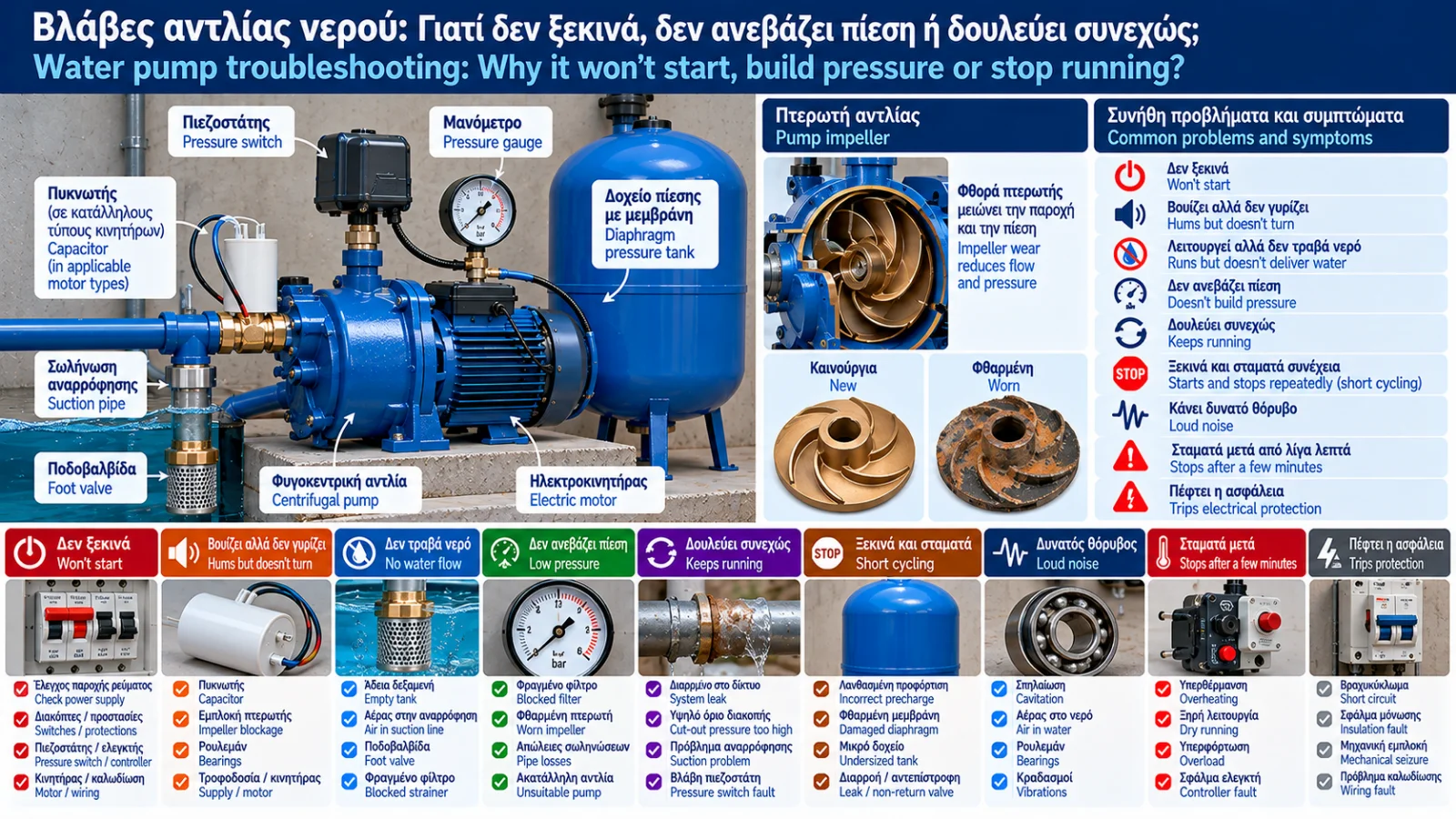
Water Pump Troubleshooting: Why It Won't Start, Build Pressure or Stop Running
Water pumps are used every day in homes, apartment buildings, storage tanks, wells and water supply installations.
When a problem occurs, symptoms may vary. The pump may fail to start, the motor may run without delivering water, system pressure may remain low or the booster may operate continuously.
The same symptom can have several different causes.
For example, low pressure may result from insufficient water supply, suction problems, impeller wear or incorrect pump selection.
For this reason, troubleshooting should follow a systematic process rather than relying on random component replacement.
This Thermosphere.gr guide explains common water pump faults, their symptoms and the principles of safe diagnosis.
1. What Are the Most Common Water Pump Problems?
Water pump faults can be grouped into four main categories.
Electrical faults: Problems involving power supply, capacitors, motors, thermal protection or control equipment.
Hydraulic faults: Poor suction, air entry, blocked filters, worn impellers or excessive system resistance.
Mechanical faults: Bearing wear, seal failure, shaft seizure or excessive vibration.
Control faults: Pressure switch, pressure sensor, pressure tank or electronic controller problems.
Identifying the likely category helps narrow down the possible causes.
2. The Water Pump Will Not Start
When the pump does not start and the motor makes no sound, the first step is to assess operating conditions and electrical supply.
Possible causes include:
Loss of electrical power.
Open isolator or activated protective device.
Tripped thermal protection.
Pressure switch not calling for operation.
Activated dry-running protection.
Electronic controller fault.
Wiring or motor failure.
In a pressure booster system, the pump should not start when pressure remains above the cut-in threshold and there is no other operating demand.
Therefore, failure to start does not always indicate a fault.
What Can Be Checked Safely?
Without opening electrical equipment, users can observe:
Whether a general power outage has occurred.
Whether the controller displays a fault code.
Whether the water tank contains water.
Whether any obvious leaks are present.
Whether the pressure gauge indicates normal operating pressure.
Voltage measurements, contact testing and motor diagnostics require qualified personnel.
3. The Pump Motor Hums but Does Not Turn
A common symptom is a humming motor that fails to start rotating.
Possible causes include:
Capacitor failure in certain single-phase motor designs.
Mechanical impeller blockage.
Worn bearings.
Electrical supply problems.
Motor winding faults.
Starting circuit failure.
Capacitor faults are common in some single-phase motors, but not all motors use the same starting arrangement.
Warning: Prolonged energisation of a motor that hums without starting can cause overheating.
The pump should be safely isolated and inspected.
Never attempt to rotate the shaft while electrical power is connected.
4. What Does the Pump Capacitor Do?
In many single-phase induction motors, a capacitor provides a suitable phase shift in an auxiliary winding.
Depending on the motor design, there may be a run capacitor, start capacitor or both.
A failed capacitor may cause:
Difficult starting.
Humming.
Reduced starting torque.
Thermal protection trips.
Diagnosis requires appropriate electrical measurements and verification against motor specifications.
Capacitors may retain a dangerous electrical charge even after power has been disconnected.
Replacement must be carried out by qualified personnel using a correctly specified component.
5. The Pump Runs but Does Not Deliver Water
When the motor operates normally but no water is delivered, the likely causes are often hydraulic.
Examples include:
Empty water tank.
Pump not correctly primed.
Air entering the suction line.
Faulty foot valve.
Leaking suction pipe.
Blocked inlet or strainer.
Excessive suction lift.
Damaged impeller or hydraulic components.
A conventional surface centrifugal pump that is not designed for dry running may suffer mechanical seal damage if operated without water.
Why Does a Pump Lose Prime?
Loss of prime may occur when air enters the suction line or water drains back towards the source after the pump stops.
Foot valve operation and suction-line tightness are critical in many surface-pump installations.
6. The Water Pump Does Not Build Pressure
A pump may deliver water but fail to reach the required pressure.
Possible causes include:
Excessive water demand.
Insufficient water supply.
Blocked filter.
Partially closed valve.
Air entering the suction line.
Worn or damaged impeller.
Incorrect rotation direction in applicable three-phase pumps.
Excessive pipe friction losses.
Incorrect pump selection for the required head.
Pressure depends on the pump performance curve and the system requirements, not motor power alone.
For example, a pump may deliver 3 m³/h at 20 metres of head but a much lower flow at 40 metres, if its performance curve permits operation at that head.
7. Why Does the Water Pump Keep Running?
In a conventional pressure-switch-controlled booster, the pump should stop when cut-out pressure is reached.
If it keeps running, possible causes include:
Continuous water consumption.
System leakage.
Cut-out pressure set beyond pump capability.
Suction problems.
Blocked supply line.
Worn hydraulic components.
Pressure switch or sensor failure.
Electronic controller problems.
Do not increase pressure switch settings arbitrarily.
If the pump cannot achieve the existing cut-out pressure, raising the setting may make the problem worse.
In inverter-controlled systems, prolonged operation may be normal when water demand continues. Diagnosis must account for the control strategy of the specific system.
8. Why Does the Pump Start and Stop Repeatedly?
Very frequent starting is known as short cycling.
It is particularly common in pressure booster systems with pressure tanks.
Possible causes include:
Incorrect tank precharge.
Damaged diaphragm or bladder.
Undersized pressure tank.
Narrow pressure differential.
Water leaks.
Faulty non-return valve.
Unstable pressure switch operation.
A 50-litre pressure tank does not provide 50 litres of usable water between cut-in and cut-out pressures.
Actual drawdown depends on precharge and operating pressure settings.
Frequent starting increases stress on the motor and electrical components.
9. Why Does Pressure Drop with All Taps Closed?
Pressure loss without visible consumption suggests water leakage or reverse flow towards the source.
Possible causes include:
Pipe leaks.
Leaking toilet cistern.
Appliance leakage.
Faulty non-return valve.
Leaking fittings.
Defects elsewhere in the water network.
A defective non-return valve may allow water to flow back towards the storage tank.
Pressure falls, potentially causing the booster to restart even when no tap is open.
10. Why Is the Water Pump Making Loud Noises?
Noise can originate from hydraulic or mechanical problems.
Common causes include:
Cavitation.
Entrained air.
Worn bearings.
Loose mounting.
Pipe vibration.
Contact between rotating components.
Operation outside the appropriate pump performance region.
Cavitation noise is often described as sounding like gravel moving through the pump.
This description is only indicative and cannot confirm a diagnosis.
New metallic noises or severe vibration require shutdown and professional inspection.
11. What Is Cavitation and Why Does It Occur?
Cavitation occurs when local pressure inside a pump falls below the liquid's vapour pressure.
Vapour bubbles form and can collapse when they enter higher-pressure regions.
Their collapse may damage pump components.
Possible causes include:
Excessive suction lift.
Undersized suction piping.
Blocked strainers.
High water temperature.
Excessive suction losses.
Insufficient available NPSH.
Proper assessment compares Net Positive Suction Head Available (NPSHa) with the pump's required NPSH and includes an appropriate safety margin.
Cavitation cannot simply be corrected by increasing motor power.
12. The Pump Stops After a Few Minutes
If the pump starts normally but stops shortly afterwards, a protective device may be operating.
Possible causes include:
Motor overheating.
Overload.
Electrical supply problems.
Mechanical stress.
Insufficient cooling.
Dry running.
Electronic controller faults.
Some motors have thermal protection that resets automatically after cooling.
This means a pump may restart unexpectedly unless electrically isolated.
Never bypass thermal protection, electrical safety devices or dry-running protection.
13. Why Does the Circuit Breaker or Electrical Protection Trip?
Electrical protection may operate due to:
Short circuits.
Insulation faults.
Motor overload.
Mechanical seizure.
Moisture in electrical components.
Wiring faults.
Incorrect or defective protective equipment.
It is important to distinguish between a circuit breaker, motor overload relay and residual-current device.
Their operating principles and fault causes are different.
Repeatedly resetting protective devices without diagnosis is not a safe solution.
14. The Pump Is Leaking Water
Leaks may occur at:
Unions.
Flanges.
Threaded connections.
Pump casing.
Mechanical shaft seal.
Leakage from a mechanical seal may indicate wear, dry running or other unfavourable operating conditions.
Not every leak can be repaired by further tightening.
Excessive tightening can damage plastic or metal components.
Before repairs, the pump must be safely isolated and depressurised.
15. Quick Water Pump Troubleshooting Table
Symptom | Possible causes | Recommended diagnostic direction |
|---|---|---|
Will not start | Supply, switch, protection, motor | Check indicators and arrange electrical diagnosis |
Hums without turning | Capacitor, blockage, motor | Shut down and obtain professional inspection |
Runs without delivering water | Air, empty tank, foot valve | Check water source and suction conditions |
Low pressure | Filter, impeller, losses, unsuitable pump | Hydraulic measurements |
Will not stop | Leak, excessive cut-out, insufficient head | Check pressure and pump curve |
Short cycling | Tank, precharge, leakage | Inspect tank and network |
Loud noise | Cavitation, bearings, vibration | Check suction and mechanical condition |
Stops after running briefly | Thermal protection, dry running | Identify protection trigger |
Electrical protection trips | Overload, insulation, short circuit | Qualified electrical inspection |
Water leakage | Seal, connection, casing | Locate leak and repair safely |
This table is intended for initial assessment, not definitive diagnosis.
16. How Is a Proper Technical Diagnosis Performed?
A systematic approach improves accuracy.
Step 1: Identify the Symptom
Determine whether the problem occurs during starting, running or stopping.
Step 2: Check Water Supply Conditions
Confirm sufficient water is available and suction conditions are suitable.
Step 3: Assess Pressure
Record operating pressures using suitable instruments.
Step 4: Check Hydraulic Performance
Where necessary, compare measured flow and head with the pump performance curve.
Step 5: Check Electrical Components
Qualified personnel assess supply voltage, motor, capacitors, protection and control equipment.
Step 6: Inspect Mechanical Condition
Evaluate bearings, impeller, seals and vibration.
The sequence should be adapted to the fault and safety requirements.
17. How Can Common Pump Failures Be Prevented?
Prevention depends on correct selection, installation and maintenance.
Useful measures include:
Correct pump sizing.
Adequate suction pipe diameter.
Preventing air entry.
Cleaning filters as specified.
Providing dry-running protection.
Correct pressure switch settings.
Checking tank precharge.
Secure mechanical mounting.
Maintaining electrical protection.
Inspecting for leaks and unusual noise.
Maintenance intervals should follow manufacturer recommendations and actual operating conditions.
18. When Should the Pump Be Stopped Immediately?
Safely stop operation if there is:
A strong burning smell.
Smoke.
Severe metallic noise.
Excessive vibration.
Visible electrical damage.
Repeated protection trips.
Suspected dry running in an unsuitable pump.
Significant water leakage near electrical equipment.
Do not touch wet electrical equipment or attempt repairs before safe electrical isolation.
19. Frequently Asked Questions
Why Won't My Water Pump Start?
Possible causes include power supply problems, pressure switch faults, activated protection, motor failure or controller problems. First confirm that the system is actually calling for the pump to start.
Why Does the Pump Hum but Not Spin?
In some single-phase motors, capacitor failure is one possibility. Mechanical or electrical faults may also be responsible. Shut down and arrange professional inspection.
Why Won't My Pump Draw Water from the Tank?
Possible causes include loss of prime, air entry, an empty tank, a faulty foot valve or blockage.
Why Won't the Booster Stop?
The system may not reach cut-out pressure because of high demand, leakage, insufficient pump performance or incorrect settings.
Why Does My Pump Start Every Few Seconds?
Common causes include incorrect precharge, damaged tank diaphragm, inadequate tank capacity or leaks.
Can Running a Pump Without Water Damage It?
Yes. Many pumps depend on water for cooling and lubrication of certain components. Dry running can cause serious damage.
Why Does the Pump Sound Like Gravel?
Cavitation is one possible explanation, but similar sounds may have other causes.
Is the Capacitor Always Responsible When a Pump Won't Start?
No. Capacitor failure is only one possible cause and applies to specific motor designs.
Conclusion
Water pump faults should not be approached through random component replacement or arbitrary setting changes.
The first step is to identify the symptom and distinguish between electrical, hydraulic, mechanical and control-related problems.
Poor suction, incorrect tank precharge, leaks, motor faults and unsuitable pump selection are common sources of trouble.
Safe and effective troubleshooting relies on actual measurements, manufacturer instructions and systematic evaluation of the possible causes.
Technical References and Further Reading
Hydraulic Institute: Pump operation, reliability and troubleshooting guidance — https://www.pumps.org/
Europump: Technical information on pumping systems — https://www.europump.net/
KSB: Pump technical reference and hydraulic phenomena — https://www.ksb.com/
Grundfos: Pump technical training and support — https://www.grundfos.com/
IEC 60034: Rotating electrical machines standards series.
IEC 60364: Low-voltage electrical installations standards series.
General references should be supplemented by the manual and technical specifications of the actual equipment.
Safety note: Electrical measurements, capacitor handling, pump disassembly and work on pressurised systems must be performed by appropriately qualified personnel after safe electrical isolation and pressure release.
Thermosphere.gr — Technical knowledge for water supply and building systems.