
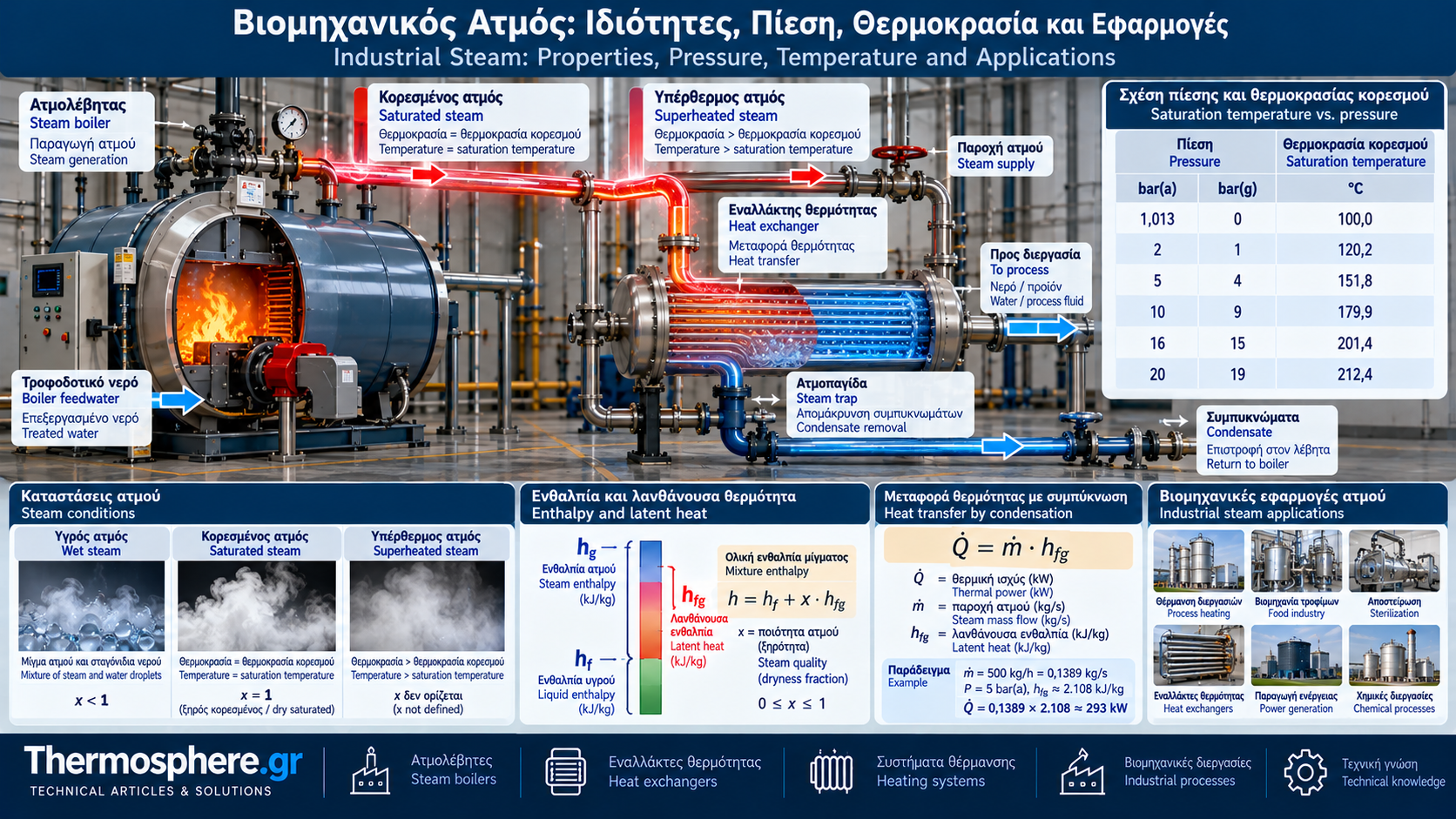
# Industrial Steam: Properties, Pressure, Temperature and Applications
## Introduction
Steam is one of the most important heat transfer media used in industrial facilities. It is widely applied in steam boilers, heat exchangers, thermal processes, sterilization systems, power generation and industrial heating.
Its widespread use is mainly due to its ability to transfer substantial energy during condensation, its relatively convenient distribution through piping and the possibility of controlling saturated steam temperature through pressure.
Proper steam system design and safe operation require an understanding of pressure, saturation temperature, enthalpy, latent heat and steam quality.
## 1. What Is Industrial Steam?
Steam is the gaseous phase of water. In industrial installations, it is typically produced by supplying heat to appropriately treated water in a steam boiler.
As water is heated, its temperature rises until it reaches the saturation temperature corresponding to the operating pressure.
During boiling, additional heat converts water into steam without increasing the temperature of the saturated mixture, provided pressure remains constant.
The energy required for this phase change is known as the latent heat of vaporization.
## 2. Saturated, Wet and Superheated Steam
### Saturated steam
Dry saturated steam exists at the saturation temperature corresponding to its pressure and contains no entrained liquid droplets.
It is widely used for heating because condensation releases substantial energy at approximately constant temperature when pressure remains stable.
### Wet steam
Wet steam is a mixture of saturated vapor and liquid water droplets.
Moisture reduces the energy available per unit total mixture mass and can increase the risk of droplet erosion, unstable operation and water hammer.
### Superheated steam
Superheated steam has a temperature above the saturation temperature at the same pressure.
It is mainly used where condensation must be avoided during expansion, such as steam turbines and certain specialized processes.
For many indirect heating applications, saturated steam is preferred because of its condensation heat transfer characteristics.
## 3. Pressure and Temperature Relationship
The saturation temperature of water increases as absolute pressure increases.
Approximate saturation temperatures are:
1.013 bar(a): 100°C.
2 bar(a): 120.2°C.
5 bar(a): 151.8°C.
10 bar(a): 179.9°C.
20 bar(a): 212.4°C.
These values apply to saturated conditions.
It is essential to distinguish:
bar(a): absolute pressure.
bar(g): gauge pressure relative to atmospheric pressure.
At atmospheric pressure of approximately 1.013 bar:
Pabs ≈ Pgauge + 1.013 bar.
Therefore, 9 bar(g) corresponds to approximately 10.013 bar(a), not 9 bar(a).
Saturation temperature depends on absolute pressure.
## 4. Steam Enthalpy
Specific enthalpy describes the energy state of a unit mass of fluid and is used in energy balance calculations.
It is commonly represented by h and expressed in kJ/kg.
Saturated steam tables provide:
hf: saturated liquid specific enthalpy.
hg: dry saturated vapor specific enthalpy.
hfg: latent enthalpy of vaporization.
The relationship is:
hfg = hg − hf.
For a saturated liquid-vapor mixture:
h = hf + x × hfg.
Where x is steam dryness fraction.
Enthalpy values depend on pressure and temperature and must be obtained from reliable steam tables or appropriate water and steam property software.
## 5. Steam Quality and Dryness Fraction
Steam quality, also called dryness fraction, is represented by x.
It is defined as:
x = mvapor / (mvapor + mliquid).
Where:
mvapor = vapor mass.
mliquid = liquid mass.
For example:
x = 1 represents dry saturated steam.
x = 0.95 means that 95% of the total saturated mixture mass is vapor and 5% is liquid water.
Steam dryness must not be confused with chemical purity or dissolved solids content.
Dryness fraction is defined for a saturated two-phase mixture and is not used as an equivalent parameter for superheated steam.
## 6. Latent Heat and Energy Transfer
The most important characteristic of steam as a heating medium is the energy released during condensation.
Inside a heat exchanger, steam transfers energy to the process fluid and becomes condensate.
For ideal condensation of dry saturated steam into saturated liquid at the same pressure:
Qdot = mdot × hfg.
Where:
Qdot = thermal power in kW when mass flow is in kg/s.
mdot = steam mass flow in kg/s.
hfg = latent enthalpy in kJ/kg.
Real systems may require a complete enthalpy balance, especially when superheat or condensate subcooling is involved.
## 7. Practical Heat Transfer Example
Consider a heat exchanger consuming:
500 kg/h of dry saturated steam.
Steam pressure: 5 bar(a).
Approximate latent enthalpy: 2,108 kJ/kg.
Convert mass flow:
500 / 3,600 = 0.1389 kg/s.
Thermal power:
Qdot = 0.1389 × 2,108.
Qdot ≈ 293 kW.
Therefore, condensing 500 kg/h of dry saturated steam under these conditions can release approximately 293 kW of thermal power.
This is an ideal calculation. Actual useful heat depends on operating conditions and system losses.
## 8. Steam Tables
Steam tables provide thermodynamic properties such as:
- Saturation temperature.
- Specific enthalpy.
- Specific volume.
- Specific entropy.
- Latent enthalpy.
- Superheated steam properties.
Reliable calculations use appropriate industrial property formulations, such as IAPWS-IF97.
Steam tables must be used with consistent units and correct identification of the thermodynamic state.
## 9. Specific Volume and Pipe Sizing
Specific volume represents the volume occupied by one kilogram of steam and is typically expressed in m³/kg.
Volumetric flow is calculated using:
Vdot = mdot × v.
Where:
Vdot = volumetric flow rate.
mdot = mass flow rate.
v = specific volume.
As pressure decreases, saturated steam specific volume generally increases significantly.
Operating pressure therefore affects pipe diameter, steam velocity and pressure losses.
## 10. Steam Quality and Operating Problems
Entrained water droplets may cause:
- Reduced heat exchanger performance.
- Droplet erosion.
- Unstable valve operation.
- Water hammer.
- Problems in sensitive industrial processes.
Steam quality is affected by boiler operation, water level, dissolved solids, load fluctuations and proper steam line drainage.
Important measures include:
- Suitable moisture separation.
- Effective condensate removal.
- Adequate pipe insulation.
- Stable boiler operation.
- Appropriate water treatment.
## 11. Saturated or Superheated Steam?
Selection depends on the application.
Saturated steam is commonly suitable for:
- Heat exchangers.
- Industrial heating.
- Thermal processing.
- Selected sterilization applications.
Superheated steam is suitable for:
- Steam turbines.
- Certain high-temperature processes.
- Applications requiring a specific degree of superheat.
Superheated steam is not automatically more efficient for every heating application.
## 12. Industrial Steam Applications
Industrial steam is used in:
- Power generation.
- Industrial heat exchangers.
- Food processing.
- Pharmaceutical processes.
- Chemical manufacturing.
- Textile production.
- Paper manufacturing.
- Cleaning and sterilization.
- Industrial heating systems.
Required steam quality depends on the process. Direct-contact and specialized hygienic applications may require specific steam purity standards.
## 13. Steam and Condensate
When steam transfers its heat, it becomes liquid water known as condensate.
Condensate often retains substantial sensible heat and, provided its quality is suitable, may be returned to the steam generation system.
Condensate recovery can reduce:
- Makeup water consumption.
- Chemical treatment requirements.
- Energy required to heat boiler feedwater.
- Hot-water discharge losses.
Proper steam trap operation, condensate return piping and condensate collection equipment are critical to system performance.
## 14. Steam System Safety
Pressurized steam contains substantial thermal energy and can cause severe injuries.
Important safety measures include:
- Suitable pressure-rated equipment.
- Functional safety valves.
- Proper steam line drainage.
- Water hammer prevention.
- Insulation of hot surfaces.
- Safe isolation and depressurization procedures.
- Inspections and maintenance by qualified personnel.
Protective devices must never be bypassed, and work on pressurized equipment must follow approved safety procedures.
## Conclusion
Industrial steam is an effective heat transfer medium because of its phase-change properties and the ability to control saturation temperature through pressure.
Understanding enthalpy, dryness fraction, saturation temperature and specific volume is essential for steam system design and operation.
Overall plant efficiency depends not only on steam generation but also on proper distribution, condensate removal and energy recovery.
Thermosphere.gr – Technical Knowledge for Professionals.