
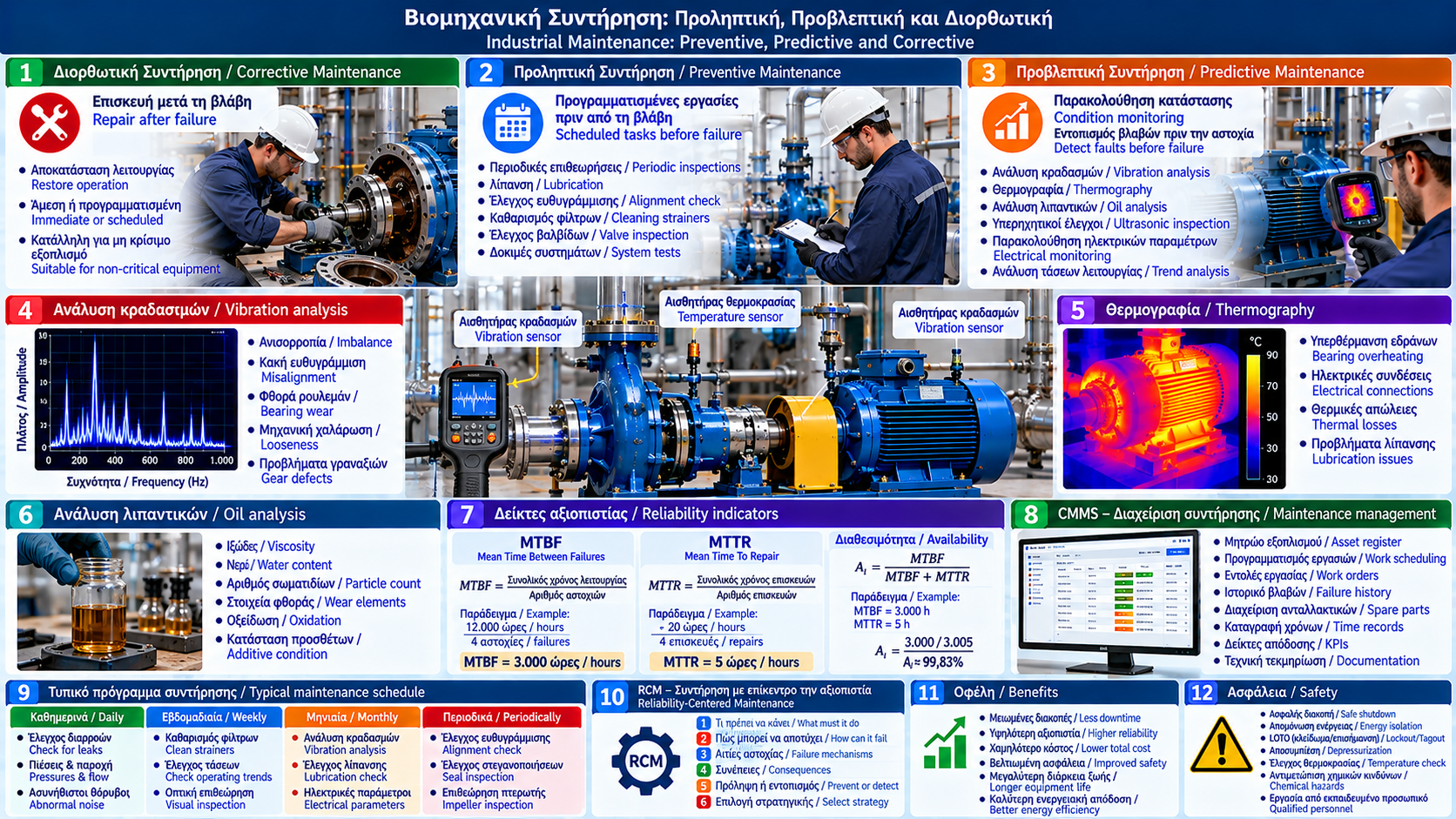
# Industrial Maintenance: Preventive, Predictive and Corrective Strategies
## Introduction
Industrial maintenance is essential for the safe, reliable and economical operation of production facilities.
Steam boilers, pumps, electric motors, gearboxes, heat exchangers, valves and rotating equipment require systematic monitoring and appropriate maintenance activities.
An unplanned failure may interrupt production, waste energy, damage equipment and create substantial financial losses.
Modern industrial maintenance goes beyond repairing a machine after it stops working. It includes prevention strategies, condition monitoring and root cause analysis.
## 1. What Is Industrial Maintenance?
Industrial maintenance includes the technical, administrative and management actions intended to retain or restore equipment's ability to perform its required function.
Main objectives include:
- Safe plant operation.
- Reduced unplanned downtime.
- Improved reliability.
- Controlled repair costs.
- Better energy efficiency.
- Longer useful equipment life.
- Compliance with applicable safety requirements.
Effective maintenance requires a suitable strategy for each asset.
## 2. Three Main Maintenance Strategies
The most familiar approaches are:
1. Corrective maintenance.
2. Preventive maintenance.
3. Predictive maintenance.
These approaches are not necessarily competing alternatives.
Industrial plants may apply different strategies depending on equipment criticality, design and failure consequences.
## 3. Corrective Maintenance
Corrective maintenance is performed after a fault or malfunction has been identified, with the objective of restoring the required function.
It may be immediate or scheduled, depending on the severity of the problem.
Examples include:
- Replacing a failed bearing.
- Repairing a leak.
- Replacing a damaged coupling.
- Restoring an electric motor.
- Repairing a malfunctioning valve.
Corrective maintenance does not always mean that equipment has completely stopped operating. An identified degradation may be corrected before final failure.
## 4. Advantages and Limitations of Corrective Maintenance
Advantages:
- Fewer scheduled interventions.
- Avoidance of unnecessary replacement of certain components.
- Suitable for selected low-cost, noncritical assets.
Limitations:
- Potential unplanned downtime.
- Higher risk of secondary damage.
- Difficult spare-parts planning.
- Potentially expensive emergency repairs.
Run-to-failure should be a deliberate, documented strategy rather than the result of neglected maintenance.
It is unsuitable where failure may create serious safety, environmental or critical production consequences.
## 5. Preventive Maintenance
Preventive maintenance is performed before a failure occurs, with the aim of reducing the probability of failure or degradation.
It may be based on:
- Time intervals.
- Operating hours.
- Number of cycles.
- Scheduled inspections.
- Defined condition criteria.
Examples include:
- Periodic bearing lubrication.
- Alignment checks.
- Mechanical seal inspection.
- Strainer cleaning.
- Coupling inspection.
- Protective system testing.
Intervals should be determined using manufacturer guidance, operating experience, criticality and available data.
## 6. Benefits and Limitations of Preventive Maintenance
Benefits:
- Better work scheduling.
- Reduction of some unplanned failures.
- Easier spare-parts management.
- Systematic equipment inspection.
Limitations:
- Planned shutdowns may be necessary.
- Some interventions may be unnecessary.
- Not all failures can be prevented.
- Incorrect intervals may increase costs or risks.
Excessive maintenance can also introduce problems such as incorrect reassembly or component contamination.
## 7. Predictive Maintenance
Predictive maintenance uses equipment condition data and analysis to estimate how faults may develop and when intervention should be planned.
It commonly relies on condition monitoring techniques.
Main methods include:
- Vibration analysis.
- Thermography.
- Lubricant analysis.
- Ultrasonic inspection.
- Electrical parameter monitoring.
- Pressure, flow and temperature monitoring.
- Operating trend analysis.
Predictive maintenance is a more specific form of condition-based maintenance when condition information is used to forecast future degradation.
A single measurement does not automatically provide a reliable failure prediction.
## 8. Vibration Analysis
Vibration analysis is primarily used for rotating equipment:
- Pumps.
- Electric motors.
- Fans.
- Gearboxes.
- Compressors.
- Turbines.
Suitable sensors can measure vibration acceleration, velocity or displacement.
Frequency analysis helps identify possible problems such as:
- Imbalance.
- Misalignment.
- Mechanical looseness.
- Bearing defects.
- Gear problems.
Accurate diagnosis requires knowledge of rotational speed, machine geometry and operating conditions.
## 9. Thermography
Infrared thermography provides an image of surface temperature distribution.
Applications include:
- Bearing inspection.
- Detection of overheating connections.
- Electrical panel inspection by qualified personnel.
- Thermal insulation assessment.
- Monitoring thermal anomalies in machinery.
Thermographic temperature readings are affected by emissivity, reflections, distance and environmental conditions.
A hot spot is an indication requiring interpretation, not automatic proof of failure.
## 10. Lubricant Analysis
Lubricant condition can provide valuable information about machine health.
Common parameters include:
- Viscosity.
- Water content.
- Particle count.
- Wear elements.
- Oxidation.
- Additive condition.
Lubricant analysis is used in gearboxes, lubrication systems, hydraulic equipment and other suitable assets.
Results should be evaluated against lubricant specifications, manufacturer limits and historical measurements.
## 11. Ultrasonic Inspection
Ultrasonic techniques can help identify:
- Compressed air leaks.
- Certain bearing problems.
- Steam trap malfunctions.
- Abnormal friction-related sounds.
- Electrical discharges with suitable equipment and procedures.
Effectiveness depends on the application, sensor, inspection method and operator competence.
## 12. Criticality-Based Maintenance
Not all equipment requires the same maintenance intensity.
Criticality can be assessed using:
- Safety consequences.
- Environmental impact.
- Production downtime cost.
- Failure probability.
- Ability to detect deterioration.
- Availability of standby equipment.
- Repair time.
- Spare-parts availability.
A critical production motor may require continuous vibration monitoring, while a noncritical auxiliary asset may be adequately managed through periodic inspections.
## 13. Reliability-Centered Maintenance (RCM)
Reliability-centered maintenance is a structured approach to selecting appropriate maintenance activities.
It considers:
1. Required equipment functions.
2. Functional failures.
3. Failure mechanisms.
4. Failure consequences.
5. Available prevention or detection methods.
6. Technically and economically appropriate strategies.
RCM does not mean that every machine needs more maintenance.
Its objective is to select effective activities based on risk and failure consequences.
## 14. Root Cause Analysis (RCA)
Root cause analysis investigates the underlying reasons for equipment failure.
Example:
A pump mechanical seal repeatedly leaks.
Replacing the seal temporarily restores operation.
Further investigation may identify:
- Misalignment.
- Dry running.
- Insufficient cooling.
- Incompatible materials.
- Excessive vibration.
RCA aims to eliminate or control the causes of repeated failure.
## 15. Mean Time Between Failures (MTBF)
MTBF represents the average operating time between failures for repairable equipment, using a consistent failure definition and observation period.
A practical estimate is:
MTBF = Total operating time / Number of failures.
Example:
A pump operates for 12,000 hours and experiences four recorded failures.
MTBF = 12,000 / 4.
MTBF = 3,000 hours.
This describes the observed failure history and does not guarantee that the next failure will occur after 3,000 hours.
## 16. Mean Time To Repair (MTTR)
MTTR is commonly used for the average active repair time.
The exact definition should be stated, because some organizations include waiting and logistical delays in their restoration metrics.
Illustrative calculation:
MTTR = Total repair time / Number of repairs.
Example:
Four repairs require 20 hours of active repair work.
MTTR = 20 / 4.
MTTR = 5 hours.
Repair time can be reduced through spare-parts availability, technical documentation and effective work planning.
## 17. Equipment Availability
In a simplified repairable-equipment model, using consistent time definitions, inherent availability can be estimated as:
Ai = MTBF / (MTBF + MTTR).
For MTBF = 3,000 hours and MTTR = 5 hours:
Ai = 3,000 / 3,005.
Ai ≈ 99.83%.
This is a theoretical inherent availability estimate and may exclude spare-parts delays, administrative time and planned downtime.
Actual operational availability may differ substantially.
## 18. Computerized Maintenance Management Systems
A CMMS is software used to organize and track maintenance work.
Typical functions include:
- Equipment registers.
- Maintenance scheduling.
- Work orders.
- Failure history.
- Spare-parts management.
- Repair time records.
- Performance indicators.
- Technical documentation.
CMMS effectiveness depends on data quality and consistent use by maintenance personnel.
## 19. Industrial Pump Station Maintenance Example
Consider an industrial pumping station with:
- Three centrifugal pumps.
- Three electric motors.
- Isolation valves.
- Suction strainers.
- Pressure and flow instruments.
Illustrative strategy:
Daily or each shift:
Check leakage, pressures, flow and abnormal noise.
Weekly:
Inspect strainers, auxiliary systems and operating trends.
Monthly or according to plan:
Analyze vibration, review electrical parameters and assess lubrication.
Periodically:
Check alignment, seals and impeller condition when required.
Intervals are illustrative and should be adapted to manufacturer instructions and asset criticality.
## 20. Industrial Maintenance Safety
Before intervention, a suitable risk assessment is required.
Key steps include:
- Safely stopping equipment.
- Isolating electrical and other hazardous energy.
- Applying lockout/tagout where required.
- Depressurizing systems.
- Draining safely.
- Checking temperature.
- Managing chemical hazards.
- Verifying a safe condition before work.
Maintenance should be carried out by appropriately trained and authorized personnel.
## 21. Selecting the Right Maintenance Strategy
The appropriate strategy depends on:
1. Equipment criticality.
2. Potential failure consequences.
3. Degradation mechanisms.
4. Detectability of deterioration.
5. Inspection and repair costs.
6. Spare-parts availability.
7. Manufacturer guidance.
8. Applicable safety requirements.
9. Plant operating experience and data.
The most effective approach is usually a combination of corrective, preventive and predictive activities.
## Conclusion
Industrial maintenance is a strategic function in modern production facilities.
Corrective maintenance restores equipment after identified faults, preventive maintenance reduces failure probability through organized activities, and predictive maintenance uses data to estimate future degradation.
Vibration analysis, thermography, lubricant analysis, MTBF and MTTR indicators, and CMMS platforms support improved asset management.
The ultimate objective is not to perform more maintenance tasks, but to achieve safe and reliable operation at an appropriate total cost.
Thermosphere.gr – Technical Knowledge for Professionals.