
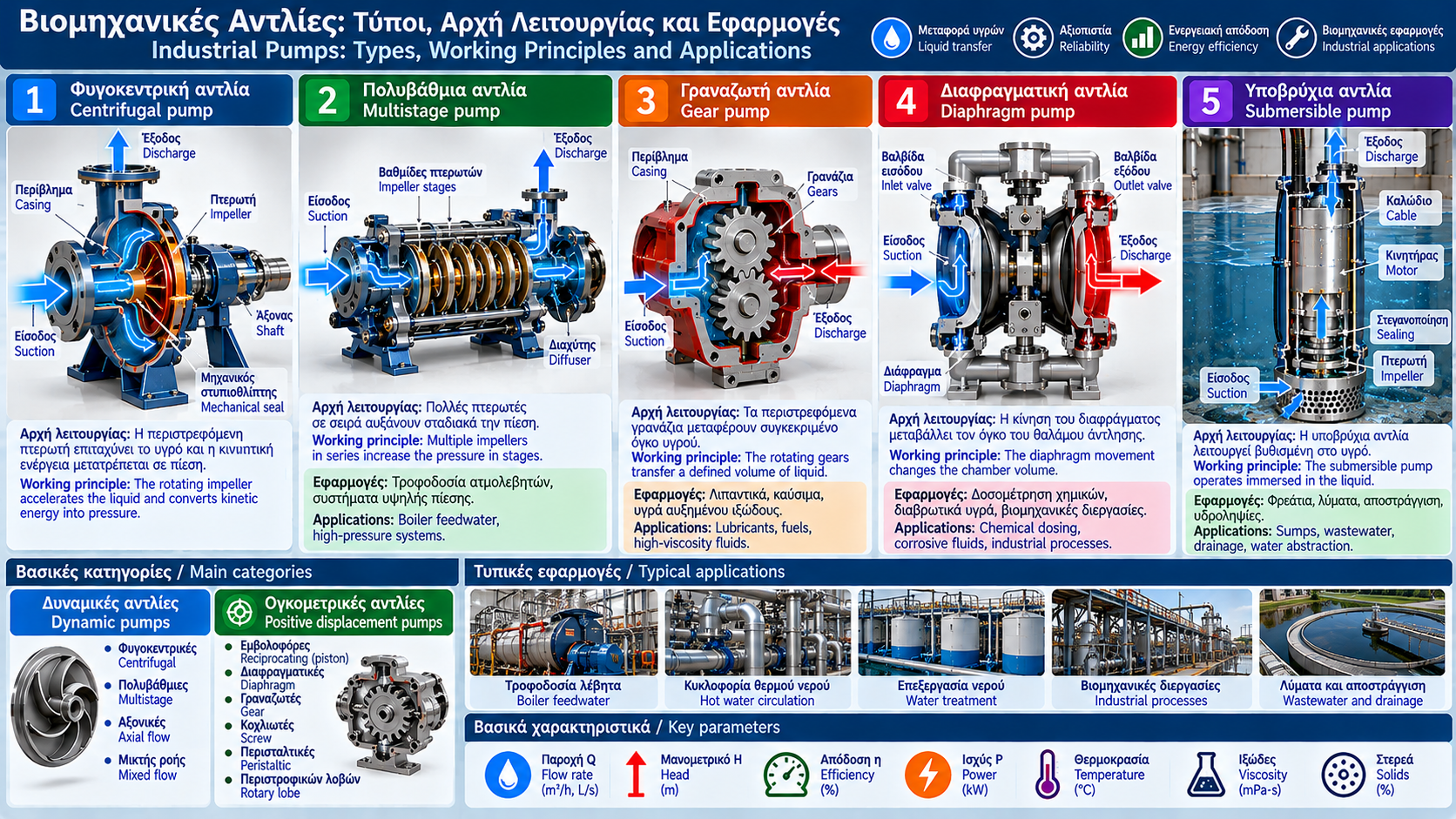
# Industrial Pumps: Types, Working Principles and Applications
## Introduction
Industrial pumps are essential mechanical equipment for transferring liquids in manufacturing plants, water treatment facilities, heating systems and industrial processes.
They are used for water circulation, boiler feedwater supply, chemical transfer, wastewater pumping and many other applications.
Selecting the correct pump directly affects energy consumption, plant reliability and maintenance costs.
No single pump type is suitable for every application. Each duty requires consideration of flow, pressure, liquid properties and actual operating conditions.
## 1. What Is an Industrial Pump?
A pump is a machine that transfers energy to a liquid, allowing it to move through piping and equipment.
This energy may be used to:
- Overcome elevation differences.
- Compensate for friction losses in pipes.
- Feed equipment operating under pressure.
- Circulate liquid in closed loops.
- Transfer liquids between tanks.
Pumps do not create liquid or increase its total quantity. They add mechanical energy to the flow.
## 2. Two Main Pump Families
Most industrial pumps belong to two broad categories:
1. Dynamic pumps.
2. Positive displacement pumps.
The main difference lies in how energy is transferred and how flow responds to changes in system pressure.
## 3. Dynamic Pumps
Dynamic pumps transfer energy to the liquid through a rotating or other dynamic mechanism.
The most common type is the centrifugal pump.
### Centrifugal Pumps
A centrifugal pump contains an impeller rotating inside a suitable casing.
Liquid enters the impeller suction region and gains energy as it passes through the blades.
Part of its kinetic energy is then converted into pressure inside the casing or diffuser.
Main components include:
- Impeller.
- Casing.
- Shaft.
- Bearings.
- Mechanical seal or other sealing arrangement.
- Suction nozzle.
- Discharge nozzle.
Centrifugal pumps are widely used because they provide continuous flow, have relatively simple construction and suit many water applications.
## 4. Advantages and Limitations of Centrifugal Pumps
Advantages:
- Continuous and relatively smooth flow.
- Wide range of available sizes.
- Suitable for many clean or appropriately handled liquids.
- Speed control capability.
- Broad availability of spare parts.
Limitations:
- Flow depends on system head.
- Efficiency decreases when operation moves significantly away from the optimum point.
- Entrained gases can affect suction performance.
- Cavitation may occur under unsuitable conditions.
- High viscosity can significantly reduce performance.
## 5. Single-Stage and Multistage Pumps
### Single-Stage Pumps
Single-stage pumps contain one main impeller.
They are used in many circulation and transfer applications where the required head can be developed by one stage.
### Multistage Pumps
Multistage pumps contain two or more impellers arranged in successive stages.
Each stage adds energy to the liquid, allowing higher total head.
Common applications include:
- Boiler feedwater supply.
- High-pressure water systems.
- Industrial water treatment.
- Reverse osmosis plants.
- Water transfer requiring elevated pressure.
The term multistage describes pump construction rather than a separate fundamental pump family.
## 6. Axial and Mixed-Flow Pumps
Dynamic pumps also include axial-flow and mixed-flow designs.
### Axial-Flow Pumps
Liquid moves mainly parallel to the impeller axis.
These pumps are commonly used for high-flow, relatively low-head applications.
### Mixed-Flow Pumps
Mixed-flow pumps combine axial and radial flow components.
They can serve duties with characteristics between radial centrifugal and axial-flow pumps.
Selection depends on plant requirements.
## 7. Positive Displacement Pumps
Positive displacement pumps transfer defined liquid volumes through repeated mechanical movement.
Unlike centrifugal pumps, their flow is primarily related to operating speed and displacement volume.
Actual flow can be affected by internal leakage, viscosity and differential pressure.
Main types include:
- Reciprocating piston pumps.
- Diaphragm pumps.
- Gear pumps.
- Screw pumps.
- Peristaltic pumps.
- Rotary lobe pumps.
Positive displacement pumps require appropriate overpressure protection. They must not operate against a closed discharge without the specified protective arrangement.
## 8. Piston and Diaphragm Pumps
### Piston Pumps
Piston movement changes the available volume inside a pumping chamber.
During suction, liquid enters the chamber. During discharge, liquid is pushed into the system.
These pumps are used where controlled flow or high pressure is required.
### Diaphragm Pumps
A flexible diaphragm changes the pumping chamber volume.
Depending on design, these pumps can be used for:
- Chemical dosing.
- Corrosive liquid transfer.
- Water treatment.
- Industrial processing.
Air-operated double-diaphragm pumps (AODD) are a distinct category used for many liquid transfer duties.
## 9. Gear and Screw Pumps
### Gear Pumps
Gear pumps use rotating gears to move liquid from suction to discharge.
They are often suitable for lubricating fluids and higher-viscosity liquids when permitted by material compatibility and manufacturer specifications.
### Screw Pumps
Screw pumps use one or more rotating screws.
Depending on design, they can provide smooth liquid transfer with relatively low pulsation.
Applications include lubricants, fuels and other industrial fluids.
## 10. Submersible Pumps
Submersible pumps are designed so that the pumping assembly, and usually the motor, operate immersed in the liquid according to their construction.
They are used in:
- Sumps.
- Pumping stations.
- Wastewater treatment plants.
- Drainage systems.
- Water abstraction.
The term submersible describes installation arrangement, not necessarily the hydraulic pumping principle.
Many submersible pumps are centrifugal pumps.
## 11. Main Operating Parameters
### Flow Rate
Flow rate is the quantity of liquid transferred per unit time.
Common units include:
- m³/h.
- L/s.
- m³/s.
### Pump Head
Head represents the energy per unit weight added to the liquid by the pump.
It is normally expressed in meters of liquid column.
It is not necessarily equal to the installation's geometric elevation difference.
### Efficiency
Efficiency indicates the proportion of mechanical power supplied to the pump that becomes useful hydraulic power.
### Power
Required power depends on flow, head, density and efficiency.
## 12. Pump Hydraulic Power
Hydraulic power is calculated as:
Ph = ρ × g × Q × H.
Where:
Ph = hydraulic power in W.
ρ = liquid density in kg/m³.
g = gravitational acceleration, approximately 9.81 m/s².
Q = volumetric flow in m³/s.
H = pump head in m.
Required pump shaft power is:
Pshaft = Ph / ηpump.
Here ηpump is the overall pump efficiency as defined by the manufacturer's performance curve.
Electrical input power must also account for motor efficiency and, where applicable, variable frequency drive efficiency.
## 13. Pump Power Calculation Example
Consider a centrifugal water pump with:
Flow: 50 m³/h.
Head: 40 m.
Density: 1,000 kg/m³.
Pump efficiency: 70%.
Flow conversion:
Q = 50 / 3,600 = 0.01389 m³/s.
Hydraulic power:
Ph = 1,000 × 9.81 × 0.01389 × 40.
Ph ≈ 5,450 W = 5.45 kW.
Shaft power:
Pshaft = 5.45 / 0.70.
Pshaft ≈ 7.79 kW.
Motor selection must not rely solely on this value.
Maximum power demand over the allowable operating range, startup conditions and manufacturer recommendations must also be checked.
## 14. Performance Curves and BEP
Centrifugal pumps are supplied with performance curves showing the relationship between flow and head.
Typical curves include:
- Q-H curve.
- Efficiency curve.
- Required power curve.
- NPSH3 curve or equivalent suction performance information.
BEP (Best Efficiency Point) is the point at which the pump reaches its maximum efficiency for a specified speed and impeller diameter.
Extended operation far outside the suitable operating range can increase vibration, hydraulic loading and wear.
The actual operating point is determined by the intersection of the pump curve and system curve.
## 15. What Is Cavitation?
Cavitation occurs when local liquid pressure falls sufficiently for vapor bubbles to form.
When these bubbles enter higher-pressure regions, they collapse and may cause damage.
Symptoms include:
- Noise.
- Vibration.
- Reduced efficiency.
- Unstable operation.
- Impeller erosion.
Suction performance is evaluated using available NPSH (NPSHa) and the manufacturer's required NPSH.
Proper design must provide an appropriate cavitation margin.
## 16. Industrial Applications
### Boiler Feedwater
Multistage centrifugal pumps are commonly used because sufficient pressure is required to introduce water into the boiler.
### Hot Water Circulation
Circulation pumps maintain flow through heat exchangers, boilers and heating networks.
### Water Treatment
Pumps are used for water transfer, filtration, reverse osmosis and chemical dosing.
### Industrial Processing
Selection depends on temperature, viscosity, corrosiveness and chemical compatibility.
### Wastewater and Drainage
Pumps with hydraulic characteristics suitable for solids, fibers and potential contaminants are used.
## 17. How to Select the Right Pump
Correct selection requires:
1. Defining normal and maximum flow.
2. Calculating total required head.
3. Recording temperature and density.
4. Checking viscosity and solids content.
5. Assessing material compatibility.
6. Evaluating suction conditions.
7. Reviewing performance curves.
8. Calculating required power.
9. Assessing energy efficiency.
10. Planning maintenance and redundancy where necessary.
Selection based only on pipe diameter or motor rating is insufficient.
## 18. Common Operating Problems
Common pump problems include:
- Reduced flow.
- Insufficient head.
- Loss of prime.
- Air ingress at suction.
- Cavitation.
- Seal leakage.
- Bearing overheating.
- Excessive vibration.
- Impeller wear.
- Motor overload.
Diagnosis should combine pressure, flow, temperature, vibration and electrical measurements.
## 19. Safety and Standards
Pumps must be installed and operated according to manufacturer instructions and applicable safety requirements.
Depending on the application, relevant standards may include:
- ISO 5199 for technical specifications of certain centrifugal pumps.
- ISO 2858 for dimensions and nominal duty points of specified centrifugal pumps.
- ISO 9906 for hydraulic performance acceptance testing.
- ISO 20816 for machine vibration evaluation where applicable.
Before maintenance, appropriate energy isolation, depressurization, drainage and checks of liquid temperature and hazards are required.
## Conclusion
Industrial pumps are fundamental equipment for liquid transfer in modern technical installations.
Centrifugal pumps serve a wide range of water transfer and circulation applications, while positive displacement pumps are frequently used where controlled delivery, high pressure or specialized fluid handling is required.
Correct selection depends on flow, head, efficiency, suction conditions and material compatibility.
Understanding these parameters provides the foundation for industrial pump sizing, energy optimization and maintenance.
Thermosphere.gr – Technical Knowledge for Professionals.