
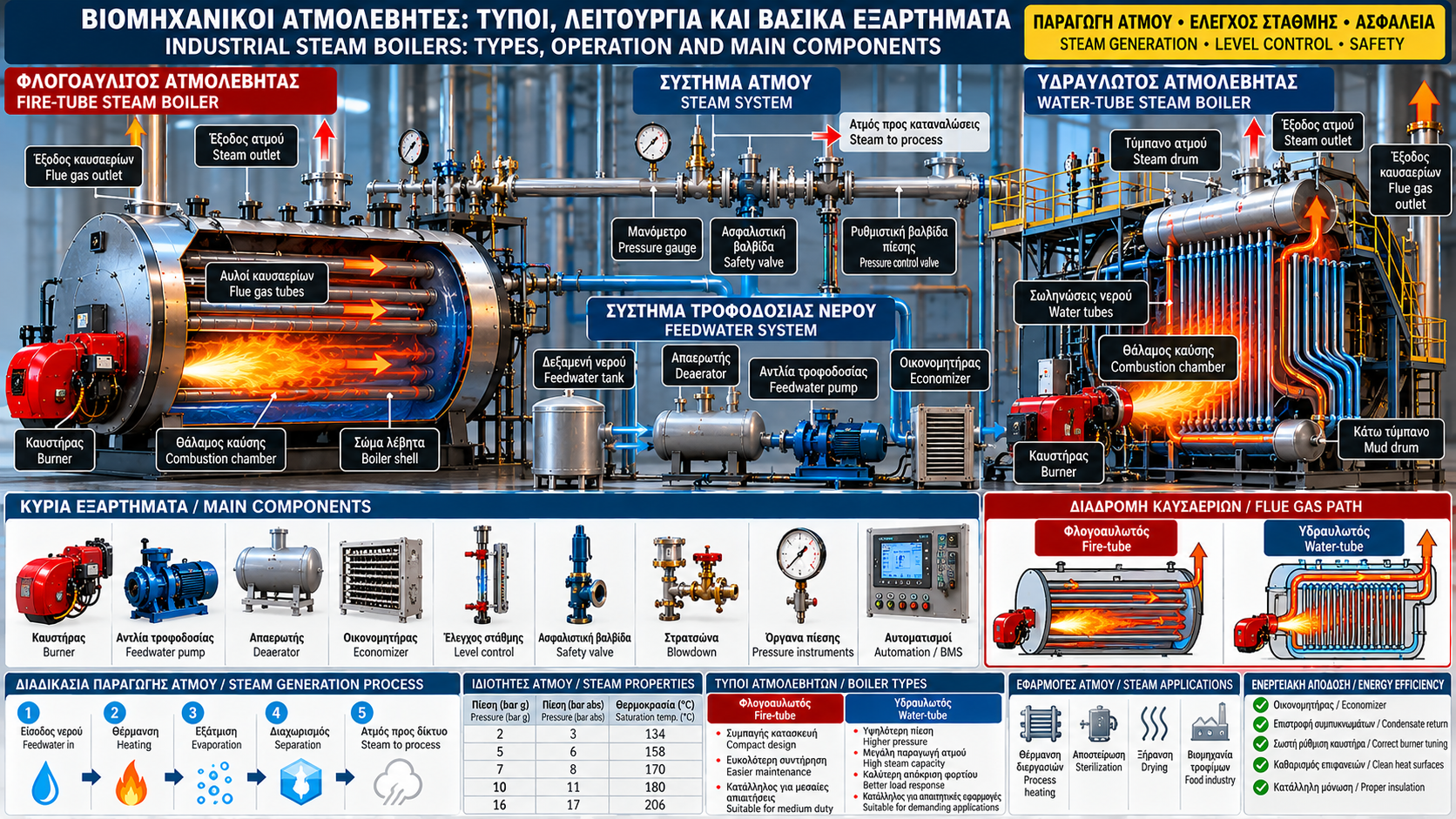
# Industrial Steam Boilers: Types, Operation, Main Components and Steam Generation
## Introduction
Industrial steam boilers are essential thermal-energy equipment in facilities that use steam for heating, product processing and industrial operations.
They are widely used in food processing, chemical manufacturing, material treatment, sterilization and numerous other applications.
Their operating principle is the transfer of heat to water to generate steam at the required pressure and flow rate.
Boiler selection and operation require an understanding of construction, thermal capacity, feedwater systems, protective devices and water quality.
## 1. What Is an Industrial Steam Boiler?
A steam boiler is equipment in which heat is transferred to water to produce steam under controlled conditions.
Heat may come from fuel combustion, electricity or another suitable energy source.
In conventional fired boilers, heat passes from combustion gases through heating surfaces into the water.
The generated steam is delivered to a distribution system for use by plant consumers.
## 2. Industrial Applications of Steam
Steam is used for heating heat exchangers, sterilization, cleaning, drying, food processing and other thermal operations.
In many applications, steam condenses while releasing its latent heat of vaporization.
The resulting condensate can be returned to the feedwater system when its quality is acceptable.
Effective steam and condensate management significantly influences energy and water consumption.
## 3. Fire-Tube Steam Boilers
In fire-tube boilers, hot combustion gases flow through tubes surrounded by water.
These boilers commonly include a furnace and several flue-gas passes inside the boiler shell.
They are widely used in industrial applications with suitable steam-pressure and production requirements.
Advantages may include relatively compact construction and accessible maintenance arrangements.
Suitability depends on rated pressure, steam output, load variation and plant characteristics.
## 4. Water-Tube Steam Boilers
In water-tube boilers, water and the water-steam mixture circulate inside tubes heated externally by combustion gases.
The arrangement may include steam drums, mud drums, headers and circulation systems.
Water-tube boilers are frequently used in higher-pressure or higher-capacity applications, depending on their design.
Their construction can accommodate various superheating and heat-recovery arrangements.
Selection requires detailed engineering and appropriate water-quality control.
## 5. Fire-Tube Versus Water-Tube Boilers
The main difference is the relative position of water and combustion gases at the heating surfaces.
In fire-tube boilers, combustion gases flow inside tubes surrounded by water.
In water-tube boilers, water circulates inside tubes exposed externally to hot gases.
Selection depends on required steam output, pressure, load response, available space and maintenance requirements.
## 6. Main Boiler Components
An industrial steam boiler may include a pressure vessel, combustion chamber, heating surfaces, burner equipment, steam outlet and feedwater connections.
Additional components include pressure instruments, level-control systems, safety valves, blowdown systems and automation.
Depending on the installation, economizers, superheaters and water-treatment equipment may also be present.
Individual components are selected according to the approved design.
## 7. Furnace and Heat Transfer
The furnace is the space in which heat is released through combustion.
Energy is transferred to boiler heating surfaces mainly by radiation and convection.
Flame geometry must be compatible with the combustion chamber.
Incorrect burner settings or deposits can reduce heat transfer and increase thermal stresses.
## 8. How Is Steam Generated?
Feedwater enters the boiler and absorbs heat through the available heating surfaces.
As energy is added, water temperature increases toward saturation conditions at the operating pressure.
Further heat input causes part of the water to evaporate.
The resulting steam is separated and delivered to the distribution system according to the boiler design.
## 9. Saturated and Superheated Steam
Saturated steam is at the saturation temperature corresponding to its pressure.
Superheated steam has a temperature above saturation at the same pressure.
Saturated steam is widely used for process heat transfer.
Superheated steam is used where different thermodynamic conditions are required, including some power-generation systems.
The choice depends on process requirements.
## 10. Steam Pressure and Temperature
Pressure is a fundamental steam-boiler operating parameter.
For saturated steam, temperature depends on absolute pressure.
For example, at approximately 10 bar absolute, water saturation temperature is about 180 °C.
A conventional pressure gauge often displays pressure relative to atmospheric pressure, which must not be confused with absolute pressure.
Accurate values should be obtained from reliable steam tables or thermodynamic software.
## 11. Boiler Steam Capacity
Steam capacity is commonly expressed in kg/h or t/h.
Rated capacity should be accompanied by the operating conditions to which it refers.
The required useful heat input depends on the specific-enthalpy difference between generated steam and feedwater.
A basic relationship is:
Q̇ = ṁ × (hsteam − hfeedwater)
Here, Q̇ represents useful thermal power, ṁ is mass flow rate and h is specific enthalpy.
Consistent units and appropriate assumptions are required when applying this relationship.
## 12. Feedwater System
Water converted to steam must be replenished in a controlled manner.
The feedwater system may include a tank, deaerator, pumps, valves and control devices.
Pump discharge pressure must be sufficient to supply the boiler under specified operating conditions.
Pump selection requires consideration of flow rate, total dynamic head, suction conditions and water temperature.
## 13. Water-Level Control
Water level is a critical safety-related parameter.
The feedwater control system maintains level within the specified operating range.
Depending on the installation, single-element, two-element or three-element control may be used.
Normal level regulation is separate from low-water-level protection.
Low-water protection must provide the required reliability and safe response.
## 14. Shrink and Swell
Boiler water-level indications can change temporarily due to variations in pressure and the volume of steam bubbles within the water.
Swell is a temporary increase in apparent level that may occur, for example, after a sudden increase in steam demand.
Shrink is a corresponding temporary decrease under other transient conditions.
These effects influence water-level control design.
They must not be confused with an actual increase or loss of the total water inventory.
## 15. Feedwater Quality
Water quality directly affects boiler safety, efficiency and service life.
Hardness, dissolved salts, oxygen, carbon dioxide and other contaminants can cause problems.
Deposits reduce heat transfer and may produce localized overheating.
Corrosion can compromise the integrity of metal surfaces.
Water-quality requirements depend on boiler type, operating pressure and manufacturer guidance.
## 16. Deaerators and Dissolved-Gas Removal
A deaerator reduces dissolved gases, particularly oxygen, in boiler feedwater.
Its operation may involve heating the water and removing released gases.
Performance depends on temperature, pressure, flow rate and design.
The deaerator is part of the overall water-treatment program and does not replace every other chemical-control requirement.
## 17. Blowdown and Dissolved-Solids Control
During steam generation, many dissolved substances remain in the boiler water.
Their concentration may increase over time.
Blowdown removes a controlled quantity of water to manage dissolved solids and other unwanted substances.
Continuous and intermittent blowdown systems may be used, depending on the design.
Excessive blowdown wastes water and energy, while insufficient blowdown can worsen boiler-water quality.
## 18. Safety Valves
Safety valves protect pressure equipment against unacceptable overpressure according to the design and applicable requirements.
Selection depends, among other factors, on allowable pressure and required relieving capacity.
They are not intended for normal operating-pressure control.
Inspection and testing must follow applicable requirements and manufacturer instructions.
Arbitrary setpoint changes or isolation of protective devices are unacceptable.
## 19. Low-Water and High-Pressure Protection
Low water level can cause dangerous overheating of boiler heating surfaces.
Excessive pressure can exceed equipment design limits.
Suitable protective shutdown devices are therefore used, independently of normal operating control where required.
These functions must be selected, tested and maintained according to the approved engineering design.
## 20. Burner and Steam-Pressure Control
The burner supplies the thermal energy required for steam generation.
In modulating systems, firing rate may be adjusted to demand using a steam-pressure controller.
Modulation can reduce unnecessary cycling when equipment is correctly selected and tuned.
Operating-pressure control does not replace independent overpressure protection.
## 21. Economizers and Heat Recovery
An economizer recovers part of the heat contained in flue gas to preheat feedwater.
This reduces the energy required inside the boiler to generate the same quantity of steam.
Savings depend on flue-gas temperature, feedwater temperature and actual operating conditions.
Design must consider permissible temperatures, corrosion risks and flow resistance.
## 22. Boiler Energy Efficiency
Energy efficiency is influenced by combustion quality, flue-gas losses, blowdown, thermal losses and operating conditions.
Returning suitable condensate can reduce water, chemical and energy consumption.
Insulation, clean heating surfaces and appropriate burner tuning also contribute to efficiency.
Calculations should distinguish boiler efficiency from overall steam-system efficiency.
## 23. Maintenance and Inspection
Preventive maintenance includes inspection of combustion equipment, water systems, instruments, automation and protective devices.
Heating-surface condition, deposits and signs of corrosion require particular attention.
Periodic inspection of pressure equipment must comply with applicable legal and technical requirements.
Work must be performed by suitably trained and authorized personnel using the required isolation procedures.
## 24. Conclusion
Industrial steam boilers combine thermodynamic processes, pressure equipment, combustion systems, feedwater supply and safety automation.
The choice between fire-tube and water-tube technology depends on actual steam-generation requirements.
Safe and efficient operation requires reliable level control, appropriate water quality, dependable protections, effective maintenance and systematic plant monitoring.