
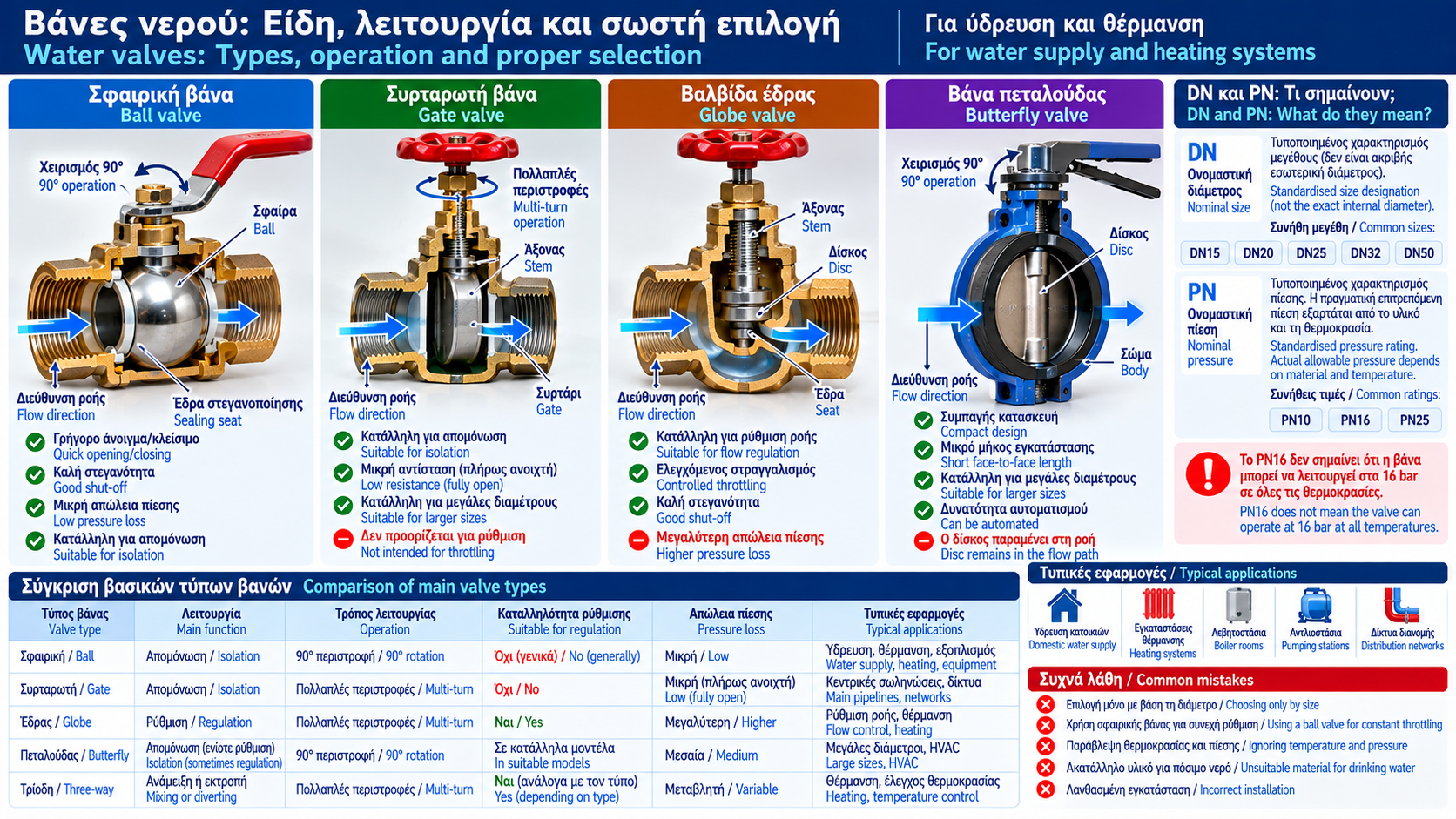
Water Valves: Types, How They Work and How to Choose the Right Valve
Water valves are essential components of plumbing and heating installations. They control, isolate, regulate or redirect water flow depending on their design.
They are found in homes, apartment buildings, boiler rooms, pumping stations, water distribution networks and industrial systems.
Although many valves appear similar externally, their operating principles and intended applications differ significantly.
A ball valve, for example, is commonly used for quick isolation, while a suitable globe valve can provide controlled throttling.
Correct valve selection affects safety, sealing performance, pressure losses, maintainability and service life.
This Thermosphere.gr guide examines the most common water valve types and the technical criteria used to select them.
1. What Is a Water Valve?
A valve is a mechanical component installed in a piping system to control fluid flow.
Depending on its design, it can provide:
Full opening.
Complete shut-off.
Partial flow regulation.
Flow diversion.
Equipment isolation for maintenance.
Not every valve is designed for continuous throttling.
The intended operating function must be confirmed using manufacturer specifications.
2. Main Types of Water Valves
Common types include:
Ball valves.
Gate valves.
Globe valves.
Butterfly valves.
Needle valves.
Three-way mixing or diverting valves.
Each category has a different internal geometry, operating mechanism and hydraulic behaviour.
3. Ball Valves: A Common Isolation Solution
A ball valve contains a spherical element with a bore.
When the bore aligns with the pipeline, water can flow.
Rotating the ball through 90 degrees closes the passage.
Advantages
Quick opening and closing.
Simple operation.
Good shut-off performance under suitable conditions.
Low pressure loss in suitable full-bore designs when fully open.
Wide availability.
Limitations
Standard isolation ball valves are generally unsuitable for continuous throttling.
Prolonged partial opening may cause wear or noise.
Suitability depends on seat materials, pressure and temperature.
Typical Applications
Domestic water supplies, manifolds, boiler rooms, heating circuits and equipment connections.
4. What Is a Full-Bore Ball Valve?
Ball valves may have full-bore or reduced-bore designs.
A full-bore valve is designed to minimise flow restriction compared with a reduced-bore valve.
This can reduce hydraulic losses.
However, actual resistance should be assessed using the manufacturer’s Kv coefficient or pressure-drop data.
Full-bore does not mean exactly zero pressure loss.
5. How Does a Gate Valve Work?
A gate valve uses an internal closure element that generally moves perpendicular to the flow direction.
When opened, the element moves away from the flow passage.
A properly designed gate valve can have relatively low resistance when fully open.
Advantages
Suitable for isolation.
Available in larger diameters.
Potentially low pressure loss when fully open.
Limitations
Usually requires multiple turns to operate.
Generally not intended for prolonged throttling.
Seats and operating mechanisms may wear.
Gate valves are used in water networks, main pipelines and isolation applications.
6. Globe Valves: When Are They Used?
A globe valve uses a closure element that moves towards or away from a seat.
Its geometry can allow more controlled adjustment of flow.
Advantages
Suitable for regulation when designed for that purpose.
Controlled throttling.
Useful in circuits requiring variable flow.
Limitations
Usually higher hydraulic resistance than a fully open full-bore ball valve.
Greater pressure drop in many applications.
May require a specified installation direction.
Installation must follow manufacturer instructions and flow-direction markings.
7. How Does a Butterfly Valve Work?
A butterfly valve contains a rotating disc inside the flow passage.
Approximately 90 degrees of rotation moves it between open and closed positions.
Butterfly valves are frequently used in larger pipe sizes.
Advantages
Compact design.
Short installation length.
Can be manually or automatically actuated.
Suitable for isolation and, in selected designs, regulation.
Limitations
The disc remains within the flow passage even when open.
Hydraulic resistance therefore depends on valve design and opening angle.
Throttling suitability must be confirmed for the specific model.
8. Three-Way Valves: Mixing and Diverting
Three-way valves have three connections and serve specialised functions.
Depending on their design, they may provide:
Mixing of two streams.
Diversion between flow paths.
Temperature control.
Hydraulic control in heating systems.
Not all three-way valves operate in the same way.
Internal flow arrangements, control characteristics and installation requirements vary.
In heating systems, three-way valves are often combined with suitable actuators and automation equipment.
9. What Do DN and PN Mean?
Two important valve designations are DN and PN.
DN — Nominal Size
DN is a standardised nominal size designation.
Examples include DN15, DN20, DN25, DN32 and DN50.
DN is not necessarily the exact internal diameter in millimetres.
Actual dimensions depend on construction and connection standards.
PN — Nominal Pressure Designation
PN is a standardised numerical designation used in pressure-related component classification.
Examples include PN10, PN16 and PN25.
PN16 does not mean every valve is suitable for 16 bar at every operating temperature.
Allowable pressure depends on materials, temperature, applicable standards and manufacturer pressure-temperature ratings.
10. Brass, Stainless Steel and Plastic Valves
Brass Valves
Brass valves are widely used in domestic water and heating systems.
Alloy selection matters, particularly for potable water and conditions that may cause dezincification.
Stainless Steel Valves
Stainless steel valves are used where suitable corrosion resistance or chemical compatibility is required.
Performance depends on the stainless steel grade and operating environment.
Plastic Valves
Plastic valves may use materials such as PVC-U, PP or other suitable polymers.
They are used where fluid, temperature and pressure conditions match their specifications.
Not all plastic valves are suitable for hot water.
11. Choosing Valves for Drinking Water
Potable water applications require particular care.
Important considerations include:
Suitability of water-contact materials.
Applicable health and regulatory requirements.
Pressure and temperature ratings.
Corrosion resistance.
Seal compatibility.
Manufacturer documentation.
The description “brass” alone does not establish suitability for drinking water.
The specific product must have appropriate documentation for its intended market and application.
12. Selecting Valves for Heating Systems
Heating system valve selection should consider:
Maximum operating temperature.
Design pressure.
Heat-transfer fluid.
Glycol or other additives.
Frequency of operation.
Installation position.
Isolation or regulation requirements.
A valve suitable for cold water is not automatically suitable for hot water or water-glycol mixtures.
A standard isolation valve is also not a substitute for a dedicated balancing valve.
13. What Is the Kv Flow Coefficient?
The Kv coefficient describes the flow capacity of a valve.
For water with a relative density of approximately 1:
Q = Kv × √Δp
Where:
Q is in m³/h.
Δp is in bar.
Kv is expressed in m³/h at a pressure drop of 1 bar.
A density correction is required for other liquids.
Example
Suppose a valve has Kv = 10 and flow is 5 m³/h.
Then:
Δp = (Q/Kv)²
Δp = (5/10)²
Δp = 0.25 bar
The pressure drop is approximately 0.25 bar under these assumptions.
Kv may vary with valve opening position.
14. How Do Valves Affect Pressure Loss?
Every valve introduces some hydraulic resistance.
Resistance depends on:
Valve type.
Internal geometry.
Flow passage.
Opening position.
Flow rate.
A fully open full-bore ball valve may have low pressure loss.
A partially closed regulating valve may intentionally produce a substantial pressure drop.
Selection should use Kv, Kvs or manufacturer pressure-drop curves.
15. How Should a Water Valve Be Installed?
Installation must follow the manufacturer’s instructions.
Key requirements include:
Confirm fluid compatibility.
Check pressure and temperature limits.
Select the correct connection type.
Follow any required flow direction.
Avoid pipe-induced mechanical stresses.
Use suitable sealing materials.
Maintain access for operation and maintenance.
Perform appropriate leak testing.
Excessive tightening torque should be avoided.
For threaded connections, body material and manufacturer instructions must be considered.
16. Why Does a Valve Leak or Fail to Shut Off?
Common causes include:
Worn seals.
Damaged valve seats.
Mineral deposits.
Foreign particles.
Corrosion.
Operating mechanism wear.
Unsuitable throttling use.
Installation stress.
Leakage may be external or internal.
Internal leakage occurs when the valve fails to isolate flow completely.
The appropriate repair depends on valve design and serviceability.
Never dismantle a valve while the system remains pressurised.
17. Comparison of Common Valve Types
Valve type | Main function | Characteristic |
Ball | Isolation | Quick 90° operation |
Gate | Isolation | Usually multi-turn |
Globe | Regulation and isolation | Throttling geometry |
Butterfly | Isolation, sometimes regulation | Compact design |
Needle | Fine adjustment of small flows | Precise opening control |
Three-way | Mixing or diverting | Three connections |
Actual suitability depends on the specific valve model and application.
18. Common Valve Selection Mistakes
Choosing Only by Pipe Size
Pipe size is insufficient without pressure, temperature and operating-function checks.
Using Standard Ball Valves for Continuous Throttling
This may cause wear, noise or poor control performance.
Ignoring Temperature
Allowable pressure and seal performance may change at elevated temperatures.
Selecting Incompatible Materials
Valve materials must suit the fluid and operating environment.
Poor Installation
Pipe stress, incorrect flow direction and excessive tightening can cause failure.
Inadequate Access
Valves that cannot be operated or replaced easily complicate maintenance.
19. Frequently Asked Questions
What Is the Best Valve for a Main Water Supply?
Suitable ball isolation valves are commonly used in domestic installations. Final selection depends on size, pressure, materials and potable-water requirements.
What Is the Difference Between Ball and Gate Valves?
A ball valve uses a rotating sphere and generally operates through 90 degrees. A gate valve uses a closure element that moves within the body.
Can a Ball Valve Be Left Half Open?
Only if the specific model is suitable for that application. Standard isolation ball valves are generally not intended for continuous throttling.
What Does PN16 Mean?
It is a nominal pressure designation, not an unconditional guarantee of operation at 16 bar at all temperatures.
What Does DN25 Mean?
It is a nominal size designation, not necessarily an exact 25 mm internal diameter.
Why Does a New Valve Leak?
Possible causes include unsuitable sealing, poor installation, debris, manufacturing defects or mechanical stress.
Are All Brass Valves Suitable for Drinking Water?
No. Appropriate material suitability and compliance documentation are required.
Conclusion
Water valves are more than simple on-off devices.
Each type has a specific operating principle, hydraulic behaviour and application limits.
Ball and gate valves are primarily used for isolation, while suitable globe valves and other specialised designs can provide regulation.
Correct selection requires checking size, pressure, temperature, materials, hydraulic losses and suitability for the intended system.
The right valve is the one that safely performs the required function—not simply the one that matches the pipe diameter.
Technical References and Further Reading
EN 1074: Valves for water supply standards series.
EN 13828: Manually operated ball valves for potable water supply installations inside buildings.
EN 806: Specifications for installations inside buildings conveying water for human consumption.
EN 1333: Definition and selection of PN.
EN ISO 6708: DN nominal size designation for pipework components.
EN 12266: Industrial valve testing.
CEN: European standardisation — https://www.cencenelec.eu/
The applicability of each standard depends on valve type, application and the relevant edition.
Safety note: Before replacing or dismantling a valve, safely isolate, depressurise and, where necessary, cool the system. Work on plumbing and heating installations should be performed by appropriately qualified personnel.
Thermosphere.gr — Technical knowledge for water supply and heating systems.