
Safety Relief Valve: How It Works, Opening Pressure and Common Problems
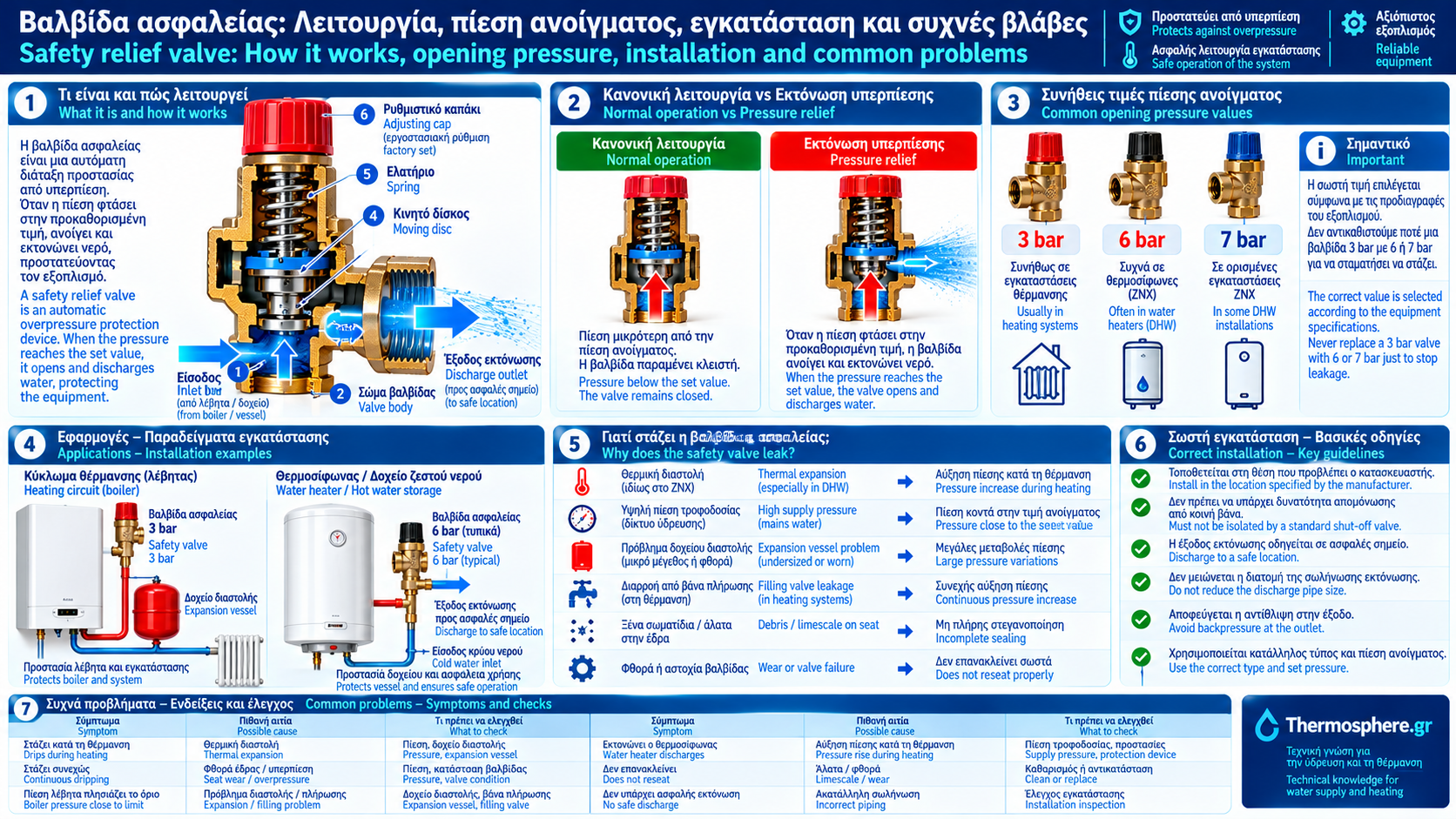
A safety relief valve is a fundamental protective component in many heating and domestic hot water installations.
Its purpose is to limit the risk of dangerous overpressure by discharging fluid when pressure reaches a specified value.
Safety valves are used in boilers, closed heating circuits, water heaters, hot water storage vessels and other pressurised applications.
A safety relief valve that leaks, opens repeatedly or fails to operate correctly should never be ignored.
It may indicate excessive pressure, thermal expansion, an expansion vessel problem, incorrect selection or deterioration of the valve itself.
This Thermosphere.gr technical guide explains how safety relief valves operate, what their pressure ratings mean and how common faults can be investigated.
1. What Is a Safety Relief Valve?
A safety relief valve is an automatic overpressure protection device.
During normal operation, it remains closed.
When pressure reaches the specified activation level, the valve begins to open according to its design characteristics.
Opening allows water or another suitable fluid to discharge, limiting further pressure increase.
When pressure decreases sufficiently, the valve may reseat.
Opening and reseating characteristics depend on the valve design and applicable standard.
2. How Does a Spring-Loaded Safety Valve Work?
A typical spring-loaded safety valve contains:
Valve body.
Fluid inlet.
Sealing seat.
Moving disc or closure element.
Spring.
Factory-calibrated or controlled adjustment mechanism.
Discharge outlet.
The spring holds the closure element against its seat.
Fluid pressure applies an opposing force.
When pressure generates sufficient force to overcome the closing force, the valve opens.
Actual behaviour depends on valve geometry and spring characteristics.
3. What Does Opening Pressure Mean?
Opening or set pressure is the value at which the valve is designed to begin activating under specified test conditions.
Common nominal ratings include:
3 bar.
6 bar.
7 bar.
8 bar.
10 bar.
These ratings are not interchangeable.
The appropriate set pressure depends on equipment design, maximum allowable pressure and applicable requirements.
Never replace a safety valve with one having a higher set pressure simply to stop leakage.
4. The 3 Bar Safety Valve in Heating Systems
Many domestic closed-loop heating systems use safety valves with a nominal set pressure of 3 bar.
This does not mean every heating system requires a 3 bar valve.
The rating must match the heating equipment and engineering design.
Under normal operating conditions, system pressure should remain below the valve’s activation pressure.
Excessive pressure rise during heating requires investigation.
5. Safety Valves on Water Heaters
Water heaters and domestic hot water storage vessels use suitable overpressure protection devices.
Depending on the equipment, nominal ratings such as 6, 7 or 8 bar may be encountered.
The correct rating must never be selected arbitrarily.
It must be compatible with:
Maximum allowable vessel pressure.
Manufacturer instructions.
Installation requirements.
Type of protective device.
Some valve assemblies combine check-valve and pressure-relief functions, but their designs and approvals differ.
6. Safety Valve Versus Pressure Reducing Valve
A pressure reducing valve and a safety relief valve serve different purposes.
Pressure Reducing Valve
Reduces and regulates downstream pressure during normal system operation.
Safety Relief Valve
Normally remains closed and opens to discharge fluid when overpressure occurs.
A pressure reducing valve does not replace a safety valve.
A safety valve is not intended for continuous pressure regulation.
7. Safety Valve Versus Check Valve
A check valve allows flow in one direction and restricts reverse flow.
A safety relief valve protects against overpressure through discharge.
These are different functions.
Some component assemblies combine several functions, but their capabilities must be confirmed in technical documentation.
8. Why Does a Boiler Safety Valve Leak?
Several causes are possible.
Excessive System Pressure
The valve may discharge water when pressure reaches its activation level.
Expansion Vessel Problems
Insufficient expansion capacity can cause excessive pressure rise during heating.
Faulty Filling Arrangement
In some systems, leakage through the filling device may allow unwanted water entry.
Seat Deterioration
After discharge, debris or wear may prevent the valve from sealing completely.
Diagnosis requires pressure measurements with the system both cold and hot.
9. Why Does a Water Heater Safety Valve Drip?
Water expands when heated.
In a hydraulically closed system, this expansion can significantly increase pressure.
When pressure reaches the activation level, the valve may discharge water.
This can occur during heating even when the valve itself is functioning correctly.
However, repeated or continuous discharge should be assessed.
Possible causes include:
Thermal expansion.
High supply pressure.
Unsuitable or defective protection equipment.
Seat deterioration.
Temperature-control problems.
Never block the discharge outlet to stop dripping.
10. Safety Valves and Expansion Vessels
An expansion vessel accommodates some of the increase in water volume caused by temperature changes.
A safety relief valve protects against overpressure.
Their functions are complementary.
A properly sized expansion vessel helps limit pressure changes during normal operation.
If the vessel has incorrect pre-charge, a damaged diaphragm or insufficient capacity, pressure may rise excessively.
A safety valve must not be used as a substitute for proper expansion management.
11. Heating System Pressure Example
Consider a hypothetical closed heating circuit:
Cold system pressure: 1.3 bar.
Pressure during heating: 2.0 bar.
Safety valve set pressure: 3 bar.
An increase from 1.3 to 2.0 bar does not by itself establish a fault.
Acceptable pressure variation depends on building height, expansion vessel design, temperature and equipment specifications.
However, repeated pressure increases towards 3 bar accompanied by discharge require technical inspection.
Arbitrarily changing filling pressure is not a safe diagnostic method.
12. What Happens When a Safety Valve Opens?
When pressure reaches the activation threshold, the valve allows fluid to discharge.
Discharge reduces the quantity of fluid in the protected section and can limit pressure.
For effective protection, the valve must have sufficient discharge capacity.
Set pressure alone is not enough.
Selection must also consider:
Required relief capacity.
Equipment maximum allowable pressure.
Temperature.
Fluid characteristics.
Discharge outlet conditions.
Sizing and selection must follow the applicable engineering requirements.
13. Where Should a Safety Valve Be Installed?
Installation location depends on system type.
Closed Heating Circuits
The valve must effectively protect the boiler or relevant equipment according to engineering design and manufacturer instructions.
Water Heaters and Hot Water Vessels
The device must be installed in the location required by the manufacturer and applicable installation rules.
The required safety valve must not be capable of being isolated from the equipment it protects by an ordinary shut-off valve.
The precise arrangement depends on the equipment and relevant regulations.
14. How Should the Discharge Outlet Be Arranged?
The discharge must be routed to a safe location according to system requirements.
Avoid:
Blocking the outlet.
Arbitrarily reducing discharge pipe size.
Creating excessive backpressure.
Discharging hot water where it may cause burns.
Concealing leakage that should be noticed.
Discharge piping must suit the temperature, pressure and manufacturer requirements.
Many applications require discharge to remain visible or otherwise detectable.
15. Why Does the Valve Continue Dripping After Opening?
After an overpressure event, the valve may fail to reseat tightly.
Possible causes include:
Debris on the seat.
Mineral deposits.
Seal deterioration.
Corrosion.
Mechanical damage.
Spring or component failure.
Replacement may be necessary.
Never interfere with the valve’s calibrated adjustment mechanism.
16. Can a Safety Relief Valve Be Adjusted?
Many domestic safety relief valves are factory-set.
Their activation pressure is a safety-critical characteristic.
It must not be changed arbitrarily.
Replacement requires a suitable device that meets the equipment specifications.
Interfering with the calibration mechanism can make the valve unreliable.
17. How Is Safety Valve Operation Checked?
Inspection depends on the valve type and manufacturer instructions.
It may include:
Visual inspection.
Leakage checks.
System pressure monitoring.
Verification of the correct set pressure.
Discharge piping inspection.
Specialist testing by qualified personnel.
Some valves have a manual test mechanism.
This does not mean the mechanism should be operated without following instructions, because hot water may discharge and the valve may fail to reseat tightly afterwards.
Only use the manufacturer’s prescribed procedure.
18. Common Faults and Troubleshooting
Symptom | Possible cause | What to check |
Drips during heating | Thermal expansion | Expansion vessel and pressure |
Continuous dripping | Seat damage or overpressure | Pressure and valve tightness |
Boiler pressure approaches limit | Expansion or filling problem | Vessel and filling device |
Water heater discharges | Pressure rise during heating | Supply pressure and protection |
Valve fails to reseat | Deposits or wear | Valve condition |
Unsafe discharge arrangement | Incorrect piping | Installation inspection |
19. Common Installation Mistakes
Incorrect Set Pressure
A higher set pressure may leave equipment inadequately protected.
Shut-Off Valve in an Unsafe Position
It may isolate the safety valve from the equipment requiring protection.
Blocked Discharge
This can make overpressure protection ineffective.
Incorrect Discharge Piping
It may create backpressure or burn hazards.
Ignoring Leakage
Repeated discharge is a symptom requiring investigation.
Replacing Without Diagnosis
A new valve may also leak if the real problem is excessive system pressure.
20. Frequently Asked Questions
Why Is My Boiler Safety Valve Dripping?
Possible causes include excessive pressure, expansion vessel problems, filling device leakage or valve deterioration.
Is It Normal for a Water Heater Safety Valve to Drip?
Some discharge during heating may occur in certain arrangements due to thermal expansion. Repeated or continuous leakage requires assessment.
Can I Replace a 3 Bar Valve With a 6 Bar Valve?
Not without explicit engineering justification and compatibility with the protected equipment. Arbitrarily increasing the set pressure is dangerous.
Does a Safety Valve Regulate Water Pressure?
No. Continuous downstream pressure control is the function of a pressure reducing valve.
Can I Block the Pipe That Is Dripping?
No. Blocking a safety valve discharge may cause dangerous overpressure.
How Often Should a Safety Valve Be Replaced?
There is no single interval for every application. Follow manufacturer maintenance requirements and applicable regulations.
Do I Need an Expansion Vessel if a Safety Valve Is Installed?
Where the system requires thermal expansion management, a safety valve does not replace an appropriate expansion vessel.
Conclusion
A safety relief valve is a critical protective component in heating and domestic hot water installations.
It operates by automatically discharging fluid when pressure reaches a specified level.
Correct selection depends not only on nominal set pressure but also on relief capacity, temperature, fluid type and equipment requirements.
Leakage should not automatically be attributed to valve failure, as it is often associated with thermal expansion or another source of overpressure.
A safety relief valve is the final line of defence against overpressure. It must never be bypassed, blocked or arbitrarily replaced with a higher-pressure valve.
Technical References and Further Reading
EN 1489: Building valves — Pressure safety valves — Tests and requirements.
EN 1490: Building valves — Combined temperature and pressure relief valves — Tests and requirements.
EN 12828: Heating systems in buildings — Design for water-based heating systems.
EN 806: Specifications for installations inside buildings conveying water for human consumption.
EN ISO 4126: Safety devices for protection against excessive pressure, where applicable.
CEN-CENELEC: https://www.cencenelec.eu/
Caleffi: https://www.caleffi.com/ — technical manuals and safety component information.
The applicability of each standard depends on valve type, equipment and the relevant edition.
Safety note: Discharge may involve hot water under pressure. Never block, isolate or modify a safety relief valve. Inspection and replacement should be performed by appropriately qualified personnel.
Thermosphere.gr — Technical knowledge for water supply and heating systems.