
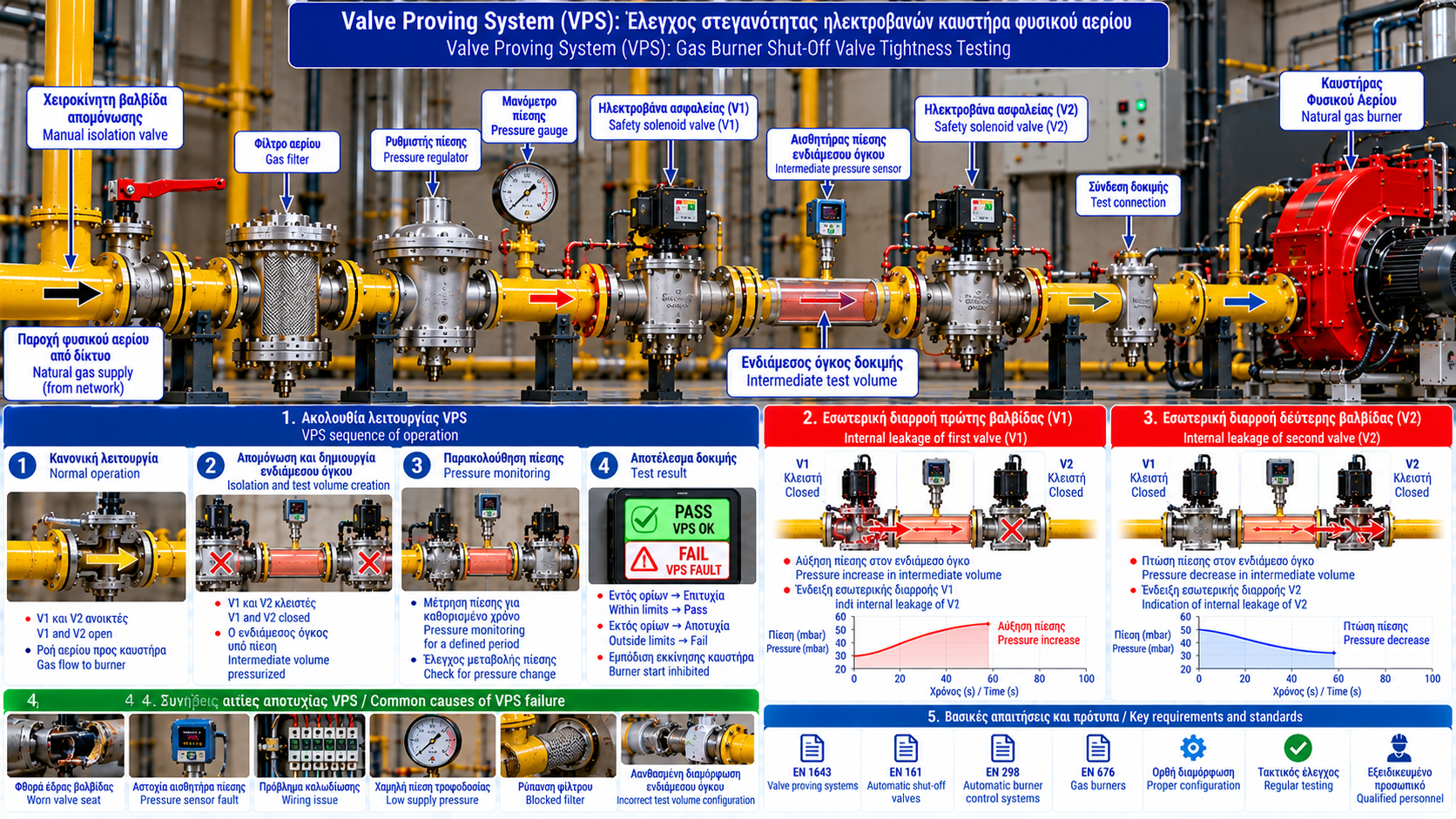
Valve Proving System (VPS): Natural Gas Burner Valve Tightness Testing
A Valve Proving System (VPS) is an important means of supervising the internal tightness of automatic gas shut-off valves in industrial burner installations.
Its purpose is to determine whether the valves exhibit unacceptable internal leakage when commanded closed.
Where required by the installation design and applicable regulations, valve proving forms part of the burner safety sequence.
A VPS does not replace general gas piping tightness testing or external leak inspection.
1. What Is a Valve Proving System?
A Valve Proving System is a device or control function designed to assess the tightness of automatic fuel shut-off valves.
It is commonly used with two safety shut-off valves installed in series.
The system evaluates pressure behavior in the intermediate volume between the valves.
The exact method depends on the VPS design, gas train configuration and manufacturer instructions.
2. Why Are Two Automatic Shut-Off Valves Used?
In suitable applications, two automatic shut-off valves are installed in series as part of the fuel safety architecture.
They must be suitable for the fuel, operating pressure and intended service conditions.
Using two valves does not eliminate the need for tightness verification where required.
3. What Is Internal Valve Leakage?
Internal leakage occurs when gas passes through the seat of a valve that should be closed.
It is different from external leakage, where gas escapes into the surrounding environment.
Valve proving is designed to assess internal valve tightness according to its specified method.
It does not certify the entire gas train against external leaks.
4. Main VPS Components
Depending on the system, components may include:
First automatic safety shut-off valve (V1).
Second automatic safety shut-off valve (V2).
Intermediate test volume.
Pressure sensor or pressure switch.
VPS control unit.
Test connections.
Burner management system interface.
Some systems integrate additional components or control functions.
5. Basic Operating Principle
A VPS evaluates pressure behavior in the volume between two closed safety valves.
Depending on the method, the system establishes or verifies a specified pressure condition and monitors subsequent changes.
Unexpected pressure changes may indicate leakage through a valve seat.
The sequence is not identical across all VPS designs.
6. Testing the First Valve (V1)
The first valve is located on the supply side.
In a suitable test sequence, the system evaluates whether gas can pass through closed V1 into the intermediate volume.
An unexpected pressure increase may indicate internal V1 leakage under the relevant test conditions.
Interpretation depends on the method and initial conditions.
7. Testing the Second Valve (V2)
The second valve is located toward the burner.
In a suitable sequence, the system evaluates whether pressure in the intermediate volume decreases in a manner consistent with possible leakage through closed V2.
Actual diagnostic logic depends on the VPS design.
A pressure decrease must not automatically be attributed exclusively to V2 without evaluating other possible causes.
8. When Does Valve Proving Occur?
Valve proving may be incorporated into the startup sequence or another specified stage of the operating cycle.
Timing depends on the manufacturer and safety control architecture.
In some systems, the test is performed before ignition.
Successful completion may be required before the burner is allowed to proceed.
9. What Happens When Valve Proving Fails?
If the VPS detects an unacceptable result, the control system may inhibit startup or place the burner into a protective lockout state.
Possible messages include Valve Proving Fault, VPS Failure, Gas Valve Tightness Fault or Leakage Test Failed.
These are illustrative descriptions rather than universal manufacturer fault codes.
10. Possible Causes of VPS Failure
A failed test does not always mean that an automatic gas valve is defective.
Possible causes include:
Internal leakage through V1.
Internal leakage through V2.
Pressure sensor faults.
Unsuitable supply pressure.
Wiring problems.
VPS controller malfunction.
Incorrect test conditions.
Related component or connection faults.
Investigation must follow manufacturer documentation.
11. Supply Pressure and VPS Performance
Supply pressure affects test conditions.
If pressure falls outside the VPS operating range, the test may not complete correctly.
Troubleshooting may therefore require verification of actual supply pressure.
Pressure settings must not be altered arbitrarily to force a successful test.
12. Importance of the Intermediate Volume
The volume between V1 and V2 is an important parameter.
Pressure response to leakage depends on volume, temperature and test conditions.
VPS suitability must therefore be assessed against the specified test volume and installation characteristics.
Not every VPS is suitable for every valve arrangement.
13. Integration with the Burner Management System
The VPS interfaces with the burner safety control system.
Depending on configuration, the controller receives a successful or failed proving status.
If valve proving is a required startup permissive, unsuccessful completion prevents the sequence from continuing.
Integration must follow the approved control and electrical design.
14. VPS Versus External Leak Testing
Valve proving assesses valve seat tightness according to its test method.
It does not replace:
External piping tightness testing.
Flange inspection.
Threaded joint testing.
Seal inspection.
Methane detection systems.
Required post-repair tests.
A gas train may pass valve proving while still having an external leak elsewhere.
15. VPS Troubleshooting Table
Symptom | Possible Cause | Investigation Focus |
VPS failure before startup | Unsuccessful proving test | Review sequence and fault code |
Unexpected intermediate pressure rise | Possible V1 leakage | Approved V1 assessment |
Unexpected pressure decrease | Possible V2 leakage or another cause | Evaluate test conditions |
Missing expected pressure signal | Sensor or test condition fault | Verify instrumentation |
Intermittent VPS faults | Variable conditions or developing fault | Review event history |
Fault after maintenance | Connection, component or setting issue | Check documentation |
Failure at a specific pressure | Operation outside specified range | Review system ratings |
These are diagnostic possibilities, not definitive fault identification.
16. Common Troubleshooting Mistakes
Replacing a valve immediately: May be unnecessary if the cause is a sensor or test condition.
Repeated resets: Do not constitute a valid troubleshooting method.
Bypassing the VPS: Defeats an intended safety function.
Arbitrary setting changes: May invalidate the test criteria.
Confusing internal and external leakage: Can lead to incorrect conclusions about gas train safety.
17. When Is Valve Replacement Necessary?
Replacement may be necessary when a valve fails to meet the required tightness criteria and repair is not permitted or appropriate.
The decision must follow manufacturer specifications, applicable requirements and approved test results.
After replacement, the required checks and safe operation verification must be completed.
18. VPS Maintenance
A preventive maintenance program may include:
Event history review.
Electrical connection inspection.
Valve condition checks.
Pressure sensor assessment.
VPS function verification.
Burner management system interface checks.
Documentation of findings.
All work must be performed by qualified personnel under approved procedures.
19. Technical Standards
Relevant references include:
EN 1643: Valve proving systems for automatic shut-off valves.
EN 161: Automatic shut-off valves for gas burners and appliances.
EN 298: Automatic burner control systems.
EN 676: Forced draught burners for gaseous fuels.
Applicability depends on the specific equipment and each standard’s scope.
Conclusion
A Valve Proving System is an important tool for supervising the internal tightness of automatic natural gas shut-off valves.
Its operation relies on controlled assessment of pressure behavior in the intermediate volume between two valves.
A failed test is a safety-related event requiring investigation, not merely an alarm to reset.
Correct selection, functional verification and maintenance of the VPS contribute to reliable and safe industrial burner operation.