
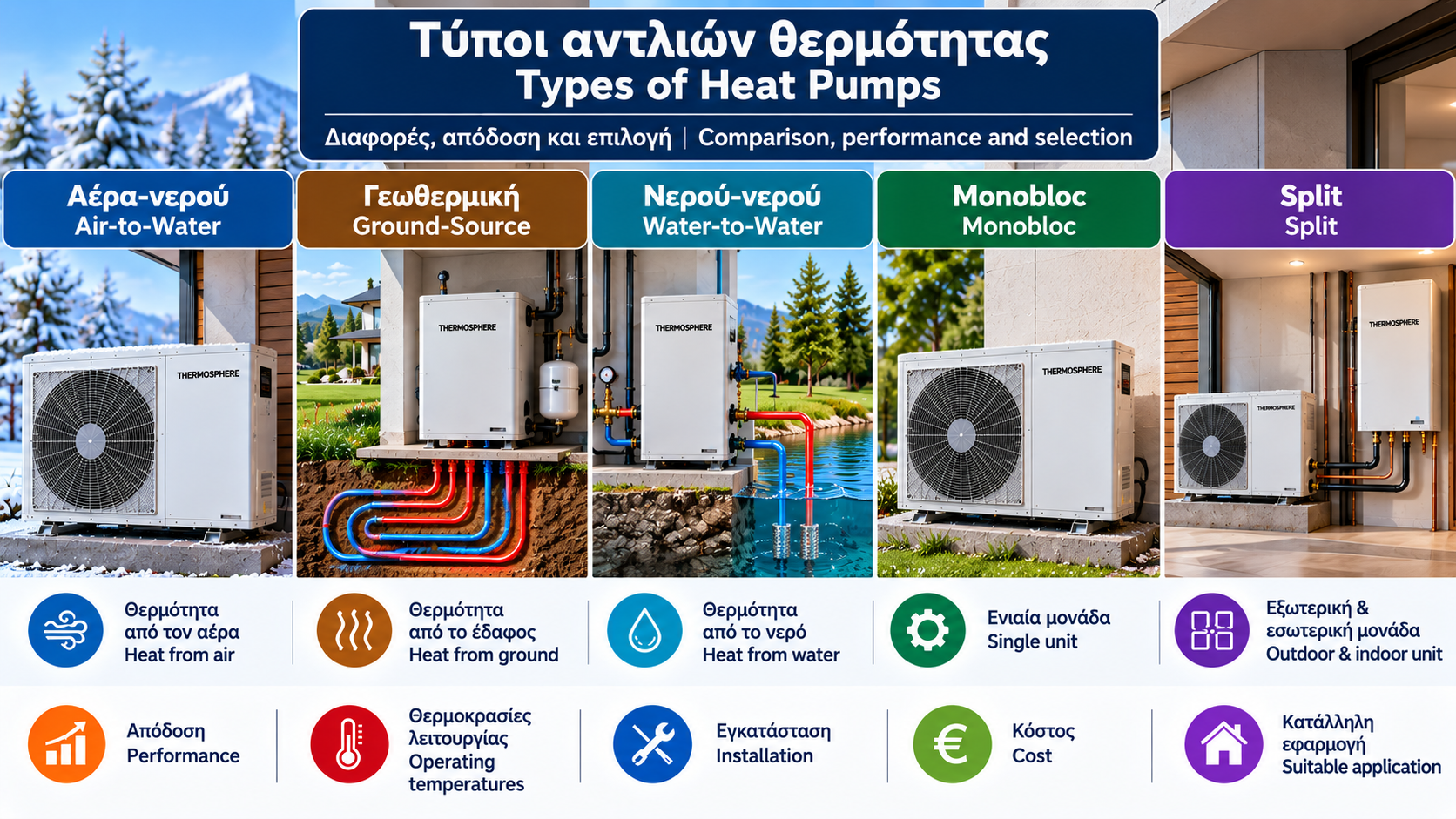
Types of Heat Pumps: Air-to-Water, Ground-Source, Monobloc and Split Compared
Heat pumps are among the most important technologies for energy-efficient building heating.
Their basic operating principle is to transfer heat from a lower-temperature source to a heating system using electrical energy.
However, not all heat pumps are the same.
They differ in the heat source they use, the way heat is delivered to a building, the configuration of the refrigerant circuit and their operating temperature capabilities.
Choosing the right system requires an understanding of these differences and a careful assessment of the building’s actual heating requirements.
1. How Are Heat Pumps Classified?
Heat pumps can be classified using several criteria.
By heat source:
Air.
Ground.
Water.
By heat delivery medium:
Water for hydronic heating.
Indoor air.
By construction:
Monobloc.
Split.
By supply temperature capability:
Systems suitable for low-temperature water heating.
Systems capable of delivering higher supply water temperatures.
These classifications overlap.
For example, an air-to-water heat pump can be designed as either a monobloc or a split system.
2. Air-to-Water Heat Pumps
Air-to-water heat pumps extract thermal energy from outdoor air and transfer it to the water circulating through a heating installation.
The heated water can supply:
Underfloor heating.
Radiators.
Fan coil units.
Domestic hot water cylinders when the system is appropriately designed.
Advantages
Relatively straightforward installation: Ground drilling or extensive underground work is generally unnecessary.
Wide availability: Numerous models are available in different capacities.
Flexible applications: Suitable for many new buildings and renovation projects.
Energy efficiency: Under suitable conditions, they deliver more thermal energy than the electrical energy they consume.
Limitations
Heating capacity and efficiency are affected by outdoor temperature.
As outdoor temperature decreases, the compressor may need to operate under more demanding conditions to reach the required water temperature.
Defrost cycles are also necessary under certain winter conditions.
Typical Applications
Air-to-water systems are often practical for homes and commercial buildings where suitable outdoor installation space is available and the unit can meet design heating loads.
3. Ground-Source Heat Pumps
Ground-source heat pumps extract heat from the ground using a suitable ground heat exchanger.
Many installations use closed-loop pipework containing water or an appropriate antifreeze solution.
The pipework may be installed:
Horizontally, across a suitable area of land.
Vertically, within boreholes.
Heat is transferred from the ground to the heat pump and then to the building’s hydronic heating system.
Advantages
More stable heat source: Ground temperature at suitable depths generally varies less than outdoor air temperature.
Potentially high seasonal efficiency: Relatively stable source temperatures can support efficient operation.
No conventional outdoor air heat exchanger fan: Typical closed-loop ground-source systems do not require the same type of outdoor air unit used by air-source heat pumps.
Limitations
Higher initial installation costs.
Land or borehole requirements.
Geological and engineering assessment.
Possible permits and regulatory requirements.
Typical Applications
Ground-source systems can be suitable where a ground heat exchanger can be installed and long-term operation justifies the investment.
4. Water-to-Water Heat Pumps
Water-to-water heat pumps use a water source to supply thermal energy.
Depending on the installation, the source may include:
Groundwater.
Surface water where permitted.
Another suitable water circuit.
Heat is transferred through a heat exchanger into the refrigerant circuit and subsequently into the heating water.
Advantages
A suitable water source with a relatively stable temperature can support high efficiency.
Limitations
Design requires careful consideration of:
Water availability and flow.
Water quality.
Corrosion and fouling risks.
Permits.
Environmental requirements.
Open-loop systems may require additional protective equipment and maintenance.
5. Air-to-Air Heat Pumps
Air-to-air heat pumps extract heat from outdoor air and deliver it directly to indoor air.
They do not necessarily heat water for a hydronic distribution system.
They represent a different heat delivery configuration from air-to-water heat pumps.
They are included here to explain the complete technical classification, while this guide primarily focuses on heat pumps used with hydronic heating systems.
6. What Is a Monobloc Heat Pump?
In a monobloc heat pump, the main refrigerant circuit components are generally contained within one factory-assembled unit.
In common outdoor air-to-water monobloc systems, heating water circulates to and from the outdoor unit.
Advantages
Factory-assembled refrigerant circuit.
Usually no on-site refrigerant pipework between separate indoor and outdoor units.
Potentially simpler hydronic configuration in some installations.
Limitations
Water circulating through externally exposed pipework requires appropriate freeze protection.
Power outages are particularly important when assessing freeze protection.
Solutions may involve suitable protective devices or approved antifreeze fluids, depending on manufacturer requirements and system design.
7. What Is a Split Heat Pump?
A split heat pump consists of outdoor and indoor units that are typically connected by refrigerant pipework.
The indoor unit may contain the refrigerant-to-water heat exchanger and associated hydronic components.
Advantages
The hydronic circuit may remain mainly indoors.
Flexibility in installation design.
Different options for integrating hydronic components.
Limitations
Refrigerant pipework must be installed correctly.
Pipe length and height difference restrictions must be observed.
Refrigerant work requires appropriately trained and, where applicable, certified personnel.
The monobloc versus split distinction describes refrigerant circuit configuration. It does not, by itself, determine energy efficiency.
8. Monobloc vs Split: Key Differences
Feature | Monobloc | Split |
Refrigerant circuit | Usually contained in one unit | Distributed between two units |
Outdoor-to-indoor connection | Usually hydronic | Usually refrigerant |
Water in exposed outdoor pipework | Usually yes | Usually no |
Freeze protection | Critical for exposed water circuits | Depends on hydronic design |
On-site refrigerant work | Usually limited | Usually required |
Efficiency | Model-dependent | Model-dependent |
It is not technically correct to assume that every monobloc system is better or worse than every split system.
Actual technical performance data should be compared.
9. Low-Temperature and High-Temperature Heat Pumps
Another important distinction concerns the supply water temperature a heat pump can provide.
Low-Temperature Systems
These are suitable for heating systems designed to operate with relatively low water temperatures, such as:
Underfloor heating.
Appropriately sized radiators.
Fan coils.
Lower supply temperatures generally support better heat pump efficiency.
High-Temperature Systems
Some models can deliver higher water temperatures to serve installations with greater temperature requirements.
This may be useful in renovation projects where replacing existing radiators is difficult.
However, the ability to achieve a higher supply temperature does not mean the same efficiency is maintained under all conditions.
As the required supply temperature increases, electrical energy consumption per unit of useful heat generally rises.
10. Understanding COP and SCOP
Heat pump performance is assessed using specific efficiency indicators.
COP — Coefficient of Performance
COP is defined as:
COP = Heating output / Electrical power input
For example, if a heat pump delivers 8 kW of heat while consuming 2 kW of electricity:
COP = 8 / 2 = 4
Under those specific test conditions, the heat pump delivers four units of thermal energy per unit of electrical energy.
COP varies with source temperature, supply water temperature and operating conditions.
SCOP — Seasonal Coefficient of Performance
SCOP represents seasonal efficiency calculated using a standardized methodology.
It is useful for comparing products under equivalent reference conditions.
SCOP values should not be compared directly when they refer to different climate zones or application temperatures.
Actual installed seasonal performance may differ from standardized ratings.
11. Comparison of Main Heat Pump Types
Type | Heat Source | Main Advantage | Main Limitation |
Air-to-water | Outdoor air | Relatively simple installation | Weather-dependent performance |
Closed-loop ground-source | Ground | More stable source temperature | Ground loop and initial cost |
Water-to-water | Water source | Potentially high efficiency | Water availability and quality |
Air-to-air | Outdoor air | Direct indoor air heating | Does not necessarily serve hydronic systems |
Actual performance and cost depend on the specific project.
12. Which Heat Pump Type Is Suitable for Each Building?
New Home With Underfloor Heating
A correctly sized air-to-water heat pump may be a practical solution.
A ground-source system may also be considered if sufficient space is available and the economics justify it.
Existing Home With Radiators
The first step is to determine whether the radiators can meet the heating load at the intended supply water temperatures.
A high-temperature heat pump should not be selected without proper assessment.
Large Building With Available Land
A ground-source solution may be worth considering if technically feasible and economically justified.
Building With Access to a Suitable Water Source
A water-to-water heat pump may be considered after evaluating flow, water quality and regulatory requirements.
13. Most Important Selection Criteria
Before choosing a heat pump, assess:
Building heat loss: Required heating capacity under design conditions.
Heat distribution: Underfloor heating, radiators or fan coils.
Supply temperature: Water temperature required to meet heating demand.
Local climate: Outdoor design temperatures and operating conditions.
Available space: Outdoor unit, indoor equipment or ground heat exchanger.
Electrical infrastructure: Available supply and electrical requirements.
Noise: Installation position and acoustic requirements.
Energy efficiency: COP, SCOP and comparable performance data.
Life-cycle cost: Initial investment, electricity, maintenance and expected operating life.
Technical support: Spare parts availability and competent service providers.
14. Common Heat Pump Selection Mistakes
Sizing Based Only on Floor Area
Floor area alone does not establish the required heating capacity.
Oversizing
An oversized heat pump may cycle excessively, especially during periods of low heating demand.
Comparing Only Nominal COP
COP at a single test condition does not describe the complete system performance.
Ignoring Supply Water Temperature
Required supply temperature strongly influences efficiency.
Choosing Monobloc or Split Without Considering Installation Conditions
The selection must account for actual installation constraints and freeze protection requirements.
Poor Hydronic Design
Even a correctly selected heat pump may perform poorly if the hydronic installation cannot maintain required flow rates and appropriate control.
15. Frequently Asked Questions
Which Heat Pump Type Is the Most Economical?
There is no universal answer. Initial cost, operating efficiency, installation requirements and maintenance must all be considered.
Is Ground-Source Better Than Air-to-Water?
Ground-source systems may offer advantages due to more stable source temperatures, but they require different infrastructure and investment.
Is Monobloc More Efficient Than Split?
Not necessarily. Efficiency depends on the specific model and its operating conditions.
Can a Heat Pump Work With Existing Radiators?
Yes, provided the radiators can meet the building’s heating requirements at the available supply temperatures. Technical assessment is essential.
Which Heat Pump Is Best for Underfloor Heating?
Heat pumps that operate efficiently at low supply water temperatures are particularly suitable for underfloor heating systems.
Conclusion
Heat pumps differ in their heat sources, construction and operating capabilities.
Air-to-water heat pumps offer installation flexibility, ground-source systems use the relatively stable temperature of the earth, and water-to-water systems can take advantage of suitable water sources.
The choice between monobloc and split primarily concerns installation configuration rather than universal performance superiority.
The right heat pump is the one selected according to the building’s actual heating requirements, required operating temperatures and installation conditions.
Thermosphere.gr — Technical knowledge for heating and building systems.