
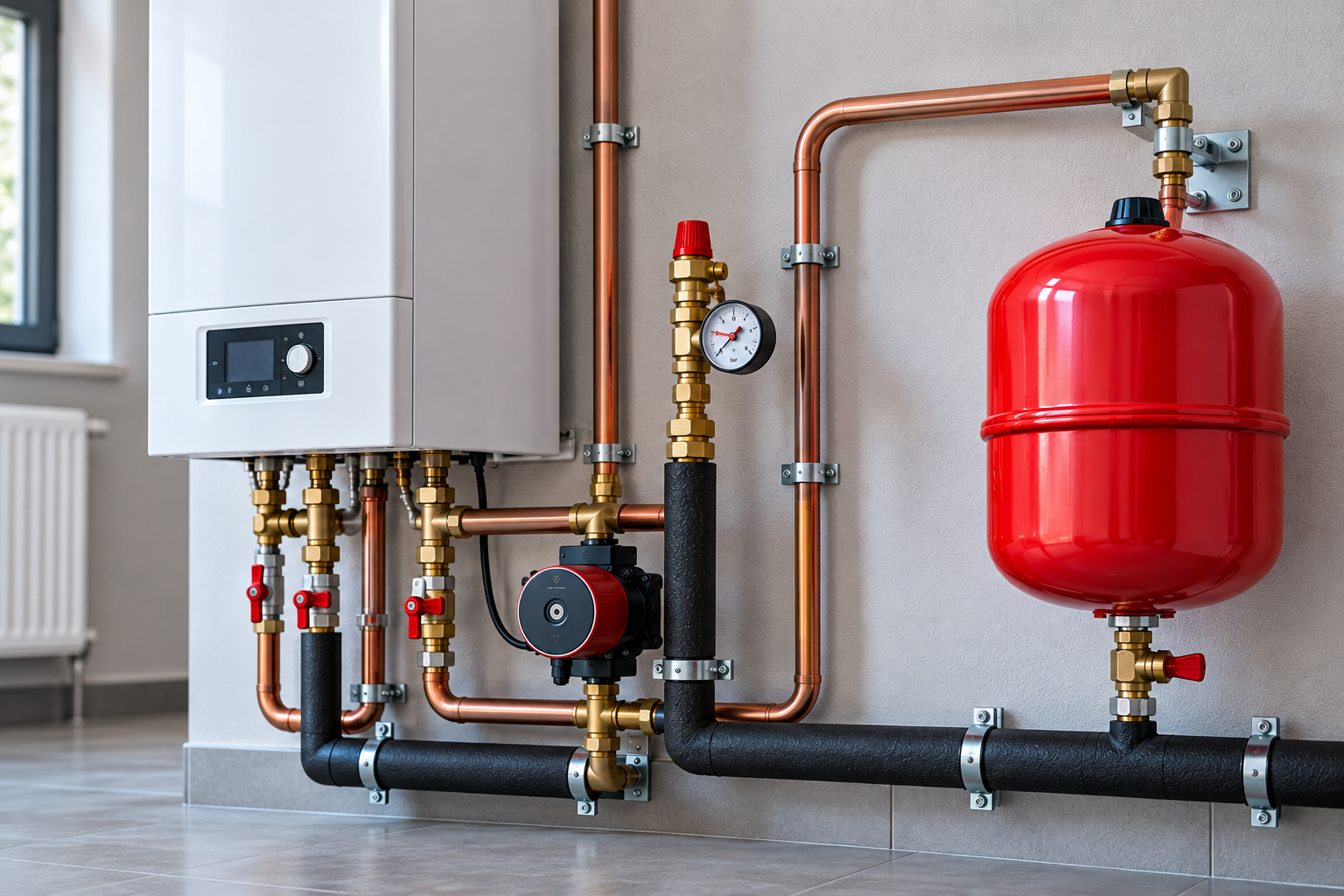
How to Install a Heating Expansion Vessel: Location, Connection and Pressure Settings
An expansion vessel is an essential component of a sealed central heating system. It accommodates the increase in water volume as the temperature rises, helping maintain system pressure within acceptable operating limits.
Correct installation involves more than connecting a vessel to a pipe. The expansion vessel must be correctly sized, connected at a suitable hydraulic location, securely supported and charged to the appropriate pressure.
This guide explains where a heating expansion vessel should be installed, how it connects to the system, how pre-charge pressure is determined and which checks are necessary before commissioning.
Important: This article provides technical information rather than instructions for unqualified DIY installation. Work on pressurised heating systems should be carried out by a suitably qualified professional in accordance with the manufacturer’s instructions and applicable safety requirements.
1. Where Should a Heating Expansion Vessel Be Installed?
In many conventional sealed heating systems, the expansion vessel is connected to the return pipework, near the boiler and on the suction side of the circulation pump.
This arrangement is also described in installation guidance for certain Flamco Flexcon expansion vessels.
The connection location matters because it influences how pressure is distributed throughout the heating circuit when the pump operates.
However, the return pipe is not automatically the correct location for every installation. Systems incorporating multiple pumps, hydraulic separators or more complex pipework arrangements require individual assessment.
Key principle: The expansion vessel must remain hydraulically connected to the sealed heating circuit it protects, in accordance with the system design and manufacturer’s instructions.
2. Why Does the Circulation Pump Location Matter?
The expansion vessel connection acts as a pressure reference point within the heating system.
When the circulation pump operates, it creates pressure differences across the circuit.
Correct positioning of the expansion vessel relative to the pump helps maintain suitable pressures throughout the system.
An unsuitable arrangement may contribute to:
Unwanted pressure fluctuations.
Difficulties removing trapped air.
Insufficient pressure in parts of the circuit.
Unstable hydraulic operation.
The final connection point should be selected according to the hydraulic design rather than simply choosing the nearest available pipe.
3. How Is an Expansion Vessel Connected?
The expansion vessel is connected to the heating circuit using suitable pipework and connection fittings.
Before installation, the technician should verify:
The vessel is designed for sealed heating systems.
Its nominal capacity and maximum allowable pressure are suitable.
The selected hydraulic connection point is appropriate.
The connecting pipework is correctly sized and configured.
Adequate mechanical support is provided.
The vessel remains accessible for inspection and maintenance.
All connections must be leak-tight and suitable for the operating temperature and pressure.
The arrangement must not allow the expansion vessel to be accidentally isolated while the heating system is operating.
Where a dedicated service isolation fitting is permitted, it must incorporate the required safeguards and be used according to the manufacturer’s instructions.
4. Vertical or Horizontal Installation?
Not every expansion vessel can be installed in every orientation.
The permitted mounting position depends on:
Vessel design.
Nominal capacity.
Diaphragm or membrane construction.
Connection arrangement.
Manufacturer’s mounting requirements.
Some smaller expansion vessels can be wall-mounted using suitable brackets, while larger vessels may require floor-standing installation.
Never assume that a vessel can be installed horizontally simply to save space. Always check the installation instructions for the specific model.
5. How Should the Expansion Vessel Be Supported?
An expansion vessel may become considerably heavier when it contains water.
Its mounting arrangement must therefore be suitable for the vessel and its operating conditions.
Important considerations include:
Wall or floor load-bearing capacity.
Approved mounting brackets.
Avoiding excessive mechanical stress on pipework.
Protection against accidental damage.
Accessibility to the gas charging valve and inspection points.
Large vessels must not place their weight on pipework that has not been designed to support them.
6. How Is Expansion Vessel Pre-Charge Pressure Set?
Pre-charge pressure is the gas pressure inside the expansion vessel when the water side is depressurised.
The factory pre-charge setting is not necessarily correct for every heating installation.
The required pre-charge depends on:
The static height of the system.
Minimum required system pressure.
Cold filling pressure.
Maximum operating pressure.
Manufacturer’s specifications.
Why Is the Boiler Pressure Gauge Not Enough?
The boiler pressure gauge measures water pressure at its installation point.
It does not directly indicate the expansion vessel’s actual pre-charge pressure.
To measure pre-charge correctly, the water side of the vessel must be appropriately depressurised.
The check and any necessary adjustment should be performed by a qualified technician.
7. What Is the Correct Filling Pressure?
There is no single filling pressure suitable for every heating installation.
The correct value depends on the building height, operating conditions and system design.
Cold filling pressure must be compatible with the expansion vessel pre-charge and sufficient to maintain adequate pressure at the highest points of the circuit.
At the same time, there must be sufficient pressure margin below the system’s maximum allowable pressure.
The final settings must be established through appropriate calculations and equipment specifications.
8. Heating Expansion Vessel Installation Procedure
A typical installation can be divided into seven main stages.
Step 1: Assess the Heating System
The technician determines the system water volume, static height, operating temperatures and pressure requirements.
Step 2: Select the Expansion Vessel
A vessel with suitable capacity, pressure rating and temperature compatibility is selected.
Step 3: Prepare the System Safely
The heating system is switched off and allowed to cool.
Before work begins, the relevant section must be safely isolated and depressurised.
Step 4: Mount and Connect the Vessel
The expansion vessel is securely mounted according to the manufacturer’s requirements and connected at the designated hydraulic location.
Step 5: Check Pre-Charge Pressure
The vessel’s pre-charge is measured and, if necessary, adjusted before the water side is filled and pressurised.
Step 6: Fill and Vent the System
The heating circuit is gradually filled to the calculated cold filling pressure.
Air is removed from the system and the vessel connection pipework where required.
Step 7: Commission and Inspect
The technician checks for leaks, verifies pressure readings and observes system behaviour during heating and cooling.
The exact sequence must follow the equipment manufacturer’s instructions.
9. What Is the Purpose of the Safety Relief Valve?
The expansion vessel and the safety relief valve perform different functions.
The expansion vessel accommodates normal thermal expansion of the heating water.
The safety relief valve provides independent protection against excessive pressure.
An expansion vessel does not replace a safety relief valve.
The valve’s opening pressure must be appropriate for the system and its components.
The discharge arrangement must also comply with applicable safety requirements.
10. How Can You Tell Whether the Installation Is Working Correctly?
Following installation, system pressure should be checked under different temperature conditions.
A certain increase in pressure as the water heats up is normal.
However, further investigation is required if any of the following occur:
Excessive pressure increases during heating.
Repeated discharge from the safety relief valve.
Significant pressure loss after cooling.
Leaks around connections.
Frequent need to top up the system.
These symptoms do not always indicate a defective expansion vessel. The entire heating installation may require inspection.
11. Common Expansion Vessel Installation Mistakes
Incorrect Connection Location
The vessel is connected without considering the circulation pump position or the hydraulic arrangement.
Incorrect Pre-Charge Pressure
The factory setting is used without confirming its suitability for the system.
Inadequate Mounting
The vessel places excessive weight on unsuitable brackets or pipework.
Incorrect Installation Orientation
The vessel is installed in a position not approved by its manufacturer.
Accidental Isolation
A closed valve prevents the expansion vessel from communicating with the heating circuit.
Incomplete Commissioning
The heating system is operated without adequate checks of pressure, leakage and correct filling.
12. Frequently Asked Questions
Should an expansion vessel be installed on the flow or return pipe?
In many conventional systems, it is connected to the return pipe, near the circulation pump suction. The correct location depends on the hydraulic design and manufacturer’s requirements.
Can an expansion vessel be installed horizontally?
Only if the manufacturer permits horizontal installation for that particular model.
Must the expansion vessel be next to the boiler?
Not necessarily. The correct hydraulic connection point is more important than physical proximity to the boiler.
Is an isolation valve required?
A dedicated, safeguarded service isolation arrangement may be permitted. However, the system must not allow accidental isolation of the vessel during normal operation.
What pressure should an expansion vessel be charged to?
Pre-charge pressure must be calculated for the particular installation. There is no universal setting suitable for every heating system.
Can I install an expansion vessel myself?
Installation involves working on a pressurised heating system and requires appropriate safety checks, pressure settings and leak testing. The work should be performed by a suitably qualified professional.
Conclusion
Correct expansion vessel installation is essential for reliable operation of a sealed heating system.
The connection location, vessel capacity, mounting arrangement and pre-charge pressure must all be considered together.
Selecting a vessel with the correct nominal capacity is only part of the process. It must also be properly integrated into the hydraulic system and checked before operation.
The final installation should always comply with the manufacturer’s instructions, applicable safety requirements and the calculations carried out by the responsible technician.
Technical References
Flamco – Flexcon Installation and Operating Instructions: https://flamco.aalberts-hfc.com/media/files/manuals/man.exp.Flexcon.v090827.pdf
Reflex – Professional Planning, Calculation and Equipment Guidance: https://www.reflex4experts.com/fileadmin/user_upload/Download_Bereich/EN/RE21161en_9140176_Brochure_Professional-planning-calculating-and-equipping_EN_21224_.pdf
These references describe particular product ranges and technical approaches. The current installation manual for the specific expansion vessel always takes precedence.