
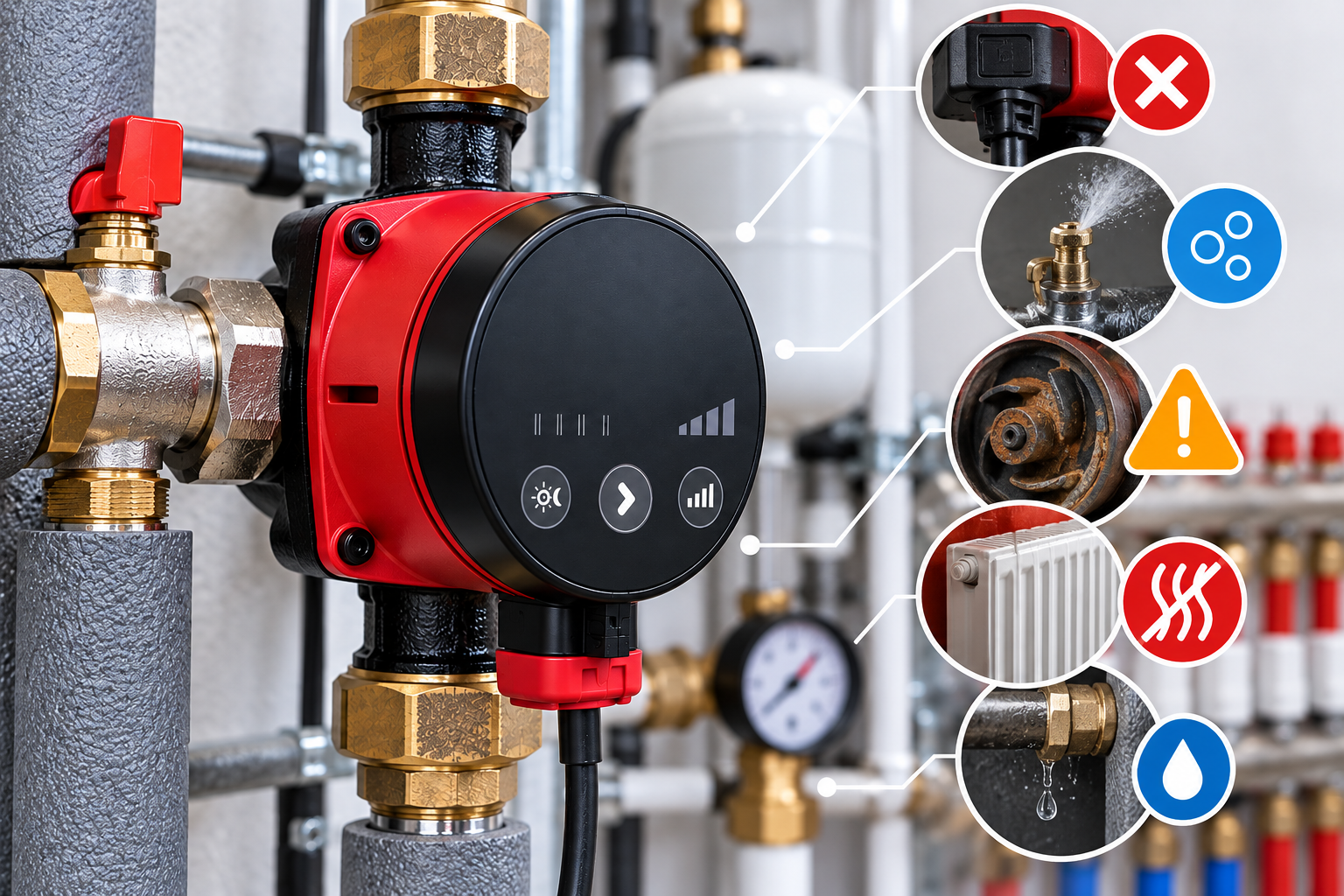
Heating Circulation Pump Noise: Humming, Gurgling and Common Causes
A heating circulation pump is an essential component of a hydronic heating system. Under normal operating conditions, it generally produces relatively little noise. However, noticeable humming, gurgling, whistling, rattling or vibration may indicate unsuitable hydraulic conditions, incorrect settings or mechanical problems.
Not every noise means the pump has failed. Sound can travel through pipes and may originate from valves, fittings or other heating system components.
This guide explains the most common circulation pump noises, their possible causes and safe preliminary troubleshooting methods.
1. What Types of Noise Can a Circulation Pump Make?
Commonly reported sounds include:
Continuous humming.
Gurgling or flowing-water sounds.
Whistling from pipes and valves.
Metallic rattling or grinding.
Excessive vibration.
A gravel-like noise.
Knocking during startup.
Each symptom may have several possible explanations. Identifying the sound is useful, but it cannot provide a definitive diagnosis on its own.
2. The Circulation Pump Hums Continuously
A quiet, steady hum can be normal for certain pump models, depending on motor type and operating conditions.
However, a new or significantly louder humming sound may be associated with:
Unsuitable speed settings.
Mechanical wear.
Partial blockage of rotating components.
Vibration transmitted through pipework.
Electrical or electronic malfunction.
Noise intensity alone cannot reliably determine the condition of the motor.
3. Gurgling Noise: Could There Be Trapped Air?
Gurgling is frequently associated with trapped air or a mixture of water and air circulating through the system.
Possible accompanying symptoms include:
Uneven radiator heating.
Interrupted or unstable circulation.
Water noises inside pipes.
Fluctuating system performance.
Air may enter after filling or maintenance, or because of problems maintaining suitable system pressure.
Air removal should follow the heating system manufacturer’s instructions.
Some electronic circulators feature a venting function, but this does not necessarily remove air from the entire heating network.
4. Whistling From the Pump or Radiators
Whistling can originate from thermostatic radiator valves, isolation valves or other restrictions where water velocity becomes excessive.
One possible cause is excessive differential pressure when heating demand decreases and the pump does not adequately adapt its performance.
Other possible causes include:
Incorrect circulator settings.
Partially closed valves.
Excessive flow through certain branches.
Poor hydraulic balancing.
Changing pump settings without understanding the system may reduce heating performance elsewhere.
5. Metallic Sounds and Excessive Vibration
Metallic rattling, grinding or strong vibration may be associated with mechanical or hydraulic problems.
Possible causes include:
Worn internal components.
Mechanical blockage.
Inadequate pipe support.
Vibration transmitted from other equipment.
Unsuitable operating conditions.
The location where the noise is heard may not be the location where it originates.
Professional inspection is recommended for persistent metallic sounds or strong vibration.
6. What Is Cavitation in a Circulation Pump?
Cavitation occurs when local liquid pressure falls sufficiently for vapour bubbles to form.
As these bubbles move into higher-pressure regions, they collapse, potentially causing noise, vibration and, in severe cases, material damage.
The resulting noise is sometimes described as gravel passing through the pump.
Conditions that may contribute to cavitation include:
Insufficient absolute pressure at the pump inlet.
High water temperature.
Excessive pressure losses upstream of the pump.
Operation under unsuitable hydraulic conditions.
Cavitation should not be confused with trapped air. These are different phenomena, although their acoustic symptoms may sometimes appear similar.
7. Can Excessive Pump Speed Cause Noise?
Yes. In certain installations, operating a circulation pump at a higher speed than necessary can increase differential pressure and noise generated by control valves.
Modern electronically controlled circulators often provide control modes such as:
Proportional differential pressure.
Constant differential pressure.
Constant curve or fixed-speed operation.
Automatic adaptive control, where supported.
The appropriate mode depends on the hydraulic design and manufacturer instructions.
Reducing pump speed is not a universal solution. An unsuitable reduction may prevent the system from achieving the required water circulation.
8. Why Can Pump Noise Be Heard Throughout the House?
Pipes can transmit mechanical vibrations from the circulation pump or other heating equipment.
Noise transmission may be increased by:
Rigid mechanical connections.
Insufficient pipe support.
Contact between pipework and building structures.
Resonance of components.
Hydraulic noise from valves.
Locating the source may require checking pipe supports, connections and operating conditions.
9. Why Does the Pump Make Noise Only During Startup?
A brief sound during startup may be associated with changes in motor speed or water flow.
However, strong knocking, repeated unsuccessful starts or unusual vibration should be investigated.
Possible causes include:
Mechanical malfunction.
Sudden flow changes.
Valve movement or closure.
Unstable control operation.
10. Circulation Pump Noises: Causes and Recommended Actions
Gurgling: Possible trapped air → Check system venting.
Whistling: High differential pressure or restricted flow → Check settings and valves.
Loud humming: Vibration or mechanical malfunction → Professional inspection.
Gravel-like noise: Possible cavitation or air → Assess hydraulic conditions.
Metallic noise: Wear or loose supports → Technician inspection.
Startup knocking: Sudden flow changes → Check system operation and controls.
These are possible explanations, not definitive diagnoses.
11. What Can Homeowners Safely Check?
Without opening or dismantling the circulation pump, homeowners can:
Observe when the noise occurs.
Determine whether it happens during startup or continuously.
Record any displayed error codes.
Check whether radiators heat evenly.
Read an accessible system pressure gauge and compare it with the equipment manual.
Record the sound to help a technician identify the problem.
Do not remove vent plugs, dismantle pump components or make arbitrary adjustments.
The pump may contain hot pressurised water and electrical components.
12. When Should You Call a Technician?
Professional assistance is recommended when:
Noise is loud or getting worse.
Metallic grinding or rattling occurs.
The pump repeatedly stops.
Fault codes appear.
Water leakage is present.
Heating performance deteriorates.
Cavitation or mechanical wear is suspected.
A technician may need to check differential pressure, flow rate, system filling pressure, control settings, valves and mechanical condition.
13. Frequently Asked Questions
Is It Normal for a Circulation Pump to Make Noise?
A quiet operating sound may be normal. New, loud or metallic noises should be investigated.
Why Does My Heating System Gurgle When It Starts?
Trapped air or unstable circulation during startup may be responsible.
Can an Electronic Circulation Pump Make Noise?
Yes. Electronic speed control does not eliminate problems caused by trapped air, hydraulic resistance or mechanical faults.
Will Lowering Pump Speed Stop the Noise?
It may reduce noise in some systems, but any adjustment must remain compatible with required flow rates and manufacturer instructions.
Can Cavitation Damage a Circulation Pump?
Prolonged or severe cavitation can cause material damage and operating problems. Hydraulic conditions should be assessed.
Conclusion
Heating circulation pump noise can result from trapped air, excessive differential pressure, unsuitable settings, vibration, cavitation or mechanical wear.
The type of sound may help identify possible causes, but reliable diagnosis requires evaluating the heating system.
Effective troubleshooting focuses on hydraulic conditions and manufacturer guidance rather than arbitrary adjustments or dismantling.
Technical References
Grundfos — Circulator technical manuals and cavitation information: https://www.grundfos.com
Wilo — Circulator installation, operation and troubleshooting documentation: https://wilo.com
Caleffi — Technical publications on air separation and hydronic systems: https://www.caleffi.com
ASHRAE — Hydronic system engineering references: https://www.ashrae.org
These are general technical reference sources. For equipment-specific procedures, consult the official manual for the installed model.