
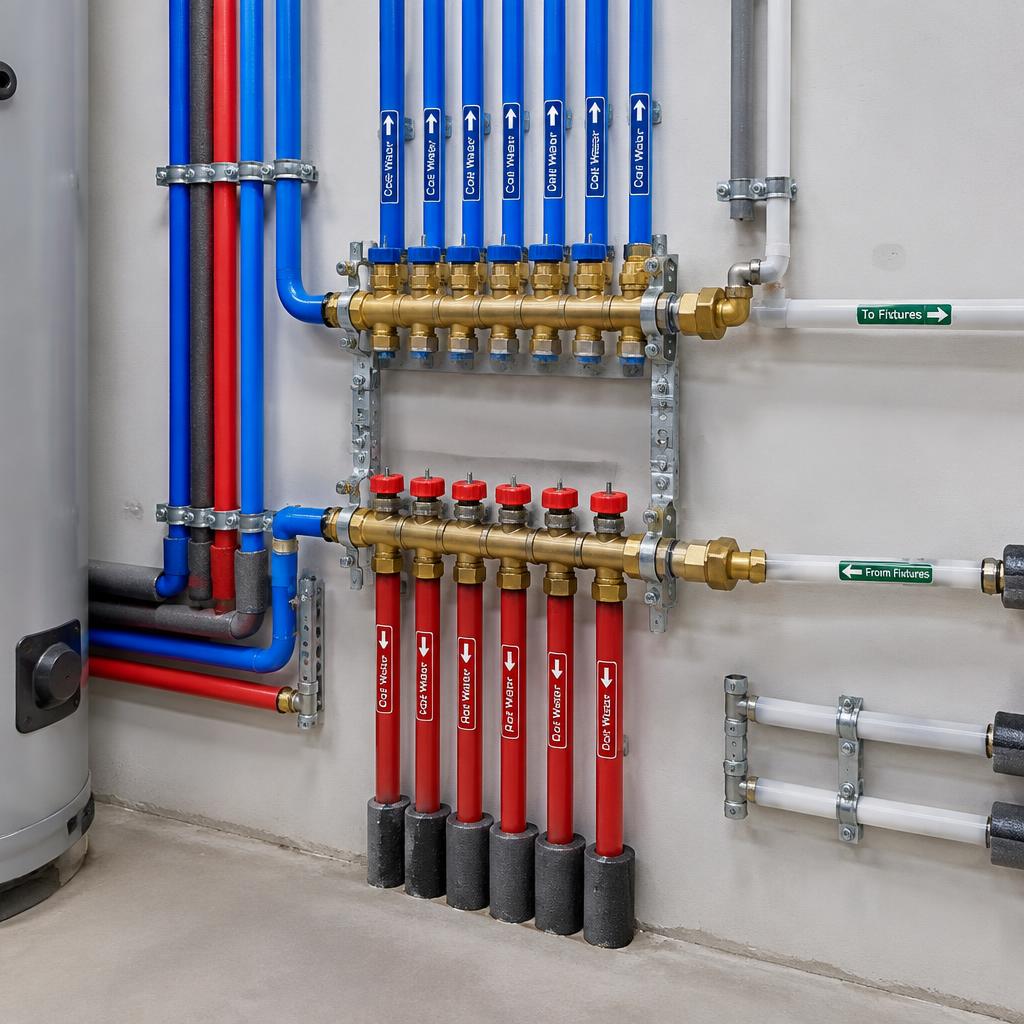
A loud "thud" when the faucet is closed, recurring banging when the washing machine is running, or a whistling sound inside the wall do not necessarily share the same cause. Water hammer is one of the most common explanations for sudden knocking sounds, but there are also issues related to support, high pressure, valves, and thermal expansion.
Proper treatment begins with observation: when the noise is heard, at what point, and with which appliance it is associated. This avoids unnecessary replacements and interventions that simply shift the problem elsewhere. Below you will find a practical guide for the owner and key inspection points for the technician.
1. What is water hammer and how to identify it
Water hammer is the sudden pressure change caused when water speed changes rapidly. A classic example is the instantaneous closing of a washing machine solenoid valve. The moving water slows down abruptly, creating a pressure wave that travels through the pipes and can cause vibrations.
Typically, a short knock is heard at the exact moment the flow stops. This phenomenon is favored by high water speeds, long piping runs, and valves that close quickly. High operating pressure can also put strain on the installation.
Other noises that sound like water hammer
- Whistling while water is running: often related to constriction, deposits, a half-closed valve, or a worn-out faucet mechanism.
- Creaking or small repetitive "ticks": can come from the thermal expansion of hot water pipes rubbing against supports or penetrations.
- Rattling in a specific supply: potential oscillation of a component, such as a toilet tank float or a check valve.
- Gurgling in radiators: often points to air or circulation problems in the heating circuit, not water hammer in the plumbing network.
The point where the noise is loudest is not always its source. Metal piping and structural elements transmit sound over long distances.
2. Practical check before any repair
Start without unscrewing components or changing settings. Record whether the knocking occurs with cold water, hot water, or both, and whether it concerns a single appliance or the whole house.
- Observe if it coincides with closing a faucet, the toilet tank refilling, or the operation of the washing machine.
- Close a standard faucet more slowly. If the knocking decreases, this is an indication of a sudden flow change, not a definitive diagnosis.
- Visually inspect accessible piping for loose supports, contact with furniture, and traces of moisture.
- In an apartment building, ask if the same sound is heard in other apartments or during the start and stop of the booster pump.
Pressure measurement: not just an estimate based on faucet force
A plumber measures static pressure with outlets closed and operating pressure with water flowing. In many domestic installations, a pressure of about 2–4 bar at the point of use is functional, but the appropriate value depends on the building height, losses, and appliance requirements.
Static pressure above about 5 bar requires evaluation, especially if it exceeds the limits of any component. A simple pressure gauge does not necessarily record the very short spikes of water hammer. In persistent cases, appropriate recording equipment is required.
If there is an active leak or intense pipe movement, stop using the system and call a technician. Close the accessible main valve of the residence only if it can be done safely, without forcing it if it is stuck.
3. Solutions according to the actual cause
Water hammer arrestor near the valve causing the hammer
A water hammer arrestor has a compressible chamber, usually with a piston or diaphragm, that absorbs part of the sudden pressure change. It is installed near the quick-acting device, according to the manufacturer's instructions. A random point at the entrance of the house does not guarantee effective protection for a remote solenoid valve.
The selection is based on diameter, flow, pressure, and network layout. For potable water, a device suitable for this use is required. DIY "dead-end" pipes with trapped air are not a reliable permanent solution because the air gradually dissolves into the water.
Pressure reducer when supply pressure is high
A reducer limits the pressure downstream of its installation point and can reduce network stress. However, it does not always replace an arrestor: rapid flow stoppage can cause water hammer even with normal pressure.
It requires correct sizing, filter checking, and adjustment with a pressure gauge. If the pressure after the reducer rises while all outlets are closed, the technician should examine both a potential failure and thermal expansion of the water.
Proper support and repair of faulty components
Proper supports, with rubber gaskets where required, limit vibration transmission. Support distances depend on material, diameter, and temperature. Overtightening is not a solution: it can prevent expansion and create new noises.
Worn-out floats, oscillating check valves, and problematic valves require repair or replacement. In common-use booster pumps, control settings, the expansion vessel, and start/stop behavior are also checked. Interventions must be made by a qualified technician, not through trial-and-error by residents.
Expansion control in hot water
When a check valve or other device prevents return to the network, water heating can increase pressure. A suitable expansion vessel for domestic water may be required, with calculated size and pre-charge pressure. A heating expansion vessel is not automatically suitable for potable water, and an expansion vessel does not always substitute for a water hammer arrestor.
4. Indicative cost and prevention
For simple, accessible installations in Greece, use the following figures only as an initial budget, not as a binding price list:
- Visit and basic diagnostic check: approx. 40–80 €.
- Small arrestor with simple installation: approx. 60–150 €.
- Residential pressure reducer with basic installation: approx. 100–250 €.
Prices vary by area, access, materials, and required conversions. Ask for a quote that clarifies labor, materials, travel, and VAT. Repairs to hidden piping or work on the communal network are billed separately.
As a precaution, check for leaks and supports, and maintain filters and valves as prescribed. Do not leave the main valve half-closed as a substitute for a reducer: it limits flow but does not reliably regulate static pressure.
5. Frequently Asked Questions
Can water hammer cause damage?
Yes, repetitive pressure spikes can strain connections, flexible hoses, and valves. A single sound does not prove imminent failure, but intense or frequent knocking requires inspection.
Is bleeding the pipes enough?
Not usually. Bleeding primarily concerns trapped air, especially in heating systems. It does not correct rapid flow stoppage, high pressure, or inadequate supports.
Why is it heard more at night?
Silence makes the noise more noticeable. Also, in some networks, pressure increases when consumption decreases. This is confirmed with measurements, not just by the time of occurrence.
Can I install an arrestor myself?
The correct position and sizing are critical, so a plumber is preferred. No component should be disassembled under pressure; isolation, safe depressurization, and protection against hot water are required.
Conclusion
The effective solution to pipe noises is not a one-size-fits-all component. Correlating the sound with valve operation, measuring pressure, and checking supports leads to the correct intervention: an arrestor, a reducer, a repair, or a combination thereof.