
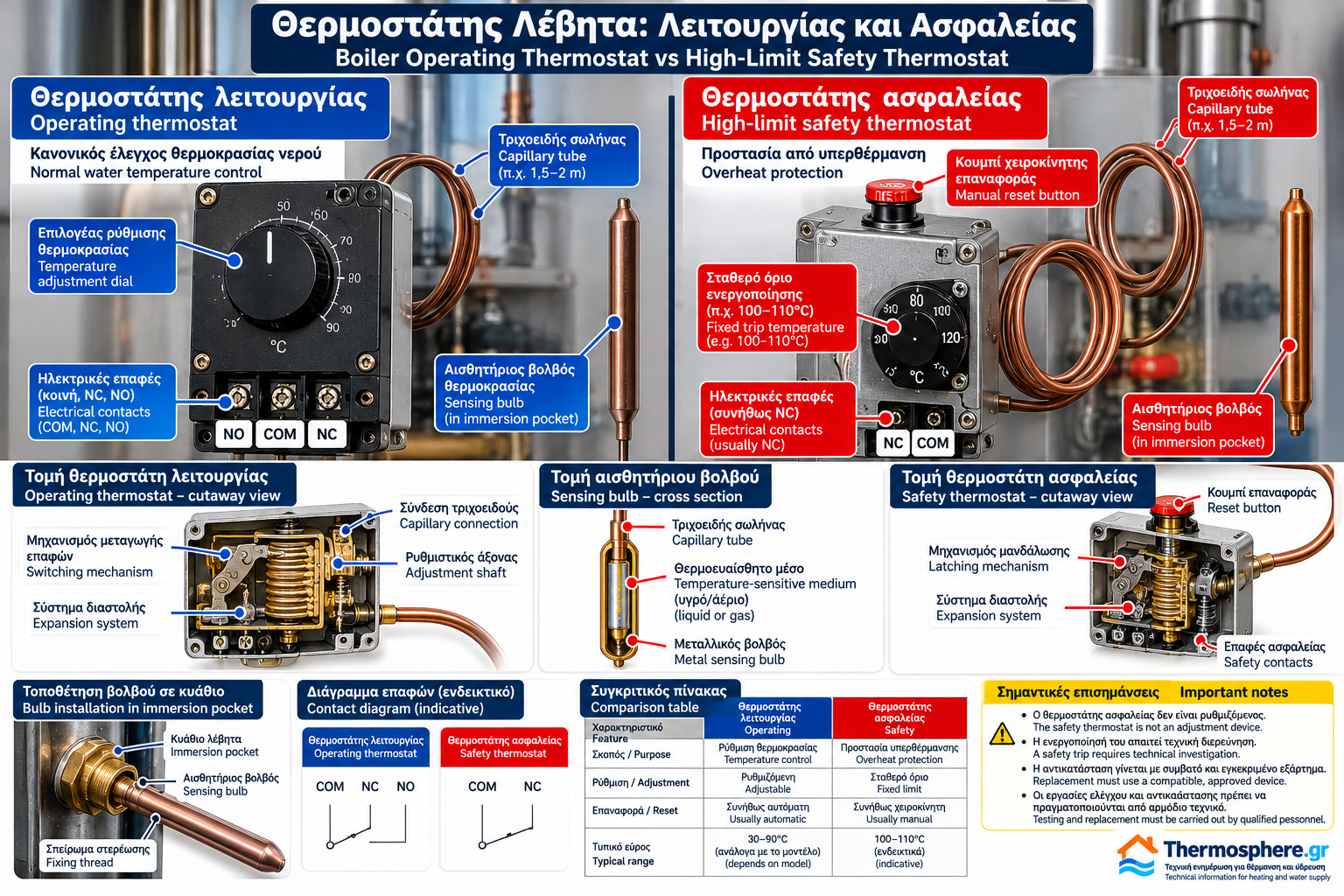
Boiler Operating Thermostat vs High-Limit Safety Thermostat: Functions, Differences and Testing
The operating thermostat and high-limit safety thermostat are two important components of a heating boiler. Although both respond to water temperature, they perform different functions.
The operating thermostat regulates normal boiler temperature, while the safety thermostat protects the equipment against excessive overheating.
In conventional floor-standing boilers, these functions are often performed by separate electromechanical thermostats. Modern boilers may instead use electronic temperature sensors and other certified protective devices.
Understanding their construction and operation is essential for accurate troubleshooting and safe maintenance.
1. What Is a Boiler Operating Thermostat?
An operating thermostat is a control device that monitors boiler water temperature and enables or interrupts heating according to a selected temperature setting.
In a conventional boiler with a separate burner, the thermostat may control the operating request sent to the burner controller.
When water temperature is below the required limit and heating demand exists, the thermostat allows heat production.
When the cutoff temperature is reached, its electrical contact changes state.
The exact behaviour depends on thermostat construction and the control panel wiring arrangement.
2. Construction of a Mechanical Operating Thermostat
A conventional remote-bulb thermostat may include:
Temperature sensing bulb.
Capillary tube.
Temperature-responsive expansion mechanism.
Electrical switching mechanism.
Temperature adjustment dial.
Electrical terminals.
Protective housing.
The sensing bulb is installed in a suitable temperature measurement position.
The capillary tube connects the sensing bulb to the thermostat mechanism.
Not all thermostats use this construction. Bimetallic, surface-mounted and electronic types are also available.
3. How Does a Capillary Thermostat Work?
In many capillary thermostats, the sensing bulb, capillary tube and temperature-responsive mechanism form a sealed system.
Temperature changes cause a change in pressure or volume of the appropriate sensing medium.
This change acts on the thermostat mechanism and operates the electrical contacts.
The thermostat can therefore control an electrical circuit without requiring a separate electronic temperature measurement system.
The capillary tube does not carry circulating heating water. It forms part of the thermostat’s sealed sensing assembly.
4. Operating Temperature Adjustment
An adjustable operating thermostat allows the required temperature to be selected using a dial.
For example, a setting of 70°C may be selected if it is appropriate for the specific boiler and heating installation.
The selected temperature does not necessarily mean that the burner starts and stops at exactly the same value.
Most mechanical thermostats incorporate a switching differential, commonly called hysteresis.
Permitted temperature settings must follow the boiler manufacturer’s instructions.
5. What Is Thermostat Hysteresis?
Hysteresis is the temperature difference between the switching-off and switching-on points.
For example, a hypothetical thermostat may operate as follows:
Heating stops at 70°C.
Heating restarts at 65°C.
Switching differential: 5°C.
Hysteresis reduces excessively frequent switching.
The actual differential depends on the thermostat model and may be fixed or adjustable.
Boiler thermal inertia may also cause water temperature to continue changing after combustion stops.
6. What Is a High-Limit Safety Thermostat?
A high-limit safety thermostat is a protective device that activates when temperature exceeds a specified threshold.
Its purpose is to prevent continued heat production under unacceptable temperature conditions.
In many boiler designs, it operates independently of the normal operating thermostat.
Common terminology includes:
High-limit thermostat.
Overheat thermostat.
Safety temperature limiter.
STB, from the German term Sicherheitstemperaturbegrenzer.
These terms do not always identify identical certification requirements or reset behaviour.
The actual safety function must be confirmed from the component specifications.
7. Construction of a Safety Thermostat
An electromechanical high-limit safety thermostat may include:
Temperature sensing bulb.
Capillary tube.
Temperature-responsive mechanism.
Safety switching contacts.
Latching mechanism.
Manual reset button.
In certain designs, the latching mechanism keeps the contacts in the protective state even after the temperature decreases.
Manual reset is a common characteristic of many high-limit safety thermostats, but the exact design varies.
8. Safety Trip Temperature
The safety thermostat activates at a predetermined temperature selected for the boiler design.
Some heating boilers use limits around 100–110°C, but these values are not universal.
The exact trip temperature must be determined from manufacturer documentation.
A safety thermostat must not be replaced with an arbitrary device having a different trip temperature or safety classification.
9. Why Are Two Thermostats Required?
The operating thermostat and safety thermostat perform separate functions.
The operating thermostat controls normal temperature.
The safety thermostat provides protection against abnormal overheating.
If normal temperature control fails, the safety device must be capable of interrupting operation according to the approved design.
This separation helps distinguish operational control from protective functions.
However, these two devices alone do not necessarily protect against every possible fault.
10. Boiler Immersion Pocket
An immersion pocket, or thermowell, is a metal fitting installed in the boiler body or hydraulic circuit.
It can accommodate the sensing bulb of a thermostat or another compatible temperature sensor.
The pocket provides thermal contact with the heating water without necessarily exposing the sensing element directly to the water.
Its design should ensure:
Suitable heat transfer.
Mechanical retention.
Water-tight construction.
Compatibility with the sensing bulb.
Correct bulb insertion is important for measurement accuracy and response time.
11. Can Two Thermostats Share the Same Pocket?
Some boilers incorporate immersion pockets specifically designed to accommodate multiple sensing bulbs.
For example, a suitable pocket may accommodate the operating thermostat bulb, safety thermostat bulb and temperature gauge sensor.
This arrangement is acceptable only when the manufacturer has designed and approved the pocket for that purpose.
Incorrect installation or overcrowding can reduce thermal contact.
12. Thermostat Electrical Contacts
Mechanical thermostats may incorporate terminals such as:
COM: Common contact.
NC: Normally closed contact.
NO: Normally open contact.
Normally open and normally closed refer to the reference contact state specified by the manufacturer.
Actual contact behaviour at a given temperature must be verified using the manufacturer’s technical diagram.
Terminal arrangements must never be assumed to be identical between different thermostat models.
13. Interaction With the Boiler Control Panel
In a conventional boiler, the operating thermostat may form part of the combustion demand circuit.
The safety thermostat may be included in a separate protective interlock arrangement.
Under normal conditions:
Heating demand is present.
The operating thermostat permits heating.
Safety devices permit operation.
The burner controller executes its approved operating sequence.
Boiler water temperature rises.
The operating thermostat interrupts the request when its limit is reached.
If overheating occurs, the safety device must interrupt operation according to the approved system design.
This is an illustrative sequence, not a universal wiring diagram.
14. Why Does the Safety Thermostat Trip?
Possible causes include:
Insufficient water circulation.
Circulation pump failure.
Air trapped in the hydraulic circuit.
Closed valves or flow restrictions.
Operating thermostat malfunction.
Electronic controller problems.
Incorrect sensor placement.
Residual heat combined with inadequate circulation after combustion stops.
A safety thermostat trip indicates that technical investigation is required.
It should not be treated as a minor inconvenience that can be resolved through repeated resetting.
15. Manual Reset of a Safety Thermostat
Manual-reset thermostats generally incorporate a dedicated reset mechanism.
Reset is possible only when the conditions specified by the manufacturer are satisfied.
The cause of overheating must be identified and corrected before the device is reset.
If the safety device trips repeatedly, boiler operation should remain suspended until the necessary technical checks are completed.
16. Common Operating Thermostat Faults
The Boiler Does Not Start
Possible causes include an open contact, incorrect setting, thermostat failure or another control circuit problem.
The Boiler Stops Too Early
This may be associated with incorrect sensing, poor thermal contact or thermostat deviation.
Water Temperature Rises Higher Than Expected
The normal control system may be malfunctioning, but the entire control arrangement requires investigation.
Frequent Burner Starts and Stops
Possible causes include switching differential, thermal inertia, equipment sizing or control strategy.
These symptoms do not automatically confirm thermostat failure.
17. Technical Thermostat Testing
Testing must be performed by appropriately qualified personnel according to manufacturer instructions.
Inspection may include:
Visual examination.
Checking capillary tube condition.
Confirming sensing bulb placement.
Inspecting electrical terminals.
Verifying component compatibility.
Measuring contact states in safely isolated circuits.
Checking functional response using approved methods.
Investigating potential overheating causes.
Protective device testing must use prescribed procedures without bypassing safety functions.
18. Thermostat Replacement
Replacement selection must consider:
Boiler manufacturer and model.
Intended thermostat function.
Temperature range or trip limit.
Switching differential.
Electrical contact ratings.
Sensing bulb dimensions.
Capillary tube length.
Reset mechanism.
Applicable safety and certification requirements.
A safety thermostat must not be replaced with an ordinary operating thermostat.
Its protective temperature limit must not be arbitrarily modified.
19. Thermostats in Modern Electronic Boilers
Modern boilers may perform normal temperature control using an NTC sensor and electronic control board.
Overtemperature protection may use a separate thermostat, dedicated sensor, certified electronic safety function or combination of protective devices.
The exact arrangement depends on the appliance design.
It should not be assumed that every electronic boiler contains two traditional capillary thermostats.
20. Comparison Table
Feature | Operating Thermostat | Safety Thermostat |
Main purpose | Temperature regulation | Overheat protection |
Function | Normal control | Protective shutdown |
Adjustment | Often adjustable | Usually predetermined |
Reset | Usually automatic | Often manual |
Activation | During normal operation | At abnormal temperature |
Bypassing | Not permitted without approved procedures | Not permitted |
Replacement | Compatible control device | Approved safety-rated device |
Conclusion
The operating thermostat and high-limit safety thermostat are separate devices with complementary roles.
The operating thermostat regulates everyday boiler operation, while the safety thermostat protects against excessive temperature.
Correct sensing bulb placement, suitable electrical connections and approved replacement components are essential for reliable operation.
The safety thermostat is not a device for everyday temperature adjustment. It is a protective component, and its activation requires investigation.
This article is intended for technical information. Thermostat testing and replacement must be carried out by qualified personnel according to manufacturer instructions.
Thermosphere.gr — Technical information for heating and water supply.