
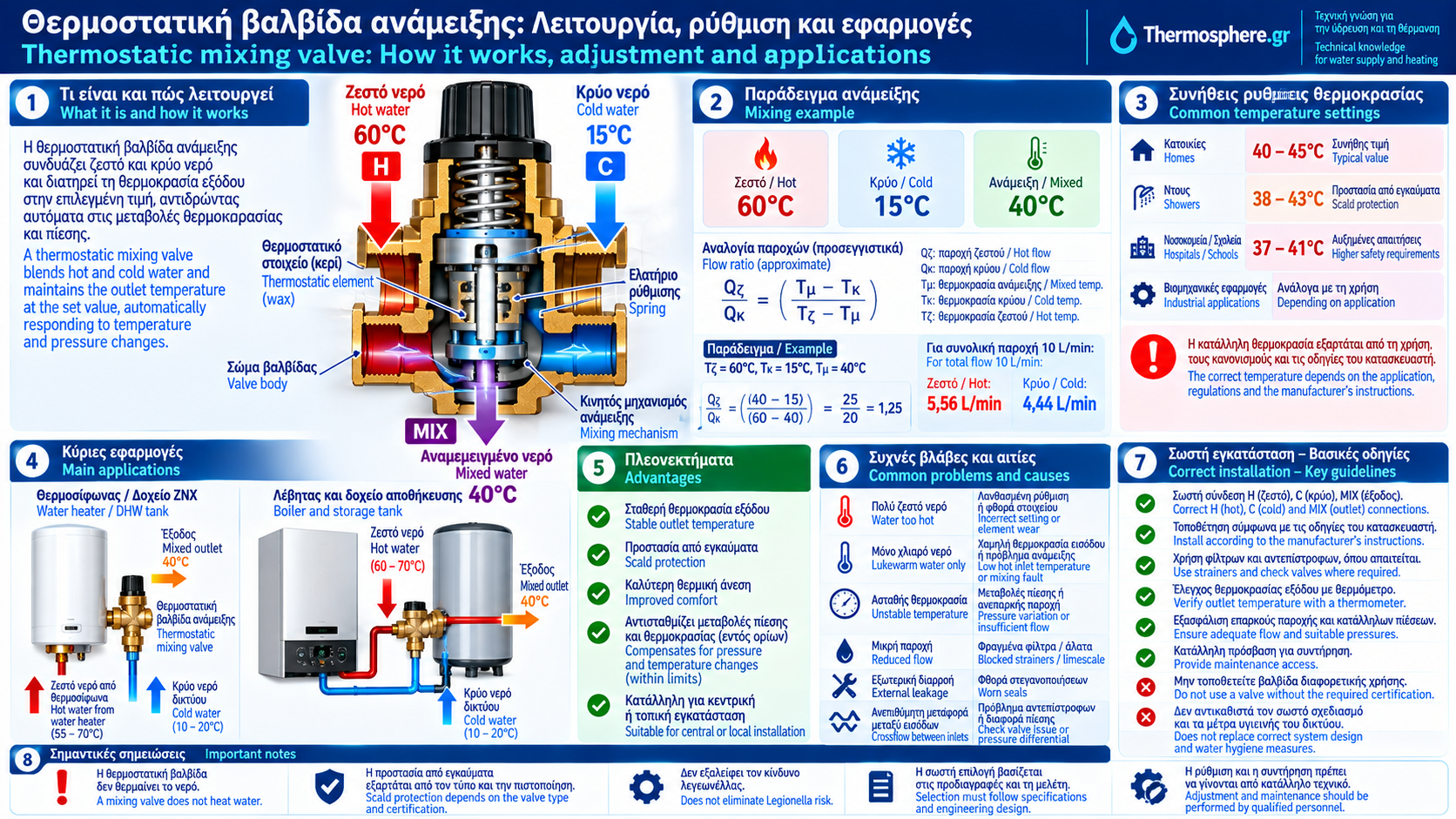
Thermostatic Mixing Valve: How It Works, Adjustment and Applications
A thermostatic mixing valve is an important component in modern domestic hot water systems.
Its primary function is to combine hot and cold water to deliver water at a selected outlet temperature.
It is used with water heaters, boilers, hot water storage vessels and central domestic hot water production systems.
Correct selection and adjustment can improve thermal comfort, reduce scalding risks and help stabilise water temperature.
However, a thermostatic mixing valve does not replace proper system design, maintenance or water hygiene measures.
This Thermosphere.gr technical guide explains how thermostatic mixing valves work, where they are installed, how they are adjusted and how common faults can be diagnosed.
1. What Is a Thermostatic Mixing Valve?
A thermostatic mixing valve is an automatic valve that combines two water supplies at different temperatures.
It generally has three connections:
Hot water inlet — H.
Cold water inlet — C.
Mixed water outlet — MIX.
It is commonly abbreviated TMV.
The mechanism changes the proportions of hot and cold water to maintain the outlet temperature close to the selected setting, within its operating limits.
2. How Does a Thermostatic Mixing Valve Work?
Inside the valve is a temperature-sensitive element that reacts to changes in mixed-water temperature.
Depending on the design, the element may use a special thermostatic material such as wax.
When outlet temperature rises above the selected value, the mechanism restricts hot water flow or changes the mixing ratio.
When temperature falls, the mechanism allows a greater proportion of hot water.
This provides automatic temperature control.
Actual accuracy depends on inlet pressures, temperatures, flow rate and valve specifications.
3. Why Is It Used in Domestic Hot Water Systems?
Water stored in a hot water cylinder may be hotter than is appropriate for direct use.
A thermostatic mixing valve allows cold water to be mixed with the hot supply before distribution or use.
Potential benefits include:
Controlled outlet temperature.
Reduced scalding risk.
Improved comfort.
More stable operation under changing conditions.
Better utilisation of stored hot water at higher temperatures, where system design permits.
Actual safety performance depends on the specific valve’s design and certified functions.
4. What Outlet Temperature Should Be Used?
The correct outlet temperature depends on the application.
Settings around 40–45°C are encountered in some domestic applications, but they are not universal recommendations.
Showers, hospitals, schools and other facilities may require different limits and special protection measures.
Selection must consider:
Intended water use.
User vulnerability.
Applicable safety requirements.
Manufacturer instructions.
Overall Legionella risk-control strategy.
Outlet temperature must be verified with a suitable thermometer.
5. Hot and Cold Water Mixing Example
Assume:
Hot water inlet: 60°C.
Cold water inlet: 15°C.
Desired mixed outlet: 40°C.
Using a simplified heat balance, neglecting heat losses and assuming similar thermophysical properties:
Qh / Qc = (Tm − Tc) / (Th − Tm)
Where:
Qh = hot water flow rate.
Qc = cold water flow rate.
Tm = mixed water temperature.
Tc = cold water temperature.
Th = hot water temperature.
Therefore:
Qh / Qc = (40 − 15) / (60 − 40)
Qh / Qc = 25 / 20 = 1.25.
For a total flow of 10 L/min, the approximate flows are:
Hot water: 5.56 L/min.
Cold water: 4.44 L/min.
This example illustrates the mixing principle. Actual performance depends on hydraulic conditions.
6. Where Is a Thermostatic Mixing Valve Installed?
Installation location depends on the intended function.
Central Mixing
The valve is installed near the outlet of the hot water production or storage system.
Point-of-Use Mixing
The valve is installed close to an individual outlet or small group of outlets.
Point-of-use mixing can provide more targeted scald protection when a suitable certified device is selected.
Choosing between central and local mixing requires consideration of water hygiene and distribution temperatures.
7. Correct Connection Arrangement
Connections are typically marked:
H — Hot water
C — Cold water
MIX — Mixed water
Correct connection is essential.
Reversing the inlets may cause incorrect regulation or unstable operation.
Depending on the model, additional components may include:
Strainers.
Check valves.
Isolation valves.
Temperature measurement points.
Always follow the manufacturer’s installation diagram.
8. How Is the Outlet Temperature Adjusted?
Adjustable thermostatic mixing valves commonly have a control knob or adjustment mechanism.
A general commissioning procedure includes:
Confirm correct H, C and MIX connections.
Check inlet pressures.
Verify inlet temperatures are within permitted limits.
Establish an appropriate flow according to instructions.
Adjust the setting gradually.
Measure outlet temperature with a reliable thermometer.
Check temperature stability under changing demand.
Do not rely only on the markings of the adjustment knob.
Actual outlet temperature must be verified.
9. What Happens When Cold Water Pressure Changes?
A thermostatic mixing valve attempts to compensate for changing supply conditions.
If cold water pressure or flow decreases, the mechanism may restrict hot water flow.
However, compensation has limits.
Large pressure differences, insufficient flow or operation outside specifications can cause temperature deviations.
Permitted differential pressures and minimum operating flow must therefore be checked.
10. What Is Scald Protection?
High-temperature water can cause scalding, especially among children, older adults and vulnerable users.
Some certified thermostatic mixing valves include a safety function that restricts or shuts down hot water delivery if cold water supply fails, under specified test conditions.
This function must not be assumed to exist in every valve.
Selection must be based on appropriate certification and technical specifications.
High-risk facilities may require dedicated point-of-use protective devices.
11. Thermostatic Mixing Valves and Legionella
Legionella bacteria can grow in water systems under favourable conditions.
Risk management includes temperature control, preventing stagnation, maintenance and suitable system design.
Thermostatic mixing creates an important design consideration.
Hot water may need to be stored and distributed at temperatures supporting the system’s hygiene strategy, while a lower temperature is required at the point of use to reduce scalding risk.
Local thermostatic mixing can form part of this strategy.
However, a thermostatic mixing valve does not disinfect water and does not eliminate Legionella risk by itself.
The installation must follow a documented water safety and risk-control approach.
12. Central Versus Point-of-Use Mixing
Central Mixing
A central valve can supply multiple outlets at a common mixed-water temperature.
Advantages:
Centralised control.
Fewer mixing valves.
Convenient access in some systems.
Limitations:
Temperatures at distant outlets may be affected by heat losses.
Water hygiene requires careful assessment.
Point-of-Use Mixing
A local valve serves an individual outlet or small group.
Advantages:
Targeted temperature control.
Potential for specific point-of-use scald protection.
Limitations:
More components.
Greater inspection and maintenance requirements.
Neither arrangement is universally suitable.
13. How to Select the Correct TMV
Selection should consider:
Hot water temperature range.
Cold water temperature.
Desired mixed temperature.
Minimum and maximum flow rates.
Available pressure.
Permitted inlet pressure differential.
Hydraulic resistance.
Scald protection requirements.
Potable-water suitability.
Maintenance requirements.
Connection size alone is insufficient for sizing.
Manufacturer flow curves and operating limits should be reviewed.
14. Why Is Outlet Temperature Unstable?
Possible causes include:
Large pressure fluctuations.
Flow below the minimum operating requirement.
Insufficient hot water temperature.
Cold water temperature changes.
Deposits inside the mechanism.
Thermostatic element deterioration.
Incorrect sizing.
Diagnosis requires temperature and pressure measurements at both inlets and the outlet.
15. Why Is the Water Only Cold or Lukewarm?
The mixing valve is not always responsible.
Check:
Actual hot water inlet temperature.
Water heater or boiler operation.
Correct H and C connections.
Possible strainer blockage.
Inlet pressure.
Thermostatic element condition.
If incoming hot water is not sufficiently hot, the valve cannot produce a higher outlet temperature.
A mixing valve combines water; it does not heat it.
16. Why Is Water Flow Reduced?
Reduced flow may be caused by:
Blocked strainers.
Mineral deposits.
Incorrect valve size.
Excessive pressure drop.
Partial mechanism blockage.
Insufficient supply pressure.
Installing a larger valve is not always the correct solution.
Minimum flow requirements for stable temperature control must also be considered.
17. Thermostatic Mixing Valve Maintenance
Maintenance depends on manufacturer instructions and water quality.
It may include:
Outlet temperature checks.
Testing under changing flow conditions.
Strainer cleaning.
Check valve inspection.
Deposit inspection.
Replacement of thermostatic cartridges where specified.
High-risk facilities may require dedicated testing schedules and recorded results.
18. Common Troubleshooting Table
Symptom | Possible cause | Check |
Water too hot | Incorrect setting or control fault | Measure temperature and inspect valve |
Lukewarm water only | Low hot inlet temperature or mixing fault | Check H and C |
Unstable temperature | Pressure variation or insufficient flow | Measure pressure and flow |
Reduced flow | Strainers, deposits or sizing problem | Check hydraulic resistance |
External leakage | Worn seals | Isolate and inspect |
Unwanted crossflow between inlets | Check valve issue or pressure differential | Inspect specified protection devices |
19. Common Installation Mistakes
Reversing Hot and Cold Connections
This can seriously affect operation.
Adjusting Without a Thermometer
Actual outlet temperature cannot be verified.
Ignoring Minimum Flow
Temperature control may become unstable.
Unsuitable Inlet Pressures
These may exceed the valve’s operating limits.
Missing Required Check Valves
Unwanted crossflow between supply lines may occur.
Ignoring Legionella Risk
Mixed-water temperature must form part of the overall water hygiene strategy.
Choosing a Valve Without the Required Certification
A general mixing valve does not necessarily provide the same scald-protection performance as a certified TMV for a specific application.
20. Frequently Asked Questions
What Does a Thermostatic Mixing Valve Do?
It combines hot and cold water and attempts to maintain the mixed outlet temperature close to a selected value.
Can I Set the Outlet to 40°C?
If the valve and application permit it, this setting may be used. Temperature must be verified and safety requirements checked.
Does Every Water Heater Need a TMV?
Requirements depend on system design, storage temperature, protection needs and manufacturer instructions.
Does a TMV Save Energy?
It does not automatically produce energy savings. It can influence the use of stored hot water, but the result depends on system design and usage patterns.
Does It Protect Against Legionella?
Not by itself. It is a temperature-control component, not a disinfection device.
Why Does Temperature Change When Another Tap Opens?
Inlet pressures and flow rates may change. The valve can compensate only within its specified operating range.
Is a TMV the Same as a Three-Way Heating Valve?
Not necessarily. A domestic hot water TMV is designed for specific water conditions and safety requirements. Three-way heating valves may have different functions and specifications.
Conclusion
A thermostatic mixing valve is an important component for domestic hot water temperature control.
Its mechanism automatically changes the ratio of hot and cold water to maintain a relatively stable outlet temperature.
Reliable operation requires correct sizing, suitable pressures, sufficient flow, proper connections and actual temperature verification.
Scald protection and Legionella control must be considered together, according to system requirements.
A correctly selected thermostatic mixing valve is more than a comfort device: it forms part of a comprehensive approach to safe domestic hot water management.
Technical References and Further Reading
EN 1111: Sanitary tapware — Thermostatic mixing valves (PN 10) — General technical specification.
EN 1287: Sanitary tapware — Low pressure thermostatic mixing valves — General technical specifications.
EN 806: Specifications for installations inside buildings conveying water for human consumption.
EN 1717: Protection against pollution of potable water in water installations.
WHO: https://www.who.int/ — Legionella and water safety information.
CEN-CENELEC: https://www.cencenelec.eu/
Caleffi: https://www.caleffi.com/ — thermostatic mixing valve technical documentation.
Applicable certification and standards depend on valve type and intended use.
Safety note: Incorrect adjustment can cause scalding. Installation, initial commissioning and safety testing should be performed by appropriately qualified personnel following manufacturer instructions.
Thermosphere.gr — Technical knowledge for water supply and heating systems.