
Thermostatic Radiator Valves: How They Work, Settings and Common Problems
Thermostatic radiator valves (TRVs) are among the most practical devices for automatically controlling room temperature in water-based radiator heating systems.
They regulate the flow of hot water through individual radiators according to the temperature of the surrounding room.
When correctly selected, installed and adjusted, TRVs can improve thermal comfort and help reduce unnecessary heating energy consumption.
However, incorrect installation, unsuitable settings or mechanical faults may cause radiators to remain cold, overheat or produce unwanted noise.
This technical guide explains how thermostatic radiator valves operate, what their temperature settings mean, how hydraulic presetting works and how to identify common problems.
1. What Is a Thermostatic Radiator Valve?
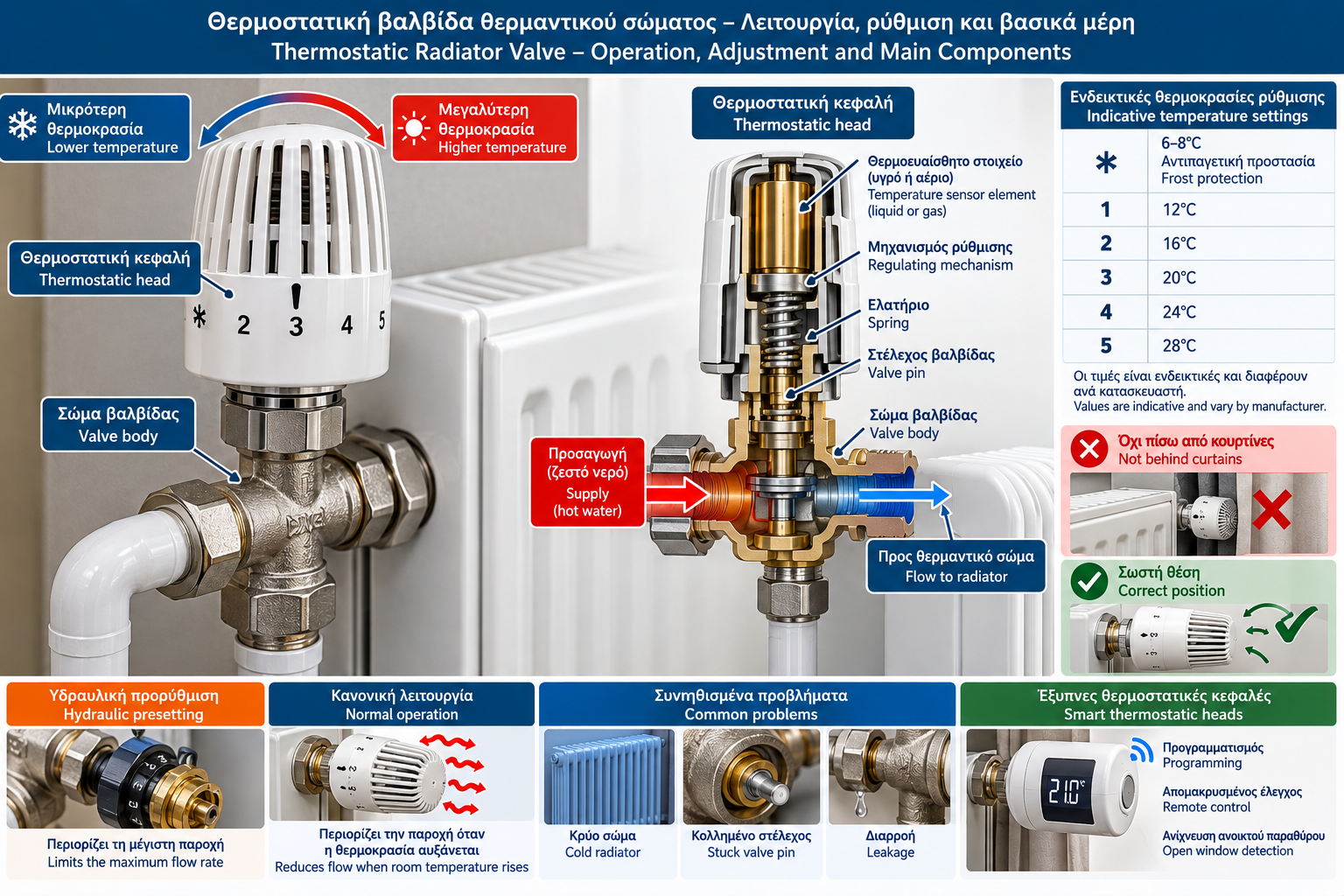
A thermostatic radiator valve, commonly abbreviated as TRV, is a device that automatically regulates the water flow through a radiator in response to room temperature.
A typical mechanical TRV consists of two main components:
Thermostatic head: Contains a temperature-sensitive element that responds to changes in ambient temperature.
Valve body: Contains the mechanism that opens or restricts water flow through the radiator.
In many installations, the thermostatic head can be replaced without draining the heating system, provided only the removable head is being replaced and the hydraulic valve body remains intact.
Compatibility between the replacement head and the existing valve must always be verified.
2. How Does a Thermostatic Radiator Valve Work?
A mechanical thermostatic head contains a temperature-sensitive element, commonly filled with liquid or another suitable expansion medium.
As the surrounding air temperature increases, the element expands and moves the valve mechanism towards the closed position.
This reduces the flow of hot water through the radiator.
When the room temperature decreases, the mechanism allows the valve to open further.
The process is automatic and does not require an electrical power supply in conventional mechanical thermostatic heads.
Important clarification
A thermostatic radiator valve does not increase the water temperature produced by a boiler or heat pump.
It controls the amount of water flowing through the radiator, not the heat generator’s supply temperature.
3. What Do Thermostatic Radiator Valve Settings 1–5 Mean?
Most mechanical thermostatic radiator heads feature a numbered adjustment scale.
These numbers represent approximate room temperature setpoints rather than heating speeds.
A commonly used indicative scale is:
Setting | Approximate Room Temperature |
* | Frost protection, approximately 6–8°C |
1 | 12°C |
2 | 16°C |
3 | 20°C |
4 | 24°C |
5 | 28°C |
Important: These values are illustrative. Actual temperature settings vary depending on the manufacturer, model, installation position and surrounding conditions.
Setting a TRV to 5 does not necessarily heat a room faster than setting it to 3.
If the valve is already fully open at both settings, increasing the setpoint will not increase the water flow further.
4. How to Set a Thermostatic Radiator Valve Correctly
The appropriate temperature depends on the room’s function, occupant preferences and building conditions.
Indicative settings may include:
Living room: approximately 20–21°C.
Bedroom: approximately 17–19°C.
Rooms used infrequently: a lower temperature where appropriate.
Bathroom: a higher temperature during periods of use, depending on comfort requirements.
These are examples, not universal requirements.
Recommended adjustment procedure
Select the desired room temperature.
Allow sufficient time for the heating system to respond.
Measure the actual room temperature using an independent thermometer.
Adjust the thermostatic head if necessary.
Avoid repeatedly changing the setting by large amounts.
The thermostatic head should be exposed to air that represents the actual room temperature.
5. Where Should a Thermostatic Head Not Be Installed?
The installation position significantly affects temperature sensing accuracy.
Problematic locations include:
Behind heavy curtains.
Inside enclosed radiator covers.
Close to independent heat sources.
Areas with restricted air circulation.
Positions where the head is exposed to unrepresentative local temperatures.
In these situations, the thermostatic head may detect a temperature different from the actual room temperature.
Where supported by the manufacturer, a thermostatic head with a remote temperature sensor may provide a suitable solution.
The permitted installation position and orientation must follow the instructions for the specific model.
6. Thermostatic Temperature Control vs Hydraulic Presetting
Thermostatic temperature control and hydraulic presetting are two different functions.
Thermostatic temperature control
This determines the desired room temperature.
The thermostatic head automatically adjusts the valve opening as the room temperature changes.
Hydraulic presetting
Hydraulic presetting limits the maximum water flow through the radiator according to the system’s design requirements.
Some thermostatic valve bodies incorporate a dedicated presetting mechanism.
This function is important for hydronic balancing.
A thermostatic head alone does not replace proper hydraulic balancing of the heating network.
7. Why Is My Radiator Not Heating Up?
A cold radiator does not automatically mean that the thermostatic valve is defective.
Possible causes include:
The room has already reached the selected temperature.
The thermostatic head is malfunctioning.
The valve pin is stuck.
Air is trapped inside the radiator.
Water flow is insufficient.
The circulation pump is not operating correctly.
The heating system is hydraulically unbalanced.
What can the homeowner check?
Without dismantling the valve, the user can verify:
Whether the heating system is operating.
Whether the TRV is set to the desired temperature.
Whether the room is already warm enough.
Whether other radiators are heating normally.
Whether visible leaks or unusual noises are present.
If the problem continues, professional inspection is recommended.
8. Stuck Thermostatic Radiator Valve Pin
A common mechanical problem is a stuck valve pin.
This may occur after a long period without heating operation.
Symptoms
The radiator remains cold.
Changing the thermostatic setting has no effect.
The thermostatic head appears functional, but water flow does not change.
Diagnosis and repair
A qualified technician may remove the thermostatic head, where permitted by the manufacturer, and inspect the movement of the valve pin.
Excessive force, hammering or unsuitable tools must not be used.
These actions can damage the valve and potentially cause leakage.
If the mechanism is defective, replacement of the valve or an appropriate service component may be required.
9. Why Does My Radiator Stay Hot All the Time?
If a radiator continues heating while the room temperature is above the selected setpoint, possible causes include:
A defective thermostatic head.
Incorrect compatibility between the head and valve body.
A valve mechanism stuck in the open position.
Incorrect temperature sensing.
Internal leakage through the valve seat.
However, a radiator remaining slightly warm does not necessarily indicate a fault.
Diagnosis should consider actual room temperature, valve operation and system conditions.
10. Whistling or Noise From a Thermostatic Radiator Valve
Noise may occur when the valve restricts water flow while the available differential pressure is excessive.
Possible causes include:
Excessive differential pressure.
Incorrect circulation pump settings.
Poor hydronic balancing.
Unsuitable valve selection.
Incorrect flow direction where the valve has specific installation requirements.
Corrective measures may include adjusting the circulation pump or introducing appropriate differential pressure control.
Replacing the thermostatic head alone will not necessarily solve the problem.
11. Smart Thermostatic Radiator Valves
In addition to conventional mechanical thermostatic heads, electronic and smart radiator thermostats are available.
Depending on the model, they may offer:
Programmable temperature settings.
Weekly heating schedules.
Remote temperature control.
Open-window detection.
Integration with home automation systems.
Before installation, mechanical compatibility with the existing radiator valve must be confirmed.
The interaction between smart radiator thermostats, central room thermostats and the heat generator must also be considered.
Smart thermostatic heads do not automatically guarantee energy savings.
Their effectiveness depends on the overall heating system and control strategy.
12. Maintenance and Prevention of Common Problems
Recommended maintenance practices include:
Keeping the thermostatic head unobstructed.
Inspecting for visible leaks.
Avoiding mechanical damage.
Checking operation before the heating season.
Investigating persistent hydraulic imbalance.
Following the manufacturer’s maintenance instructions.
Some manufacturers recommend a particular thermostatic head position during periods when heating is not required.
Always follow the instructions for the specific product.
13. Frequently Asked Questions
What number should I set my thermostatic radiator valve to?
On many thermostatic heads, setting 3 corresponds to approximately 20°C.
However, the exact relationship depends on the manufacturer and model.
Does setting a TRV to 5 heat the room faster?
Not necessarily.
If the valve is already fully open, selecting a higher temperature does not increase the flow beyond its maximum available value.
Why is my radiator cold when the heating is on?
Possible causes include the room reaching its setpoint, a stuck valve, trapped air, insufficient water flow or incorrect hydronic balancing.
Can I replace only the thermostatic head?
In many cases, yes.
The replacement head must be mechanically compatible with the existing valve body.
Should every radiator have a thermostatic valve?
The appropriate arrangement depends on the system design and central heating controls.
The installation must maintain the required water circulation, particularly when several thermostatic valves close simultaneously.
Conclusion
Thermostatic radiator valves provide an effective method of controlling individual room temperatures in hydronic heating installations.
Correct selection, installation and adjustment can improve thermal comfort and help reduce unnecessary heating operation.
For reliable system performance, thermostatic radiator valves must work correctly with the circulation pump, central heating controls and hydraulic balancing arrangements.
Fault diagnosis should be based on actual symptoms and operating conditions rather than automatically replacing components.
Technical References
EN 215 — Thermostatic Radiator Valves: Requirements and Test Methods.
CIBSE — Guide B1: Heating.
CIBSE — Commissioning Code W: Water Distribution Systems.
Danfoss — Technical documentation for thermostatic radiator valves and sensors.
IMI Heimeier — Technical documentation for thermostatic heads and presettable radiator valves.
Honeywell Home / Resideo — Technical documentation for thermostatic radiator controls.
This article provides general technical information and does not replace installation-specific engineering design, manufacturer instructions or professional diagnosis.