
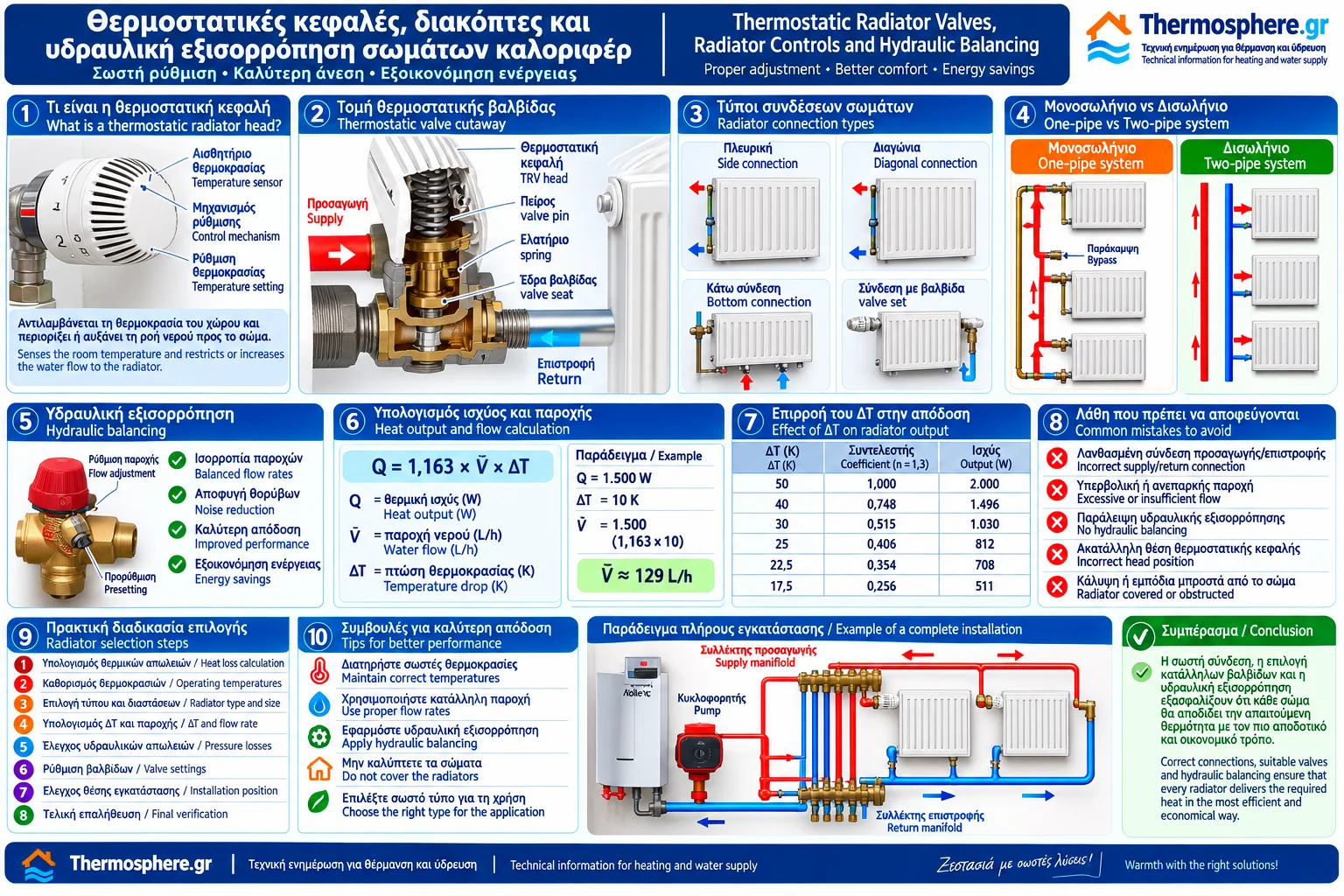
Thermostatic Radiator Valves, Radiator Controls and Hydraulic Balancing
Correct radiator operation depends not only on heat output and radiator size, but also on water flow and room temperature control.
Thermostatic radiator heads, supply and return valves, and hydraulic balancing components are essential elements of many efficient hydronic heating installations.
When properly selected and adjusted, these components improve local temperature control, reduce unwanted overheating and support appropriate water distribution throughout the heating system.
1. What Is a Thermostatic Radiator Head?
A thermostatic radiator head is a device that adjusts hot water flow through a radiator according to the temperature sensed near the head.
It is installed on a compatible thermostatic valve body.
The head does not heat the water and does not necessarily control the boiler or heat pump directly.
Its primary function is local radiator heat output regulation through water flow control.
2. How Does a Mechanical Thermostatic Head Work?
A typical mechanical thermostatic head contains a temperature-sensitive element, a mechanical transmission system and a temperature setting mechanism.
The temperature-sensitive element may contain liquid, gas or another suitable material.
As the surrounding temperature increases, the element changes its volume or mechanical state and moves the valve mechanism.
This gradually restricts water flow.
When the temperature decreases, the mechanism allows the valve to open further.
Many mechanical thermostatic heads provide proportional regulation rather than simple on/off operation.
3. Thermostatic Head vs Thermostatic Valve
These terms are often confused.
Thermostatic head: Senses temperature and generates the mechanical control action.
Thermostatic valve body: The hydraulic component installed in the pipework that changes the available flow area.
The two components work together but are not the same device.
Mechanical and functional compatibility must be verified.
4. What Do the Numbers on a Thermostatic Head Mean?
Many thermostatic heads have numbered settings, commonly from 1 to 5.
These numbers represent approximate temperature settings rather than valve opening percentages.
For example, position 3 may correspond to approximately 20°C on a particular model.
Actual temperature values vary by manufacturer and model.
Setting the head to 5 does not necessarily heat the room faster than the available radiator capacity allows.
It generally selects a higher temperature setpoint.
5. Thermostatic Head vs Room Thermostat
A thermostatic head controls water flow through an individual radiator.
A room thermostat typically participates in controlling heating demand for the system or a heating zone.
If the room thermostat stops calling for heat, a thermostatic head cannot independently guarantee heating.
Similarly, a thermostatic head may reduce radiator output even while the heating system is operating.
Their interaction must be considered when designing the control system.
6. Correct Thermostatic Head Installation
Installation position affects temperature sensing accuracy.
Mechanical heads must be installed according to manufacturer instructions.
Horizontal mounting is preferred in many designs to reduce the influence of heat from the valve and pipework.
Potential problems arise when the head is:
Behind heavy curtains.
Inside a closed radiator cover.
Close to another heat source.
In an area with restricted air circulation.
Exposed to direct sunlight.
A remote temperature sensor may be appropriate in such situations.
7. Electronic and Smart Thermostatic Radiator Heads
Electronic heads use temperature sensors, an electronic controller and a motorised valve actuator.
Depending on the model, features may include:
Time scheduling.
Digital temperature indication.
Wireless communication.
Remote control.
Open-window detection.
Smart home integration.
Capabilities vary significantly between products.
A smart head does not automatically guarantee energy savings. Actual results depend on settings, schedules and the heating system.
8. What Is a Radiator Valve?
A radiator valve is a hydraulic component used to regulate or stop water flow.
Common types include:
Manual radiator valves.
Thermostatic radiator valves.
Special one-pipe radiator valves.
Integrated panel radiator valves.
Combined bottom connection valve sets.
The correct type depends on the radiator connection and piping distribution system.
9. What Is a Lockshield Valve?
A lockshield valve is commonly installed on the return side of a radiator.
Depending on its design, it may provide:
Radiator isolation.
Flow restriction.
Basic hydraulic adjustment.
Some installations use lockshield valves for balancing.
However, not all lockshield valves have calibrated flow measurement characteristics.
Accurate adjustment therefore depends on the specific valve's technical data.
10. What Is Thermostatic Valve Presetting?
Presetting mechanically limits the maximum available valve flow under defined hydraulic conditions.
Many modern thermostatic valves have numbered preset positions.
Presetting is not the same as adjusting the thermostatic head's temperature setting.
The thermostatic head sets the temperature target. Presetting establishes the hydraulic characteristics of the available valve opening.
Presetting can help prevent excessive flow through low-resistance branches.
11. What Do Kv and Kvs Mean?
The Kv coefficient describes a valve's hydraulic flow capacity at a particular opening.
For water under common reference conditions, the approximate relationship is:
V̇ = Kv × √Δp
Where:
V̇ is water flow in m³/h.
Kv is the flow coefficient in m³/h at a 1 bar pressure difference.
Δp is differential pressure in bar.
Kvs is the flow coefficient at the fully open valve position under the applicable manufacturer test conditions.
Accurate selection requires product-specific technical data.
12. Calculating Required Radiator Flow
Assume a radiator must deliver:
1,500 W
With a design water temperature drop of:
10 K
For water at typical heating temperatures:
Q(W) ≈ 1.163 × V̇(L/h) × ΔT_water(K)
Therefore:
V̇ = 1,500 / (1.163 × 10)
V̇ ≈ 129 L/h
Or:
0.129 m³/h
This is the design flow required for the specified heat transfer and temperature drop.
13. Example Kv Calculation
Assume the design differential pressure across the valve is:
10 kPa = 0.1 bar
Required flow:
0.129 m³/h
Using:
Kv = V̇ / √Δp
Kv = 0.129 / √0.1
Kv ≈ 0.41
A valve preset providing an appropriate Kv of approximately 0.41 would be required under these assumptions.
Final selection must be verified using manufacturer presetting tables.
The 10 kPa differential pressure is an illustrative assumption, not a universal design value.
14. What Is Hydraulic Balancing?
Hydraulic balancing is the process of adjusting water flow throughout a heating network to meet design requirements.
Without balancing, water may be distributed unevenly.
Low-resistance branches may receive excessive flow.
More distant radiators may receive insufficient flow.
Hydraulic balancing does not mean every radiator should receive the same flow.
It means each radiator should receive the flow required by its heating load and design conditions.
15. Static vs Dynamic Hydraulic Balancing
Static Balancing
Uses fixed valve settings based on defined design conditions.
These settings do not automatically adapt when operating conditions change.
Dynamic Balancing
Uses components that regulate flow or differential pressure as hydraulic conditions change.
Examples include:
Pressure-independent control valves where appropriate.
Automatic flow limiters.
Differential pressure controllers.
Selection depends on the network design and operating behaviour.
16. What Happens When Thermostatic Valves Close?
In a variable-flow two-pipe system, closing thermostatic valves reduces the total flow demand.
Differential pressure across other valves may change depending on pump characteristics and network conditions.
Potential consequences include:
Valve noise.
Unstable control.
Excessive flow through open branches.
Unfavourable pump operation.
Variable-speed pumps, differential pressure control and other appropriate hydraulic solutions can address these issues.
17. Thermostatic Valves in One-Pipe Systems
One-pipe systems with bypass loops require suitable one-pipe radiator valves.
The valve must maintain the intended circulation through the loop when flow through the radiator is restricted.
Replacing a dedicated one-pipe valve with an unsuitable conventional valve may affect downstream radiators.
Head and valve selection must match the system arrangement.
18. Thermostatic Radiator Valves With Heat Pumps
Heat pump systems must maintain the manufacturer's required minimum water flow and, where applicable, minimum system water volume.
If multiple thermostatic valves close simultaneously, total system flow may decrease.
Depending on system design, this can interfere with heat pump operation.
Solutions may include appropriate hydraulic arrangements, controlled zones, differential bypasses or other design-specific measures.
A buffer tank is not automatically required in every heat pump installation.
19. Thermostatic Valves With Condensing Boilers
Thermostatic radiator valves can reduce unwanted overheating in individual rooms.
However, condensing boiler efficiency also depends on suitable supply and return water temperatures and overall control strategy.
TRVs should be combined with:
Correct radiator sizing.
Appropriate weather compensation where applicable.
Hydraulic balancing.
Compatible pump control.
Compliance with boiler minimum circulation requirements.
Excessive flow restriction is not inherently an energy-saving measure.
20. Common Problems and Faults
Radiator Does Not Heat
Possible causes include:
The thermostatic head has reached its setpoint.
The valve remains closed.
Insufficient water flow.
Trapped air.
Another hydraulic fault.
Radiator Remains Hot
Possible causes include:
Incorrect head setting.
Poor sensor position.
Valve mechanical malfunction.
Incorrect connection.
Whistling Noise
This may be associated with excessive differential pressure across a partially open valve.
Uneven Heating Between Radiators
This may indicate flow imbalance, although other causes must also be investigated.
A single symptom is not enough for a reliable diagnosis.
21. Can a Thermostatic Valve Pin Become Stuck?
In some mechanical valves, the moving pin may become difficult to operate after prolonged inactivity.
This can interfere with valve opening and closing.
Head removal and mechanism inspection must follow manufacturer instructions.
Excessive force must not be used, and pressurised water-retaining components must not be dismantled without appropriate expertise.
22. Practical Hydraulic Balancing Procedure
A technically sound process includes:
Identify all radiators.
Determine the heating requirement of each room.
Define supply and return temperatures.
Calculate the required flow for each radiator.
Review valve characteristics.
Determine available differential pressure.
Select appropriate valve presets.
Check circulation pump settings.
Commission and verify flow conditions.
Check operation under different heating demands.
Document final settings.
Hydraulic balancing should be performed by suitably trained personnel using appropriate design information and measurement instruments where required.
23. Frequently Asked Questions
Will Setting a TRV to 5 Heat the Room Faster?
Usually not if the valve is already sufficiently open and the radiator is operating at its available maximum output. A higher setting primarily increases the temperature target.
Should All Radiators Have the Same Presetting?
No. Presetting depends on each radiator's required flow and available differential pressure.
Does Every Radiator Need a Thermostatic Head?
Not necessarily. This depends on the system control strategy and minimum circulation requirements.
Can Any Thermostatic Head Fit Any Valve?
No. Mechanical and functional compatibility must be confirmed.
Does Hydraulic Balancing Always Reduce Energy Consumption?
It can improve operation and reduce excessive flow, but actual energy savings depend on the original system condition and overall control settings.
Conclusion
Thermostatic radiator heads regulate local room temperature by increasing or restricting water flow through radiators.
Supply and return valves, presetting mechanisms and differential pressure control components provide hydraulic adjustment.
Hydraulic balancing ensures that each radiator receives the appropriate design flow.
The thermostatic head controls temperature. Hydraulic balancing controls water distribution. Both are important where required by the heating system design.
This article is intended for technical information. Valve selection and adjustment must follow engineering design and manufacturer instructions.
Thermosphere.gr — Technical information for heating and water supply.