
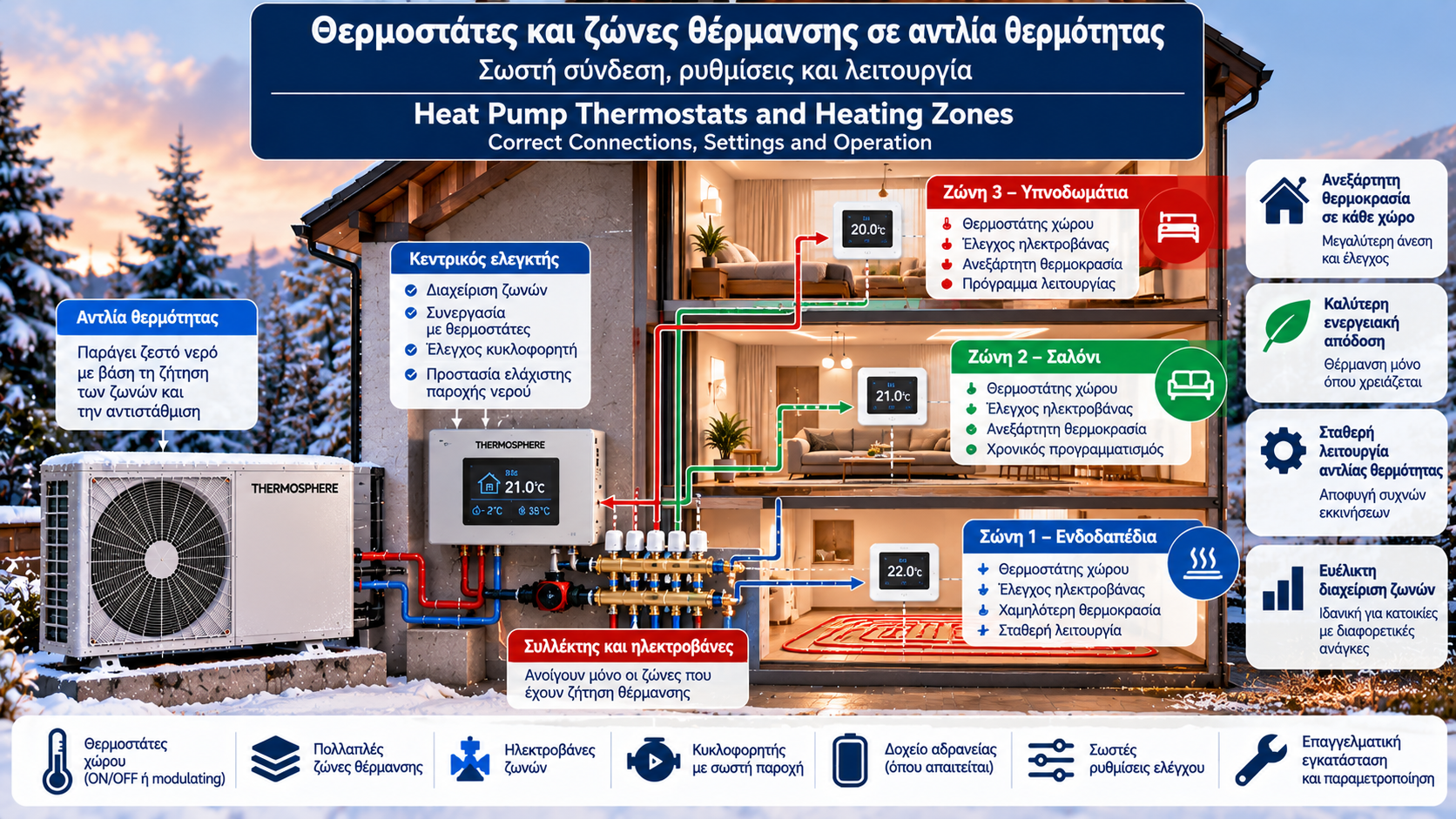
Heat Pump Thermostats and Heating Zones: Correct Connections, Settings and Operation
A heat pump does not operate independently of the rest of the heating system. To provide comfort and efficient operation, it must work correctly with room thermostats, indoor temperature sensors, zone valves and circulation pumps.
A small home may have one central thermostat. Larger buildings may have several independent heating zones, each controlled by a separate thermostat.
Multiple zones provide greater flexibility, but they also require careful design.
One of the most common problems occurs when several thermostats close their zones simultaneously, reducing the water flow required by the heat pump.
This guide explains how thermostats and heating zones operate, how they should be coordinated and which installation mistakes should be avoided.
1. What Is the Role of a Thermostat?
A thermostat monitors room temperature and compares it with the desired setting.
For example, if the desired temperature is 21°C and the actual temperature is 19°C, the thermostat may request heating.
When the desired temperature is reached, it may reduce or stop heating demand, depending on the control system.
The thermostat does not necessarily determine the water temperature produced by the heat pump.
In many installations, flow temperature is controlled separately through weather compensation.
2. What Is a Room Temperature Sensor?
A room sensor measures the actual temperature at a specific location.
It may be integrated into a thermostat or installed as a separate component.
Some systems use this measurement only for display purposes.
Others use it to influence heating demand, target flow temperature or overall heat pump operation.
Sensor placement is important.
Avoid locations close to:
Radiators.
Direct sunlight.
External doors.
Draughts.
Fireplaces.
Heat-producing appliances.
An unrepresentative temperature measurement can lead to incorrect control decisions.
3. What Is an ON/OFF Thermostat?
An ON/OFF thermostat typically provides a simple heating demand signal.
When heating is required, it activates the relevant contact or output.
When the desired temperature is reached, the signal changes state.
This does not necessarily mean the compressor stops immediately.
The heat pump controller may apply delays, minimum operating times and other protective functions.
ON/OFF thermostats can be used in many installations when they are compatible with the equipment.
However, frequent switching commands may cause undesirable intermittent operation.
4. What Is a Modulating Thermostat?
The term modulating thermostat generally describes a controller capable of communicating more information than a simple ON/OFF signal.
Depending on the manufacturer and communication protocol, it may support:
Temperature setpoint adjustments.
Room temperature feedback.
Operating schedules.
Control adjustments.
System information and diagnostics.
Not every modulating thermostat is compatible with every heat pump.
Communication requires an appropriate protocol and manufacturer support.
A thermostat designed for a boiler may not be compatible with a heat pump.
5. What Are Heating Zones?
A heating zone is an area of a building that can be controlled independently.
For example, a house may have:
Ground-floor zone.
First-floor zone.
Bedroom zone.
Home-office zone.
Each zone may have a different temperature setpoint and operating schedule.
This arrangement can improve comfort control.
However, the more independent zones a system has, the more important proper hydraulic and electrical coordination becomes.
6. How Does a Heating Zone With a Motorized Valve Work?
In a typical installation, the zone thermostat sends a signal to a motorized valve or electrothermal actuator.
When heating is required, the valve allows water to circulate through the zone.
When heating is no longer required, the valve may close.
The heat demand signal sent to the heat pump must be coordinated with valve operation.
If the heat pump operates while all zone valves are closed, the required water flow may not be maintained.
The exact operating sequence depends on the control system design.
7. Why Is Minimum Water Flow Critical?
Every heat pump has specific water circulation requirements.
The minimum permitted flow rate is defined by the manufacturer.
If several heating zones close simultaneously, total water flow may decrease significantly.
Possible consequences include:
Low-flow faults.
Operating interruptions.
Unstable temperature control.
Protective shutdowns.
Defrost problems in certain installations.
Multiple thermostats must not compromise the minimum hydraulic flow required by the heat pump.
8. What Is Short Cycling?
Short cycling occurs when a heat pump starts and stops too frequently, with short operating periods.
Possible causes include:
Very low active heating demand.
Several closed heating zones.
Minimum heat pump output exceeding the current load.
Insufficient system water volume.
Frequent thermostat switching.
Unsuitable control settings.
Frequent starts may affect efficiency and operating behaviour.
There is no single acceptable number of compressor starts applicable to every heat pump model.
9. Is a Buffer Tank Always Necessary?
No.
A buffer tank may be used to increase system water volume or meet specific hydraulic design requirements.
In some installations, it helps manage minimum water flow and reduce undesirable cycling.
However, a buffer tank is not required in every heat pump system.
Its necessity, capacity and connection arrangement should be determined by system design and manufacturer requirements.
An incorrectly configured buffer tank may introduce unwanted temperature mixing or additional heat losses.
10. What Is Hydraulic Separation?
Hydraulic separation is used when different circuits require different hydraulic operating conditions.
For example, the heat pump may have its own circulation circuit while heating zones are served by another pump.
Depending on the installation, separation may be provided by a hydraulic separator or a suitably configured tank.
The arrangement must be carefully designed to avoid unnecessarily increasing required flow temperatures or reducing system efficiency.
11. How Do Thermostats Work With Underfloor Heating?
Underfloor heating has high thermal inertia.
This means room temperatures may respond several hours after a change in operating conditions.
Very frequent thermostat switching does not necessarily improve control.
In many installations, stable operation with suitable weather compensation and correct hydraulic balancing may provide better results.
Room thermostats can serve as supplementary controls for individual zones.
The correct strategy depends on the system design.
12. What Happens When Radiators and Underfloor Heating Are Combined?
A mixed heating system may have two different water temperature requirements.
For example:
Underfloor heating may operate at a lower flow temperature.
Radiators may require a higher flow temperature.
Such systems may require a mixing valve, separate circulation pump and appropriate zone controls.
A heat pump should not be assumed to supply two independent flow temperatures directly without the necessary hydraulic arrangement.
The final solution must be determined through proper system design.
13. How Is Heating Demand Communicated to the Main Controller?
In a multi-zone system, a central controller may collect heating demand signals from several thermostats.
If one or more zones require heating, the controller may activate the overall demand signal to the heat pump.
At the same time, the corresponding valves must be open and adequate water circulation must be available.
Some installations use valve end switches or operating delays.
Electrical connections must follow the manufacturer’s wiring diagrams.
Voltage must never be applied to an input intended for a volt-free contact unless the manufacturer explicitly permits it.
14. What Is Thermostat Hysteresis?
Hysteresis is the temperature difference used by a thermostat to avoid continuous switching.
For example, a thermostat may activate heating slightly below the desired temperature and deactivate it slightly above that value.
Exact behaviour depends on the control algorithm.
Very narrow hysteresis may increase switching frequency.
Excessively wide hysteresis may cause larger indoor temperature variations.
Settings should be compatible with the thermal response of the heating system.
15. Should Unused Rooms Always Be Completely Closed Off?
Reducing heating in unused rooms may reduce heating demand.
However, completely closing multiple zones is not always the best solution.
It may cause:
Active heating demand below the heat pump’s minimum output.
Reduced water circulation.
Frequent compressor cycling.
Large temperature differences between rooms.
Greater reheating requirements.
The appropriate approach depends on insulation, occupancy and system design.
16. Can Smart Thermostats Reduce Energy Consumption?
Smart thermostats may offer useful functions such as:
Heating schedules.
Remote control.
Temperature monitoring.
Multi-zone management.
Occupancy-based adjustments.
However, a smart thermostat does not automatically guarantee energy savings.
An unsuitable control algorithm may create frequent operating interruptions.
Compatibility with the heat pump must be confirmed before installation.
17. How Do Thermostats Work With Weather Compensation?
Weather compensation determines target flow temperature based on outdoor conditions.
Thermostats determine whether individual rooms or zones require heating.
In a properly designed installation, these functions can operate together without excessive interruptions.
Some systems also allow indoor temperature feedback to modify the heating curve.
The control strategy should follow the capabilities of the specific heat pump controller.
18. What Happens When a Thermostat or Sensor Fails?
A faulty thermostat or sensor may produce incorrect heating commands.
Possible symptoms include:
A room failing to heat.
A zone remaining permanently active.
Incorrect displayed temperature.
A zone valve failing to respond.
Unexplained heating demand.
Communication faults.
Diagnosis must distinguish sensor faults from wiring, actuator or controller problems.
Electrical testing should be performed by qualified personnel.
19. Practical Example: A Home With Three Heating Zones
Consider a house with:
Zone A: Living room.
Zone B: Bedrooms.
Zone C: Home office.
Each zone has its own thermostat.
In the morning, the living room and office may require heating.
In the evening, demand may come mainly from the bedrooms.
The control system must open the appropriate valves and communicate the combined heating demand to the heat pump.
At the same time, it must maintain the minimum required water flow even when only one small zone is active.
This is one of the key issues that must be addressed during system design.
20. Common Installation Mistakes
Too Many Small Heating Zones
The heat pump may operate with an extremely low active heating load.
All Zone Valves Can Close
Required water flow may be restricted.
Incompatible Thermostat
The thermostat may not support the required electrical contact or communication protocol.
Poor Sensor Placement
Measured temperatures may not represent actual room conditions.
Missing Hydraulic Balancing
Some zones receive more heat than others.
Incorrect Hysteresis Settings
The system receives frequent switching commands.
Poor Circulation Pump Coordination
The hydraulic circuits fail to maintain the necessary water flow.
21. Pre-Installation Checklist
Before connecting thermostats and heating zones, consider:
How many independent zones are actually needed?
What is the minimum heating load when only one zone is active?
What is the heat pump’s minimum required water flow?
Can all zone valves close simultaneously?
Is a buffer tank or another hydraulic solution necessary?
Are the thermostats compatible?
Is the operating sequence correctly designed?
Are different flow temperatures required?
Are room sensors correctly positioned?
Has hydraulic balancing been completed?
22. Frequently Asked Questions
Can I Use Any Thermostat With a Heat Pump?
No. Electrical input requirements, contact type and communication compatibility must be verified.
Is a Smart Thermostat Better?
It may offer more features, but it is not necessarily more efficient in every installation.
Can I Install a Thermostat in Every Room?
It may be technically possible, but zone design must ensure adequate water flow and compatible heat pump operation.
Is a Buffer Tank Always Needed With Multiple Zones?
No. The requirement depends on system water volume, minimum flow, minimum heat pump output and manufacturer specifications.
Why Does My Heat Pump Start and Stop Frequently?
Possible causes include low active heating demand, frequent thermostat commands, restricted water flow or unsuitable settings.
Should I Turn Off Bedroom Heating During the Day?
It depends on the building and zoning arrangement. Completely closing zones may create problems in certain systems.
How Does a Thermostat Work With Weather Compensation?
The thermostat controls heating demand, while weather compensation adjusts flow temperature according to outdoor conditions.
Who Should Connect the Thermostats?
Connections and configuration should be completed by appropriately qualified technicians following manufacturer instructions.
Conclusion
Thermostats, room sensors and heating zones are important components of a heat pump control system.
When properly coordinated, they can improve indoor comfort and provide more effective heating management.
However, adding more heating zones does not automatically increase energy savings.
System design must consider minimum water flow, minimum heat pump output, water volume and control compatibility.
Effective control does not simply mean installing more thermostats. It means coordinating temperature, water circulation and heating demand correctly.
Thermosphere.gr — Technical knowledge for heating and building systems.