
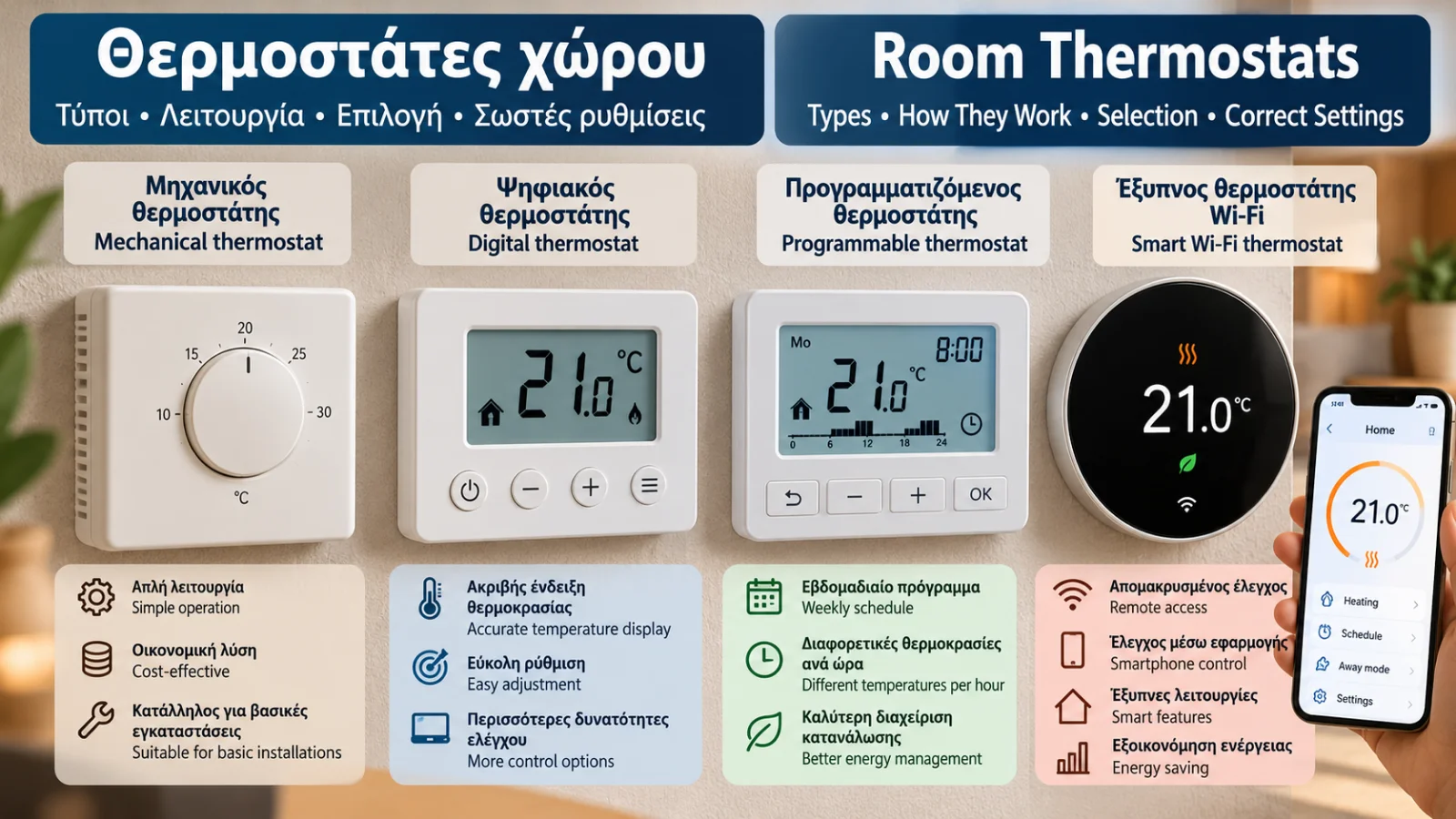
Room Thermostats: Types, How They Work, Selection and Correct Settings
A room thermostat is one of the most important control devices in a heating installation. Its main function is to monitor room temperature and communicate heating demand to the system so that comfortable indoor conditions can be maintained.
Although it is a relatively small device, its selection, location and settings can significantly influence the operation of a boiler, heat pump or heating circuit.
Today, room thermostats are available in mechanical, digital, programmable and smart versions, offering different levels of control and communication.
However, a more expensive or technologically advanced thermostat is not automatically the best solution for every installation.
This Thermosphere.gr guide explains the main types of room thermostats, their operating principles, selection criteria and practical settings for reliable, energy-efficient heating.
1. What Is a Room Thermostat?
A room thermostat is a control device that compares the measured indoor temperature with the desired temperature, known as the setpoint.
Depending on the difference between these values and the control method, it sends a signal requesting heating, stopping heating demand or adjusting the heating system's output.
For example, if the desired temperature is 21°C and the room is colder, the thermostat may request heat.
When the desired temperature is reached, the control signal changes according to the thermostat's operating logic.
The exact behaviour depends on whether the system uses simple ON/OFF control, time-proportional control or modulating communication with the heating equipment.
2. How Does an ON/OFF Thermostat Work?
A basic ON/OFF thermostat has two main operating states:
Heating demand.
No heating demand.
In many installations, the thermostat controls an electrical contact that allows the boiler or heating controller to recognise a request for heat.
This does not mean that the thermostat directly powers the burner or compressor.
Heating equipment has its own internal control and protection systems.
Operating Example
Suppose the desired indoor temperature is 21°C.
The thermostat may request heating when the temperature falls below a defined threshold and stop requesting heat when another threshold is reached.
The actual switching points depend on the thermostat's hysteresis and control algorithm.
Not all thermostats use the same switching differential.
3. What Is Thermostat Hysteresis?
Hysteresis, also known as the switching differential, is the temperature difference used to prevent continuous switching between heating demand and no demand.
For example, a thermostat set to 21°C may use separate thresholds for starting and stopping heating.
Hysteresis helps stabilise temperature control.
An excessively small switching differential may cause frequent heating requests in certain installations.
An excessively large differential may produce noticeable room-temperature fluctuations.
The appropriate setting depends on the thermostat, building thermal inertia and heating system.
Important: Some modern thermostats use adaptive or time-proportional algorithms rather than relying only on fixed hysteresis.
4. Mechanical Room Thermostats
Mechanical thermostats use a temperature-sensitive mechanism to operate an electrical contact.
Typical characteristics include:
Simple operation.
Rotary temperature selector.
Limited scheduling capabilities.
No internet connection.
Generally low purchase cost.
Advantages
Their main advantage is simplicity.
They can be suitable for installations requiring basic room-temperature control.
Limitations
Temperature indication and adjustment precision may be limited compared with electronic models.
They also generally lack weekly scheduling and remote access.
5. Digital Room Thermostats
Digital thermostats use an electronic temperature sensor and an electronic control circuit.
Typical features include:
Digital temperature display.
More precise setpoint selection.
Adjustable hysteresis on certain models.
Operating-status indicators.
Additional control parameters.
A digital thermostat is not necessarily programmable or smart.
Having a digital display does not automatically mean that the device supports Wi-Fi or smartphone control.
6. Programmable Thermostats
Programmable thermostats allow users to set different target temperatures for different times of day or days of the week.
An illustrative schedule might include:
Period | Example setpoint |
|---|---|
Morning occupancy | 20–21°C |
Unoccupied period | 17–19°C |
Evening occupancy | 20–21°C |
Sleeping hours | 18–20°C |
These values are illustrative rather than universal recommendations.
Appropriate settings depend on occupant needs, building characteristics and the heating system.
When Is Scheduling Useful?
Scheduling can be particularly useful in homes with predictable occupancy patterns.
However, heating systems with high thermal inertia, such as certain underfloor heating installations, may not benefit from frequent large temperature setbacks.
7. Smart and Wi-Fi Thermostats
Smart thermostats combine heating control with additional communication and automation capabilities.
Depending on the model, they may offer:
Wi-Fi connectivity.
Smartphone applications.
Remote temperature adjustment.
Weekly scheduling.
Occupancy detection.
Smartphone-based geofencing.
Heating-operation statistics.
Adaptive control algorithms.
Integration with compatible smart-home systems.
Not every smart thermostat supports all these functions.
Is Internet Access Always Required?
Not necessarily.
Some smart thermostats continue basic local heating control during an internet outage, while remote features become temporarily unavailable.
Others rely more heavily on external services.
Before purchasing, check how the thermostat behaves when internet connectivity is lost.
8. Comparison of Thermostat Types
Feature | Mechanical | Digital | Programmable | Smart |
|---|---|---|---|---|
Basic temperature control | Yes | Yes | Yes | Yes |
Digital display | Usually no | Yes | Usually | Usually |
Time scheduling | No | Model-dependent | Yes | Usually |
Smartphone control | No | Usually no | Model-dependent | Often |
Remote access | No | Usually no | Model-dependent | Often |
Advanced automation | Limited | Model-dependent | Model-dependent | Model-dependent |
These categories overlap. A smart thermostat is generally also digital and programmable.
9. Wired vs Wireless Thermostats
Wired thermostats connect to the heating controller or equipment through suitable wiring.
Wireless thermostats communicate with a compatible receiver or controller.
Wired Thermostats
Advantages may include:
No wireless communication required between thermostat and receiver.
Ability to use existing suitable wiring.
A relatively straightforward communication arrangement.
Wireless Thermostats
Advantages may include:
Greater flexibility in thermostat placement.
Useful where suitable wiring is unavailable.
Some models can be relocated.
Potential limitations include:
Dependence on wireless signal quality.
Battery replacement on certain models.
Compatibility requirements between thermostat and receiver.
Important: Wireless does not necessarily mean Wi-Fi. Many wireless thermostats use a dedicated radio connection between the room unit and receiver.
10. ON/OFF vs Modulating Thermostats
The control method is more important than the thermostat's external appearance.
ON/OFF Control
The thermostat requests or stops heating.
The heating equipment determines how to respond using its internal control logic.
Modulating Control
In compatible systems, the thermostat or controller can exchange additional operating information with the heating equipment.
This may allow the heating system to adjust its output according to room demand.
Examples include compatible communication protocols such as OpenTherm and manufacturer-specific control systems.
Important: Compatibility must be verified. A modulating thermostat cannot use its full functionality unless the heating equipment supports the same communication protocol.
Electrical connections and communication protocols will be covered in a separate Thermosphere.gr article.
11. Where Should a Room Thermostat Be Installed?
Thermostat location directly affects the temperature it measures.
A suitable location should represent the normal thermal conditions of the main occupied area.
Avoid installing thermostats:
In direct sunlight.
Above or immediately next to a radiator.
Close to fireplaces or other local heat sources.
Near external doors with frequent draughts.
Behind curtains or large furniture.
In areas with strong local temperature variations.
A mounting height of approximately 1.5 m above floor level is commonly used when consistent with manufacturer instructions.
The final position should reflect room usage and the device's installation requirements.
12. What Temperature Should You Set in Winter?
There is no single ideal temperature for every household.
Suitable settings depend on:
Occupant comfort and individual needs.
Building insulation.
Humidity and air movement.
Heating-system type.
How each room is used.
For many homes, approximately 19–21°C is a common starting range during occupied periods.
However, it is not a universal requirement or a suitable target for every person and building.
Does Setting the Thermostat to 25°C Heat the Room Faster?
With a basic ON/OFF thermostat, choosing a higher setpoint does not itself increase the heating capacity of the boiler or heat pump.
It generally extends the duration of heating demand.
More advanced control systems may behave differently.
13. Should You Lower the Temperature at Night?
Reducing indoor temperature overnight can lower building heat loss by reducing the temperature difference between indoors and outdoors.
However, the final energy benefit depends on how the heating system restores the desired temperature.
Systems with high thermal inertia or heat pumps that perform efficiently at low, stable water temperatures may experience long recovery periods or require higher water temperatures after a large setback.
The best strategy therefore varies between installations.
14. Room Thermostats and Heat Pumps
Heat pumps often operate efficiently when combined with appropriate weather compensation and relatively stable heating-water temperatures.
A simple ON/OFF thermostat may be suitable for certain installations, but its connection and configuration must follow the heat pump manufacturer's instructions.
In some systems, frequent interruptions of heating demand can reduce opportunities for continuous compressor operation.
In others, the room thermostat acts as a temperature limiter or works alongside a dedicated controller.
There is no universal thermostat configuration suitable for every heat pump.
15. Room Thermostats and Boilers
In boiler installations, the thermostat may control heating demand through a suitable contact or compatible communication system.
Condensing boilers can often benefit from controls that adjust flow temperature and burner operation.
However, efficiency depends on the overall installation, return-water temperature, heat emitters and control strategy.
Simply replacing a thermostat does not guarantee a particular percentage of energy savings.
16. How to Choose the Right Thermostat
Before purchasing, consider the following:
1. Heating-system type
Is the installation based on a boiler, heat pump or multi-zone system?
2. Control compatibility
Does the system require an ON/OFF contact, a particular communication protocol or a dedicated controller?
3. Electrical requirements
What supply voltage and contact or output type are supported?
4. Scheduling needs
Is daily or weekly programming required?
5. Remote access
Would smartphone control be useful?
6. Number of heating zones
Is one thermostat sufficient, or does each zone require separate control?
7. Installation conditions
Is suitable wiring available, and can the thermostat be placed correctly?
8. Product support
Are manuals, software updates and technical support available?
17. Common Thermostat Mistakes
Mistake 1: Installing the Thermostat Near a Radiator
The thermostat may measure a higher temperature than the rest of the room.
Mistake 2: Using Large Daily Temperature Setbacks
In some systems, recovery may be slow or energy-inefficient.
Mistake 3: Choosing an Incompatible Thermostat
Being able to connect wires physically does not guarantee electrical or functional compatibility.
Mistake 4: Increasing the Setpoint to Heat Faster
In basic ON/OFF systems, this usually does not increase heating speed.
Mistake 5: Ignoring Thermal Inertia
Underfloor heating and heavy building structures respond differently from low-inertia heating systems.
Mistake 6: Overlooking Wi-Fi Compatibility
Some smart thermostats require specific wireless network settings, applications or user accounts.
18. Frequently Asked Questions
Is a Mechanical or Digital Thermostat Better?
It depends on the installation. Mechanical thermostats offer simplicity, while digital models usually provide greater adjustment flexibility and clearer temperature information.
Does a Smart Thermostat Always Reduce Heating Costs?
No. It can improve scheduling and control convenience, but actual savings depend on the building, user behaviour and heating equipment.
Can Any Thermostat Be Connected to My Boiler?
No. Electrical and functional compatibility must be confirmed using the manufacturer's instructions.
Does a Thermostat Need Wi-Fi to Work?
Not all thermostats require Wi-Fi. Many smart models also retain basic local control without an internet connection.
Where Is the Best Place to Install a Thermostat?
In a representative occupied area, away from direct sunlight, local heat sources and strong draughts.
Should Heating Be Turned Completely Off When Nobody Is Home?
This depends on the duration of absence, outdoor temperature, thermal inertia and frost-protection requirements. There is no single answer suitable for every installation.
Conclusion
The right room thermostat should be selected according to heating-system compatibility and actual user requirements.
Mechanical thermostats provide simplicity, digital models offer more convenient adjustment, programmable thermostats support time scheduling, and smart thermostats add remote management and automation features.
However, effective heating control depends on more than device features.
Correct placement, appropriate temperature settings, sensible scheduling and compatibility with the heating equipment are essential for comfort and energy-efficient operation.
Technical References and Further Reading
EN 12098 series — Controls for heating systems.
EN 15500-1 — Control for heating, ventilating and air-conditioning applications: Electronic individual zone control equipment.
EN ISO 52120-1 — Contribution of building automation, controls and building management to building energy performance.
OpenTherm Association — Technical documentation for compatible heating communication systems.
Official thermostat and heating-equipment manufacturer manuals — Compatibility, electrical requirements, placement and control parameters.
Safety note: Electrical installation and modification of heating-control circuits should be performed by appropriately qualified personnel in accordance with manufacturer instructions and applicable requirements.
Thermosphere.gr — Technical knowledge for heating and building systems.