
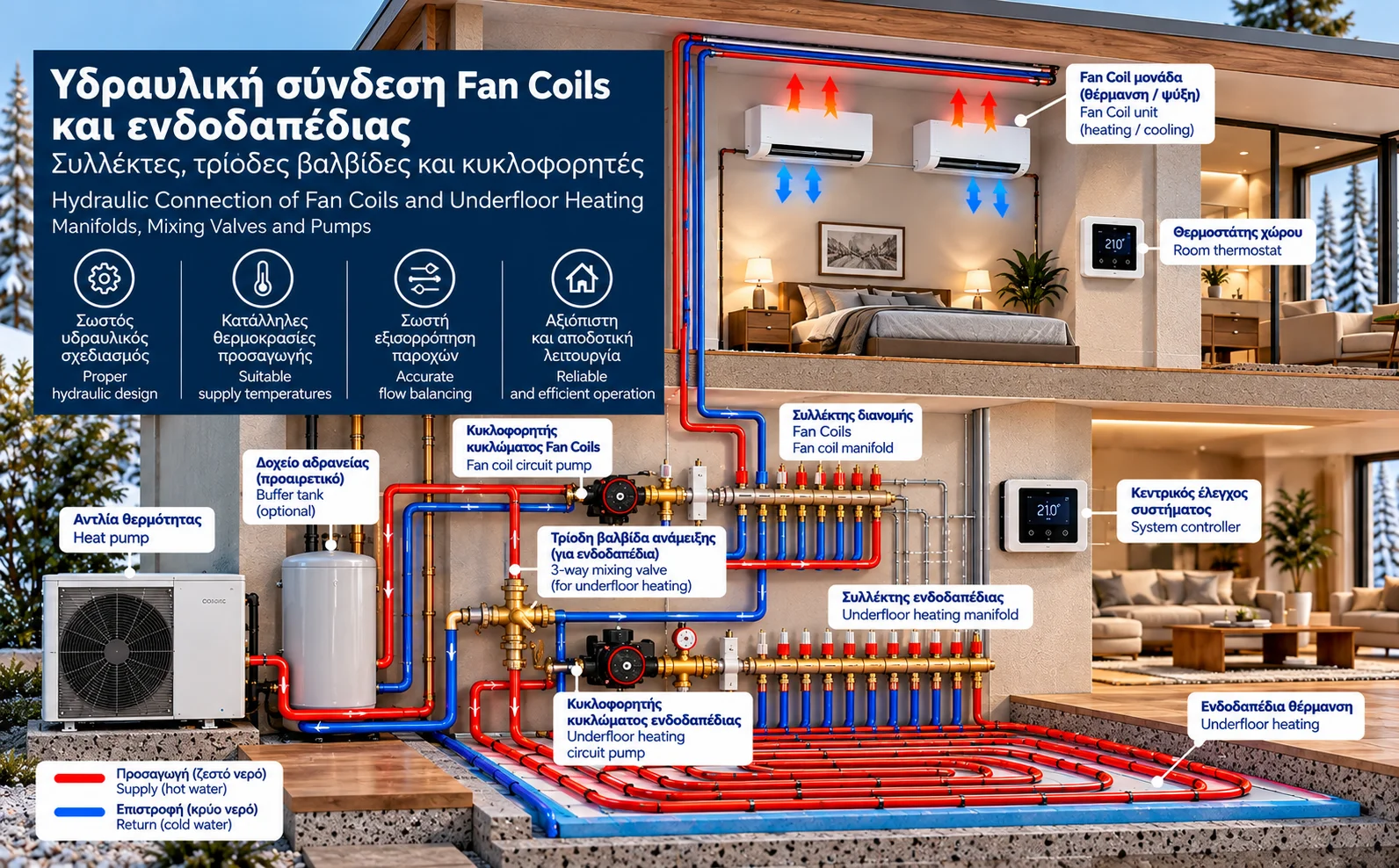
Supply Water Temperatures for Fan Coils and Underfloor Heating: Settings and Efficiency
Supply water temperature is one of the most important operating parameters of a heat pump. It determines the temperature of the water delivered to the heating terminals.
When fan coil units and underfloor heating operate within the same installation, selecting the correct temperature becomes particularly important.
Underfloor heating transfers heat through a large floor surface, while fan coils use a heat exchanger and fan. Their operating requirements may therefore differ.
This guide explains typical operating temperatures, their relationship with energy efficiency and the role of weather compensation.
1. What Is Supply Water Temperature?
Supply water temperature is the temperature of the water entering a heating circuit.
Return water temperature is the temperature of the water flowing back from the circuit toward the heat source.
The difference between these temperatures depends on the heating output and water flow rate.
For a water-based circuit, thermal power can be approximated by:
Q = ṁ × cp × ΔT
Where:
Q = thermal power (W).
ṁ = mass flow rate (kg/s).
cp = specific heat capacity of water (J/kg·K).
ΔT = supply-to-return temperature difference (K).
This relationship shows that heat transfer depends on both water flow and temperature difference.
2. What Temperature Does Underfloor Heating Need?
Hydronic underfloor heating generally operates with relatively low water temperatures.
Many residential systems use supply temperatures of approximately 30–40°C.
Well-insulated buildings may require lower temperatures, while other installations may have different requirements.
The appropriate temperature depends on:
Room heat losses.
Pipe spacing.
Floor covering thermal resistance.
Floor construction.
Available heating area.
Required indoor temperature.
Floor surface temperatures must remain within the comfort and safety limits established by the design and applicable standards, such as EN 1264.
3. What Temperature Do Fan Coils Need?
Fan coil units do not have one universal required water temperature.
Their heating capacity depends on water temperature, water flow, room temperature and fan speed.
Some units are designed to provide useful heating output with supply temperatures around 35–45°C.
Other units may need higher temperatures to meet the same heating demand.
Manufacturer performance tables must therefore be checked at actual design conditions.
Example
A fan coil may provide sufficient heating at a 45°C supply temperature but fail to meet the room load at 35°C.
Reducing water temperature generally reduces available heat exchanger output when other conditions remain unchanged.
4. Indicative Temperature Ranges
System | Indicative Supply Temperature |
|---|---|
Underfloor heating | 30–40°C |
Low-temperature fan coils | 35–45°C |
Fan coils with higher temperature requirements | Above 45°C where necessary |
Combined fan coil and underfloor circuit | Determined by system design |
These values are illustrative, not universal recommended settings.
5. How Does Supply Temperature Affect COP?
The coefficient of performance, or COP, expresses the ratio of delivered heating energy to consumed electrical energy under specified operating conditions.
For example, a COP of 4 means that the heat pump delivers 4 kWh of heat for every 1 kWh of electricity under those conditions.
In heating mode, lower required supply temperatures generally support better heat pump efficiency.
This is because the required temperature lift between the heat source and the heating circuit is reduced.
Actual performance also depends on:
Outdoor temperature.
Heat pump technology.
Defrost operation.
Water flow.
Compressor operating conditions.
Auxiliary electricity consumption.
The goal is therefore to use the lowest supply temperature that still meets the building's heating demand.
6. What Happens When Fan Coils and Underfloor Heating Need Different Temperatures?
Consider an installation where:
Underfloor heating meets its design load at 35°C.
Fan coils require 45°C.
The heat pump may produce water at the higher required temperature.
A suitable mixing circuit can then provide cooler water to the underfloor heating.
However, producing water at 45°C instead of 35°C may reduce heat pump efficiency.
For this reason, selecting fan coils capable of meeting the required load at lower water temperatures is often worth considering during the initial design.
7. What Is Weather Compensation?
Weather compensation is a control strategy that adjusts supply water temperature according to outdoor conditions.
During mild weather, a building generally requires less heat.
The controller can therefore reduce the supply temperature.
As outdoor temperatures fall, the required water temperature may increase.
Illustrative Example
Outdoor Temperature | Example Supply Temperature |
|---|---|
15°C | 28°C |
10°C | 31°C |
5°C | 34°C |
0°C | 37°C |
-5°C | 40°C |
This is a hypothetical weather compensation curve, not a universal set of correct values.
The actual curve must reflect building heat demand and equipment characteristics.
8. How Should Weather Compensation Be Adjusted?
Settings should begin with the engineering design and manufacturer instructions.
The building's behaviour should then be assessed under different outdoor conditions.
If rooms cannot reach the desired temperature during cold weather, the curve may need adjustment.
If rooms overheat in mild conditions, a different adjustment may be required.
Underfloor heating's thermal inertia must be considered.
Frequent large setting changes make reliable assessment more difficult.
9. The Role of Supply and Return Temperature Difference
The supply-to-return temperature difference, or ΔT, is related to heat output and water flow.
There is no single ideal ΔT for every installation.
The appropriate value depends on:
Heat pump specifications.
Heating terminal type.
Required water flow.
Heating output.
Circulation pump operation.
An unusually large or small temperature difference may indicate that further inspection is necessary, but it does not identify a specific fault by itself.
10. Common Temperature Setting Mistakes
Excessively High Supply Temperature
Water temperatures higher than necessary may reduce energy efficiency.
Excessively Low Supply Temperature
If heating terminals cannot provide sufficient output, rooms will not reach the required temperature.
Incorrect Fan Coil Selection
Selecting units based only on nominal capacity at high water temperatures may result in insufficient heating performance with a heat pump.
Constant Thermostat Adjustments
Frequent changes in setpoint can interfere with stable operation, especially in high-thermal-mass floor systems.
Ignoring Hydraulic Balancing
Correct supply temperature alone cannot compensate for unsuitable water flow distribution.
11. Practical Example
Consider a two-story house with underfloor heating downstairs and fan coils upstairs.
The engineering design shows that:
Underfloor heating requires a 35°C supply temperature at design conditions.
The selected fan coils can also meet their heating loads at 35°C.
A common low supply temperature may therefore be possible, provided the hydraulic requirements are also satisfied.
If the fan coils required 45°C, a different hydraulic arrangement or larger low-temperature fan coils could be considered.
The latter option may improve heat pump efficiency but should be evaluated against equipment costs.
12. Frequently Asked Questions
Is 35°C ideal for every installation?
No. The correct temperature depends on building heat losses, heating terminals and system design.
Can fan coils operate with 30°C water?
Some models may deliver heat at this temperature, but their available output must be checked against the required room load.
Does weather compensation always reduce energy consumption?
Correctly configured weather compensation can improve seasonal efficiency, but results depend on the settings and the system's operating behaviour.
Is continuous underfloor heating operation better?
For many high-thermal-mass installations, stable operation with suitable weather compensation can be effective. However, the best strategy depends on the building and its occupancy pattern.
Conclusion
Correct supply water temperature is essential for efficient heat pump operation with fan coils and underfloor heating.
The objective is not simply the lowest possible temperature, but the lowest temperature that reliably meets the building's heating demand.
Suitable fan coil selection, hydraulic balancing and properly adjusted weather compensation can improve both system operation and energy efficiency.
Thermosphere.gr — Technical knowledge for heating and building systems.