
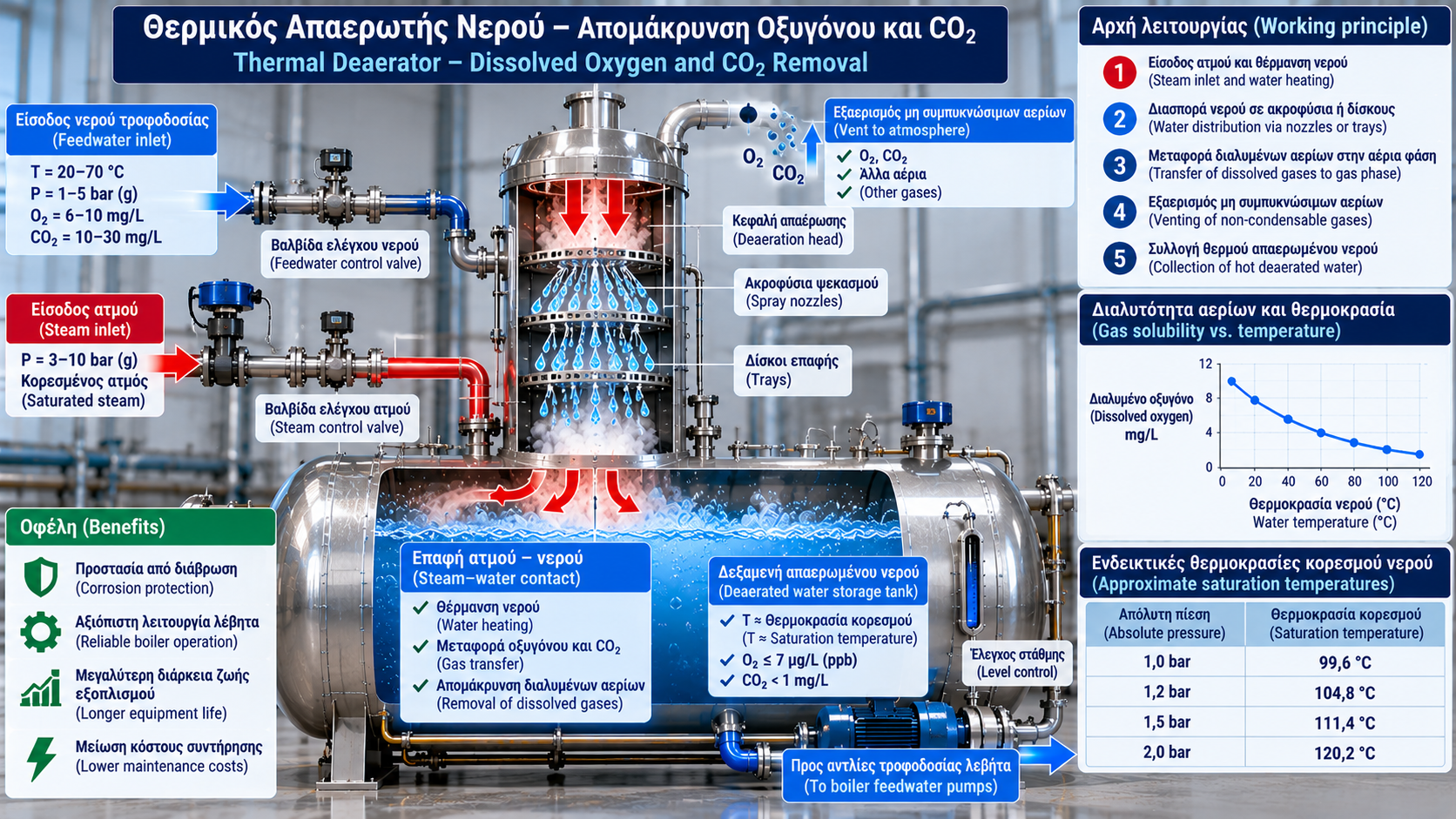
# Thermal Deaerators: Dissolved Oxygen and CO₂ Removal from Water
## Introduction
Thermal deaerators are important components of boiler feedwater preparation in many industrial steam generation facilities.
They use heating and direct steam-water contact to remove dissolved gases, particularly oxygen (O₂) and free carbon dioxide (CO₂).
Effective deaeration reduces corrosion risks and supports the reliability of boiler feedwater systems.
## 1. Why Is Dissolved Oxygen Harmful?
Dissolved oxygen participates in electrochemical corrosion reactions on metallic surfaces.
In boiler feedwater systems, oxygen can contribute to localized corrosion known as pitting.
Pitting is particularly dangerous because it can cause deep cavities and eventually perforate piping or equipment.
The actual corrosion risk depends on oxygen concentration, temperature, pH, construction materials and overall water chemistry.
## 2. The Role of Carbon Dioxide
Carbon dioxide dissolves in water and participates in equilibria involving carbonic acid, bicarbonate and carbonate ions.
Free dissolved CO₂ can lower water pH and contribute to corrosion.
In steam systems, additional CO₂ can be generated by the thermal decomposition of bicarbonate compounds and transported into condensate networks.
Thermal deaerators primarily remove free dissolved CO₂.
They do not necessarily remove bicarbonate ions or eliminate all possible sources of CO₂ formation inside the boiler system.
## 3. Thermodynamic Principle of Thermal Deaeration
Thermal deaeration is based on changes in gas-liquid equilibrium.
For most gases, solubility in water decreases as temperature increases under comparable gas partial-pressure conditions.
The relationship can be described qualitatively using Henry's law.
For dilute solutions, using an appropriately defined Henry solubility coefficient:
C = kH × p
Where:
C = Dissolved gas concentration.
kH = Henry solubility coefficient at the specified temperature.
p = Partial pressure of the gas in the gas phase.
The equation depends on the convention used to define Henry's constant.
Inside a thermal deaerator, heating and steam contact promote the transfer of dissolved gases from the liquid into the gas phase.
## 4. Why Is Steam Used?
Steam provides thermal energy and creates favorable mass-transfer conditions.
When steam contacts colder water, some of it condenses and transfers latent heat.
At the same time, steam flow helps transport released gases toward the venting system.
Performance depends on:
- Steam flow rate.
- Water temperature.
- Operating pressure.
- Contact surface area.
- Contact time.
- Water and steam distribution.
- Removal of non-condensable gases.
## 5. Saturation Temperature and Operating Pressure
Thermal deaerators commonly operate with water close to the saturation temperature corresponding to the internal pressure.
Approximate saturation temperatures for pure water are:
- 1.0 bar absolute: approximately 99.6°C.
- 1.2 bar absolute: approximately 104.8°C.
- 1.5 bar absolute: approximately 111.4°C.
- 2.0 bar absolute: approximately 120.2°C.
These values are approximate.
Absolute pressure must not be confused with gauge pressure.
For example, at an atmospheric pressure of approximately 1 bar, 0.2 barg corresponds to approximately 1.2 bara.
Operating conditions must comply with equipment pressure ratings and manufacturer specifications.
## 6. Main Stages of Thermal Deaeration
### Initial Heating
Feedwater enters the deaerator and is heated through direct contact with steam.
### Water Distribution
Water is distributed through spray nozzles or trays, increasing the contact area.
### Dissolved Gas Transfer
Oxygen and free carbon dioxide transfer from the water into the gas phase.
### Venting
Non-condensable gases leave through a suitable venting arrangement together with some water vapor.
### Deaerated Water Collection
The heated deaerated water collects in a storage tank and is supplied to the boiler feedwater pumps.
## 7. Spray and Tray Deaerators
### Spray-Type Deaerators
Spray-type units distribute water into droplets through specially designed nozzles.
The increased contact area promotes heat and mass transfer.
### Tray-Type Deaerators
Tray-type units distribute water over multiple contact stages.
This arrangement provides repeated contact between water and steam.
### Spray-Tray Deaerators
Combined spray-tray designs are used in some industrial installations to enhance heat and mass transfer.
Equipment selection should be based on flow requirements, water quality and operating conditions.
## 8. Venting and Energy Losses
Venting is necessary to remove non-condensable gases.
Insufficient venting can allow gases to accumulate and reduce deaeration efficiency.
Excessive venting increases steam losses.
The correct venting arrangement depends on equipment design.
Some installations use vent condensers to recover part of the thermal energy without obstructing the necessary gas discharge.
## 9. Measuring Residual Dissolved Oxygen
Deaerator performance can be evaluated by measuring dissolved oxygen at the outlet.
Some thermal deaerators are designed to achieve oxygen concentrations of approximately 7 μg/L (7 ppb) or lower under specified conditions.
Actual limits depend on equipment specifications and the requirements of the water-steam system.
Sampling must use appropriate cooling arrangements and prevent atmospheric oxygen from entering the sample.
Otherwise, measurements can be misleading.
## 10. Causes of Poor Deaeration Performance
High outlet oxygen concentrations may be associated with:
- Insufficient heating.
- Low or unstable steam supply.
- Inadequate venting.
- Blocked spray nozzles.
- Damaged contact trays.
- Uneven water distribution.
- Operation above rated capacity.
- Incorrect sampling methods.
- Air ingress downstream of the deaerator.
Diagnosis requires evaluation of temperature, pressure, flow and dissolved oxygen measurements.
## 11. Energy Efficiency
The deaerator forms part of the plant's overall thermal balance.
Steam demand depends on incoming water temperature, water flow, steam conditions and heat losses.
Recovering hot condensate can reduce the heat required for feedwater heating.
However, the design must still maintain the conditions required for effective deaeration.
## 12. Maintenance and Safety
Preventive maintenance includes:
- Pressure and temperature monitoring.
- Spray nozzle and tray inspection.
- Steam valve checks.
- Venting system inspection.
- Water level monitoring.
- Dissolved oxygen measurement.
- Safety device inspection.
- Storage tank and piping inspection.
Maintenance must be performed only after suitable isolation, depressurization and cooling.
## Conclusion
Thermal deaeration is an effective method for reducing dissolved oxygen and free CO₂ in boiler feedwater.
Its operation depends on appropriate heating, direct steam-water contact and controlled venting.
Stable pressure, correct temperature, effective water distribution and systematic monitoring are essential for reliable performance.
Thermosphere.gr – Technical Knowledge for Professionals.