
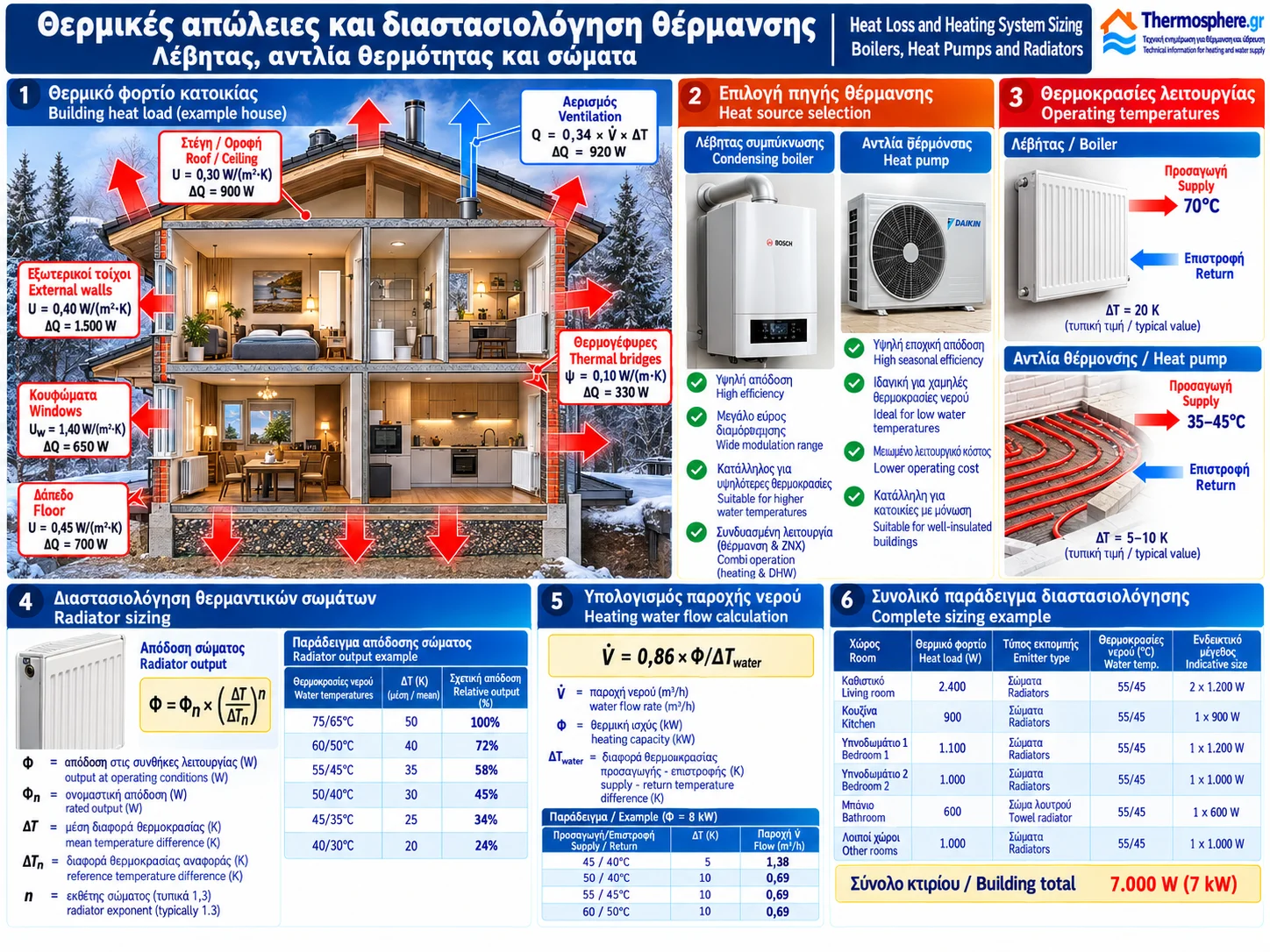
Heat Loss and Heating System Sizing: Boilers, Heat Pumps and Radiators
Correct heating system sizing begins with determining the building's actual heating requirements.
Boilers, heat pumps and radiators should not be selected solely on the basis of floor area, the capacity of existing equipment or generic watts-per-square-metre rules.
Every building has different heat losses depending on its insulation, windows, geometry, thermal bridges, ventilation and outdoor conditions.
A proper heating design determines both the overall building design heating load and the load of each individual room.
These results form the basis for equipment selection.
1. What Is Heating System Sizing?
Heating system sizing is the process of selecting suitable equipment and operating parameters.
It includes:
Heat source capacity.
Radiator or other emitter output.
Supply and return water temperatures.
Required water flow rates.
Hydraulic circuit resistance.
Circulation pump selection.
Heating capacity modulation.
Part-load operation.
Correct sizing is not simply choosing equipment with a sufficiently high nominal capacity.
It means ensuring that the entire installation operates together under the required conditions.
2. Relationship Between Heat Loss and Heating Capacity
Design heating load represents the heating output required to maintain indoor temperatures under specified winter design conditions.
For example, if a building has a calculated design heating load of 8 kW, it requires approximately 8 kW of net heating input under those design conditions.
It does not require 8 kW continuously throughout winter.
As outdoor temperature increases, building heat loss generally decreases.
The heat source must therefore cover the design load while also operating efficiently at lower heating demands.
3. Why Are W/m² Rules Insufficient?
Generic estimates such as 60, 80 or 100 W/m² are often used.
These figures may be useful for very preliminary assessments.
However, they do not adequately account for:
Geographic location.
Insulation.
Window area.
Room height.
External surface exposure.
Ventilation.
Thermal bridges.
Indoor design temperatures.
Two 100 m² homes can have substantially different heating loads.
A detailed calculation using an appropriate methodology, such as EN 12831-1, provides a more reliable basis.
4. Building Load vs Room Load
Two different heating requirements must be distinguished.
Building heating load: Used to select the heat source and design the overall heating installation.
Room heating load: Used to select radiators, fan coils or other heat emitters.
Consider a hypothetical dwelling:
Room | Heating Load |
|---|---|
Living room | 2,400 W |
Kitchen | 900 W |
Bedroom 1 | 1,100 W |
Bedroom 2 | 1,000 W |
Bathroom | 600 W |
Other rooms | 1,000 W |
Total | 7,000 W |
These are illustrative values.
Each room's heating emitters must cover its load under the intended operating conditions.
5. How Is Boiler Capacity Selected?
Design heating load is a key parameter for boiler selection.
However, it is not the only consideration.
Other factors include:
Design heating load.
Available useful boiler output.
Modulation range.
Minimum operating capacity.
Part-load efficiency.
Heating water temperature.
Domestic hot water requirements, where applicable.
For example, a dwelling with an 8 kW heating load does not necessarily require a 24 kW boiler solely for space heating.
A combination boiler may have a higher nominal capacity because of domestic hot water production requirements.
In that case, minimum space-heating output and modulation capability are especially important.
6. What Is Boiler Oversizing?
Oversizing occurs when installed capacity exceeds actual requirements without adequate technical justification.
An excessively large boiler, particularly one with a high minimum output, may experience:
Frequent starts and stops.
Short operating cycles.
Increased thermal stress.
Less favourable part-load operation.
Potentially reduced seasonal efficiency.
However, oversizing does not always produce identical consequences.
Actual behaviour depends on modulation range, system water volume, controls and hydraulic design.
7. Condensing Boilers and Return Temperature
In condensing boilers, return water temperature affects the potential for water vapour in flue gases to condense.
Generally, lower return temperatures favour condensation.
The exact onset and extent of condensation depend on flue gas composition, excess air and operating conditions.
Lower heating water temperatures can improve efficiency, provided the heat emitters can still cover the required load.
8. How Is Heat Pump Capacity Selected?
Heat pump selection requires more than comparing nominal capacity with calculated heat loss.
The available heating capacity of an air-source heat pump depends on:
Outdoor temperature.
Heating water supply temperature.
Defrost conditions.
Compressor type.
Operating limits.
Control strategy.
A heat pump advertised as a 10 kW unit does not necessarily deliver 10 kW at every outdoor temperature and water temperature.
Selection should be based on manufacturer performance tables or capacity curves.
9. What Do A7/W35 and A−7/W55 Mean?
Air-source heat pump performance is commonly reported using conditions such as:
A7/W35
A7: Outdoor air temperature of 7°C.
W35: Water temperature of 35°C under the specified test condition.
A−7/W55
A−7: Outdoor air temperature of −7°C.
W55: Water temperature of 55°C under the specified test condition.
These conditions help compare available heating capacity and efficiency.
The manufacturer's definition and applicable test standard should always be checked.
10. Heat Pump Selection Example
Consider a dwelling with:
Design heating load: 8 kW.
Outdoor design temperature: −2°C.
Required supply water temperature: 45°C.
Two hypothetical heat pumps are considered.
Parameter | Heat Pump A | Heat Pump B |
|---|---|---|
Nominal capacity at a selected reference condition | 9 kW | 11 kW |
Available capacity at −2°C / 45°C | 7.2 kW | 8.6 kW |
Building heating load | 8 kW | 8 kW |
Heat Pump A does not independently cover the assumed design heating load.
Heat Pump B provides sufficient available capacity under the specified condition.
However, this does not automatically make Heat Pump B the best choice.
Minimum output, seasonal efficiency, defrost performance, hydraulic compatibility and operating strategy must also be considered.
The figures are educational and do not represent commercial models.
11. Monovalent and Bivalent Operation
Monovalent operation: The heat pump covers the required heating load independently under the specified design conditions.
Bivalent operation: The heat pump operates together with an additional heat source, such as an electric heater or boiler.
In a bivalent installation, the heat pump may cover a large proportion of annual heating demand, while the additional source operates when necessary.
The preferred strategy depends on climate, energy prices, available capacities and project objectives.
12. What Is the Bivalent Point?
The bivalent point is the operating condition where available heat pump capacity equals the building heating load.
At lower outdoor temperatures, depending on system configuration, additional heating capacity may be required.
The bivalent point cannot be determined from nominal heat pump capacity alone.
It is found by comparing the building heating load curve with the heat pump's available capacity curve.
13. Supply and Return Water Temperatures
In a hydronic heating system, water transfers heat from the heat source to the emitters.
Supply temperature is the temperature of the water delivered to the heating circuits.
Return temperature is the temperature of water returning to the heat source.
Example operating conditions include:
75/65°C.
55/45°C.
45/40°C.
35/30°C.
These conditions are not universally suitable for every installation.
They depend on heating loads, emitters, heat source characteristics and hydraulic design.
14. Why Does Water Temperature Affect Radiator Output?
Radiator heat output depends on the temperature difference between the radiator surface and the surrounding room air.
As heating water temperature decreases, radiator output generally decreases.
A radiator that provides sufficient output at high water temperatures may not be adequate when connected to a lower-temperature heat pump system.
Its actual output must therefore be checked under the new operating conditions.
15. Radiator Heat Output Calculation
For many conventional radiators, the following approximate relationship is used:
Φ = Φn × (ΔT / ΔTn)^n
Where:
Φ = radiator heat output under the examined conditions.
Φn = rated output under reference conditions.
ΔT = mean radiator-to-room temperature difference.
ΔTn = reference temperature difference.
n = radiator-specific exponent.
Accurate sizing requires manufacturer data and coefficients for the applicable reference conditions.
Using the arithmetic mean water temperature is an approximation. Where greater accuracy is required, an appropriate mean temperature difference should be used.
16. Radiator Output at Lower Temperatures: Example
Assume a radiator with:
Rated output: 2,000 W.
Reference temperature difference: ΔTn = 50 K.
Illustrative exponent: n = 1.3.
Operating conditions:
Supply: 45°C.
Return: 40°C.
Room: 20°C.
Approximate mean water temperature:
Tmean = (45 + 40) / 2 = 42.5°C
Temperature difference:
ΔT = 42.5 − 20 = 22.5 K
Estimated output:
Φ = 2,000 × (22.5 / 50)^1.3
Φ ≈ 708 W
A radiator rated at 2,000 W under reference conditions provides approximately 708 W in this simplified example.
The final value must be verified against manufacturer performance data.
17. Why Are Larger Radiators Needed at Lower Temperatures?
Lower operating temperatures reduce the heat output per unit radiator surface area.
Maintaining the same room heating capacity may require:
Larger radiators.
Radiators with additional heat transfer surfaces.
Fan coils.
Underfloor heating.
Improved insulation to reduce the heating load.
The most suitable solution depends on the building and the installation.
18. Calculating Heating Water Flow Rate
The heat transferred by water depends on mass flow rate and the temperature difference between supply and return.
The basic relationship is:
Φ = ṁ × cp × ΔTwater
Where:
Φ = heat transfer rate in W.
ṁ = mass flow rate in kg/s.
cp = specific heat capacity in J/(kg·K).
ΔTwater = water temperature difference in K.
For water at typical heating temperatures, the following approximation is often used:
V̇ ≈ 0.86 × Φ / ΔTwater
Where:
V̇ = volumetric flow rate in m³/h.
Φ = thermal capacity in kW.
ΔTwater = temperature difference in K.
The factor 0.86 is approximate and depends on fluid properties.
Glycol mixtures require appropriate adjustments.
19. Heating Water Flow Example
Assume:
Heating capacity: 8 kW.
Supply temperature: 45°C.
Return temperature: 40°C.
ΔTwater = 5 K
V̇ ≈ 0.86 × 8 / 5
V̇ ≈ 1.38 m³/h
If the same capacity is transferred with a 10 K temperature difference:
V̇ ≈ 0.86 × 8 / 10
V̇ ≈ 0.69 m³/h
For the same heat transfer rate, a smaller water temperature difference requires a higher water flow rate.
Actual design flow must comply with heat source and hydraulic system requirements.
20. Relationship Between Flow Rate and Circulation Pump
A circulation pump must provide the required flow rate against the hydraulic resistance of the circuit.
It is not selected solely on the basis of heating capacity.
Relevant factors include:
Pipe friction losses.
Local pressure losses.
Valves.
Heat exchangers.
Radiators.
Minimum flow requirements.
Correct pump selection and hydraulic balancing contribute to stable operation and reduced unnecessary electricity consumption.
21. What Is Weather Compensation?
Weather compensation is a control method that adjusts heating water supply temperature according to outdoor temperature.
When outdoor conditions are milder, building heat loss decreases and a lower supply temperature may be sufficient.
When outdoor temperature falls, the required supply temperature may increase.
The appropriate heating curve depends on:
Building heat loss.
Radiator output.
Building thermal inertia.
Building operating characteristics.
Heat source type.
Weather compensation can improve performance, particularly in heat pumps and condensing boilers.
22. How Does Insulation Affect Equipment Sizing?
Insulation reduces transmission heat loss.
This can allow:
Lower required heating capacity.
Lower supply water temperatures.
Improved heat pump operation.
Greater potential to reuse existing radiators.
Lower annual space heating demand.
However, the reduction in design heat loss is not necessarily proportional to the reduction in final energy consumption.
Energy use also depends on system operation and efficiency.
23. Building Renovation Example
Consider a hypothetical dwelling with an initial design heating load of:
12 kW
After insulation and window improvements, a new calculation determines:
7 kW
The design load reduction is:
(12 − 7) / 12 × 100
≈ 41.7%
This can significantly change heat source selection.
Existing radiators may also become capable of meeting room loads at lower water temperatures.
That possibility must be checked room by room.
24. Oversizing and Undersizing
Oversizing
Possible consequences include:
Higher initial cost.
Frequent cycling.
Unfavourable low-load operation.
Less effective equipment utilisation.
Undersizing
Possible consequences include:
Insufficient heating at design conditions.
Lower indoor temperatures.
Need for supplementary heating.
Reduced thermal comfort.
Selection should follow a documented design strategy rather than arbitrary safety margins.
25. When Is a New Heat Loss Study Needed?
A new or updated heat loss calculation is particularly useful when:
Replacing a boiler with a heat pump.
Adding substantial insulation.
Replacing windows.
Changing room use.
Extending a building.
Modifying radiators.
Investigating significant temperature differences between rooms.
Replacing equipment originally selected without a reliable design study.
Existing equipment capacity is not, by itself, reliable evidence of actual building heating requirements.
26. Practical Heating System Sizing Procedure
A complete process includes:
Step 1 — Building Survey: Record geometry, materials, insulation, windows and room use.
Step 2 — Heat Loss Calculation: Determine room-by-room and building design heating loads.
Step 3 — Operating Temperature Selection: Establish supply and return temperatures.
Step 4 — Emitter Verification: Confirm radiator or other emitter output under design conditions.
Step 5 — Heat Source Selection: Check available capacity and part-load performance.
Step 6 — Hydraulic Design: Determine flow rates, pipework, pressure losses and circulation pumps.
Step 7 — Control Review: Consider weather compensation, minimum flow, zoning and equipment compatibility.
Step 8 — Commissioning: Perform hydraulic balancing, control adjustment and performance verification.
27. Relevant Technical Standards
Important references include:
EN 12831-1: Design heating load calculation.
EN 442: Radiator thermal performance and testing.
EN 14511: Heat pump performance testing and characteristics.
EN 14825: Seasonal energy efficiency of heat pumps.
EN ISO 6946: Thermal resistance and transmittance of building elements.
EN ISO 13370: Heat transfer through the ground.
For projects in Greece, applicable KENAK requirements, relevant TOTEE technical guidance and national regulations must also be considered.
Current standard editions and manufacturer performance data should be verified during actual engineering design.
Conclusion
Correct heating system sizing combines thermal and hydraulic design.
Building heat loss determines the heating requirements, but final equipment selection also depends on operating temperatures, available performance, water flow rates and control strategy.
For boilers, modulation range and part-load efficiency are important.
For heat pumps, available heating capacity under actual design conditions must be verified.
For radiators, output at the intended supply and return temperatures must be confirmed.
The best heating system is not necessarily the most powerful one. It is the system that meets the building's heating requirements while operating efficiently throughout most of the heating season.
This article is intended for technical information. Calculations are educational examples and do not replace a complete engineering design study.
Thermosphere.gr — Technical information for heating and water supply.