
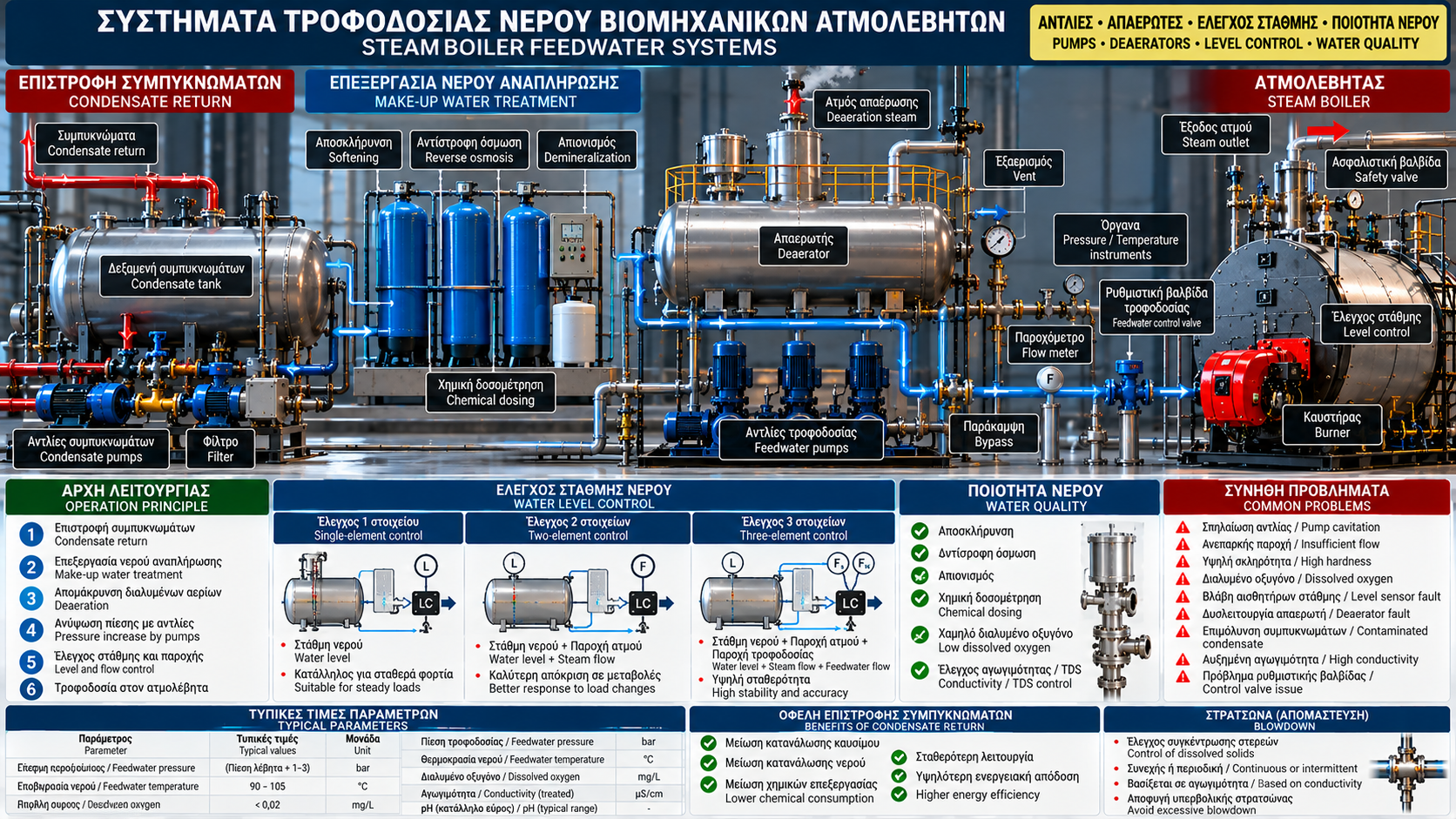
# Steam Boiler Feedwater Systems: Pumps, Deaerators, Level Control and Water Quality
## Introduction
The feedwater system is one of the most important auxiliary systems of an industrial steam boiler.
During steam production, water is converted into steam and leaves the boiler. This quantity must be replenished with water of suitable quality at a controlled flow rate.
Insufficient feedwater can cause dangerously low water levels, while poor water quality may result in deposits, corrosion and reduced efficiency.
A complete system commonly includes condensate management, makeup-water treatment, a feedwater tank or deaerator, feedwater pumps and level-control automation.
## 1. The Role of Feedwater
Feedwater replaces water removed from the boiler through steam generation and blowdown.
It must be supplied at the required pressure, temperature, flow rate and quality.
Continuous water availability is essential for stable operation.
System design must consider actual operating conditions and expected losses, not only rated steam capacity.
## 2. Basic Feedwater System Arrangement
A typical installation may include condensate return, a makeup-water treatment unit, a feedwater tank or deaerator, pumps and a boiler feedwater control valve.
The system may also incorporate pressure, temperature, level and conductivity instruments.
The exact arrangement depends on boiler type, operating pressure and production requirements.
## 3. Condensate Return
When steam is used for indirect heating, it often condenses and can be returned to the system.
Condensate normally contains valuable thermal energy and, if uncontaminated, can reduce makeup-water requirements.
Returning condensate reduces water, treatment-chemical and fuel consumption.
Quality must be monitored because contaminated condensate can create serious boiler problems.
## 4. Makeup Water
Makeup water compensates for nonreturned condensate, blowdown and other operational losses.
The required quantity depends on condensate return rate and plant operation.
Before entering the system, it may require softening, reverse osmosis, demineralization or another suitable treatment.
Technology selection should follow water analysis and boiler requirements.
## 5. Feedwater Tank
The feedwater tank collects treated makeup water and suitable returned condensate.
It may include level control, temperature sensors, venting, overflow and heating equipment.
Design must consider variable flows, water temperature and pump suction conditions.
An ordinary atmospheric tank does not necessarily provide the same dissolved-gas removal performance as a properly designed thermal deaerator.
## 6. What Is a Deaerator?
A deaerator reduces dissolved gases in feedwater, especially oxygen and, depending on conditions, carbon dioxide.
In thermal deaerators, water contacts steam and is heated close to the saturation temperature at the corresponding pressure.
Released gases are removed through an appropriate vent system.
Performance depends on design, temperature, pressure, flow rate and correct operation.
## 7. Why Remove Dissolved Oxygen?
Dissolved oxygen can cause corrosion, particularly in piping, tanks and feedwater equipment.
Corrosion may lead to localized damage, leakage and reduced service life.
Deaeration is an important control measure but does not necessarily eliminate the need for chemical treatment.
Acceptable oxygen limits depend on the specific installation requirements.
## 8. Boiler Feedwater Pumps
Feedwater pumps transfer water from the tank or deaerator into the boiler.
Multistage centrifugal pumps are frequently used, especially when high discharge pressure is required.
Selection must satisfy the required flow and total dynamic head.
Water temperature, suction conditions, construction materials and compatibility must also be considered.
## 9. Required Feedwater Flow
Required feedwater flow relates to steam production, blowdown and changes in boiler water inventory.
Under simplified steady-state conditions:
ṁfeedwater ≈ ṁsteam + ṁblowdown
The relationship must be adapted to actual system conditions.
Rated pump capacity may include an appropriate engineering margin, which should not be selected arbitrarily.
## 10. Pump Pressure and Total Dynamic Head
The pump must overcome boiler pressure, friction losses in piping and equipment, and any relevant elevation difference.
Selection is based on the actual system operating curve.
Boiler pressure alone is insufficient to determine the required pump.
Operating variations, valves and feedwater conditions must also be considered.
## 11. Cavitation and NPSH
Cavitation occurs when local liquid pressure becomes low enough for vapor bubbles to form and subsequently collapse.
It may cause noise, vibration, impeller damage and reduced performance.
Adequate available NPSH is particularly important for hot feedwater pumps.
The relationship between available NPSH and manufacturer requirements must be suitable throughout the intended operating range.
## 12. Standby Pumps and Availability
Many industrial installations use more than one feedwater pump.
A duty-and-standby arrangement can improve availability.
Automation may provide automatic changeover, running confirmation and alarms.
Redundancy must reflect plant reliability requirements and does not replace low-water protection.
## 13. ON/OFF Feedwater Control
Some systems start and stop the feedwater pump according to water-level signals.
This method may be suitable for particular boiler types and capacities.
Start frequency, load variation and hydraulic behavior must be evaluated.
Normal level control must not be confused with independent low-water-level protection.
## 14. Continuous and Modulating Feedwater Control
Larger or more demanding systems may use continuous flow modulation.
This can be achieved through a control valve, variable-frequency drive or suitable combination.
The objective is to stabilize boiler level and match feedwater supply to steam demand.
Selection depends on boiler requirements and overall hydraulic design.
## 15. Single-Element Level Control
Single-element control uses measured boiler water level as its primary input.
The controller adjusts feedwater delivery to maintain level near the setpoint.
This method can perform adequately when load changes are relatively moderate.
Rapid steam-demand changes may cause difficulties because of shrink and swell.
## 16. Two-Element Level Control
Two-element control typically uses boiler water level and steam flow.
Steam-flow measurement allows the controller to respond more promptly to demand changes.
The exact configuration depends on the automation system.
This method may provide improved performance compared with simple level control in suitable applications.
## 17. Three-Element Level Control
Three-element control typically uses boiler water level, steam flow and feedwater flow.
The combination provides steam-demand compensation and feedback on actual feedwater delivery.
This technique is widely used where significant load variations occur.
It requires reliable instruments, correct measurement ranges and appropriate controller tuning.
## 18. Shrink and Swell in Level Control
Indicated water level depends on more than the total water inventory.
Sudden pressure and load changes alter the volume of steam bubbles within boiler water.
Increasing steam demand may initially increase apparent level even while total water inventory decreases.
Understanding this behavior is essential when designing level-control systems.
## 19. Low-Water-Level Protection
Low water level is a serious steam-boiler hazard.
Exposing heated surfaces without adequate cooling can cause dangerous overheating.
Suitable protective devices therefore initiate the required safe shutdown.
These protections must be designed and tested according to applicable requirements and cannot be replaced by the normal level controller.
## 20. Water Softening and Reverse Osmosis
Water softening primarily reduces calcium and magnesium ions responsible for hardness.
Reverse osmosis removes a broader range of dissolved substances through membrane separation.
These technologies are not equivalent, and their suitability depends on raw-water quality and boiler requirements.
Some installations combine them with other treatment methods.
## 21. Conductivity, TDS and Blowdown
Conductivity is often used as an indirect indicator of ionic dissolved substances.
Its relationship to total dissolved solids varies with water composition.
Controlled blowdown removes some boiler water to maintain suitable water-quality conditions.
Settings must reflect actual water characteristics and operating requirements.
## 22. Common Feedwater System Faults
Possible problems include insufficient pump flow, cavitation, level-sensor faults, malfunctioning control valves and automation problems.
Poor deaerator performance or condensate contamination can also affect the boiler.
Diagnosis should combine recorded data, approved drawings and manufacturer instructions.
Critical protections must never be bypassed to maintain operation.
## 23. Preventive Maintenance and Monitoring
Maintenance programs should cover pumps, seals, bearings, filters, valves, measuring instruments and automation.
Water quality, deaerator performance and condensate-return conditions require systematic monitoring.
Safety functions must be tested under approved procedures by authorized personnel.
Trend and fault records help identify declining performance before major failures occur.
## 24. Conclusion
The feedwater system is fundamental to safe and efficient industrial steam boiler operation.
Pumps, deaerators, condensate return, water treatment and level-control automation must operate as an integrated system.
Correct equipment selection, reliable measurement and regular maintenance help prevent faults, reduce energy consumption and protect the boiler.