
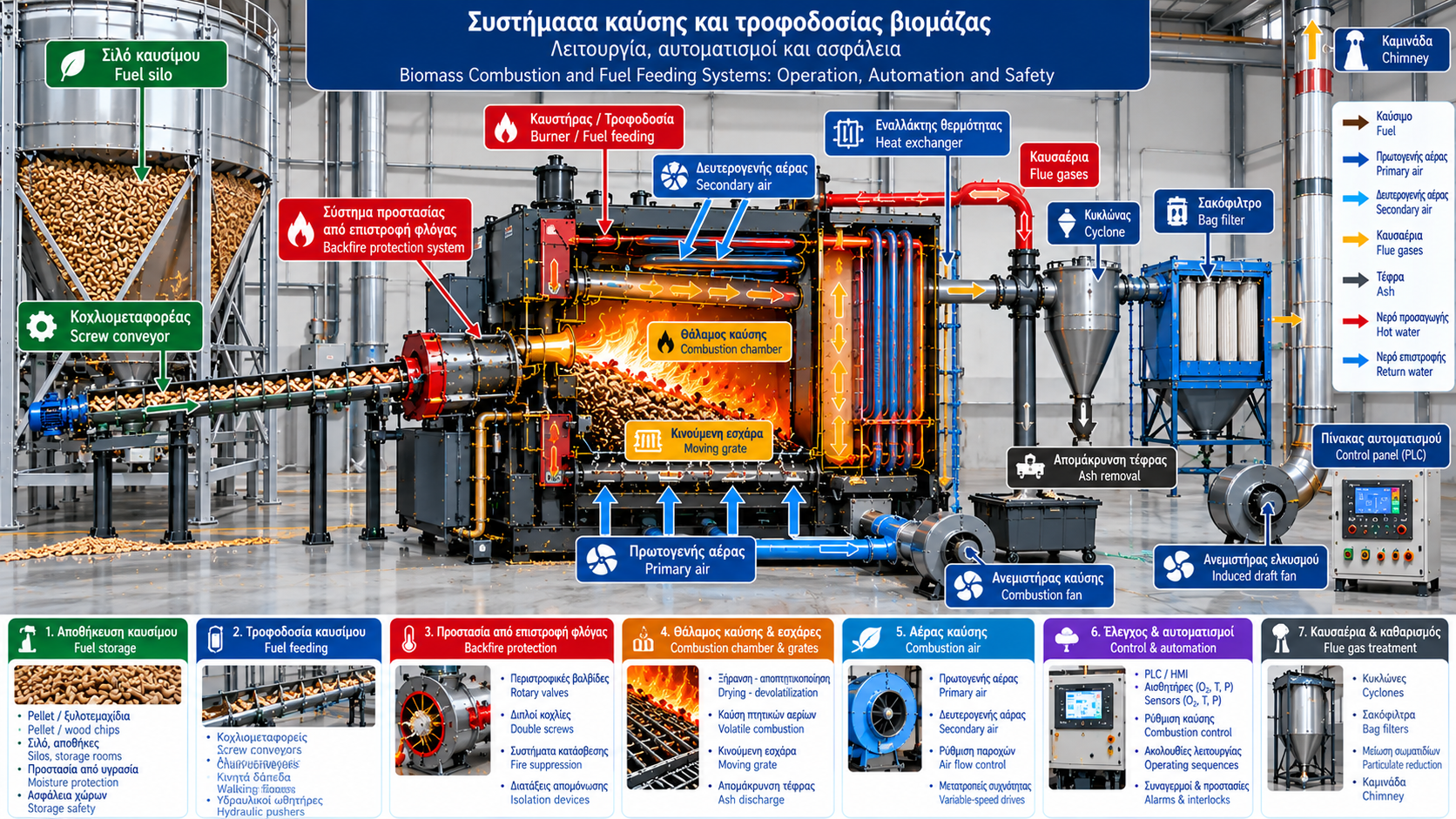
Biomass Combustion and Fuel Feeding Systems: Operation, Automation and Safety
Industrial biomass boilers rely on the coordinated operation of fuel storage, mechanical feeding, combustion equipment and control systems.
Unlike liquid and gaseous fuels, solid biomass can vary significantly in moisture content, particle size, bulk density and ash composition. These properties influence fuel handling, combustion stability, thermal efficiency and emissions.
1. Fuel Storage and Handling
Biomass fuels are stored in silos, bunkers or dedicated storage facilities.
Wood pellets can be conveyed using screw conveyors or pneumatic systems, while wood chips often require more robust extraction equipment such as walking floors or hydraulic pushers.
Equipment selection depends on fuel characteristics and required conveying capacity.
Storage design must address moisture ingress, dust accumulation, fuel bridging, fire hazards and potential hazardous atmospheres.
2. Screw Conveyors and Feeding Equipment
Screw conveyors use rotating helical flights to transport biomass fuel through an enclosed casing.
Conveying capacity depends on screw diameter, pitch, rotational speed, inclination, filling level and fuel properties.
Common problems include blockages, foreign objects, mechanical wear and inconsistent fuel delivery.
Variable-frequency drives can provide adjustable feeding rates where supported by the equipment design.
3. Backfire Protection
Backfire and heat propagation from the combustion chamber towards fuel storage represent significant hazards.
Depending on the risk assessment, protective measures may include rotary valves, mechanical isolation devices, separated feeding stages, temperature monitoring and engineered fire suppression.
The protective arrangement must comply with manufacturer requirements and the installation’s safety design.
Stopping the feeding screw alone does not provide adequate protection.
4. Combustion Chambers and Grates
Biomass combustion involves drying, devolatilization, oxidation of volatile gases and burnout of the remaining char.
Fixed grates are used in certain boiler configurations, while moving grates facilitate fuel movement, combustion completion and ash discharge.
The appropriate technology depends on boiler capacity and fuel characteristics.
5. Primary and Secondary Air
Primary combustion air is generally introduced beneath or through the fuel bed.
Secondary air is supplied above the fuel bed to promote mixing and combustion of volatile gases.
Correct air distribution helps reduce carbon monoxide emissions and unburned residues.
Excessive combustion air, however, can increase flue gas heat losses.
6. Oxygen-Based Combustion Control
Modern biomass boilers may use oxygen sensors installed in the flue gas path.
The controller adjusts air supply and fuel feeding according to measured conditions and thermal demand.
There is no universal oxygen setpoint suitable for every boiler. Appropriate settings depend on fuel type, equipment design and manufacturer specifications.
7. Combustion Fans and Draught Control
Combustion fans provide the air required for fuel oxidation.
Industrial systems may also incorporate induced-draught fans to move flue gases through treatment equipment and towards the chimney.
Stable furnace pressure is important for safe and efficient operation.
Variable-frequency drives can improve process control and, under suitable operating conditions, reduce fan electricity consumption.
8. PLC Automation
Programmable logic controllers coordinate fuel feeding, ignition, combustion fans, thermal output and ash removal.
They also monitor sensors and manage operating alarms and shutdown sequences.
Safety-critical functions require an appropriate safety architecture and, where necessary, independence from the standard process controller.
9. Common Operating Problems
Unstable fuel feeding can cause fluctuations in combustion temperature and thermal output.
Incomplete combustion may result from poor air distribution, unsuitable fuel moisture or grate problems.
Ash deposits and unburned residues can reduce equipment performance.
Loss of draught or overheating requires the prescribed protective response.
10. Preventive Maintenance and Safety
Preventive maintenance includes inspection of conveyors, motors, gearboxes, fans, grates and instrumentation.
Backfire protection and ash removal systems must also be checked according to the maintenance plan.
Before intervention, equipment must be safely isolated and residual heat hazards assessed.
Conclusion
Reliable biomass combustion requires integrated design of fuel storage, feeding, combustion air and automation.
Correct equipment selection, effective combustion control, appropriate safety protections and systematic maintenance are essential for efficient and dependable industrial biomass operation.