
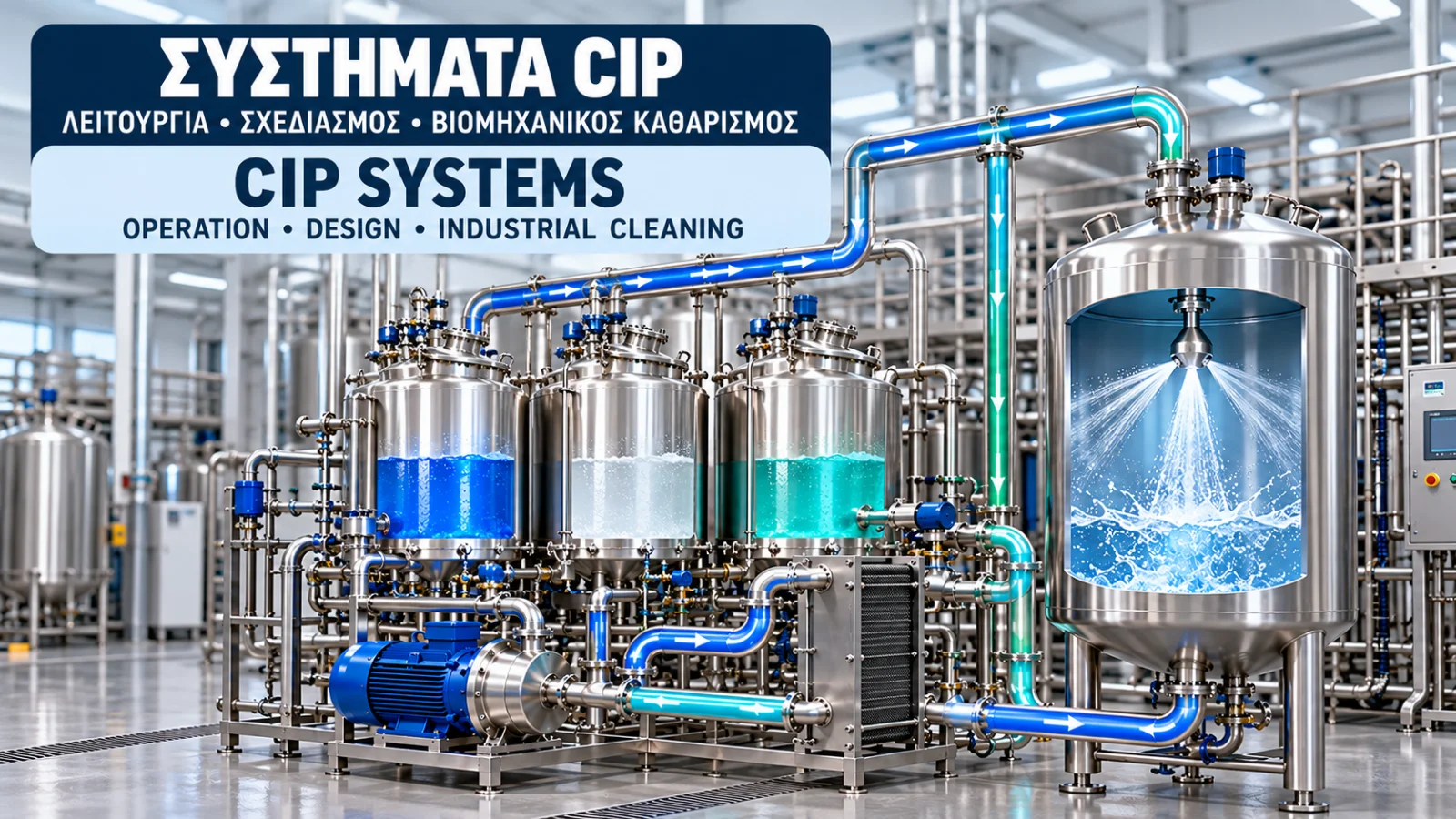
CIP Systems (Cleaning in Place): Complete Guide to Operation and Design
Introduction
Industrial equipment cleaning is essential for product quality, hygienic processing and operational reliability.
In the food, beverage, dairy, pharmaceutical and biotechnology industries, the internal surfaces of tanks, pipelines, pumps and heat exchangers frequently come into contact with products that leave organic and inorganic deposits.
Cleaning in Place (CIP) enables appropriately designed equipment to be cleaned without complete disassembly, using controlled circulation or spraying of water and cleaning solutions.
Successful CIP operation depends on mechanical design, cleaning chemistry, temperature, hydraulic performance, automation and verification.
1. What Is a CIP System?
Cleaning in Place is a cleaning method in which specially prepared solutions flow through or are sprayed onto internal equipment surfaces while the equipment remains installed.
Typical applications include:
Process pipelines.
Storage and mixing tanks.
Hygienic pumps.
Process valves and manifolds.
Heat exchangers.
Liquid processing equipment.
Not every component can be effectively cleaned in place. Equipment must be designed for sufficient surface coverage, drainage and cleaning-fluid circulation.
2. How Does CIP Work?
A CIP unit prepares water or cleaning solution at the required concentration and temperature.
A supply pump circulates the fluid through the selected cleaning circuit. Chemical action and fluid movement remove deposits from product-contact surfaces.
Depending on the system design, the returning solution is recovered for reuse or discharged.
Rinsing and, where necessary, sanitization or disinfection complete the process.
3. The Four Factors Affecting CIP Performance
The Sinner cleaning principle describes four interacting factors.
Temperature
Temperature affects the solubility of deposits and the kinetics of cleaning reactions.
Higher temperatures may improve cleaning performance for certain deposits, but inappropriate temperatures can damage equipment or make some protein residues more difficult to remove.
Contact Time
Cleaning solutions must remain in contact with surfaces long enough to remove the relevant deposits.
Insufficient contact time may result in incomplete cleaning, while excessive time increases operating costs and production downtime.
Chemical Action
Alkaline and acidic solutions are selected according to the nature of the contamination.
Concentration must be appropriate for the soil type, equipment materials and chemical supplier's instructions.
Mechanical Action
In pipelines, flowing liquid generates shear forces that help remove deposits.
In tanks, mechanical action may be provided by spray balls, rotating spray heads or rotary jet cleaners.
These four factors must be considered together.
4. Main Components of a CIP System
Cleaning Tanks
Tanks store and prepare water and cleaning solutions.
A centralized CIP installation may contain separate tanks for alkaline solution, acidic solution and recovered rinse water.
CIP Pumps
Pumps provide the flow rate and pressure required for cleaning.
Selection depends on pipeline dimensions, hydraulic losses, cleaning-device requirements and the properties of the cleaning solutions.
Heat Exchangers
Heat exchangers raise cleaning solutions to the specified temperature.
The heating system must provide sufficient thermal capacity to achieve and maintain the required conditions.
Valves and Pipelines
Valves direct cleaning fluids through selected process circuits.
Proper valve arrangements help prevent unintended connections between cleaning chemicals and production materials.
Sensors and Automation
Typical instruments include temperature sensors, conductivity meters, flowmeters, pressure transmitters and level sensors.
pH measurement may also be used where appropriate.
A programmable logic controller (PLC) automates the cleaning sequence and records critical process parameters.
5. Typical CIP Cleaning Stages
Pre-Rinse
Water removes loose product residues before chemical cleaning begins.
Effective pre-rinsing can reduce contamination of subsequent cleaning solutions.
Alkaline Cleaning
Alkaline cleaning agents, frequently based on sodium hydroxide (NaOH), are used to remove many organic deposits, including fats and proteins.
The required concentration, temperature and exposure time depend on the specific application.
Intermediate Rinse
An intermediate rinse removes alkaline cleaning chemicals before subsequent stages.
This is particularly important when an acid cleaning stage follows.
Acid Cleaning
Acidic solutions are used where necessary to remove mineral scale and inorganic deposits.
Acid cleaning is not mandatory in every CIP cycle.
Final Rinse
The final rinse removes residual cleaning chemicals.
Completion criteria may involve conductivity measurements or other validated methods.
Sanitization or Disinfection
Where required, an additional stage reduces microbial contamination to the specified level.
Cleaning and sanitization are different processes and should not be treated as equivalent.
6. CIP Flow Rate and Velocity
Hydraulic performance plays an important role in mechanical cleaning.
For many hygienic pipeline applications, flow velocities around 1.5–3.0 m/s are used as engineering reference values.
However, this is not a universal requirement. Actual cleaning conditions must follow equipment specifications and validated process requirements.
Volumetric flow is calculated as:
Q = A × v = (π × D² / 4) × v
Where:
Q = volumetric flow rate (m³/s).
A = internal pipe cross-sectional area (m²).
D = internal pipe diameter (m).
v = average fluid velocity (m/s).
Calculation Example
Consider a pipeline with an internal diameter of 50 mm and a target velocity of 1.5 m/s.
D = 0.05 m
Q = (π × 0.05² / 4) × 1.5
Q ≈ 0.002945 m³/s
Converting to cubic metres per hour:
Q ≈ 10.6 m³/h
Therefore, approximately 10.6 m³/h is required to achieve a velocity of 1.5 m/s in this particular pipe.
Pump selection must also account for the total hydraulic resistance of the cleaning circuit.
For tanks equipped with spray devices, cleaning requirements depend on spray coverage, flow and operating pressure rather than pipeline velocity alone.
7. Hygienic Design and Dead Legs
Even a correctly programmed CIP cycle may fail if cleaning solutions cannot reach certain internal surfaces.
Important hygienic design considerations include:
Minimizing dead legs and stagnant zones.
Using suitable welds and connections.
Selecting chemically compatible gaskets.
Ensuring effective surface wetting.
Providing adequate drainage.
Allowing inspection where required.
EHEDG guidelines and relevant 3-A Sanitary Standards provide important principles for hygienic equipment design and cleanability.
8. Cleaning Validation and Verification
Completing an automated cleaning cycle does not, by itself, demonstrate that all surfaces have been cleaned successfully.
Depending on the application, performance assessment may include:
Temperature monitoring.
Flow and contact-time verification.
Cleaning chemical concentration checks.
Conductivity measurements.
Visual inspection.
Residue testing.
Microbiological testing where required.
Validation establishes that a defined cleaning procedure is capable of achieving its intended result.
Verification confirms that the procedure has been implemented correctly and continues to meet its specified criteria.
9. Water and Energy Efficiency
CIP operations consume water, cleaning chemicals, electricity and thermal energy.
Potential optimization measures include:
Recovery of suitable cleaning solutions.
Optimization of rinse duration.
Efficient pump operation.
Thermal insulation.
Conductivity-based control of rinse transitions.
Analysis of recorded cleaning-cycle data.
Changes to critical cleaning parameters must be assessed to ensure that validated cleaning effectiveness is maintained.
10. Common CIP Problems
Incomplete Cleaning
Possible causes include insufficient flow, inappropriate chemical concentration, inadequate temperature or poor surface coverage.
Excessive Cycle Duration
Long cleaning cycles may result from slow heating, unnecessarily long rinses or inefficient sequence design.
High Water Consumption
Excessive consumption may be associated with unsuitable rinse completion criteria or valve-control problems.
Unstable Chemical Concentration
Possible causes include dosing-system faults, sensor errors or unsuitable solution recovery arrangements.
Residues in Specific Locations
Persistent deposits may indicate dead legs, inadequate wetting or hygienic design deficiencies.
11. Operational Safety
CIP chemicals can be corrosive and may be used at elevated temperatures.
Safe operation requires appropriate personal protective equipment, controlled chemical dosing, equipment isolation procedures and compliance with chemical safety data sheets.
Incompatible chemicals must not be mixed.
In particular, acids must not come into contact with hypochlorite-based products because hazardous chlorine gas may be released.
Facilities should incorporate appropriate protective devices, operating procedures and emergency response arrangements.
Conclusion
Cleaning-in-place systems are essential components of hygienic industrial processing.
Reliable performance requires appropriate equipment design, suitable hydraulic conditions, controlled cleaning chemistry and documented assessment of cleaning effectiveness.
With effective automation and monitoring, CIP systems can support consistent cleaning, reduced production downtime and more efficient use of water, chemicals and energy.
Technical References
EHEDG — Hygienic Design Requirements for CIP Installations, Guideline Document 50.
https://2024.ehedg.org/guidelines-working-groups/guidelines/guidelines/detail/hygienic-design-requirements-for-cip-installations3-A Sanitary Standards — Cleanability of Equipment.
https://my.3-a.org/Knowledge-Center/Resource-Papers/Cleanability-of-Equipment3-A Sanitary Standards — Equipment Cleaning: CIP vs. COP.
https://www.3-a.org/news/sanitary-design-connections-spring-2022Alfa Laval — CIP Station: Cleaning-in-Place Systems.
https://www.alfalaval.gr/products/process-solutions/brewery-solutions/cip-modules/cip-station/ISO 14159 — Safety of machinery — Hygiene requirements for the design of machinery.