
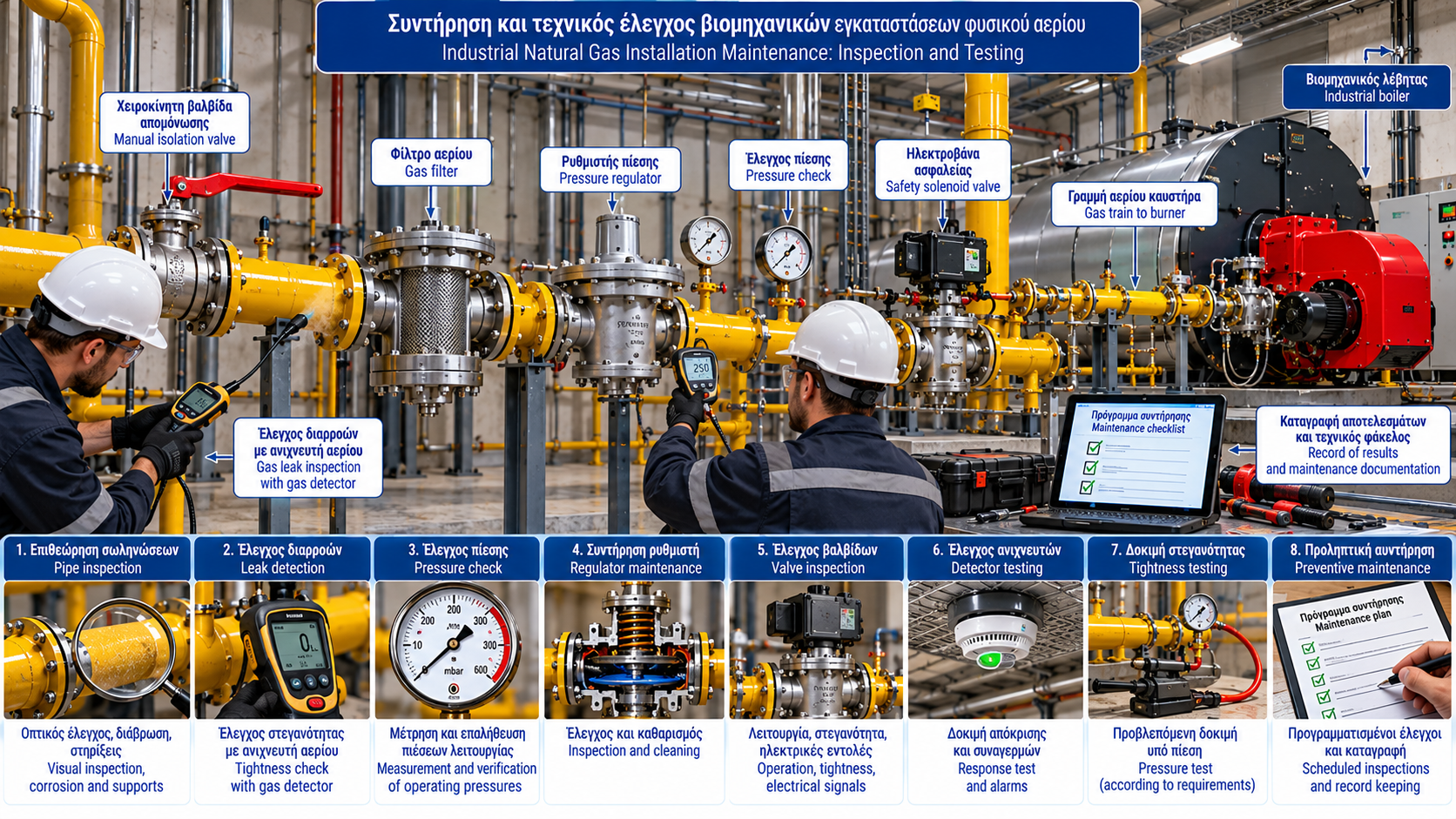
Industrial Natural Gas Installation Maintenance: Inspection, Tightness Testing and Failure Prevention
Maintenance of an industrial natural gas installation is essential for preserving equipment safety, reliability and operational availability.
An industrial network may include main distribution piping, pressure regulation stations, branch lines, isolation valves, monitoring instruments and burner supply systems.
Maintenance must address the installation as a complete system rather than focusing only on components that have already failed.
1. Why Preventive Maintenance Matters
Industrial gas systems often operate for long periods under changing load conditions.
Over time, seals may deteriorate, corrosion may develop, regulator performance may change and monitoring devices may malfunction.
An organized maintenance program supports early fault detection, gas tightness, protective device reliability, reduced unplanned shutdowns and proper technical documentation.
Preventive maintenance cannot eliminate every possible failure, but it reduces the risk of critical conditions remaining undetected.
2. Scope of a Technical Inspection
A comprehensive inspection may include:
Review of technical records and failure history.
Visual inspection of gas piping.
Examination of pipe supports and corrosion protection.
Inspection of valves and joints.
Pressure verification at designated points.
Checks of pressure regulation and protective equipment.
Tightness testing using approved procedures.
Verification of alarms and emergency shutdown functions.
Documentation of findings and corrective actions.
The exact scope depends on equipment, operating pressure, risk assessment and applicable requirements.
3. Gas Piping Inspection
Gas piping forms the main fuel distribution network.
Inspection should assess general condition, accessibility, mechanical protection and visible corrosion.
Special attention is required in areas exposed to moisture, vibration, mechanical damage and corrosive conditions.
Visual inspection may not be sufficient to assess concealed or internal deterioration.
Where necessary, suitable non-destructive examination methods should be applied by qualified personnel.
4. Pipe Supports and Mechanical Loads
Pipe supports must maintain the network without introducing unacceptable mechanical stress.
Potential problems include misalignment, loose supports, vibration, thermal movement and unexpected external loading.
Assessment must reflect the approved piping design and actual operating conditions.
5. External Gas Tightness
External tightness refers to preventing natural gas from escaping into the surrounding environment through piping, joints, valves and other components.
Testing must use approved methods and suitable instruments.
Depending on the installation, portable gas detectors or other specified methods may be used.
Test conditions and acceptance criteria must follow the applicable technical requirements.
An open flame must never be used to locate a gas leak.
6. Tightness Testing Versus Operational Leak Checks
It is important to distinguish between:
Operational leak checks: Assessment of possible gas emissions at accessible locations using appropriate methods.
Formal tightness testing: A specified test of a defined section or component under controlled conditions.
Internal valve tightness testing: Verification that a closed valve restricts gas passage within its specified limits.
These procedures are not identical and do not necessarily replace one another.
Arbitrary test pressures must never be applied to installations containing sensitive regulators, instruments or valves.
7. Pressure Regulator Maintenance
Pressure regulators must maintain the required downstream pressure throughout the specified operating range.
Assessment may include inlet and outlet pressure checks, performance during load changes, abnormal pressure fluctuations, external condition and applicable protective functions.
Disassembly or adjustment must follow manufacturer instructions and be performed by authorized personnel.
8. Isolation Valve Inspection
Manual and automatic valves perform different functions.
Manual valves provide planned isolation of installation sections.
Automatic safety shut-off valves operate with the burner or installation safety controls.
Inspections should address operational condition, external tightness and internal tightness where required.
An electrical closing command does not, by itself, prove that a valve is gas-tight.
9. Pressure Instruments and Sensors
Pressure gauges, transmitters and switches provide monitoring or protective functions.
Maintenance may include physical inspection, wiring checks, indication verification, calibration where required, alarm response testing and documentation.
Instruments must be suitable for their measurement range and accuracy requirements.
10. Gas Detection System Maintenance
Methane detectors and monitoring controllers are part of the protective system where specified.
Maintenance may include response testing, calibration, alarm checks and verification of the required shutdown actions.
A normal reading on a detector display does not automatically confirm that the sensor has been functionally tested.
11. Common Technical Failures
Pressure Drop During Operation
Potential causes include insufficient supply capacity, excessive network losses, clogged filters or regulator malfunction.
Unstable Outlet Pressure
Possible factors include regulator faults, changing flow demand and unsuitable operating conditions.
Signs of External Leakage
Approved emergency procedures must be followed, with assessment by authorized personnel.
Repeated Alarms
Alarms may result from actual process conditions, equipment failures or instrument faults.
Repeatedly resetting an alarm without investigating the cause is not an appropriate corrective action.
12. Organizing a Preventive Maintenance Program
Maintenance planning should be based on equipment criticality and risk.
Typical activities include operational monitoring, scheduled visual inspections, periodic functional testing and specialist maintenance work.
There is no single inspection interval suitable for every industrial gas installation.
Intervals must be justified by applicable regulations, manufacturer requirements and risk assessment.
13. Safe Work Procedures
Work on natural gas systems requires proper planning and authorization.
Approved isolation, verification and return-to-service procedures must be followed.
Lockout/Tagout (LOTO) procedures should be applied where relevant.
Closing a valve alone must not be assumed to establish a verified safe condition.
Disassembly, testing and recommissioning must be performed only by appropriately authorized personnel.
14. Maintenance Records and Failure History
Maintenance documentation supports traceability and continuous improvement.
Records should identify the inspection date, responsible personnel, equipment, test method, measurements, deviations, corrective actions and verification results.
Analyzing repeated failures may reveal underlying systemic problems.
15. Standards and Regulations
Relevant technical references include:
EN 15001-2: Operational requirements and maintenance for gas installations within its scope.
EN 15001-1: Design, construction, inspection and testing of corresponding installations.
EN 1775: Gas pipework for buildings, where applicable.
EN 161: Automatic gas shut-off valves.
EN 1643: Valve proving systems for automatic shut-off valves.
In Greece, the applicable technical regulations, pressure category and installation-specific requirements must also be considered.
The applicability of standards and mandatory inspection intervals must be verified for each installation.
Conclusion
Industrial natural gas maintenance is an ongoing process of technical monitoring, inspection and safety verification.
Piping inspections, tightness checks, regulator assessment, valve testing and gas detection system maintenance contribute to reliable operation and reduced failure risk.
An effective program depends on risk assessment, manufacturer instructions, complete records and qualified personnel.