
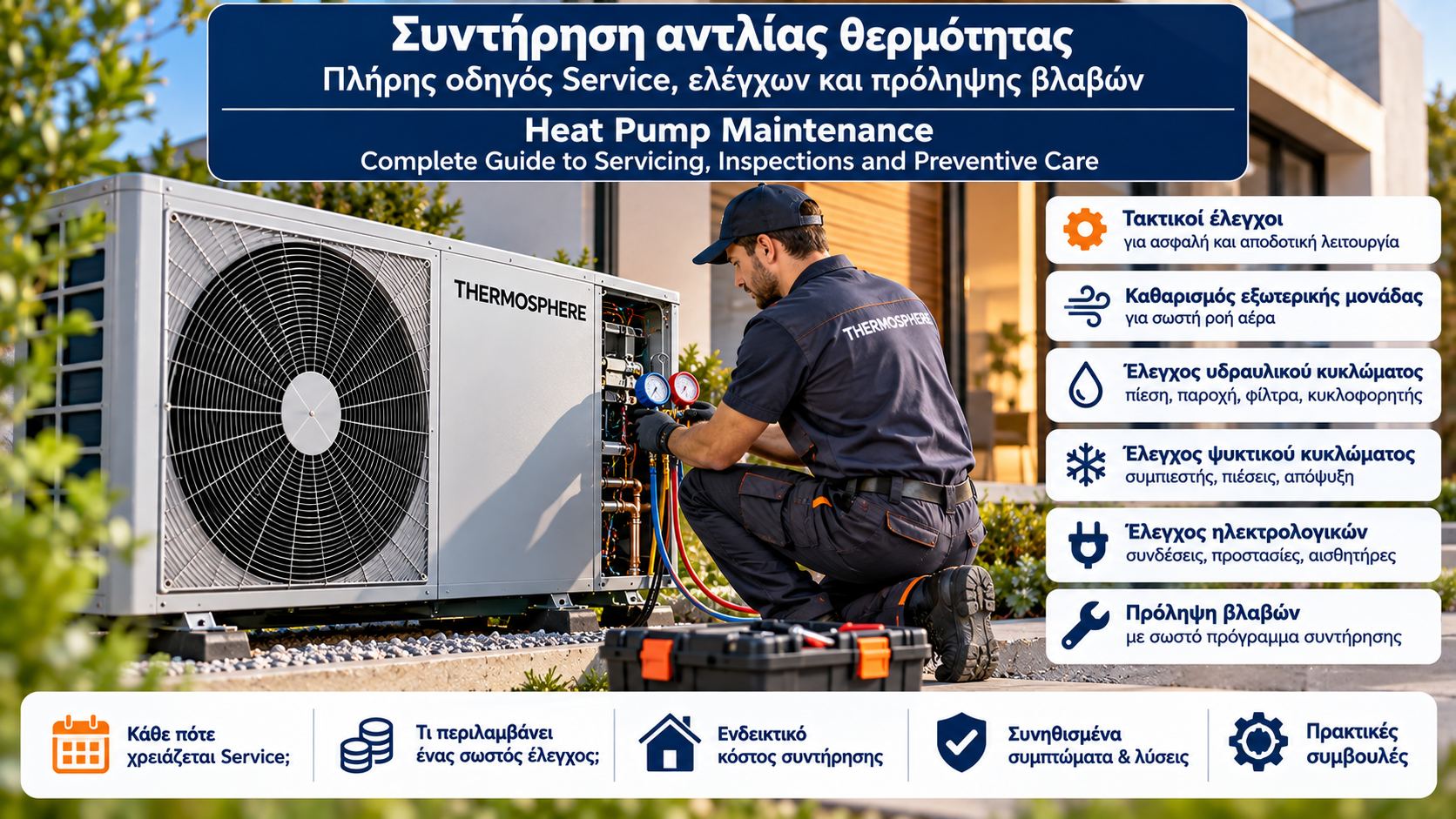
Heat Pump Maintenance and Servicing: Complete Guide to Inspections and Preventive Care
Proper heat pump maintenance is essential for efficient, safe and reliable operation.
Although modern heat pumps include advanced controls, sensors and self-diagnostic systems, they still require appropriate inspection and maintenance.
Over time, dirt accumulation on heat exchangers, reduced water flow, incorrect settings or component wear can affect energy efficiency and reliability.
This guide explains what heat pump servicing includes, how frequently inspections may be required, which components need attention and what warning signs indicate that professional assistance is necessary.
1. Why Do Heat Pumps Need Maintenance?
A heat pump combines a refrigerant circuit, electrical components, controls and, in air-to-water systems, a hydraulic heating circuit.
All these elements must operate correctly for the system to deliver reliable heating.
Preventive maintenance helps:
Maintain energy efficiency.
Identify developing problems early.
Reduce unexpected interruptions.
Protect compressors, pumps and heat exchangers.
Verify the operation of safety devices.
Maintain manufacturer-specified operating conditions.
Maintenance cannot eliminate every possible failure, but it can reduce problems associated with inadequate care.
2. How Often Should a Heat Pump Be Serviced?
There is no single servicing interval that applies to every heat pump.
Maintenance frequency depends on:
Manufacturer instructions.
Heat pump type.
Operating hours.
Environmental conditions.
Heating-system water quality.
Warranty requirements.
Applicable regulatory obligations.
For many residential installations, a professional inspection before the heating season is a practical approach when consistent with manufacturer guidance.
Systems operating under demanding conditions may require more frequent checks.
3. Outdoor Unit Inspection and Cleaning
Air-to-water heat pump outdoor units are continuously exposed to environmental conditions.
Dirt and debris may accumulate around the fan and heat exchanger, including:
Leaves.
Dust.
Lint.
Pollen.
Snow or ice.
Other airflow obstructions.
Restricted airflow can reduce performance and affect operating conditions.
What Can the Owner Check?
Owners can visually inspect the area around the outdoor unit and keep manufacturer-required clearances free from obstruction.
Electrical covers should not be opened, objects should not be inserted through fan guards, and high-pressure water should not be directed at heat exchanger fins.
More extensive cleaning must follow manufacturer instructions.
4. Hydraulic Circuit Inspection
In air-to-water heat pumps, adequate water circulation is essential for transferring heat into the building.
A professional inspection may include:
System pressure.
Water flow rate.
Circulation pump operation.
Filter condition.
Air within the circuit.
Valve operation.
Water leaks.
Supply and return temperatures.
Insufficient water flow may cause operating faults or activate protective shutdowns.
5. Water Filters and Magnetic Dirt Separators
Many heating systems include particle filters or magnetic dirt separators.
These devices capture contaminants circulating in the heating water.
Magnetic separators are designed to collect ferromagnetic particles.
Accumulated dirt can increase hydraulic resistance and restrict water flow.
During servicing, the technician inspects and cleans these components where required.
The procedure may involve isolating parts of the circuit and safely managing system pressure.
It should not be attempted without appropriate training.
6. System Pressure and Expansion Vessel
The expansion vessel accommodates changes in heating-water volume as temperature changes.
If it is not functioning correctly, symptoms may include:
Large pressure fluctuations.
Safety relief valve discharge.
Repeated need to add water.
Low-pressure faults.
Correct system pressure depends on installation height and design requirements.
There is no universal pressure suitable for every home.
Expansion vessel pre-charge testing requires an appropriate professional procedure.
7. Refrigerant Circuit Inspection
The sealed refrigerant circuit contains the refrigerant specified by the manufacturer, such as R32 or R290.
Professional assessment may include:
Operating information.
Temperatures and pressures where applicable.
Compressor behaviour.
Protective fault history.
Signs of possible refrigerant leakage.
Relevant component condition.
A properly sealed heat pump does not require routine refrigerant top-ups.
If refrigerant has been lost, the underlying cause must be identified and addressed.
Special Considerations for R32 and R290
R32 belongs to flammability category A2L, while R290 belongs to category A3.
Work involving these refrigerants requires appropriate training, equipment and safety procedures.
Owners must not attempt to open, repair or recharge refrigerant circuits.
8. Compressor Inspection
The compressor is a central component of the refrigerant circuit.
Depending on the equipment, assessment may involve:
Reviewing operating data.
Investigating unusual noise or vibration.
Evaluating starting frequency.
Checking relevant electrical parameters.
Reviewing recorded faults.
Frequent cycling may be associated with oversizing, inadequate system water volume, incorrect control settings or other causes.
It does not automatically indicate compressor failure.
9. Sensors and Control Systems
Modern heat pumps use sensors to monitor temperatures, pressures and other operating variables.
Incorrect readings can result in inefficient operation or fault conditions.
Relevant checks may include:
Outdoor temperature sensor.
Supply and return water sensors.
Refrigerant circuit sensors.
Thermostats and controllers.
Weather compensation settings.
Operating schedules.
Control settings should match the building’s actual heating requirements.
10. Defrost System Inspection
During cold and humid weather, frost may develop on the outdoor heat exchanger.
The heat pump automatically initiates defrost cycles to remove it.
Maintenance assessment may include:
Correct defrost operation.
Condensate drainage.
Airflow obstructions.
Excessive ice accumulation.
Outdoor unit mounting conditions.
Visible steam or water during defrost can be normal.
Persistent ice that obstructs operation requires investigation.
11. Electrical Safety Inspection
Heat pumps contain power electronics, circuit boards, sensors and electrical connections.
A professional electrical inspection may include:
Wiring condition.
Protective devices.
Electrical connections.
Earthing.
Power supply.
Electrical fault investigation.
These tasks must be performed by appropriately qualified personnel using safe electrical isolation procedures where required.
12. Weather Compensation and Flow Temperature
Weather compensation adjusts heating-water temperature according to outdoor conditions.
Incorrect settings may cause:
Excessively high supply-water temperatures.
Reduced seasonal efficiency.
Unnecessary electricity consumption.
Unstable room temperatures.
Optimising the heating curve is an important part of system performance assessment.
The objective is to meet heating demand using the lowest suitable supply-water temperature.
13. Domestic Hot Water System Maintenance
If the heat pump also produces domestic hot water, the associated equipment requires appropriate inspection.
This may include:
Hot water storage tank.
Temperature sensors.
Three-way diverter valve.
Safety devices.
Corrosion protection where applicable.
Water hygiene control strategy.
Temperature settings and thermal disinfection procedures must follow manufacturer instructions and applicable water hygiene requirements.
14. Common Warning Signs
Insufficient Heating
Possible causes include:
Incorrect settings.
Reduced water flow.
Insufficient available capacity.
Sensor faults.
Refrigerant circuit problems.
Low-Flow Faults
Possible causes include:
Blocked filter.
Air in the heating circuit.
Circulation pump problems.
Closed valves.
Increased Electricity Consumption
Possible causes include:
Excessively high supply temperature.
Colder weather.
Frequent electric backup heating.
Restricted airflow.
Incorrect controls.
Unusual Outdoor Unit Noise
Possible causes include:
Loose components.
Vibration.
Fan obstructions.
Mechanical faults.
None of these symptoms alone provides a definitive diagnosis.
15. Owner Checks vs Professional Servicing
Task | Owner | Professional |
Visual outdoor unit inspection | Yes | Yes |
Safely removing leaves from surrounding area | Yes | Yes |
Checking controller indications | Yes | Yes |
Recording fault codes | Yes | Yes |
Internal water filter servicing | Not without training | Yes |
Electrical connection inspection | No | Yes |
Refrigerant circuit work | No | Appropriately qualified specialist |
Expansion vessel testing | No | Yes |
Advanced control adjustments | Only as instructed | Yes |
16. How Much Does Heat Pump Servicing Cost?
Servicing costs vary according to:
Heat pump type and capacity.
Number of units.
Equipment accessibility.
Manufacturer-required tasks.
Cleaning and inspection requirements.
Travel distance.
Replacement parts and repairs.
A basic preventive inspection is not equivalent to comprehensive troubleshooting or repair work.
A written quotation describing the included tasks is the most reliable basis for comparing service offers.
17. Illustrative Maintenance Schedule
Task | Illustrative frequency |
Outdoor unit visual inspection | Periodically |
Controller and fault-code review | Periodically |
Professional system inspection | According to manufacturer guidance, often annually |
Water filter cleaning | Based on condition and instructions |
Expansion vessel inspection | According to maintenance schedule |
Refrigerant circuit checks | When technically or legally required |
Defrost and drainage inspection | Before or during heating season, where appropriate |
Electrical protection inspection | According to applicable requirements |
This schedule is illustrative. Manufacturer instructions and applicable regulations take precedence.
18. Frequently Asked Questions
Does a Heat Pump Need Annual Servicing?
Many installations benefit from annual professional inspection, but the required frequency depends on the manufacturer and operating conditions.
Does Refrigerant Need Regular Refilling?
No. The refrigerant circuit is sealed, and any loss of refrigerant should be investigated.
Can I Clean the Outdoor Unit Myself?
Owners can keep the surrounding area clear and safely remove external obstructions. Internal cleaning must follow manufacturer instructions.
Is Ice Formation Normal?
Temporary frost formation can be normal in certain weather conditions. The heat pump should remove it through its defrost cycle.
Can Maintenance Reduce Electricity Consumption?
Maintenance can help restore or preserve expected efficiency when dirt, restricted flow or incorrect settings are affecting performance. No fixed percentage saving can be guaranteed.
What Should I Do When a Fault Code Appears?
Record the exact code, consult the user manual and contact the installer or technical support where necessary. Avoid repeated resets without identifying the cause.
Conclusion
Heat pump maintenance involves much more than cleaning the outdoor unit.
It includes assessing hydraulic and refrigerant circuits, electrical components, controls and overall operating conditions.
Early fault detection and correct system adjustment support reliability and energy efficiency.
A properly maintained heat pump is more likely to operate efficiently, safely and with fewer avoidable interruptions.
Thermosphere.gr — Technical knowledge for heating and building systems.