
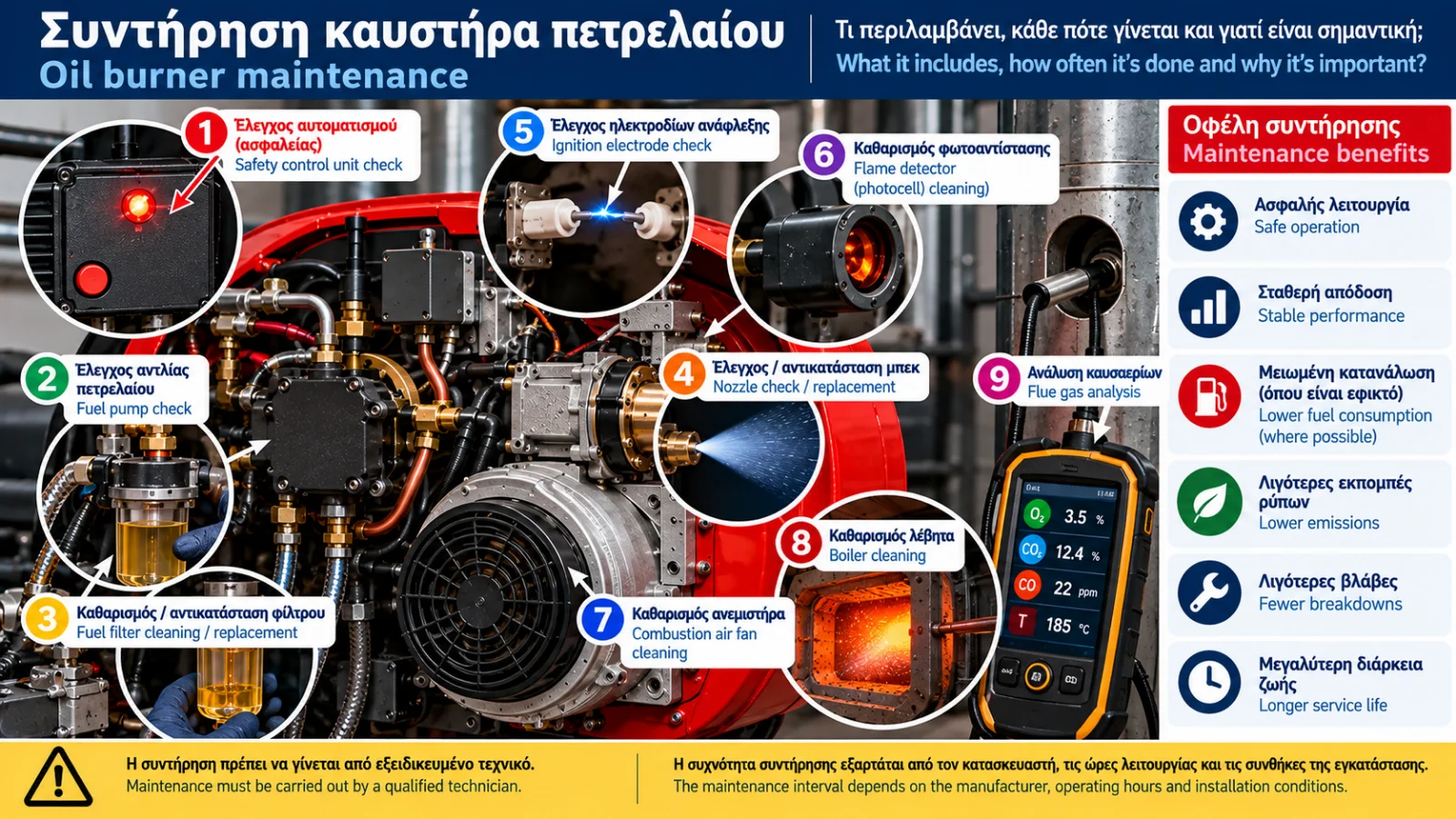
Oil Burner Maintenance: How Often and What a Full Service Includes
Oil burner maintenance is essential for the safe, reliable and efficient operation of an oil-fired central heating system.
Over time, fuel filters and nozzles may become contaminated, ignition components may deteriorate and soot deposits may accumulate on boiler heat-exchange surfaces.
These changes do not always cause immediate shutdown. A burner may continue to ignite even when combustion quality or heating efficiency has deteriorated.
For this reason, maintenance should not be limited to cleaning the external casing or performing a brief startup test.
This Thermosphere.gr technical guide explains what professional maintenance involves, which components require inspection and why flue gas measurements are important for verifying operating conditions.
1. Why Is Oil Burner Maintenance Necessary?
An oil burner combines mechanical, electrical and electronic components.
During operation, it must provide:
Reliable fuel delivery.
Proper fuel atomisation.
Sufficient combustion airflow.
Dependable ignition.
Stable flame formation.
Correct safety-control operation.
Regular maintenance helps identify wear and deterioration before more serious faults develop.
Cleaning the boiler's heat-exchange surfaces can also help reduce losses caused by soot deposits.
Maintenance does not guarantee a fixed percentage of fuel savings. Actual results depend on the equipment's initial condition, settings, heating demand and operating conditions.
2. How Often Should an Oil Burner Be Serviced?
For many residential oil-fired heating systems, an annual professional service is a common preventive maintenance practice.
However, the exact interval depends on:
Manufacturer instructions.
Operating hours.
System type and capacity.
Fuel quality.
Storage and operating conditions.
Applicable regulatory requirements.
Installations operating for long periods may require more frequent attention.
Scheduling maintenance before the heating season is practical because it allows problems to be identified before periods of high demand.
Important: Annual servicing as a general practice should not be confused with a specific legal requirement. Inspection obligations and documentation requirements depend on the installation and applicable local regulations.
3. What Does a Full Oil Burner Service Include?
A complete service is not a single cleaning task.
It combines inspection, cleaning, functional checks and measurements.
Inspection area | Purpose |
|---|---|
Fuel filters | Maintain reliable fuel delivery |
Oil nozzle | Check condition and compatibility |
Fuel pump | Assess fuel delivery and operation |
Ignition electrodes | Support reliable ignition |
Flame detector | Verify flame supervision |
Fan and burner head | Support proper airflow |
Burner safety control | Verify specified safety functions |
Boiler | Inspect combustion chamber and heat-exchange surfaces |
Flue system | Assess condition and safe exhaust discharge |
Flue gases | Verify combustion performance |
The scope of work depends on the burner and boiler manufacturer's service instructions.
4. Fuel Filter Inspection and Maintenance
Fuel filters protect the fuel supply components from particles and contamination.
Filter condition is influenced by:
Fuel cleanliness.
Storage tank condition.
Operating duration.
Sediment accumulation.
Fuel storage conditions.
A contaminated filter may restrict fuel flow.
A qualified technician assesses the filter and performs the required cleaning or replacement according to its design.
Following fuel-system work, leak-tightness and proper fuel delivery must be verified.
5. Oil Nozzle Inspection and Replacement
The nozzle atomises fuel inside the combustion chamber.
Atomisation quality influences ignition, flame geometry and combustion performance.
Maintenance considerations include:
Correct nominal flow rating.
Specified spray angle.
Required spray pattern.
Compatibility with the burner.
Nozzle condition and service history.
Some maintenance programmes specify periodic nozzle replacement even when no obvious fault is present.
Replacement must follow manufacturer instructions rather than arbitrary component selection.
Combustion performance may need to be checked and verified after nozzle replacement.
6. Fuel Pump Maintenance
The fuel pump supplies oil to the nozzle at the required pressure.
Inspection may include:
Checking for leakage.
Assessing fuel supply conditions.
Evaluating pump operation.
Inspecting relevant filters or components where specified.
Taking measurements according to the pump and burner specifications.
There is no single pump pressure suitable for every oil burner.
Pressure settings should not be changed without technical justification and combustion verification.
7. Ignition Electrode Inspection
Ignition electrodes produce the spark needed to establish the flame.
Over time, problems may include:
Wear.
Deposits.
Insulation deterioration.
Incorrect positioning.
Connection problems.
Correct electrode spacing and positioning depend on the burner manufacturer.
There is no universal electrode dimension suitable for all burners.
Warning: Ignition circuits generate hazardous high voltage. Inspection must be performed only by qualified personnel using appropriate safety procedures.
8. Flame Detector Inspection
A photocell or another type of flame detector is part of the burner safety system.
Contamination or deterioration may affect flame-detection reliability.
A technician may assess:
Cleanliness of the sensing surface.
Correct installation.
Wiring condition.
System response according to specifications.
Diagnosis must distinguish a defective detector from genuine flame instability.
Bypassing or artificially activating flame detection is not an acceptable practice.
9. Combustion Fan and Burner Head Cleaning
The combustion fan and burner head influence the quantity and distribution of combustion air.
Dust and deposits may alter operating conditions.
Inspection may include:
Fan impeller condition.
Air passage cleanliness.
Burner head condition.
Visible signs of deterioration.
Confirmation of specified settings.
Cleaning must not alter manufacturer-defined geometry or adjustments.
10. Why Does the Boiler Also Need Cleaning?
The burner produces the flame, but the boiler transfers heat to the heating water.
During operation, deposits can accumulate on heat-exchange surfaces.
Soot restricts heat transfer and may increase flue gas temperature.
Boiler maintenance may include:
Combustion chamber inspection.
Heat-exchange surface cleaning.
Door and seal inspection.
Checking for corrosion or deterioration.
Inspecting combustion gas passages.
Required procedures depend on boiler design and materials.
Servicing the burner without assessing the boiler may leave important performance problems unresolved.
11. Flue and Chimney Inspection
Safe removal of combustion products is a critical part of the installation.
Inspection may include:
Flue pipe condition.
Joint tightness.
Deposits and obstructions.
Signs of condensation or corrosion.
Suitability of flue gas discharge.
Combustion air provision.
Chimney inspection and cleaning may require separate specialist work.
The absence of visible smoke does not establish that the flue system is operating safely.
12. Burner Safety Control Checks
The burner controller supervises ignition, flame presence and required operating conditions.
During maintenance, relevant safety functions are checked according to the equipment manual.
Depending on the model, assessment may cover:
Operating indicators.
Startup sequence.
Flame supervision.
Response to specified fault conditions.
Fuel shutoff operation.
Safety testing requires approved procedures and must not involve improvised bypasses.
13. Why Is Flue Gas Analysis Important After Servicing?
Cleaning and component replacement alone do not demonstrate that combustion is correct.
Final assessment requires suitable instruments.
Relevant parameters include:
O₂: residual oxygen.
CO₂: carbon dioxide.
CO: carbon monoxide.
Flue gas temperature.
Combustion air temperature.
Smoke or soot index.
Flue draught or pressure, where required.
Acceptable values depend on the burner, boiler, fuel and applicable requirements.
Universal target values should not be applied to every installation.
The interpretation of these measurements is discussed in the separate Thermosphere.gr article on oil burner adjustment.
14. What Should Be Included in the Service Record?
Useful maintenance records include:
Service date.
Burner and boiler models.
Work completed.
Replacement components.
Combustion measurements.
Findings and outstanding issues.
Recommended follow-up actions.
Technician identification.
Where required by local regulations, the relevant inspection or service documents must also be completed and provided.
Good documentation makes it easier to compare operating measurements between service visits.
15. What Affects Oil Burner Service Cost?
Service costs vary between installations.
Factors include:
Burner type and capacity.
Equipment accessibility.
Boiler condition.
Cleaning requirements.
Replacement parts.
Additional tests or repairs.
Before commissioning maintenance, property owners should clarify which tasks are included and whether replacement parts are charged separately.
The lowest price does not necessarily indicate an adequate service.
Completeness of inspection and appropriate documentation are more important.
16. What Can Owners Monitor Between Services?
Property owners can observe basic operating conditions without opening the burner.
Useful warning signs include:
Unusual noises.
Repeated lockouts.
Fuel odours.
Visible leakage.
Smoke or soot.
Changes in heating performance.
Unexplained changes in fuel consumption.
Recurring faults should be professionally assessed rather than repeatedly reset.
If smoke enters the building, fuel leakage is suspected or carbon monoxide exposure may be occurring, leave the hazardous area and seek appropriate assistance immediately.
17. Frequently Asked Questions
How Often Should an Oil Burner Be Serviced?
Annual professional servicing is common in many residential installations. Actual intervals must follow manufacturer instructions and applicable requirements.
Does a Burner Need Servicing if It Runs Normally?
Yes. Normal ignition does not prove that combustion is correct or that deposits and wear are absent.
Must the Nozzle Be Replaced Every Time?
Not necessarily. Replacement depends on the maintenance programme, manufacturer specifications and professional assessment.
Is Cleaning the Burner Enough?
No. Functional checks, combustion measurements where required and boiler inspection are also important.
Should the Boiler Be Cleaned Too?
Yes, according to its condition and service requirements. Deposits can reduce heat transfer.
Does Maintenance Reduce Oil Consumption?
It may recover performance lost through fouling or poor operation, but no fixed savings percentage can be guaranteed.
Who Should Perform Oil Burner Maintenance?
An appropriately qualified technician working in accordance with equipment instructions and applicable regulations.
Conclusion
Oil burner maintenance is a comprehensive inspection and verification process, not simply a cleaning operation.
It includes assessing fuel delivery, the nozzle, pump, ignition system, flame detector, combustion fan and safety controls.
The condition of the boiler and flue system is equally important.
Maintenance is properly completed when safe operation has been confirmed and the required measurements have been documented.
Technical References and Further Reading
EN 267: Automatic forced draught burners for liquid fuels.
EN 230: Automatic burner control systems for oil burners.
EN 50379: Specifications for portable electrical apparatus designed to measure combustion flue gas parameters of heating appliances.
Riello: Official operation and maintenance manuals — https://www.riello.com/
Baltur: Burner technical documentation — https://www.baltur.com/
Danfoss: Fuel pump and nozzle technical documentation — https://www.danfoss.com/
Testo: Combustion analysis instrument information — https://www.testo.com/
General references do not replace the service manual for the exact equipment or applicable regulatory requirements.
Safety note: Burner servicing involves fuel systems, electrical circuits and safety components. It must be performed by appropriately qualified personnel.
Thermosphere.gr — Technical knowledge for heating and building systems.