
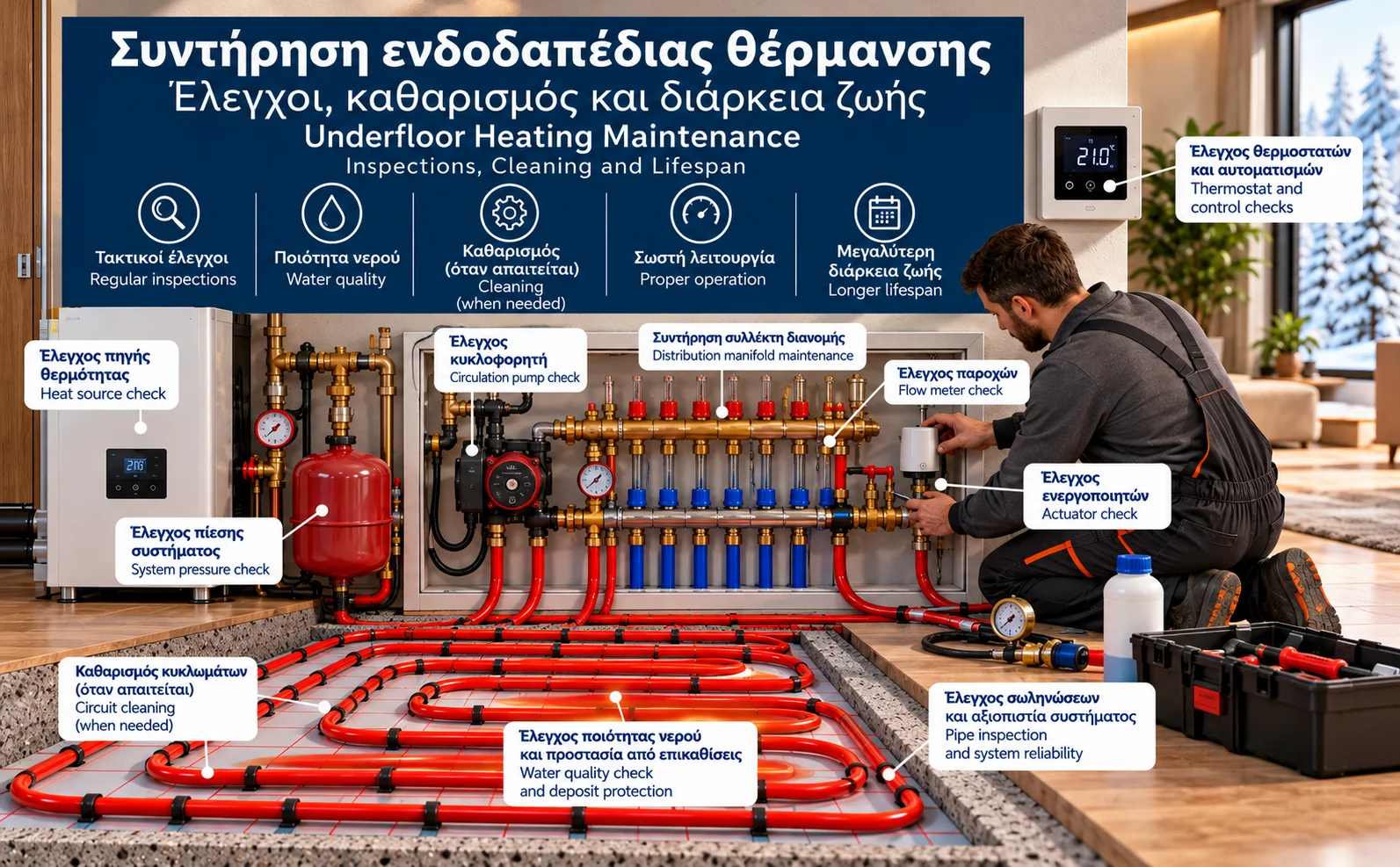
Underfloor Heating Maintenance: Inspections, Cleaning and Lifespan
Hydronic underfloor heating is generally considered a reliable heating solution. Its embedded pipes are protected within the floor structure and contain no moving mechanical components.
However, this does not mean that the entire heating installation is maintenance-free.
The distribution manifold, circulation pump, valves, controls and heat source require periodic inspection to maintain reliable performance.
Water quality and correct system pressure also influence long-term durability.
This guide explains the essential maintenance checks, when system cleaning may be necessary and what determines the lifespan of hydronic underfloor heating.
1. Does Underfloor Heating Need Maintenance?
Yes, although it is important to distinguish the embedded pipe circuits from the rest of the equipment.
Pipes inside the floor are designed for long-term operation and normally do not require routine replacement or dismantling.
Accessible mechanical and electrical components, however, should be inspected periodically.
Typical maintenance activities include:
Checking system pressure.
Inspecting the manifold and connections.
Checking the circulation pump.
Testing thermostats and actuators.
Assessing water quality.
Confirming correct heat-source operation.
Reviewing circuit flow rates when performance problems occur.
2. Checking System Pressure
Pressure is an important indicator of a hydronic heating system's condition.
In a sealed installation, pressure varies as water temperature changes.
Some difference between cold and hot operating conditions is normal.
However, continuously falling pressure may indicate:
Water leakage.
Expansion vessel problems.
Water loss through the safety relief valve.
Leaking connections.
Other system faults.
There is no single correct pressure for every building.
The required pressure depends on installation height and equipment specifications.
Repeatedly adding water without identifying the cause is not an appropriate long-term solution.
3. Distribution Manifold Maintenance
The distribution manifold is one of the main inspection points.
It distributes heating water to individual floor circuits.
Maintenance checks may include:
Inspecting connections for leaks.
Checking isolation valves.
Examining flow meters and regulators.
Testing thermal actuators.
Inspecting filling and venting connections.
Checking the condition of the manifold cabinet.
A malfunctioning actuator may prevent a particular room from heating.
Similarly, a defective flow meter may make hydraulic adjustments difficult.
Components should only be replaced after the actual fault has been identified.
4. Circulation Pump Inspection
The circulation pump moves water through the heating system.
Insufficient flow may reduce heating output in some circuits.
A technical inspection may cover:
Motor operation.
Selected control settings.
Error indications.
Unusual noises.
Available flow.
Electrical connection condition.
Pump settings should not be changed arbitrarily because this may disturb the system's hydraulic balance.
5. Water Quality and Deposit Prevention
Water quality plays an important role in system reliability.
Unsuitable water conditions or oxygen ingress can contribute to corrosion and deposits, particularly in metallic components.
Potential consequences include:
Particle accumulation.
Restricted water flow.
Pump damage.
Valve malfunction.
Reduced system performance.
Water treatment should follow manufacturer specifications and relevant technical guidance, such as VDI 2035 where applicable.
Chemical additives must not be introduced without checking compatibility with all system materials.
6. Does Underfloor Heating Need Flushing?
A correctly installed and maintained sealed system does not automatically require regular circuit flushing.
Cleaning may be appropriate when there is evidence of:
Restricted flow.
Significant deposits.
Repeated valve problems.
Contaminated system water.
Performance issues after installation work.
How Is Cleaning Performed?
A qualified technician should first assess the condition of the installation.
Depending on the findings, controlled flushing of individual circuits or another suitable cleaning method may be used.
Cleaning pressure, flow and chemicals must remain compatible with the pipes, valves and other components.
Aggressive cleaning without a documented need is not recommended.
7. Thermostat and Control System Checks
Thermostats and actuators regulate individual heating zones.
Maintenance should confirm that:
Thermostats display reasonable temperatures.
Heating requests are transmitted correctly.
Actuators open and close as intended.
No visible wiring faults are present.
Weather compensation and other controls follow the intended settings.
Electrical work must be performed by appropriately qualified personnel.
8. Is Annual Air Bleeding Necessary?
Not necessarily.
A properly filled and sealed system should not continuously accumulate significant quantities of air.
If repeated venting is required, the underlying cause should be investigated.
Possible causes include incomplete initial venting, air introduced during maintenance, unsuitable pressure conditions or defective components.
Repeated venting without diagnosis is not a permanent solution.
9. How Long Does Underfloor Heating Last?
Pipes used in approved underfloor heating systems are designed for long service life.
For many plastic piping applications, design specifications are based on service-life periods of approximately 50 years under defined temperature and pressure conditions.
This does not guarantee that every installation will operate without problems for 50 years.
Actual lifespan depends on:
Pipe quality.
Operating temperatures and pressures.
Installation workmanship.
Water chemistry.
Protection against overheating.
Maintenance of other system components.
Circulation pumps, actuators and valves may require repair or replacement much sooner than embedded pipes.
10. How Often Should Maintenance Be Performed?
Maintenance intervals depend on manufacturer instructions, system usage and installation requirements.
An annual preventive inspection is often a practical approach, particularly when combined with boiler or heat pump servicing.
Indicative Maintenance Schedule
Maintenance Task | Suggested Timing |
|---|---|
Visual pressure check | Periodically, according to instructions |
Manifold inspection | During preventive maintenance |
Circulation pump check | According to manufacturer guidance |
Thermostat check | At the start of the heating season |
Water quality assessment | Based on system requirements and findings |
Circuit flushing | Only when technically justified |
Hydraulic balancing | After modifications or when problems arise |
This schedule is indicative and does not replace manufacturer requirements.
11. Common Maintenance Mistakes
Repeatedly Adding Fresh Water
Frequent refilling may introduce additional oxygen and dissolved minerals, depending on water quality.
Arbitrary Flow Adjustments
Changing manifold settings without design information may cause uneven heating.
Using Incompatible Chemicals
Cleaning products and additives must be compatible with all system materials.
Ignoring Small Leaks
A minor leak at an accessible connection can develop into a more serious problem.
Neglecting Heat Source Maintenance
A well-maintained floor heating network cannot deliver efficient heating if the boiler or heat pump is malfunctioning.
12. Frequently Asked Questions
Should underfloor heating water be replaced every year?
No. Annual water replacement is not a general requirement for a properly functioning sealed system. Water replacement should be based on a specific technical need.
Can I clean the manifold myself?
A simple external visual inspection may be appropriate. Dismantling, flushing and hydraulic work should be carried out by a qualified technician.
When is hydraulic balancing necessary?
It may be needed when rooms heat unevenly, after significant system modifications or when measured flow rates differ from design requirements.
Can underfloor heating fail after many years?
Yes. Although embedded pipes are designed for long service life, mechanical and electrical components are subject to wear and may eventually require replacement.
Conclusion
Proper underfloor heating maintenance focuses mainly on prevention and inspection of accessible components.
Embedded pipe circuits do not necessarily require frequent cleaning when the installation is correctly designed and operates with suitable water quality.
Monitoring pressure, inspecting the manifold, checking the circulation pump and maintaining appropriate control settings help preserve reliability and energy efficiency.
Maintenance should follow equipment specifications, with technical interventions performed by qualified professionals.
Thermosphere.gr — Technical knowledge for heating and building systems.