
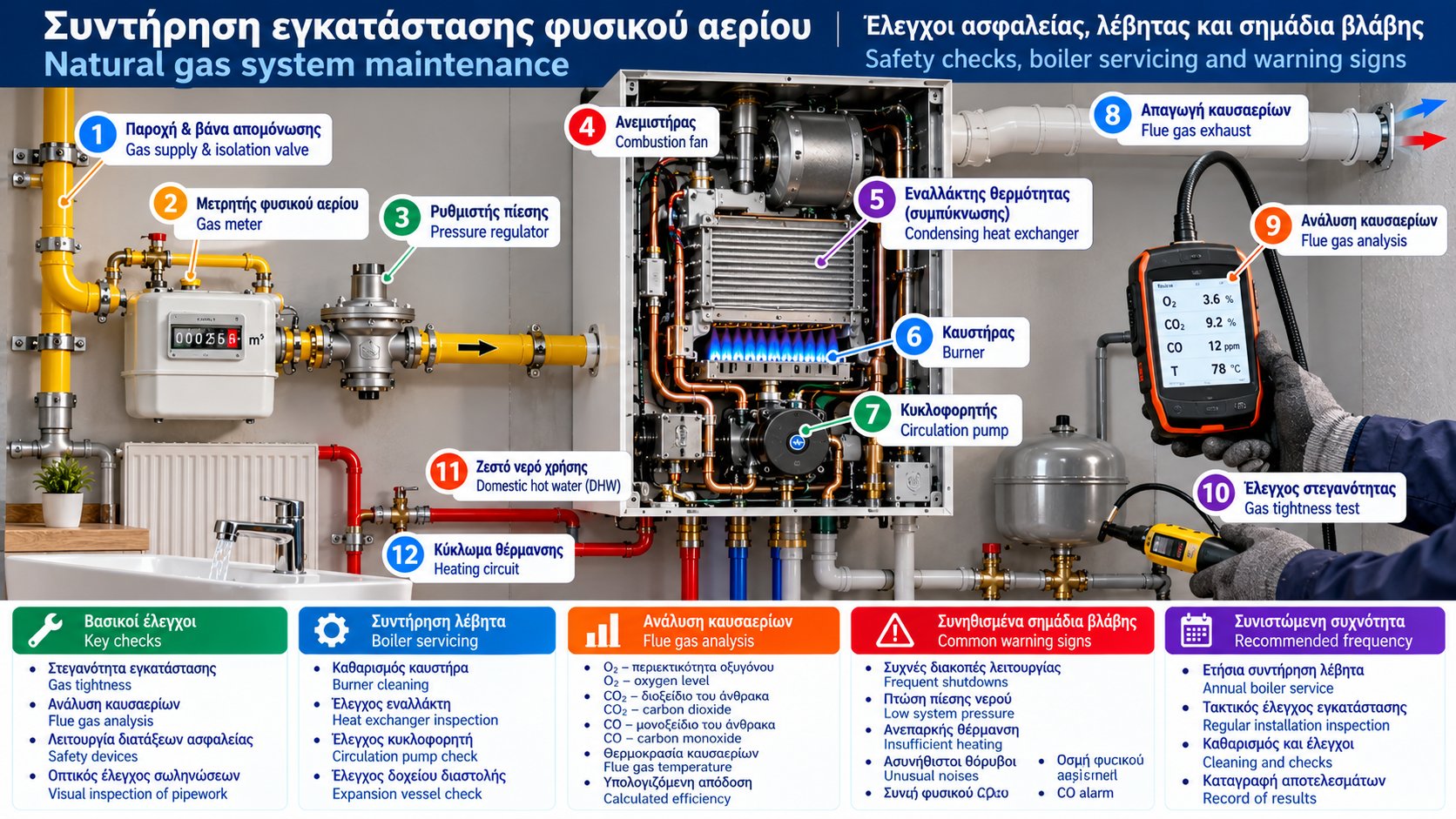
Residential Natural Gas Maintenance: Safety Checks, Boiler Servicing and Warning Signs
Maintaining a residential natural gas installation is essential for safe and reliable heating operation.
Modern gas boilers contain multiple protective devices, sensors and electronic controls. However, these systems do not eliminate the need for regular professional inspection.
Preventive maintenance can help identify issues involving gas tightness, combustion, water circulation and flue gas exhaust before they lead to shutdowns or hazardous conditions.
1. What Does Natural Gas Maintenance Include?
Two different activities must be distinguished.
Gas appliance servicing covers the boiler, burner, heat exchanger, safety devices and related components.
Gas installation inspection covers the pipework, connections, isolation valves and overall condition of the gas distribution system within the property.
These activities are related but are not identical.
Their frequency and scope depend on applicable regulations, manufacturer instructions and installation conditions.
2. How Often Should a Gas Boiler Be Serviced?
Many residential boiler manufacturers specify annual servicing.
However, the correct interval must be verified against the specific appliance instructions and applicable legal requirements.
Intensive use, difficult operating conditions or recurring faults may justify additional inspections.
Servicing should never consist solely of resetting fault codes.
3. Gas Pipework and Joint Tightness
Gas tightness is a fundamental safety requirement.
Over time, mechanical stresses, corrosion, unauthorized modifications or defective connections may affect installation integrity.
Qualified personnel can carry out the appropriate inspections using suitable instruments and approved procedures.
A maintenance leak check is not necessarily equivalent to the complete tightness test required for a newly constructed installation.
Test methods, pressures and acceptance criteria depend on the purpose of the inspection and applicable regulations.
Never use an open flame to locate a gas leak.
4. Burner and Combustion System Inspection
The burner is responsible for controlled natural gas combustion.
Depending on the appliance, maintenance may involve assessing:
Burner condition.
Ignition performance.
Flame supervision.
Operating stability.
Behavior at different firing rates.
Associated protective functions.
Combustion adjustments must be carried out by qualified personnel following manufacturer procedures.
5. Flue Gas Analysis
Flue gas analysis is an important part of professional boiler servicing.
A suitable analyzer can measure or calculate parameters such as:
O₂: Oxygen concentration.
CO₂: Carbon dioxide concentration.
CO: Carbon monoxide concentration.
Flue gas temperature.
Calculated combustion efficiency, according to the instrument method.
Acceptable values depend on boiler model, fuel characteristics, firing rate and manufacturer specifications.
There is no single target O₂ or CO₂ concentration applicable to every residential gas boiler.
6. Why Is Carbon Monoxide Dangerous?
Carbon monoxide (CO) is a colorless, odorless gas.
It can be produced by incomplete combustion.
Exposure can cause severe poisoning.
Possible symptoms include headache, dizziness, nausea and weakness, although these symptoms are not specific enough to diagnose exposure.
If a carbon monoxide alarm activates or exposure is suspected, immediately move to fresh air and contact emergency services from a safe location.
Do not remain inside to investigate the source.
7. Flue System Inspection
Safe removal of combustion products is essential.
Depending on the system, professional inspection may assess:
Flue pipe condition.
Connections to the appliance.
Signs of damage or deterioration.
Flue routing.
Terminal condition.
Condensate management where applicable.
Requirements vary according to boiler and flue system design.
8. Heat Exchanger Maintenance
The heat exchanger transfers combustion heat to the heating water.
Deposits and contamination may reduce heat transfer or affect boiler operation.
For condensing boilers, inspection and cleaning must follow the manufacturer’s specific instructions.
Unsuitable chemicals or cleaning methods can damage the heat exchanger and must not be used.
9. Circulation Pump and Hydraulic System Checks
A gas boiler operates as part of a water-based heating system.
Maintenance may include checking:
Circulation pump operation.
Heating system pressure.
Expansion vessel.
Water-side safety relief valve.
Air within the circuit.
Filters or dirt separators.
Visible water leaks.
Required system filling pressure depends on installation height and design.
One fixed pressure setting is not appropriate for every home.
10. Condensate Drainage Inspection
Condensing boilers produce condensate during operation.
The drainage system must safely remove this liquid.
Potential issues include:
Blocked drainage.
Contaminated condensate trap.
Improper drainage connection.
Freezing of exposed pipe sections in cold conditions.
Inspection and cleaning must follow appliance instructions.
11. Safety Device Inspection
Gas boilers include protective systems that monitor critical operating conditions.
Depending on the model, these may include:
Flame supervision.
Overtemperature protection.
Water pressure monitoring.
Fan or air-path monitoring.
Gas valve control.
Electronic fault monitoring.
Testing must follow the manufacturer’s approved procedures.
Never bypass a safety device to keep a boiler running.
12. Common Warning Signs
Symptom | Possible Cause | Recommended Response |
Frequent shutdowns | Combustion, sensor or supply problem | Professional inspection |
Repeated water pressure loss | Leak or expansion vessel problem | Hydraulic system assessment |
Inadequate heating | Controls, circulation or heat-load issue | System diagnosis |
Unusual noises | Air, flow problems or deposits | Technician inspection |
Unstable domestic hot water | Sensor, flow or heat exchanger issue | Hot water system inspection |
Natural gas smell | Possible gas leak | Immediate emergency procedure |
CO alarm activation | Possible carbon monoxide exposure | Evacuate and contact emergency services |
These are possible causes, not definitive diagnoses.
13. What Should You Do If You Smell Gas?
If a gas leak is suspected:
Do not use matches, lighters or flames.
Do not operate electrical switches.
Do not use electrical appliances in the affected area.
Leave the area.
If safe, shut off the designated gas valve and open doors or windows.
From a safe location, contact the gas network operator’s emergency service or relevant emergency authorities.
Do not attempt repairs or return until the area has been declared safe.
14. Can Homeowners Service Their Own Boilers?
Homeowners may monitor user-accessible indications and follow basic operating instructions.
They must not interfere with:
Gas valves.
Burners.
Combustion settings.
Gas connections.
Safety devices.
Flue systems.
Technical work must be performed by legally qualified personnel.
15. What Should a Maintenance Record Include?
A structured maintenance record may include:
Service date.
Appliance identification.
Qualified technician details.
Work performed.
Flue gas measurements.
Identified defects.
Replaced parts.
Recommended follow-up actions.
Documents and inspection records required by law.
Documentation helps compare equipment condition between successive inspections.
16. Preventive Maintenance and Energy Efficiency
Maintenance is not only about preventing failures.
Correct burner operation, clean heat-transfer surfaces and suitable water circulation help maintain system performance.
However, a specific percentage of energy savings cannot be promised without actual measurements before and after servicing.
The impact on consumption depends on initial equipment condition and operating circumstances.
17. Technical Standards and Regulatory Framework
Depending on the installation, relevant standards may include:
EN 15502: Gas-fired central heating boilers.
EN 1775: Gas pipework for buildings.
EN 12828: Design of water-based heating systems.
EN 50291: Electrical apparatus for carbon monoxide detection in domestic premises.
In Greece, the applicable gas installation technical regulation, current maintenance requirements and manufacturer instructions must also be considered.
Gas installation inspection obligations should not be confused with appliance servicing requirements.
Conclusion
Safe residential natural gas operation depends on proper installation, appropriate use and preventive maintenance.
Gas tightness inspections, flue gas analysis, boiler checks and safety device assessments are important elements of technical supervision.
Recognizing unusual symptoms early and arranging servicing by qualified personnel helps protect occupants and maintain reliable operation.