
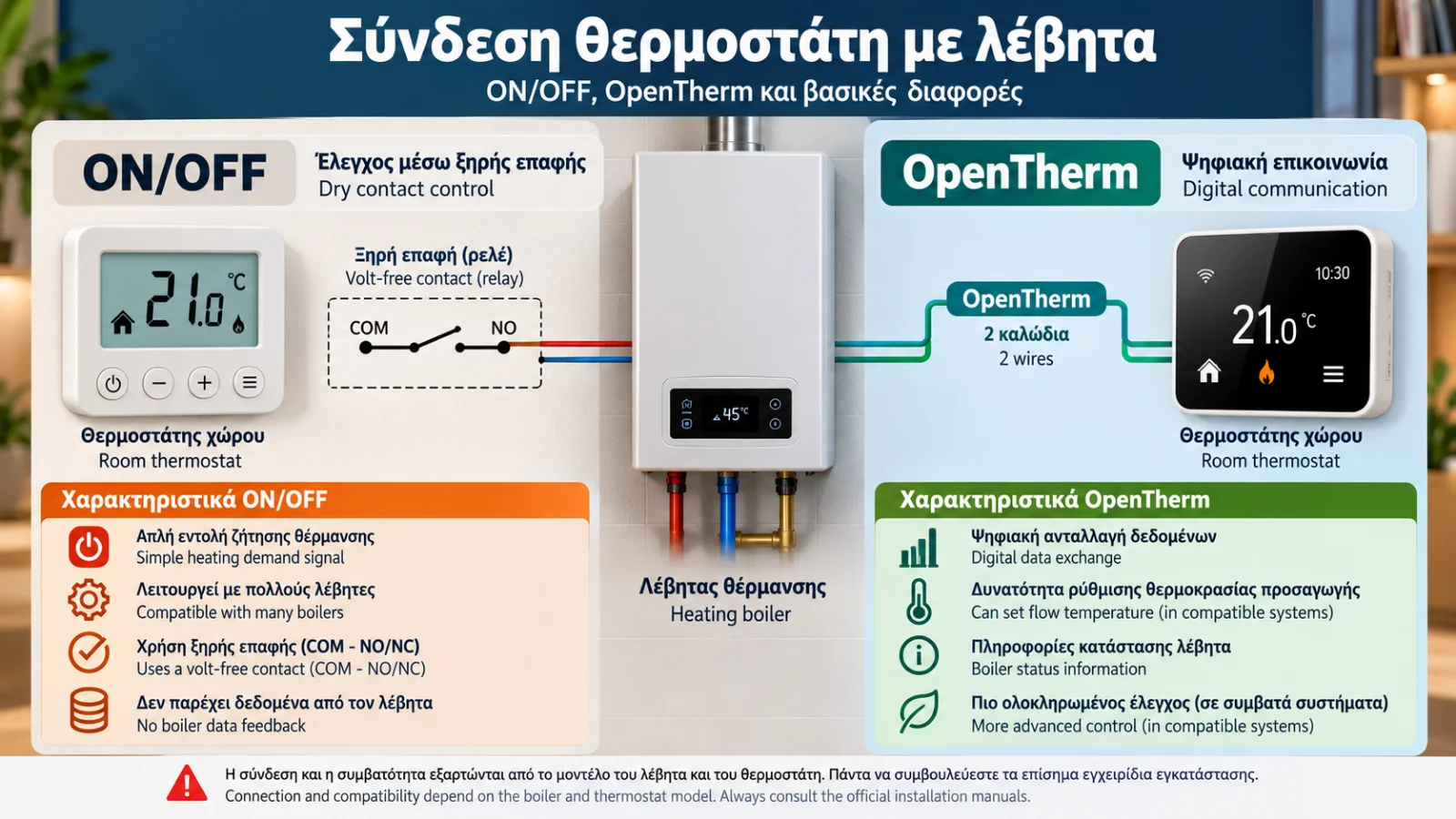
Connecting a Thermostat to a Boiler: ON/OFF, OpenTherm and Troubleshooting
Connecting a room thermostat to a boiler is a fundamental part of a heating control system. The thermostat communicates heating demand, allowing the boiler or heating controller to respond according to the installation's operating requirements.
However, not all boilers and thermostats use the same control method.
Some systems rely on a simple ON/OFF electrical contact, while others support digital communication protocols such as OpenTherm or manufacturer-specific control systems.
Incorrect thermostat selection or wiring can lead to unreliable operation, loss of control functions or damage to boiler electronics.
This Thermosphere.gr technical guide explains the main connection methods, the differences between ON/OFF and OpenTherm, essential compatibility requirements and common troubleshooting procedures.
1. What Does a Boiler Thermostat Do?
A room thermostat measures indoor temperature and compares it with a selected setpoint.
When heating is required, it communicates a demand signal to the boiler or central heating controller.
Depending on the system, this may involve:
Opening or closing an electrical contact.
Exchanging digital operating data.
Sending a request through a zone controller or intermediate control device.
The thermostat does not replace the boiler's safety systems.
Flame supervision, overtemperature protection, pump management and other protective functions remain under the control of the appropriate boiler components.
2. How Does ON/OFF Thermostat Control Work?
ON/OFF control is one of the most common methods of communicating heating demand.
The thermostat changes the state of an electrical contact, allowing the boiler to determine whether space heating is required.
When the room temperature is below the required value, the thermostat requests heating.
When the temperature reaches the relevant switching threshold, heating demand stops.
Does ON/OFF Mean the Boiler Always Runs at Full Power?
No.
A modern modulating condensing boiler may adjust burner output internally even when the external thermostat provides only an ON/OFF demand signal.
The thermostat determines whether heating is requested, while the boiler's internal controller manages burner operation.
Therefore, ON/OFF thermostat control does not necessarily mean fixed maximum burner output.
3. What Is a Volt-Free or Dry Contact?
A dry contact, also called a volt-free or potential-free contact, is an electrical switching contact that does not independently supply voltage to the controlled circuit.
Many thermostats use relay outputs with this arrangement.
These outputs may be suitable for boiler thermostat inputs designed to accept contact closure, provided that the electrical specifications are compatible.
Why Does It Matter?
Applying an external voltage to a boiler input intended for a volt-free contact can damage its electronic control board.
Likewise, a thermostat output that supplies voltage must not be assumed to be equivalent to a dry-contact relay.
Important: A volt-free contact does not mean the connected circuit is necessarily safe to touch. Voltage may be present from the equipment connected to the contact.
4. Understanding COM, NO and NC Terminals
Many relay-based thermostats use the following terminal designations:
Terminal | Meaning | Function |
|---|---|---|
COM | Common | Common relay terminal |
NO | Normally Open | Contact normally open |
NC | Normally Closed | Contact normally closed |
NO and NC describe the relay's normal state, generally when the relay is not energised.
Many heating-control applications use a contact that closes when heating is requested.
However, the correct terminals must always be determined from the specific thermostat and boiler installation diagrams.
There is no universally correct wiring arrangement for every model.
5. What Is OpenTherm?
OpenTherm is a digital communication protocol used between compatible heating controllers and heating appliances.
Unlike a basic ON/OFF contact, it supports the exchange of operating information.
Depending on the devices and their implementation, supported functions may include:
Heating-demand communication.
Requested heating-water temperature.
Operating-temperature information.
Boiler status information.
Support for modulating heating control.
Not every OpenTherm device supports every available protocol function.
Actual functionality depends on the implementation in both the thermostat and the boiler.
6. ON/OFF vs OpenTherm
Feature | ON/OFF | OpenTherm |
|---|---|---|
Main control method | Switching contact | Digital communication |
Data exchange | Not through the basic contact | Yes |
Requested flow-temperature control | Not through the basic contact | Possible |
Boiler status feedback | Not through the basic contact | Possible |
Protocol compatibility required | No | Yes |
Internal boiler modulation | May still operate | May operate with additional external control |
OpenTherm can provide more sophisticated control in compatible installations.
However, it does not automatically guarantee a specific reduction in energy consumption.
Efficiency depends on the heating equipment, flow and return temperatures, building characteristics and control settings.
7. Are All Boilers Compatible with OpenTherm?
No.
Some boilers support OpenTherm, others use proprietary communication systems, and some accept only conventional thermostat demand inputs.
Compatibility may also vary by model version, market or optional control accessories.
Before selecting a thermostat, verify:
The exact boiler model.
Its official installation manual.
The designated control terminals.
Supported communication protocols.
Any required interface modules or adapters.
The presence of two control terminals does not establish OpenTherm compatibility.
8. Thermostat Connections on Oil Boilers
In oil-fired heating installations, the thermostat may communicate with a boiler control panel, burner-demand circuit, circulation-pump controller or zone-control system.
The actual arrangement depends on the installation design.
In some systems, the thermostat does not connect directly to the burner controller.
Instead, heating demand passes through an intermediate control panel.
Safety thermostats, high-limit controls and other protective devices must never be bypassed.
The approved electrical diagram determines the correct arrangement.
9. 230 V, Low-Voltage and Battery-Powered Thermostats
One common source of confusion is the difference between thermostat power supply and thermostat output.
A thermostat may:
Operate on batteries and provide a dry-contact relay output.
Use a 230 V power supply with an independent dry-contact output.
Use a 230 V power supply and provide a switched-voltage output.
Use a dedicated low-voltage or digital communication connection.
The thermostat's supply voltage alone does not determine its compatibility with a boiler.
Supply requirements, output characteristics and boiler-input specifications must be checked separately.
10. How Do Wireless Boiler Thermostats Work?
Many wireless thermostat systems contain two units.
Room thermostat: Measures temperature and transmits heating demand wirelessly.
Receiver: Receives the signal and connects electrically to the boiler or heating controller.
Depending on the model, the receiver may use a relay contact or a supported digital communication protocol.
Wireless communication between the thermostat and receiver is not necessarily Wi-Fi.
Many systems operate independently of an internet connection.
11. The Thermostat Requests Heat but the Boiler Does Not Start
This is a common heating-control problem.
The thermostat itself is not necessarily defective.
Possible causes include:
Incorrect temperature setpoint.
Disabled heating schedule.
Low thermostat batteries.
Loss of communication between wireless thermostat and receiver.
A control-wiring fault.
Incorrect boiler operating settings.
An active boiler fault or protective lockout.
Missing demand from another required control component.
Basic Checks Without Opening Electrical Equipment
The user can check:
Whether the thermostat is switched on.
Whether the target temperature exceeds the measured room temperature.
Whether heating mode is selected.
Whether a low-battery warning appears.
Whether the boiler displays an error code.
Whether the boiler is set to summer or domestic-hot-water-only operation.
If these checks do not resolve the issue, professional diagnosis is required.
12. The Boiler Keeps Running After the Setpoint Is Reached
Possible explanations include:
Continued heating demand due to thermostat settings or control logic.
Heating demand from another zone.
Independent weather-compensation operation.
A boiler function unrelated to space heating.
A fault in the control relay or associated automation.
It is also important to distinguish burner operation from pump operation.
A circulation pump may continue running for a defined period after heating demand ends.
This does not necessarily indicate that the burner is still operating.
13. The Thermostat Works but the Room Remains Cold
A functioning thermostat does not guarantee that sufficient heat reaches the room.
Potential causes include:
Low heating-water flow temperature.
Inadequate water circulation.
Closed valves or thermostatic radiator valves.
Air trapped in the heating circuit.
Insufficient heating output under current conditions.
Incorrect thermostat placement.
Zone-control problems.
Diagnosis must therefore consider both the electrical controls and the hydraulic heating system.
14. Professional Troubleshooting Procedure
A qualified technician should use a structured diagnostic approach.
Step 1: Identify the Equipment
Record the exact models of the boiler, thermostat, receiver and any intermediate controllers.
Step 2: Review Technical Documentation
Check the manufacturer's approved wiring diagrams and electrical specifications.
Step 3: Check Operating Status
Review the thermostat, receiver, control-panel and boiler indications.
Step 4: Verify Heating Demand
Determine whether the appropriate heating-demand signal reaches the designated control point using suitable safe testing methods.
Step 5: Check Boiler Response
Confirm whether the boiler recognises the demand and whether operating settings or safety conditions prevent heating.
Step 6: Assess the Heating Installation
If the boiler operates correctly, inspect circulation pumps, valves, zone controls and heat distribution.
Electrical measurements must be performed only by appropriately qualified personnel using suitable instruments and safety procedures.
15. Common Thermostat Replacement Mistakes
Choosing a Thermostat Based Only on Appearance
Two visually similar thermostats may have completely different electrical outputs.
Confusing a Dry Contact with a 230 V Output
This can cause serious damage to boiler electronics.
Assuming Every Digital Connection Uses OpenTherm
Manufacturers may use different communication protocols.
Ignoring Intermediate Controllers
In multi-zone installations, the thermostat may connect to a zone controller rather than directly to the boiler.
Bypassing Safety Devices
Bypassing protective devices is not an acceptable repair or testing method.
Overlooking Boiler Configuration
Some boilers require specific settings for the selected control method.
16. Frequently Asked Questions
Can I Replace a Basic Thermostat with a Wi-Fi Model?
Often, but electrical compatibility, supply requirements and output characteristics must first be verified.
Is OpenTherm Better Than ON/OFF?
OpenTherm may provide additional control capabilities in compatible installations, but it is not automatically the best solution for every heating system.
Does a Condensing Boiler Require OpenTherm?
No. Many condensing boilers support conventional ON/OFF demand while independently modulating burner output.
What Do COM and NO Mean?
COM is the relay's common terminal, while NO is its normally open contact. Their correct application depends on the equipment wiring diagrams.
Why Does the Thermostat Show Heating Demand but the Boiler Remain Off?
Possible causes include communication problems, wiring faults, incorrect settings or boiler protective conditions.
Can I Bridge Boiler Terminals to Test the Thermostat?
Terminals must not be bridged without verifying the manufacturer's approved diagnostic procedure. Incorrect bridging may create electrical hazards or damage the boiler control board.
Conclusion
Correct thermostat-to-boiler connections require a clear understanding of the control method and verified compatibility between the devices.
ON/OFF control remains suitable for many heating installations, while OpenTherm can provide additional communication and control capabilities when supported by both the thermostat and the boiler.
The key consideration is not simply choosing the most advanced thermostat, but ensuring that electrical characteristics, communication protocols and heating-system requirements are correctly matched.
When faults occur, diagnosis should cover the complete control chain: thermostat, receiver, wiring, control panel, boiler and hydraulic heating circuit.
Technical References and Further Reading
OpenTherm Association: https://www.opentherm.eu/
EN 60730-1: Automatic electrical controls — General requirements.
EN 60730-2-9: Particular requirements for temperature sensing controls.
Official boiler and thermostat manufacturer installation manuals: Approved electrical connections, terminal designations and compatibility requirements.
Safety note: This article provides general technical information and does not replace equipment-specific wiring diagrams. Thermostat installation, replacement and electrical testing must be carried out by appropriately qualified personnel.
Thermosphere.gr — Technical knowledge for heating and building systems.