
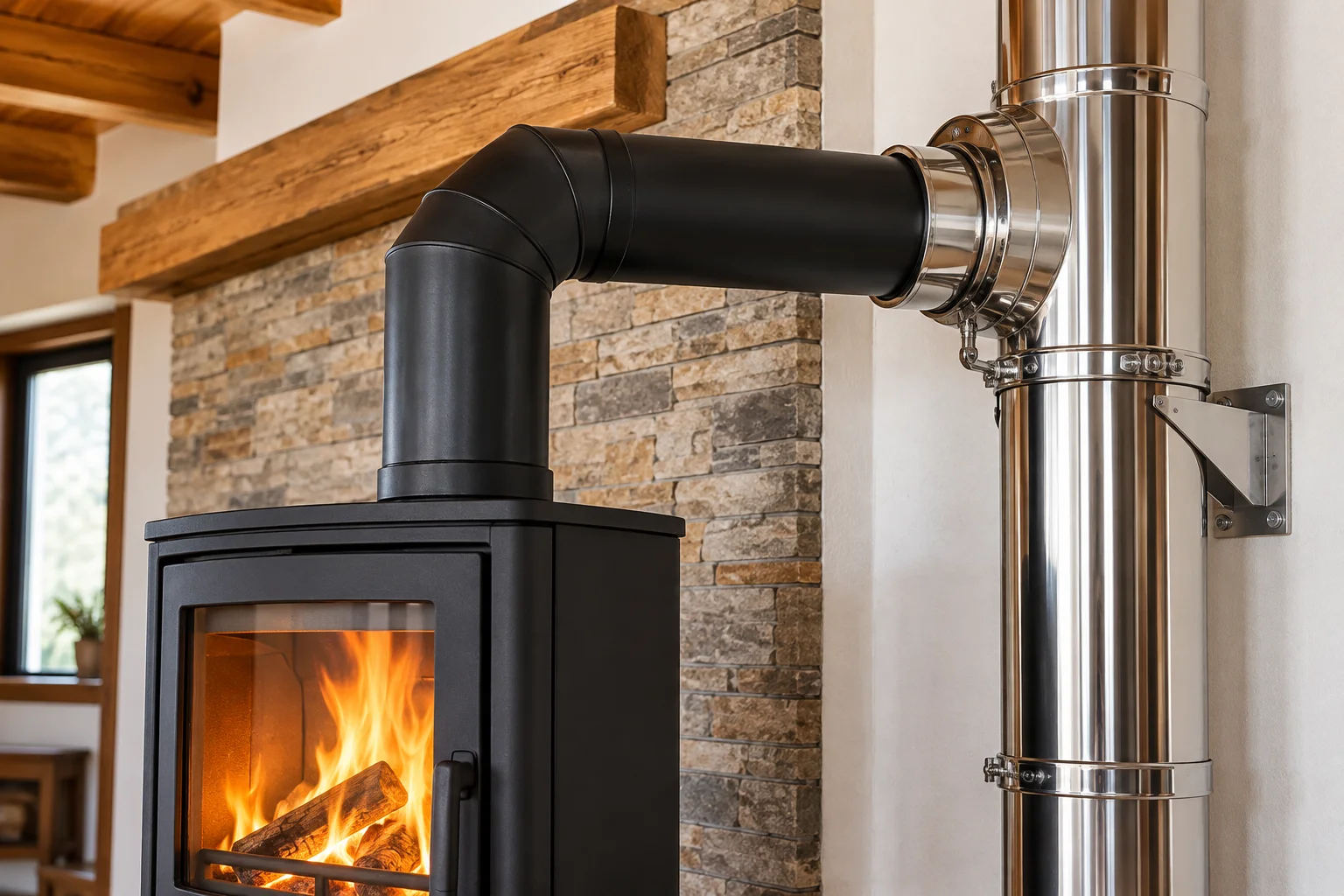
Connecting a Wood Stove or Fireplace to a Chimney: Correct Installation and Common Mistakes
Connecting a wood stove to a chimney, or connecting a fireplace or fireplace insert to a flue system, is a critical part of a solid-fuel heating installation.
Correct selection and installation of the connecting flue pipe affect combustion gas evacuation, appliance performance and building safety.
An unsuitable connection can lead to poor chimney draft, smoke backflow, excessive deposits, overheating of nearby materials or combustion gases escaping into occupied rooms.
For this reason, the connection should never be treated as a simple matter of joining two pipes.
The connecting flue pipe, chimney and heating appliance must form a technically compatible system designed and installed in accordance with manufacturer instructions and applicable requirements.
What Is the Difference Between a Flue Connector and a Chimney?
The terms are sometimes used interchangeably, but they describe different parts of a combustion gas evacuation system.
Connecting Flue Pipe
The connecting flue pipe is the section that carries combustion gases from the appliance outlet to the chimney.
For wood-burning stoves, it is commonly referred to as a stove pipe or chimney connector.
The connecting flue may include:
Straight pipe sections.
Elbows and bends.
Connecting adapters.
Inspection components.
Other compatible fittings.
Chimney
The chimney is the system that carries combustion gases to the outside atmosphere.
It may be a metal chimney, a masonry chimney fitted with a suitable liner, or another approved construction.
A chimney can run inside the building or be installed externally.
A pipe approved for use as a connecting flue is not automatically approved for use as a complete chimney system.
Why Is the Correct Chimney Connection Important?
During operation, a wood stove or fireplace produces hot combustion gases that must be discharged safely and reliably.
Their movement depends on several factors:
Flue gas temperature.
Pipe and chimney diameter.
Overall chimney height.
Bends and changes of direction.
Flow resistance and pressure losses.
Combustion air supply.
Wind conditions.
Joint tightness.
A correctly designed connection helps the installation operate within its intended limits.
However, a suitable connector cannot compensate for a fundamentally undersized or incorrectly designed chimney.
Which Flue Pipe Is Suitable for Connecting a Wood Stove?
The appropriate connecting pipe depends on the appliance and its manufacturer's requirements.
Solid-fuel appliances require flue components with technical classifications suitable for the expected operating temperatures and conditions.
Selection should consider:
Operating temperature.
Fuel type.
Required diameter.
Construction material and relevant product specifications.
Compatibility of joints and fittings.
Required clearance from combustible materials.
Suitability for the intended operating conditions.
An ordinary metal pipe should not be used simply because its dimensions match the stove outlet.
Single-Wall or Twin-Wall Flue Pipe?
Both single-wall connecting pipes and insulated twin-wall chimney systems may be found in solid-fuel heating installations.
However, they serve different purposes.
Single-Wall Flue Pipe
A single-wall metal pipe may be suitable as a connecting flue in appropriate, accessible locations, provided that its product classification and installation instructions permit that application.
Its external surface can reach very high temperatures during operation.
Special attention must therefore be paid to the required clearances from combustible materials.
Insulated Twin-Wall Chimney
A certified twin-wall chimney system typically consists of an inner flue liner, an insulation layer and an external casing.
Depending on its classification and manufacturer instructions, it may be suitable for particular external routes and building penetrations.
Insulation reduces heat transfer but does not mean the external surface will always remain safe to touch.
It also does not eliminate required clearances from combustible materials.
How Is the Correct Flue Pipe Diameter Selected?
The connecting flue diameter must be compatible with both the appliance and the chimney.
The appliance manufacturer's specified flue outlet diameter is an important starting point.
However, the final selection should not depend on this dimension alone.
Other factors include:
Nominal appliance output.
Flue gas mass flow.
Operating temperature.
Chimney height.
Connecting pipe length.
Changes of direction.
Pressure losses.
Can the Flue Pipe Diameter Be Reduced?
Reducing the diameter without technical justification can increase resistance to flue gas flow.
It should not be done unless expressly permitted by the appliance manufacturer and supported by the appropriate design assessment.
Is a Larger Flue Pipe Always Better?
No.
An excessively large cross-section can affect flue gas velocity and temperature.
Correct sizing depends on the installation requirements, not on the assumption that a larger pipe always performs better.
How Important Is the Length of the Connecting Flue?
The length of the connecting flue affects both pressure losses and flue gas cooling.
A complicated route can increase resistance to gas flow.
For this reason, designers generally aim for an appropriate and relatively straightforward route without unnecessary changes of direction.
However, there is no universal maximum connecting pipe length that applies to every wood stove or fireplace.
The relevant limitations depend on the appliance instructions, the flue system and the technical design.
How Many Elbows Can Be Used in a Chimney Connection?
Elbows and bends increase resistance to flue gas flow.
Their effect depends on:
The angle of the change in direction.
Fitting geometry.
Pipe diameter.
Flue gas velocity.
Total route length.
Numerous or abrupt changes of direction can contribute to draft problems.
They can also create areas where inspection and cleaning become more difficult.
The number and type of elbows must be compatible with the system design and manufacturer requirements.
Should a Connecting Flue Pipe Have a Slope?
Certain installation arrangements require a specified slope for connecting pipe sections.
The appropriate direction and permitted slope depend on the appliance and flue system.
It is not safe to apply an arbitrary slope rule to every installation.
Particular care is required to avoid arrangements that trap condensate or obstruct the intended flow of combustion gases.
How Is a Wood Stove Connected to a Chimney?
Installation must follow an approved design and the relevant manufacturer instructions.
At a general level, professional installation and assessment involve the following stages.
1. Checking the Appliance
The stove's technical characteristics and combustion gas evacuation requirements are established.
2. Inspecting the Existing Chimney
The condition, cross-section, route, classification and suitability of the chimney are assessed.
3. Selecting a Compatible Connecting Flue
Pipes and fittings appropriate for the specific application are selected.
4. Planning the Route
Pipe length, elbows, mechanical supports and required safety clearances are considered.
5. Checking the Connections
Joints must be assembled in the manner specified by the relevant manufacturer.
6. Verifying Fire Safety Requirements
The installation must comply with the required clearances from combustible materials and approved penetration arrangements.
7. Checking System Operation
The required functional and safety checks must be completed before the appliance enters normal service.
This overview explains the technical process; it is not a set of do-it-yourself installation instructions.
Connecting a Fireplace Insert to a Chimney
Fireplace inserts and enclosed fireplaces have specific combustion gas evacuation requirements.
The connection must be compatible with:
Flue outlet diameter.
Flue gas temperature.
Draft requirements.
Connecting flue route.
Combustion air conditions.
Fire safety requirements.
Particular attention is needed when the appliance is enclosed within a fireplace surround or construction containing insulation and structural materials.
These materials must be suitable for the temperatures and installation clearances involved.
Can a Wood Stove Be Connected to an Old Masonry Chimney?
A connection is acceptable only if the existing chimney is suitable for the intended new application.
The assessment should consider:
Internal cross-section.
Overall chimney height.
Condition of the chimney walls.
Gas tightness.
Existing deposits.
Fuel compatibility.
Cleaning access.
Temperature and fire safety requirements.
An older masonry chimney may require repairs, a suitable internal liner or replacement.
Its previous use does not automatically establish its suitability for a new appliance.
Can Two Wood Stoves Share the Same Chimney?
Connecting two solid-fuel appliances to a common chimney must not be undertaken without specific technical design.
The arrangement must be permitted by the relevant appliance and chimney requirements and appropriately assessed.
An unsuitable shared connection may cause flow problems or unwanted combustion gas backflow.
A large chimney diameter alone does not establish that a multiple-appliance connection is suitable.
Stove Pipe Clearance from Combustible Materials
Connecting flue pipes serving solid-fuel appliances can develop high external surface temperatures.
Particular care is needed near:
Timber beams.
Wooden wall cladding.
Furniture.
Curtains.
Certain insulation materials.
Other combustible building components.
The required clearance is not identical for every product.
It must be determined from the specific connector classification, manufacturer instructions and applicable installation requirements.
Using an insulated pipe does not automatically make direct contact with timber acceptable.
Passing a Flue Pipe Through a Wall or Ceiling
Penetrations through building elements are especially critical.
A conventional connecting stove pipe should not be assumed suitable for passing through any wall or ceiling.
Depending on the installation, dedicated penetration components and an appropriate chimney system may be required.
Relevant considerations include:
Clearance from combustible materials.
Thermal expansion.
Mechanical support.
Fire protection.
Weatherproofing or building-envelope integrity where applicable.
Inspection access.
Required safety clearances must not be filled arbitrarily with insulation materials.
How Does Combustion Air Affect Chimney Performance?
Correct combustion gas evacuation depends partly on adequate combustion air supply.
In highly airtight buildings, the available combustion air may be limited.
Kitchen extractor fans and other mechanical ventilation systems can also create negative pressure inside the building.
This can interfere with the operation of natural-draft appliances.
The installation must provide the necessary combustion air conditions in accordance with appliance instructions and applicable requirements.
Why Is Smoke Escaping from the Stove Pipe Connection?
Smoke near the connection may be associated with:
Insufficient chimney draft.
Unsuitable flue diameter.
Excessive pressure losses.
Inadequate combustion air.
Leaking joints.
Deposits inside the flue.
Unfavourable pressure conditions.
Diagnosis should distinguish between leakage through a defective joint and smoke spillage caused by draft problems.
If smoke or combustion gases are entering the room, the appliance should not be used again until the problem has been safely assessed.
If a carbon monoxide alarm activates or serious exposure to combustion gases is suspected, occupants should leave for fresh air immediately and contact emergency services from a safe location.
The 10 Most Common Wood Stove and Fireplace Connection Mistakes
1. Using an Unsuitable Flue Pipe
Not every metal pipe is suitable for solid-fuel combustion gases.
2. Reducing the Flue Diameter Without Approval
An arbitrary reduction may increase pressure losses and adversely affect chimney draft.
3. Creating an Overly Complicated Route
Unnecessary bends and long horizontal sections can make reliable operation more difficult.
4. Using Incompatible Connections
Mixing components from different systems without documented compatibility can compromise tightness.
5. Providing Inadequate Mechanical Support
The route must be supported according to the component and installation requirements.
6. Installing Too Close to Combustible Materials
High surface temperatures can create a serious fire hazard.
7. Using an Unsuitable Wall or Ceiling Penetration
Penetrations require appropriate approved arrangements and fire protection.
8. Ignoring Combustion Air Requirements
Insufficient air supply can interfere with appliance operation and safe flue gas evacuation.
9. Connecting to an Old Chimney Without Inspection
An existing chimney may be damaged or unsuitable for the new appliance.
10. Failing to Provide Inspection and Cleaning Access
Difficult access can contribute to excessive deposits and inadequate maintenance.
What Should Be Checked After Installation?
Before the appliance enters normal service, an appropriately qualified professional should verify the relevant requirements, including:
Compatibility between the appliance and chimney.
Correctness of flue connections.
Mechanical stability.
Fire safety clearances.
Access for inspection and cleaning.
Combustion air conditions.
Flue gas evacuation performance.
Absence of indications of combustion gas leakage.
Compliance with manufacturer instructions.
The specific commissioning tests depend on the installation.
How Should a Wood Stove Connecting Flue Be Maintained?
The connecting flue should be included in the installation's inspection and cleaning programme.
Wood-burning appliances can produce soot and creosote deposits.
Accumulation of these substances can restrict flue gas flow and increase the risk of a chimney fire.
Cleaning frequency depends on:
Appliance usage.
Fuel type and quality.
Combustion conditions.
Chimney configuration.
Manufacturer recommendations.
Cleaning methods must be appropriate for the specific flue system.
Which European Standards Apply to Chimney Connections?
Depending on the product and installation, relevant standards may include:
EN 1443: General chimney requirements and classification.
EN 1856-1: Requirements for metal chimney systems.
EN 1856-2: Requirements for metal flue liners and connecting flue pipes.
EN 13384-1: Thermal and fluid dynamic calculation methods for chimneys serving one combustion appliance.
EN 15287-1: Design, installation and commissioning requirements for chimneys within its scope.
Applicable appliance standards, manufacturer instructions and national requirements must also be considered.
Frequently Asked Questions
Can I Connect a Wood Stove to a Chimney Myself?
The installation affects both fire safety and combustion gas evacuation. It should be carried out and checked by an appropriately qualified professional in accordance with applicable requirements.
Should the Stove Pipe Diameter Match the Stove Outlet?
The diameter must follow the appliance manufacturer's instructions and the technical design. It should not be changed arbitrarily.
Can I Use a Single-Wall Stove Pipe?
Only where its product classification, installation instructions and the requirements of the specific route permit that use.
How Many Elbows Can I Install?
There is no universal number suitable for every installation. Bends must be accounted for in the design and assessment of pressure losses.
Can I Connect a Wood Stove to an Existing Fireplace Chimney?
Only after the existing chimney has been assessed for suitability. A liner or other technical modification may be required.
Can a Stove Pipe Touch Wood?
Direct contact with timber must not be assumed acceptable. The installation must comply with the required safety clearances and approved construction details.
Why Does My Stove Smoke When I Open the Door?
Possible causes include insufficient draft, combustion air problems, an unsuitable flue route or negative pressure in the room. The appliance and installation should be assessed.
Does the Stove Pipe Need Cleaning?
Yes. The connecting flue should be included in the system's inspection and maintenance programme in accordance with manufacturer instructions.
Conclusion
Correctly connecting a wood stove or fireplace to a chimney is essential for safe and reliable heating system operation.
The connecting flue must be selected according to appliance compatibility, correct diameter, operating temperature and chimney requirements.
Pipe bends, route length, joint integrity, combustion air supply and clearances from combustible materials all require careful consideration.
A safe installation depends on suitable products, sound technical design, correct assembly and professional verification—not improvised connections.
Technical References
EN 1443 — Chimneys: General requirements.
EN 1856-1 — Chimneys: Requirements for metal chimneys — Part 1: System chimney products.
EN 1856-2 — Chimneys: Requirements for metal chimneys — Part 2: Metal flue liners and connecting flue pipes.
EN 13384-1 — Chimneys: Thermal and fluid dynamic calculation methods — Part 1.
EN 15287-1 — Chimneys: Design, installation and commissioning — Part 1.
The applicable editions of these standards, manufacturer instructions and national regulations must be verified for each installation.